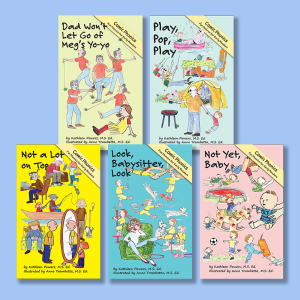
Mrs. K and Mrs. A publish fifth book, “Not Yet, Baby”

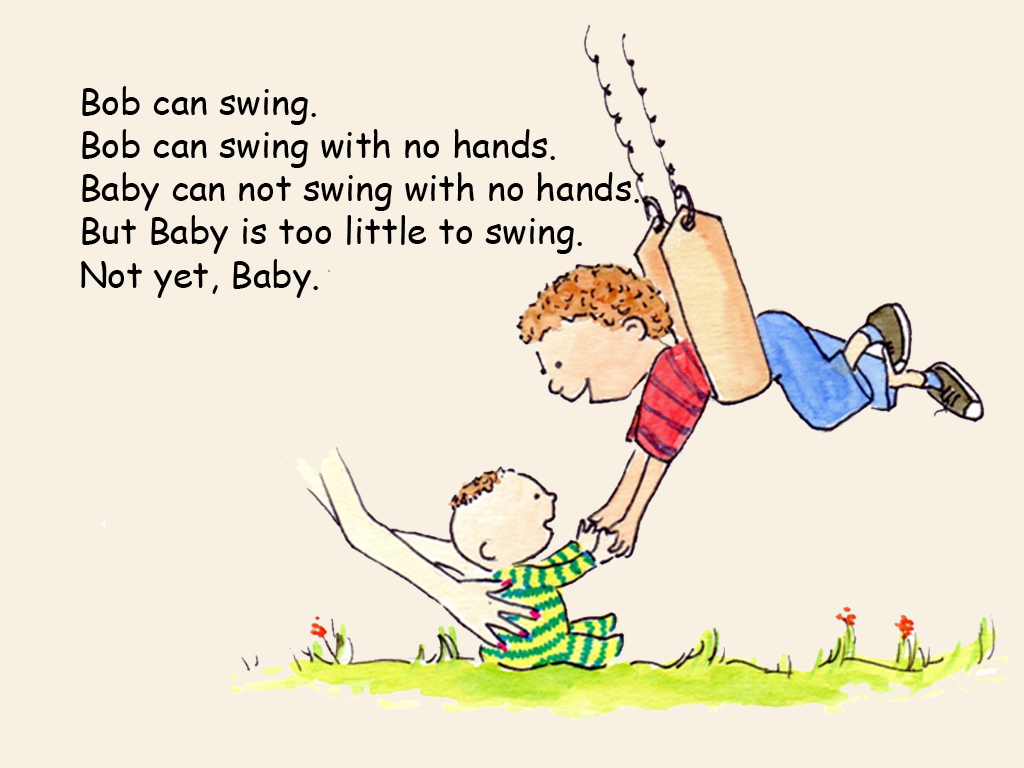
Our fifth book for children learning to read was published this past week as an app on Apple products.  Not Yet, Baby is the story of a big brother and the family baby.  The little one wants to do whatever the big brother does.

This slideshow requires JavaScript.

If big brother swims, baby wants to swim.  If big brother eats a hot dog, baby wants to eat a hot dog.  If big brother kick-boxes, baby wants to kick box.  Often in danger, the baby is dragged away just in time by two arms.

Like our other books, Not Yet, Baby illustrates typical yet humorous situations that a four, five, or six-year old would understand.  The book uses mostly one syllable, short vowel words appropriate for beginning readers.  Interactive activity pages follow—word searches, matching rhyming words, filling in the correct vowel and answering yes and no questions.

This slideshow requires JavaScript.

The idea came to me as I was traveling through national parks in Utah and Arizona last summer.  Occasionally I would get a text or a picture from my son, Tom, the dad of two little boys.  The younger one was walking and following his three-year-old brother everywhere.  Whatever the older boy had, the baby wanted.  Whatever the older boy was doing, the baby was underfoot.

I reminded Tom that he too, had been a younger brother and had been a pain in the neck to his big brother, Lou.  Lou would build elaborate corrals with wooden blocks, enclosing a dinosaur in "Not Yet, Baby" sketch bookeach compartment.  Tom would totter across the rug, destroying the entire habitat.  On the tour bus in the Rockies, as I remembered spending hours restraining the rambunctious Tom, the ideas flowed, and within a few days I had a book full of sketches!

As you read Not Yet, Baby, you may remember being the older child trying to understand the limitations of a younger one.

Page 13 of "Not Yet, Baby"

Here’s page 13 of “Not Yet, Baby” from the sketch book idea.

Or maybe you can relate to a baby trying to keep up, or the adult who works tirelessly to keep one child safe and another one happy.  Maybe the story will lead to talks with your child about your childhood or his.  There’s so much to talk about in Not Yet, Baby.  You can find the “Not Yet, Baby” iTunes app at http://goo.gl/CVTFZx.

Mrs. A

Do you know how many pages a day your child reads?

Research shows that the more pages a student reads each day, the more likely it is that the student will do well on reading tests at school.  Some students will breeze through pages while others will snail-read.  What is important is that they keep reading.  Eventually, the slow reader will read faster if the reading level is appropriate and the genre alluring.

Girl looking at a chart of the number of pages she's read in the week.If you are not sure how much reading your child is doing daily, you might start a chart on which the child logs in the number of pages read after every reading session.  Over several weeks a pattern will emerge, so that you can assess how many pages your child is reading daily.  This can be helpful to get an accurate understanding of your child’s reading.  Sometimes the numbers tell a different story from what we assume.

How many pages are enough?  How many are too little?

Since books vary in the number of words per page, these are questions without solid answers.  But there is a way to find out if your child’s reading is improving.

  • Look up the Accelerated Reader level of the books your child is bringing home from the school media center.  Often books from school libraries have the reading level coded onto the spine or onto a front or back cover.  Your child should be reading books at the reading level appropriate for his skills.  If he is consistently reading books at the same reading level, or moving from one level to a higher level, and the number of pages he reads is increasing, that is a positive clue.
  • If he is reading for about the same amount of time each day (20 to 30 minutes for a kindergartener, 30 minutes for a first grader), and the number of page read is increasing, that is another positive clue.

On the chart you want to see an increase in the number of pages read if the child reads at the same level and for the same amount of time.  Then you can suspect that your child is improving.  But to be sure, ask the child about the story or nonfiction topic.  Ask what the book is about (main ideas).  Ask the child to put the ideas of the story in order (sequencing).  If the child can do that, the child is probably grasping the story line and is improving in his reading skills.

To encourage the child, display the chart prominently, and point out the improvement.  If a child needs external motivation, offer a reward when she reads a certain number of pages a day for a week.  But for many children, just seeing the number go up and the pleasure this brings to you will be enough reward.

What is Accelerated Reader? Is it appropriate for my kindergartener?

Accelerated Reader (called A.R. by most students) is a computer software program that can be purchased by school districts.  It is designed to encourage reading by children.  A child selects a book from more than 25,000 titles (fiction and nonfiction), reads it, and then takes a quiz on the contents.  The books in the database are classified according to their reading level.  When a child masters a certain number of books at one level, she is encouraged to choose books at the next level.

Because each child is reading at his or her own level, children are competing with themselves, trying to better their previous reading levels.  One student might be reading Junie B. Jones books while another student in the same grade might be reading Harry Potter books.  Teachers usually set individual goals for students based on the number of books read, their quality and their difficulty level.  Often school time is used for quiet reading of A.R. books and students are assigned A.R. reading for homework.Two students taking reading tests on portable NEO computers.

When a student begins an A.R. program, he is assessed to find his reading level.  He is offered hundreds of books to read in this range.  When he finishes reading a book, he takes a multiple choice test (usually ten questions) on that book online using a classroom computer, a media center computer, a NEO 2, a tablet, Apple apps, or other electronic equipment.  Immediately the student receives his score which is converted into points using this formula:  (10 + reading level) x (words in book ÷ 100,000).

How do students know the reading level of a book?  Some libraries have three-ring binders listing A.R. books and their reading levels.  In my neighborhood school, books have colored dots attached to their spines, and nearby, a prominent chart lists the colors and reading level they signify.  Students look for books with their color on the spine.  But other media centers have other ways of differentiating reading levels.

In my neighborhood school, students accumulate points to “buy” a cap and later buttons to attach to the cap.  The more buttons, the more reading the child is doing and the more success the child is having.  Hats are usually not allowed in the school, but students who earn A.R. hats can wear those hats and do so proudly.  Other schools reward students in other ways.

Teachers receive feedback from the program, allowing them to intervene in a child’s learning if he is not making progress.

Students in my neighborhood school each have a Neo 2 assigned to them.  This is a portable electronic device that they can keep in their desks and use to take A.R. tests.  Additionally, they can use the device for other software programs, such as computing math facts.  The Neos allow a student to take an A.R. test at almost any time of the day without forming a queue at the classroom computer.  Students who finish assignments early are often allowed to work on their Neos.

Is the A.R. program appropriate for a kindergartener?  The child must be able to read a bit in order to take the quizzes.  And if she does poorly on a quiz and wants to take it again, she can’t.  She must move on to another book.  But if your child can read, it’s a way to encourage more reading and to prove to you and her that she is understanding what she reads.

–Mrs. K

Accelerated Reader was a popular program in the school where I taught.  There were competitions each month and each quarter to see who had earned the most points.  A school winner was announced at the Honors Assembly.  High scores were posted, and occasional ice cream parties recognized achievement.

Many teachers and parents liked the program because it got children reading.  A child who detested “reading for fun” would read an A.R. book.  The competitive nature of the program encouraged some kids to read more and more.  Teachers required a certain number of A.R. points to be earned as homework.  Because the A.R. books were good, teachers and students assumed the child was reading quality books.  I noticed kids talking about books and recommending books to each other.  They remembered the name of the author and then read his entire collection.

One criticism of the program is that the test questions are based on the ability to remember trite facts, not to comprehend the information.  For example a typical question might be “What was the name of Tom’s cat?”  A student who did not have the skill to remember details would do poorly, even though he may have truly understood the symbolism and irony of the story.  Another criticism is that a student could choose easy books, not challenging books.  Fifth graders were reading “picture books” to earn 2 points, rather than chapter books worth 12 points.

Even so, I think A.R. is a good program.  My children did not read for pleasure.  I forced them to read 30 minutes a day.  Had there been an Accelerated Reader program in their school, I know they would have been motivated to earn points.  Reading a picture book is better than reading no book.  Reading twenty picture books and earning perfect scores on the tests might encourage students to try reading something a bit more challenging.

Accelerated Reader is not a free program.  Each test must be purchased by the school district.  It requires a lot of work to set up, but once it is implemented, it is great.  More books/tests can be added every year.

If your child does not have A.R. in his school, talk to the media specialist or the principal.

–Mrs. A

Can my child become smarter? If so, how?

According to Annie Murphy Paul, the author of The Brilliant Report, a blog about the science of learning, intelligence is a somewhat fluid quality which can be increased. In a recent blog, Eight Ways of Looking at Intelligence, she gives eight insights into how intelligence can change. I have paraphrased her ideas as they might apply to children, and I have added information about how her insights might apply to teaching children how to read.child who's tired,cold, hungry, tells his mother he probably won't learn much in school the way he feels.
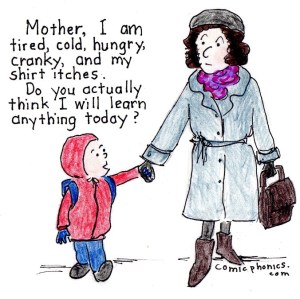
1. Situations can make children smarter. Children’s intelligence is not a locked-in trait; it is a fluid condition than can improve over time. Genes probably play the biggest role in creating intelligence, but environment has a powerful effect too.

For example, if a child is in an angry mood, or is bothered by itchy clothes, or needs a nap, or is hardly ever read to, or gets little exercise, that child will not be receptive to working on reading skills. But if the child is alert and rested, in comfortable clothes, and gets regular daily exercise, the child is ready for that “teachable moment.”

2. Beliefs can make children smarter. If a child thinks, “I can’t read that. It’s too hard,” this self-imposed limit becomes a fact. On the other hand, if a child thinks, “I can do that,” her openness to success becomes a fact too.

So how can you help a child who puts up barriers to learning? Analyze your child’s reading level and then find books at that level or just below, so that the child encounters success. For example, if your child can read some short vowel words (hat, can, did) but hasn’t yet learned about silent e (cake, kite, bike), find books with mostly short vowel words. As he reads aloud, you jump in and read the difficult words to give him a sense of mastery.

3. Expertise can make children smarter. Experts in any area think differently from nonexperts. Yes, they know more, but they also think deeply, and almost unconsciously, like an athlete who has done a particular dive or dance routine thousands of times. What we would have to focus intently on, they can do almost thoughtlessly because the knowledge has been learned so well.

A kindergartener might already be an expert skier or video game winner. How did he become that expert? Practice, practice and more practice. You can help your child to become an expert reader by encouraging the same degree of practice.

4. Attention can make children smarter. Double-tasking—like watching a parade while eating an ice cream cone—means the child gives less attention to both tasks. Babies are notorious for their short attention spans, but by preschool or kindergarten, those attention spans are much longer.

Can you lengthen a child’s attention span? Sure. Work with a child on her reading for ten minutes every day this week; for twelve minutes next week; for 14 minutes the following week. If necessary, as the lesson lengthens, take a two minute break partway into the lesson, and encourage the child to move her body before resuming study. Let the child know her attention span is lengthening and that you are proud of her.

5. Emotions can make children smarter. If a child is in a positive mood, he is more apt to work at learning to read. If he is anxious, part of his brain won’t be available for learning since it is already busy being scared.

So how can you create a positive mood in your child when it’s time to read? Try turning reading time into a warm, one-on-one, special occasion between your child and you. Make reading a safe experience (no laughing at the child’s ignorance; no chiding him for not remembering how to read a word). This will allow the child to use his whole brain for learning.

6. Technology can make children smarter. Computers, tablets, digital watches, and calculators can extend a child’s mind just like a flash drive can extend your computer’s memory. But they can also make children lazy. (For example, do you memorize phone numbers any more or do you program them into your cell phone and let the phone remember for you? Can your child read an old-fashioned clock or does she need a digital one to tell time?)

A positive way for your child to use technology is to extend knowledge he already has mastered. When he knows how to read enough words to write a short message, help him to send an email to Aunt Carol. Turn off “Spell check” and let him write the words he doesn’t know phonetically. Or let him FaceTime or Skype an out-of-town relative and read a book to show what he has learned.

7. Children’s bodies can make them smarter. Compare the learning abilities of a well-fed child with a malnourished one. Compare the responses of children who get adequate sleep with those who do not.

Requiring the child to eat well-balanced meals and to go to bed at a certain hour can be hard, especially as the child grows older and more independent. Yet, if we want our children to learn optimally, we must enforce rules of behavior which are in their best interests. Call the rules “house rules” to separate them from you. “House rules: Everyone eats at 6. Kids take baths at 7. Kids go to bed at 8. Adults go to bed at 10. House rules.”

8. Relationships make children smarter. Children learn by watching, listening, helping, and asking questions. One sign of a smart kid is that she asks many questions. But to be successful gaining knowledge, the child must have an adult or older sibling who is willing to take her questions, not someone who says “Scram.”

You can encourage your child to ask questions when you are reading to her or when she is reading to you. Make asking questions as natural as turning a page. “Why does the caterpillar make a cocoon?” “Why can’t the king’s soldiers and king’s men put Humpty Dumpty together again?” Some important questions to ask for reading comprehension are “What is happening? What’s it all about? Can you tell me the story in order. What do you think will happen next?” If your child is shy about asking questions, reward her for doing so with a hug or a comment like, “Great question!”

Barbara Park, “mother” of Junie B. Jones, leaves behind millions of happy child readers

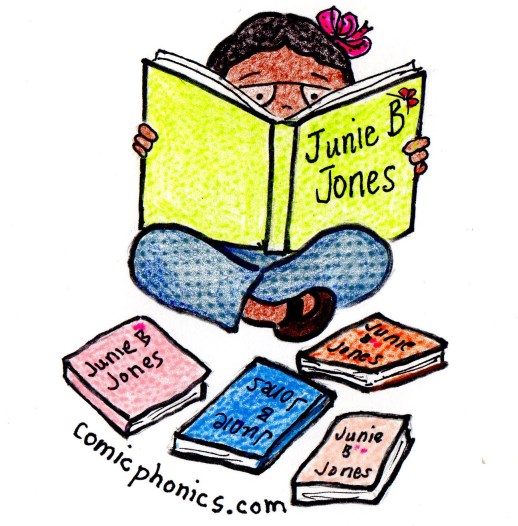
If there is one favorite book of little girls learning to read in English, it is every book starring Junie B. Jones, the rambunctious kindergartener and then first grader, who so often gets in trouble for being herself. With more than 55 million copies of “Junie B. Jones” books in circulation, author Barbara Park has reached millions of children with the antics of her sassy child character, Junie B., and her friends Lucille, that Grace, William, and Meanie Jim.Girl reading Junie B. Jones.

Sadly, there will be no more “Junie B. Jones” books. Author Barbara Park died on Friday, November 15.

I first used Junie B. books to teach children how to read with a Korean-born girl who didn’t know what to make of the cheeky kindergartener, laughing out loud at the silly ways Junie B. used to avoid taking the school bus home. At first we read together, but eventually my student couldn’t wait for a whole week to pass before starting another Junie B. book. She took them out of the library four or five at a time. When book number 26, “Aloah-ha-ha,” was about to be published, she was tingling with excitement and rushed to the book store the day it came out. She lent me that book after she read it, but told me I needed to return it so her brother could read it when he was old enough.

Another little girl whom I introduced to Junie B. stayed up late into the night reading with a flashlight.

If you are not familiar with Park’s series, the books are appropriate for students who have mastered basic phonics skills—short and long-vowel words, and some multi-syllabic words. For students who are not there yet, reading with an adult or older child is a way to enjoy Junie B.’s antics, with the adult reading the parts the child cannot.

Start your child with the first book, “Junie B. Jones and the Stupid, Smelly Bus.” You will be hooked by the ebullient Junie B. who hides atop a pile of construction paper in a kindergarten cupboard while her teacher walks the students to the buses. Later, when the school is empty, Junie B. uses her teacher’s new modeling clay, and sneaks into the nurse’s office and tries on bandages and crutches, all blithely unaware that her frantic teacher, mother and the police are searching for her.

The stories are so humorous that children find them page-turners. Clever line drawings throughout the books add to their appeal. In one book, Junie B. thinks her mother has given birth to a monkey. In another, she receives a Valentine from a secret admirer. Junie B. practices to be a beautician by cutting her own hair. She dresses up for career day by copying the school janitor, whose large ring of keys she admires so much.

Sometimes Junie B. says things the wrong way which children find funny. But she makes the same kinds of mistakes that all children do when they learn English. In some of the books, Junie B. keeps a journal in which she crosses out mistakes and fixes them.

But it is her wacky world view that lures children to read book after book. Like J. K. Rowling with her “Harry Potter” series, Barbara Park has created an unforgettable child character set in the familiar world of kindergarten and first grade. When my granddaughter was learning to read in kindergarten, I gave her a set of Junie B. kindergarten books. When my granddaughter started first grade, I gave her a set of Junie B. first grade books. When she lost a tooth, we read “Junie B., First Grader Toothless Wonder.”

Luckily for us, Barbara Park’s work lives on, and Junie B. Jones will be engaging young readers for generations to come.

More tips to help a child read bigger words

  • The same rule that applies to CVC/CVC words applies to CVC/CVCE words; that is, to words of two syllables which have (usually) a short vowel in the first syllable, two consonants in the middle of the word, and a long vowel in the second syllable controlled by a silent “e” at the end of the word.  The syllables split between the middle two consonants unless there is a blend, in which case the syllables split before or after the blend.
  • To teach these words, it might be easier to find some compound words that form this way, such as “tadpole,” “backbone” and “pancake.”  Make a list and let the child circle the two separate words which form the compound word.  Then ask the child to put the separate words together to form a new word.  Some words you might use are
     
    Two words that together make one word
  • When these words are mastered, move on to CVC/CVCE words which are not compound words such as “membrane,” “umpire” and “pollute.”  The same rule applies as above.  Have the child divide the word between the syllables.  If the child has trouble deciding where to divide, remind her that usually one syllable ends and another one begins between the two middle consonants.  Help her to identify blends that need to stay together in the same syllable.  Some words you might use are
     
    two syllables divided by middle consonants
  • When your child understands the pattern, you might explain that some bigger words follow the same pattern.  Introduce three syllable words with the CVC/CVC/CVCE pattern, such as “illustrate,” “vaccinate” and “indispose.” But if the child is struggling to understand the previous CVC/CVCE words, hold off on three syllable words.  Some words you might us are
     
    Introduce three syllable words.

Our blog will continue to teach multisyllabic words in the near future.  Let us know if you find this information useful or if you have particular problems teaching your child reading.  We will investigate for you and offer the best advice we can find.  –Mrs. K and Mrs. A

My granddaughter can read small words, but she stumbles over bigger words when we read together. How can I help her?

Here are some tips to help with bigger words:

  • If you are reading for sheer enjoyment, anticipate the words she might not know and say them quickly, so she can keep reading and not lose her thought.  Don’t worry that she might not be learning new word attack skills in your reading session; she is learning other aspects of reading such as fluency and comprehension which are often hard to learn when she stops to consider every new word.  Also, if she is tired or ornery, this kind of reading lesson gets her to read without causing frustration.grandparent reading with grandchild.
  • But if you are reading with your granddaughter to help her decipher words, and if she is in a receptive mood, you might cover parts of the word (usually syllables) and then uncover them, so she can join them together.  For example, if the word is “continent,” cover the “tinent” part with your thumb and let her say “con.”  Then cover the “con” and the “ent” parts and let her read “tin.”  If she mispronounces “tin,” pronounce it correctly.  Then cover all but the “ent” and let her figure out those four letters.  If she can put it together, fine, but if not, you do it while covering and exposing parts of the word as you say it.  Then move on to another word.  The goal should be to teach her a method of figuring out words, not mastering every word you encounter in a particular lesson.
  • If you own the book, and don’t mind marking it, you could highlight every word she can read correctly.  She will see that the number of words she can read far outnumbers the few she can’t.  You might ask her what she notices about the words that are not highlighted.  She might say, “They are long,” or “They have lots of letters.”  Tell her there are ways to figure out those words just like there are ways to figure out three-letter words, and you will work with her on those long words.
  • A good place to begin is with compound words.  They can be easy to decipher if the child looks for small words inside big words.  Try some with her such as “pancake,” “popcorn” and “forget.”  Make a list of such words and let her be the detective, discovering the small words inside the large words.  Have her circle each of the small words and then pronounce them together.  Some words you might use are:compound words are small words inside big words
  • Some longer words have pronunciation rules that are easy for a child to remember.  For example, if a six- or seven-letter word has double consonants in the middle (biggest, kitten, flabby), that means the word usually has two parts, or syllables, and the first syllable ends between the “twin” letters.  (Use the word “syllable” since this is a term your granddaughter will need to learn anyway.)  Phonics books sometimes refer to these words as VC/CV or CVC/CVC words since they generally have short vowel sounds in both syllables.  You could practice a handful of those words, writing them on notebook paper for your granddaughter to pronounce.  Choose words whose letters follow the rules of phonics so she is not confused.  Have her draw a line between the double consonants and then pronounce each syllable.  Some words you might use are:"twin" letter words have double consonants in the middle.
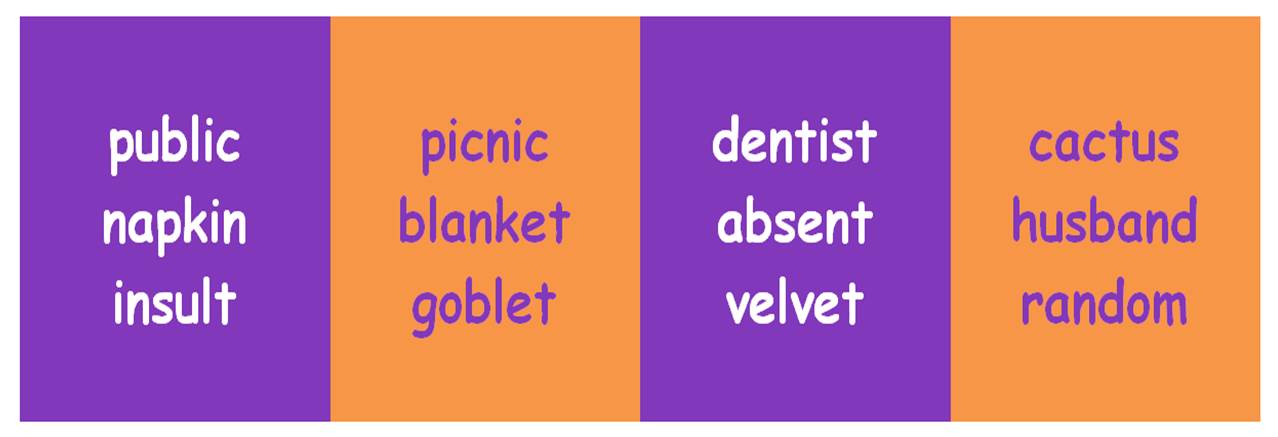
  • Some other six- or seven-letter words have one vowel near the beginning, another vowel near the end, and two or three consonants in the middle.  These are a variation on VC/CV or CVC/CVC words with twin conconants.  Show her words like “contest,” “nutmeg” and “insect.”  Explain that the words have two syllables, and that the first syllable ends between the two consonants.  Have her draw a line between the middle consonants and then pronounce each syllable.  Some words you might use are:two syllable words with vowels in the first and last syllable

Our blog will have more on how to teach multisyllabic words in the near future.  Let us know if you find this information useful or if you have particular problems teaching your child reading.  We will investigate for you and offer the best advice we can find.  –Mrs. K and Mrs. A

Reading Rainbow app attracts young readers

Do you remember watching Reading Rainbow as a child?  It’s the American PBS television series encouraging young children to read.  It was broadcast for 23 years, from 1983 to 2006, winning 26 Emmy Awards for “Outstanding Children’s Series.”  Today it is still watched on video in schools around the country and is available for sale.

Well, times change.  A year ago the Reading Rainbow app was released with new books reviewed, new toddler reading iPad miniadventures for host LeVar Burton and updated music.  Within 36 hours of its release, it became the number one educational app.  The Reading Rainbow app has been viewed 2.5 million times since then, with 50,000 digital books a week going into homes of subscribers.

Burton, who owns the rights to Reading Rainbow and has developed the app, says he has proven that kids will read on electronic devices.  The app contains a combination of animated characters, video field trips, music and of course, books—hundreds and hundreds of books.

The cost to subscribe is about $10 monthly.  The app is available on Apple operating systems of 5.0 or later.  Like the TV series, the app targets elementary school-aged children.

How about you?  Has your child tried this app?  Do you recommend it?  Or do you recommend another app to encourage reading for young children?  Please take a minute to let our blog readers know.

Is your home print-rich?

Are children’s books plentiful in your home?girl looking at book display  Are magazines your child might enjoy—even for the pictures—obvious?  Do you display books on coffee tables?  Does your child have a bookcase—or a shelf—to call his own?  Do you stand up books in their attractive jackets so that your child will be lured to read them?

Research shows that the more contact children have with reading materials—books, magazines, comic books, emails, book apps—the better readers children become.

The first step to getting your child to read more is to provide more reading materials.  Take her to the library and bring home not one or two but ten books.  Then display the books where the child is likely to see them and read them.red headed girl in easy chair reading If the child has a designated reading spot—a certain chair in a window, the end of a couch near a lamp, her bed—prop up the books there to entice her.  Set aside some time every day and read with her, or let her read to you.

Is a bookstore one of your weekly stops?  Or the book section of a department store?  Even if you just prowl through the children’s section with your child, he will find books he might like to read.  If you can afford them, great, but if not, write down titles and go to your public library to request them.  Make your child aware of your determination to find the books he wants.

Studies show that having a variety of books at hand motivates kids to read.  Combine that with more time to read, and kids become better readers.  One study shows that the best predictor of reading achievement (high test scores, for example), is the amount of time kids read on their own, without pressure to read.

What have you done to make your home a place where your child wants to read?  Please share your ideas by responding to this blog.  Your email won’t be shown, nor your name.  But your ideas might spur another parent or teacher to increase the reading of her children and students.

How do I teach CVC words that end in –ck and words that end in –ook without confusing my son?

When a child is learning to read, and is at the short vowel, one-syllable, consonant-vowel-consonant (CVC) word stage, the child often encounters words from the word family –ook (book and look, for example) or words that end with –ck (sock and truck, for example).  Strictly speaking, these word don’t follow the CVC rule for pronunciation, so they should be taught separately, starting with the –ck family words.

CVC words that end in _ch and _ook.

To enlarge, click on the picture.

Usually there is no problem reading CVC -ck words once the child understands that –ck is a single sound.  But reading, pronouncing and spelling the –ook words can be a problem.  How can you help your child?

"I know that word, Mom," says the child lookinFirst, wait until your child is comfortable with CVC –ck words (see list above) to explain this difference.   Teach the CVC words that end in –ck first and make sure the child understands how to read, pronounce and spell those words.  Then introduce –ook family words.

  • Point out to your child that the –ook sound is not the same as the short –ock or short –uck sound.  Say the sounds aloud so the child can hear the difference, and ask the child to say the sounds too.  Don’t show letters at this point since it is the sound that guides the child as to which letters to use.  The child needs to be able to hear the difference.
  • If you have pictures of words that end in –ock (clock, dock, flock, knock,), in -uck (buck, puck, suck, tuck, truck) and –ook (book, cook, crook, hook, rook) you could create a set of flash cards for the child to sort by sound.  As the child sorts, ask the child to pronounce the word to be sure she is hearing the word correctly.
  • Tell your child that after a word with the –ook sound, just a “k” is used, as in book and look, two words the child might already know as sight words.  You could create a set of flash cards with the –ook family words on them and use them as sight words if that helps.
  • If you have letter tiles, practice moving them to show –ook family words and ask the child to read them after your example.
  • When the child seems comfortable with the difference in sound, practice moving tiles to show the difference in spelling.  For example, construct l-o-ck, and under it construct l-oo-k.  Say each word and ask the child to tell what he notices.  Do the same with other word pairs such as cr-o-ck and cr-oo-k; h-o-ck and h-oo-k; r-o-ck and r-oo-k; and t-o-ck and t-oo-k.
  • Practice moving tiles so that just one word—lock—appears.  Ask the child to pronounce it.  Take out the -ck and put in –ook and ask the child to pronounce the new word.  Keep moving tiles around until the child grasps the correct pronunciation of each word.
  • When you are reading –ck and –ook words, reinforce the spelling.

At this point the child usually hasn’t learned how to read long vowel sounds, so there is no need to add to confusion by introducing words like bake and smoke now.