How lack of vocabulary stymies reading comprehension

Three superior ways of acquiring new vocabulary were found by the National Reading Technical Assistance in 2010.  They are

  • Higher frequency of exposure to targeted vocabulary words
  • Explicit instruction of words and their meanings
  • Questioning and language engagement

child with adult helping to read

Working with children daily, I see firsthand how a lack of vocabulary stymies their efforts to comprehend what they read.  For example, in the past week, a fourth grader reading aloud to me

  • pronounced “archaeological” as “architectural” and didn’t realizing his mistake.
  • did not know the meaning of the word “bid” as it was used in the passage. When I questioned him further, he admitted not knowing any meanings of that word.
  • did not know the meaning of “ancestral.” Questioning him showed me he did know what “ancestor” means.  When I pointed out that the roots of “ancestral” and “ancestor” are the same, he was able to figure out “ancestral.”
  • did not know the meaning of “interwoven.” Questioning showed me he did not know what “weave” means.  When I explained “weave” and “interwoven,” he still had no idea what “interwoven” meant in the passage because it was being used as a metaphor.
  • could not pronounce or understand “initial” used as an adjective. When I pronounced it, he still had no idea.  When I reminded him about the initials of his name, he recognized the word, but had no idea what it meant in context.  I explained that initials are the first letters in his name, and that “initial” in context meant “beginning” or “first.”  Then he understood.
  • could not pronounce or understand “notoriously.” He knew “famous,” so I said “notorious” means famous for doing something bad.  Still he was confused.  “Like Hitler.”  “What’s Hitler?”

Even though this boy was reading near his Lexile number, he either missed or misinterpreted chunks of the reading passage because of lack of vocabulary.

I will recommend to his mother that he works on vocabulary each lesson, using one of the many good vocabulary-building series available.  He also needs to read more and widely.

But doing one lesson in a vocabulary book, and then moving on to the next, is not enough.  He needs to hear the new vocabulary words often, review them, be questioned about their meanings, and be able to use them correctly in sentences.

If you are a parent, I recommend you either begin using a vocabulary-building series of workbooks, or if your child uses them at school, review past “learned” words with him or her.  My experience working with children, especially ESL children, shows me they need to engage with the words often in order for the words to become part of their vocabulary.
Are digraphs the same as blends?

Blends are combinations of two or three consonant sounds in which the original sounds are clearly heard.  For example, in the word “friend,” the “f” and the “r” are pronounced the usual way and sound as they normally do.  Blends are also called consonant clusters.

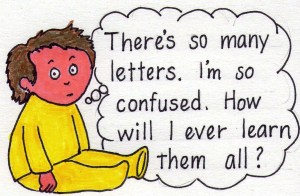
child musing about confusion over so many letters

Digraphs are combinations of two or three consonant sounds too, but the original letter sounds change.  For example, in the word “thin,” the “t” and the “h” are not pronounced in the usual way.  When together in a word, they are pronounced in a new way, to create a new sound.

Digraphs can also be combinations of two or three vowel sounds which create a new sound.  For example, when “o” and “i” are together, as in the word “void,” the vowel sound created is neither an “o” sound nor an “i” sound.  Vowel digraphs include ai, au, aw, ay, ea, ee, ei, eu, ew, ey, ie, oi, oo, ou, ow, and oy.  Vowel digraphs are rarely called by that term; instead they are called diphthongs if they are called anything at all.

In the US, almost always a digraph refers to a consonant digraph.

When I was in school, my teachers didn’t use the word “digraph.”  Instead, they called all consonant letter combinations ”blends.”  And they didn’t use the word ”diphthongs” either.  But today American children are expected to know those words, and more importantly, how to pronounce digraphs and diphthongs.

Turn car rides into educational opportunities

Spring break is almost here.  For many kids, that means road trips to Disney World, the Grand Canyon or maybe to Grandma’s house.

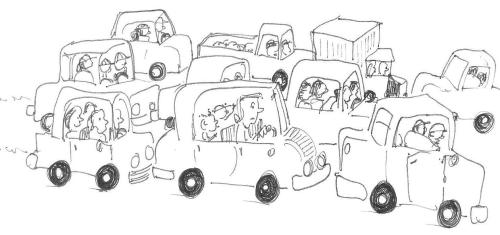
cars in travvic

Those long hours in the car might mean movie time, video game time or time playing on the phone.  But they also offer great learning opportunities.

  • For preschoolers learning their letters or numbers, make a game of finding a particular letter on a billboard, license plate or directional sign.
  • Say a letter sound (not a letter name) and let your child identify which letter matches that sound.
  • If it’s dark, you can say two words and ask the child which word begins with a particular letter. Stick to letters the child knows so she can feel successful.
  • For kids learning rhymes (sometimes called word families), suggest a word which the child can then rhyme once, twice or three times. Or go back and forth, first you, then the child, then you, then the child, until no one can think of another word.  The last one to think of a word could decide what the first word of the next round is.
  • For kids learning how to put letter sounds together to form words, sound out a CVC word and ask the child to identify it.  Then let the child sound out a word and see if you can identify it.
  • Another rhyming game is for the adult to say a nursery rhyme and ask the child to name the words which rhyme. (Hickory, dickory dock, the mouse climbed up the clock.)
  • Sequencing is a skill kindergarteners work on. You could say three activities—not in time order—and the child could put the events in the correct order.  (Mom filled the car with gas.  Dad put the suitcases in the car.  Billy packed his suitcase.)
  • Cause and effect is a skill third graders work on. You could name both a cause and an effect, and the child could identify which is which.  (Sleeping Beauty slept for 100 years.  Sleeping beauty pricked her finger.)
  • Categorizing words is an elementary school-aged skill. For example, you could say blue jay, cardinal and bird.  The child needs to find out which one in the category word.
  • Comparisons are another easy word game. You say that the answers are bigger than, smaller than or the same size.  Then you say, “An elephant is something than a mouse.”  The child tells the correct relationship.  You could use longer than and shorter than, heavier and lighter and older and younger.
  • Working memory is a skill children need to extend. Start with two words (or numbers or letters) which the child needs to repeat.  Let the child add another word and you repeat all three words.  Then let the child repeat all three words and add a fourth.  For some children this skill is incredibly difficult, so for them you might want to cap the list at four words.  For other children, seven or ten words might be possible.
  • This is a great time to review math facts. If your third grader has just learned multiplication, review the facts.
  • For older children or children learning English as a second language, car time can be vocabulary review time. You give the definition and the child gives the word.  Or let your child throw out a word meaning, and you have to identify it.  Children love stumping their parents.
  • Older children encounter idioms all the time, but they don’t always understand them.  Throw out an idiom–Jason is blue–and let your child explain what it means.

Of course these educational moments could also happen on your long flight to India or Taiwan.  They could just as easily happen on the way to school in the morning or on the way to soccer practice in the afternoon.  There are so many times you can exploit one-on-one education with your child.

What kind of books do you read to your kids?

When my kids were little, I selected their reading materials from the picture book section of my library and book store.  In retrospect, I was limiting my children’s literature to fairy tales, Dr. Seuss and fiction of all kinds.

Yet children need exposure to nonfiction as well:  how to books, how things work books, information about animals and the natural world we live in, biographies, history, books with maps and tables, books about dinosaurs, even current events news.

Take a quick survey of the books you have read to your preschooler in the past week.  Were any of them nonfiction?

Expand your child’s horizons starting today.  Find the nonfiction section of the children’s section of your library and see what’s there that might interest your child.

  • Does he like dinosaurs? Lots of books explore the lives of these amazing creatures.  Or does he have a pet?  Books on dogs, cats, birds and almost every other animal abound.
  • Is your daughter into fashion? Find books about how clothes have changed over the centuries.  Find a biography of Coco Channel.  Look for a magazine with Downton Abbey or Academy Award dresses.
  • Is your child into building? You can find books and magazines on how to build a soap box, a tree house or a house of cards.  Or you can learn how a spider builds a web, how a bird builds a nest or how a beaver dams a stream to build a house with an underwater doorway.
  • Do you travel with your child? Magazines highlight fascinating places around the world.  Even if your child can’t read, together you can compare your home with the ones pictured.  Or together you can wonder what it would be like to take a gondola ride or to walk on the Great Wall of China.  Maybe you could plan a vacation.
  • Did Grandpa serve in the Army? Let Grandpa read to your child about the locations where he served or about the military uniforms he wore.  Did Grandpa fly a jet?  Find books about military aircraft.
  • Cooking books are great how-to books. With your child, find a picture of something you would like to eat and cook it together.
  • How about the handbook for your car? Or you phone?  Your child and you can look over the pictures and identify parts and what they do, picking up vocabulary.
  • Look for books with maps, charts, tables, pictographs, photos and other non-textual ways of presenting information.  Help your child to understand what those graphics mean.

Reading nonfiction is harder than reading fiction, yet students must be adept at both kinds of literature under the Common Core State Standards.  Start now preparing your child for his future by exploring nonfiction together.

Numbers, numbers

2-3      Between 2 and 3 years old, toddlers learn a new word every day.

3rd      Third grade is long past the time to intervene for a struggling reader.

3-4      3 to 4 letters/spaces to the left and 14-15 letters/spaces to the right of where we fix our eyes is where we pick up meaning from what we read .

4          There are 4 ways to pronounce the letter A using standard American English.

4-5      Children should be speaking in complete sentences by 4 or 5 years old.

6-12    Between 6 and 12 months old, infants should start babbling.

10-15   A typical student needs to interact with a word 10 to 15 times in order to learn it.

12-18   Children usually say their first words between 12 to 18 months, but not always.

18-24   Children usually say their first tiny sentences between 18 and 24 months.

20        If a child can count to 20, that is a sign he might be ready for kindergarten.

20-30 Kindergarten children should read or be read to 20 to 30 minutes daily.

24th    US students scored 24th out of 65 countries taking the latest Program for International Assessment tests.

30       First graders should read or be read to 30 minutes daily.

42-44 The number of letter sounds in standard American English is 42 to 44, depending where you live.

220     There are 220 Dolch words, better known as sight words.

300    Children from professional families hear 300 more spoken English words in an hour than children of parents on welfare.

1,000 Parents should read to their children 1,000 books before kindergarten, according to the 1,000 Books Foundation.

2,000 A student learns about 2,000 new words a year.

88,500 An incoming high school freshman should know 88,500 word families.

2,250,000 A student reading an hour a day will read 2.25 million words in a year.

32,000,000 Children from professional families hear about 32 million more words—including repeated words—than children from poorly educated families.

Writing more leads to better reading comprehension

Yes, writing more does lead to better reading comprehension. Research proves it. But why?

Student holding paper and reading it as he is writing

The authors of The Reading – Writing Connection (2010) suggest many reasons:

  • Both reading and writing are forms of communication. When writers create a text, little light bulbs go off as they think about their audience and what that audience needs in order to understand and want to continue reading their texts.  Students write, but at the same time they act as readers, their own first audience.
  • Writers think about composing skills when they read the texts of other writers. Why does the author use that vocabulary word? Why does the author have a first person narrator? How does the author identify characters through their dialog?  Does an autobiography have to start with a birth?  Does a story need to go in chronological order.? If not, how can  ideas be arranged?  How do other authors do this?  They read to find out.
  • How do other writers connect sentence ideas or paragraphs? How do they explain things—with figures of speech or with examples? How do other authors make a difficult idea clear? Do they depend on charts, graphs or maps?

When writers read, they are not merely enjoying or gaining information. They are also aware that what they are reading was written by someone who had to make writing decisions, the same kind of writing decisions they have to make. By thinking about those decisions, student writers understand better what they are reading.

How can writing improve reading?

When educators combed research on the writing / reading connection in 2010, they found three writing activities which improve reading comprehension.

EPSON MFP image

  • Having students write about the stories and texts they read by writing personal responses, analyses, or interpretations; by writing summaries; by writing notes; and by answering or asking questions in writing about what they have read.
  • Having students learn about the process of writing; about how texts are structured; about how paragraphs and sentences are put together; and about how to spell.
  • Having students write  frequently.

All of these writing activities improve students’ reading. In future blogs, we will look at why these activities improve reading, and how these activities can be incorporated into a student’s schoolwork or work at home. We’ll start in the next blog with the last idea, that students should write more to improve their reading.

Meanwhile, for more information, see Writing to Read.  At this site you can read the full report, Writing to Read; evidence for how writing can improve reading by Steve Graham and Michael Hebert for the Carnegie Corp. of NY, 2010.

You might also enjoy reading Shanahan on Literacy, a blog about reading by an expert in the field. In his current blog, Dr. Shanahan comments on ideas in this report.

Eye tracking problems can lead to poor comprehension

I worked with a third grader recently whose Iowa scores indicate she is low for reading comprehension.

While she read for me, she skipped little words, like “a” or “in.” She also changed the pronunciation of some small words, saying “shine” when the text said “shin.”

girl in chair reading

Most importantly, she would skip whole lines of text without realizing she had done so. As the lesson continued, she skipped more and more lines of text until she was skipping almost every other line.

What gives?

This child is showing weak eye tracking, sometimes called jumpy eyes. Eye tracking is the ability of both eyes to work together, almost like a single eye, as they read across a line of text.

One symptom of weak eye tracking is skipping over tiny words, especially high frequency words such as articles (a, an, the) and prepositions (in, on, of, for). This does not usually interfere with comprehension. After all, some Asian languages lack articles completely, and the meaning of many prepositions can be inferred from the rest of the phrase. Shorter words and predictable words are likely to be skipped. Longer words, or words that are not high frequency words, are more likely to be read.

Another symptom of weak eye tracking is reading the first few letters of a word correctly, and then guessing at the ending. This impacts comprehension more. If a child reads “read” and then guesses at the rest of the word, she might say “reading” or “ready,” words with different meanings.

But skipping whole lines of text is a serious concern and impacts reading comprehension the most. We all skip lines from time to time, but when we realize that what we are reading makes no sense, we go back and pick up the missing line. Poor readers who are not picking up meaning from the words don’t notice that they have skipped a line. If the paragraphs are long, or the type face is small, this tendency to skip lines increases.

Sometimes eye tracking problems manifest themselves as blurry or shadowy text. It can be hard for the child to “see” the word within the blur. Or sometimes the first letter of one word can seem to be connected to the last letter of the word before, such as, “Th elittl egir lslep t.

Some other signs of eye tracking problems include

  • An aversion to reading
  • Losing your place while reading
  • Guessing at words, especially longer words
  • Poor fluency
  • Tiring after a few minutes of reading

What can you do to help your child with eye tracking problems?

  • First, have his eyes checked to be sure he can see properly.
  • Check with your school district to see if there is a specialist in eye tracking who can test your child and work with him.
  • When he reads for you, instruct him to move his finger under every single word as he reads. Stop him if he skips any words or mispronounces them.
  • If the child is somewhat hyperactive or easily distracted, you might create a book mark with a cut out the size of a line of type. The book mark will block the distracting words while helping the child to focus on the single line of text he is reading.
  • Frequently stop the child to ask what the words mean. If he can’t explain, go back and read again, perhaps slower, and ask after each sentence what that sentence means.

States’ standards for student achievement have risen, says journal

45 states have raised their English and math standards since 2011, a result of adopting Common Core State Standards, according to Education Next, a journal reporting on K-12 education.

EPSON MFP image

EPSON MFP image

Education Next says this change is a significant improvement from the low standards set by most states following the implementation of the 2001 No Child Left Behind law.

Education Next has graded states on the rigor of their statewide tests for fourth and eighth graders in English and math for several years. While six states received an “A” grade in 2005, that number jumped to 24 in 2015. And while in 2005 17 states received a “D” or “F” grade, in 2015 only one state (Texas) received a “D” grade and none received an “F.”

Those 24 states which received an “A” grade include Alaska, Arizona, Arkansas, Colorado, Connecticut, District of Columbia, Georgia, Idaho, Illinois, Kansas, Maine, Maryland, Mississippi, Montana, New Jersey, New York, New Hampshire, New Mexico, North Dakota, Pennsylvania, Rhode Island, South Dakota, Utah, and Vermont.

Two states, Wisconsin and Florida, are not included in the data because they had not reported test results by the middle of January when the data was compiled.

Education Next published a table showing the rigor of state testing from 2003 to 2015. Forty-eight states and the District of Columbia are included in the table, available at http://educationnext.org/after-common-core-states-set-rigorous-standards/.

However, the change in standards has not led to greater achievement by students. In most states, about one-third of students taking their first Common Core Standards-aligned tests in the spring of 2015 passed, and about 2/3 failed.

Critics of the improved state standards, who wrote to the journal, question whether present-day curricula supports the new state standards; whether the new standards are reasonable; whether teacher-made tests are aligned with the new standards; whether the previous statewide tests used as comparisons are aligned with what is tested on the new tests; and whether teachers have been properly trained to prepare students for these new tests.

How should children increase their vocabularies?

Research shows that a rich vocabulary is essential to reading comprehension. But are any methods of learning vocabulary better than others?

Yes.  A 2010 survey of research about vocabulary acquisition by the National Reading Technical Assistance showed three  ways are superior:

  • “Higher frequency of exposure to targeted vocabulary words will increase the likelihood that young children will understand and remember the meanings of new words and use them more frequently.” This means rereading The Three Little Pigs or a social studies chapter to a child three, four and five times has value in helping a child learn new vocabulary.

mother works with child reading story book

  • “Explicit instruction of words and their meanings increases the likelihood that young children will understand and remember the meanings of new words.” Your stopping to explain the meaning of a word helps a child to remember it. Learning words in the context of a story book or a science lesson helps students retain the meaning better than singling out a list of words, not in any context, for learning. Using multimedia, in addition to books, greatly helps ESL students to learn vocabulary and pronunciation.
  • “Questioning and language engagement enhance students’ word knowledge.” When a teacher or parent asks questions or comments on a new word, a child remembers that word better. Starting with easy questions and then building to more difficult questions helps too. While learning, the child should not be a passive listener; he needs to interact to retain vocabulary better.