How teachers can better deal with sensory integration issues

Many school teachers think that the more wall space covered with sight words, the ABC’s, classroom rules, maps, posters, the periodic table, steps in the writing process, and photos of fossils the better students can learn.

hard books, easy book because of white space, graphics

Not so.  At least, not so for students with sensory integration issues.  For them the information  meant to help instead distracts and makes focusing difficult.

What can teachers do to modify their classrooms so children can focus better?

  • First, assume sensory integration (SI) issues are as real as the problems of a child needing glasses or using crutches. To get the best possible learning from SI children, meet their needs.
  • Leave plenty of “white” space on the walls. Just as white space on a page of print encourages reading, white or blank space on classroom walls lessens distractions and encourages learning.
  • Limit wall decorations—especially graphic or vivid decorations—to the back of the room where students are not barraged by them. When students face forward, they should see the teacher, the board and the clock, but not distractions.
  • Make sure every student sits in a desk chair which allows the student’s feet—toes and heels—to touch the floor without straining. Children forced to sit in chairs too big for them are uncomfortable, and that discomfort distracts them from learning.
  • Leave elbow space next to every student desk. A student who must sit with both sides of her desk touching another desk can feel claustrophobic, making learning hard.  At the very least, put only two student desks together.
  • Don’t place students so that they face other students.
  • Leave space before and behind a student’s desk so that he can comfortably push back his chair or enter and leave his desk without bumping into another student’s desk. Leave enough space so another student’s feet can’t touch the chair ahead from behind.
  • When students sit cross-legged in a group, if a student wants to sit at the rear, allow it. If a student wants to stand at the back of the line, allow it.  Students sensitive to touch will be grateful and you will have fewer fights and less fidgeting.
  • If a student is concerned about the condition of a used book—ripped or folded pages, highlighting, doodling in margins—assume the concern is real and will interfere with learning. Find a book in better condition.
  • If students share pencils from a classroom bin, assign someone to sharpen them daily or twice daily. Writing with sharp points not only looks better but encourages students to do well.  Dull points can really annoy students with sensory integration issues.
  • Instruct students to use indoor voices in the classroom.

Let students know they can approach you if they have SI issues.  Ask them how they would solve a problem.  Many times they have already figured out how to live with SI.
How to answer test questions for reading passages

Beginning in third grade, students need to learn strategies for answering multiple choice and fill-in-the-blank questions.  Here is a five-part strategy which works.

Student holding paper and reading it as he is writing

First, read the questions, not the selection.  That way, as you read the selection, you already know what the questions are and you might find answers.

Second, as you read the questions, circle key words.  Now find those same key words in the selection and circle them there.  Read the sentence or two before the circled words and the sentence or two after to be sure you have the right answer.

Third, underline the correct answer.  Next to the underline write the number of the question in case you need to go back later to check.

Fourth, in multiple choice questions, cross out any wrong answers. Don’t let them distract you. Usually one or two are obviously wrong, and the two left are pretty close to the right answer.  But one of those is usually better.

EPSON MFP image

Fifth, figure out the main idea.  Almost always one question asks for the main idea.  The question might ask, “What was this reading passage about?”  Or it might ask, “What could be another name for this story?”  To find out, reread the title or headline.  Reread the first paragraph, and especially if you are reading nonfiction, reread the last sentence of the first paragraph.  Or sometimes the main idea can be found in the last paragraph where the passage might be summarized.  Still don’t know?  Look for key words throughout the passage, words that are repeated.

Helping a child with sensory integration issues

Sometimes what we think is a reading problem is really a sensory integration problem.

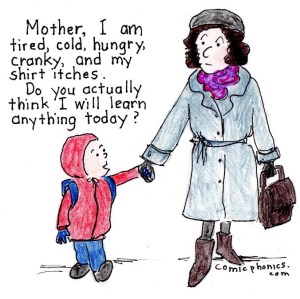
child tired, cold, hungry with mother

Sensory integration means sorting through all the input from our senses—what we see, hear, smell, taste or feel—into a meaningful message in our brains. Sometimes too much sensory data clogs our brains, causing problems. On an airplane, for example, some of us can easily tune out the baby crying and the plane bumping through clouds.  But others are ready to scream.

A child might show sensory integration issues if the cat is purring is too loudly.  Or the new shoes are too tight.  The bath towel is too scratchy.  The banana texture is too squishy.  Bathtub bubbles hurt .  The label inside the T-shirt tickles.

If you child has sensory integration issues here’s how you can help her focus when reading:

  • Motion: Make sure she is sitting in a still, comfortable place where she is less likely to fidget.  No gliders or swings.  Not in the back seat of a moving car.  Make sure her feet are supported.
  • Sound: Eliminate noise distractions.  Turn off the TV and radio.  Put the dog in his cage.  Stop the washing machine.  Seclude your child to the quietest part of the house.  If there is still noise, turn on your hair dryer or your vacuum cleaner to provide constant, steady “white” noise which obscures background sounds.  One of those recordings of waves or a mother’s heartbeat meant for new babies might also help.
  • Sight: Face a plain painted wall if possible.  No wallpaper with designs.  Draw the blinds.  Surround the child with calm, soothing colors like pastels, whites or tans.  No oranges, reds or bright pinks.  Choose picture books with plainer backgrounds so the child’s eyes know what to focus on.
  • Touch: Dress the child in soft, comfortable, nonbinding clothes.  Remove shoes and socks.  Have her sit on a smooth or pillowy surface—nothing scratchy.  If you are with her, cuddle if she likes but keep some distance if she prefers not to be touched.
  • A trick an occupational therapist taught me: To settle the child, scratch her back for a few minutes.  Begin at the neck and scratch straight down the backbone—not sideways and not from the bottom up, but from the top of the spine to just below the waist.  Scratch with your nails hard enough for the child not to feel tickled but not roughly enough to hurt.  (This is a great technique to help a baby relax to fall asleep, too.)

In the next blog we’ll talk about some modifications a teacher can make to a classroom to help children with sensory integration issues to prevail in school.


Facing dyslexia in a preschooler

So you suspect your preschooler has dyslexia.  What can you do?

  • Realize that the younger a child is when identified as dyslexic, the sooner help can begin. If possible, you want to identify the situation before the child becomes frustrated and discouraged, and before the child is labeled as “different.”child making letter T with his body
  • Ask your school district to test the child. Because of the child’s age, the district might balk, and say he will be tested when in kindergarten, or first grade, or later.  Sometimes the district will become involved if you have some “proof” that the child is dyslexic.  This might require private testing at your expense by some recognized expert.
  • From the school district, find out what services your child will receive and when.baby reading a book
  • If the school district “officially” won’t help, make an appointment with your elementary school’s reading specialist. She will probably have ideas you can start with, and she might be able to lend you materials or at least identify materials that will help.
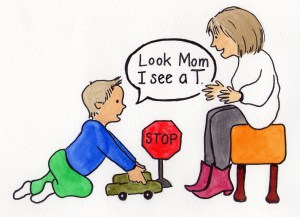
  • Consider hiring a reading tutor, one with experience teaching children with dyslexia. A good tutor will use many strategies, particularly game-like, hands-on approaches that will appeal to a preschooler.boy sees a T in STOP
  • If someone else in the immediate family has dyslexia, there’s a good chance your child has the same kind of reading problem and can be helped the same way. What worked for your other relative?
  • Check out ideas on the internet. Use keywords such as dyslexia, preschooler, reading and learning strategies.
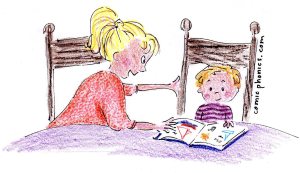
  • Begin working with your child yourself. Focus on the sounds of the language first, and make sure your child can hear them and pronounce them properly.  Only then match sounds with letters.mother works with child reading story book
  • Is letter recognition difficult? Buy an ABC puzzle or letter tiles or a Scrabble game.  Use the letters to play games forcing the child to identify letters.  Unfortunately, most sources for letters use only capital letters, and it is generally lower case letters which cause problems.
  • Work on printing letters properly. If fine motor coordination is difficult, use a computer keyboard instead.  But again, most keyboards identify the keys with capital letters.Mother shows child spelling of her name Kelly
  • Use music. Teach your child the ABC song.  Sing songs together which rhyme or read nursery rhymes.
  • Teach directions. Up, down. Left, right.  Inside, outside.
  • You may find it takes longer for your dyslexic child to master certain skills when compared to a child without reading difficulties. Be patient.  If a younger sibling is catching on faster than the dyslexic child, work with each child independently and out of earshot from one another.  If at all possible, conceal from your child that he is having reading difficulties.  Find ways for him to succeed at learning.A teacher says the first part of a rhyme, and the child says the rest of it.

How about pulling your child out of preschool, or stopping all reading instruction for a year or until the child is seven or until the child reaches first grade?  These are not good solutions.  In pre-K students are expected to know their letter sounds and to match them with ABC’s.  In kindergarten children are expected to read CVC words, high frequency words, and some two-syllable words.  A child who can’t keep up with his classmates develops low self-esteem which can intensify reading problems.

Be proactive.  If you think your three or four-yer-old shows signs of reading difficulty, act as soon as possible for the best outcome.

Can dyslexia be identified in a preschooler who can’t read yet?

Yes.  Check this list of indicators developed by Decoding Dyslexia, New Jersey.  But keep in mind that a child exhibiting one or two of the indicators isn’t necessarily dyslexic.  For example, almost all children learning their letters mix up b and d.  But a child EPSON MFP imageshowing several of the indicators might foreshadow problems learning to read or spell.  That child should be tested.

Dyslexia is defined as a neurological learning disability.  Children having difficulty with word recognition, fluency, poor spelling or decoding might be dyslexic.  The sooner it can be identified in a child, and the earlier intervention can begin, the better the chances that the child will learn to read.

A key indicator is family history.  If a parent or a sibling has had trouble learning to read, there is a greater chance that another member of the family will have trouble.

According to Decoding Dyslexia, New Jersey, Language indicators could include:

  • delayed speech
  • trouble learning the alphabet, numbers, and days of the week
  • difficulty rapidly naming people and objects
  • lack of interest in stories and books
  • mispronouncing words
  • difficulty using new vocabulary words correctly
  • trouble distinguishing words from other words that sound similar
  • struggling to identify or produce words that rhyme

Reading indicators could include:

  • difficulty naming and recognizing the letters of the alphabet
  • problems matching letters to their correct sounds
  • scoring below expected reading level for his/her age
  • trouble understanding the difference between sounds in words
  • difficulty blending letter sounds within words
  • trouble recognizing and remembering sight words
  • confusing letters and words that look similar
  • losing his/her place—and skipping over words—while reading
  • avoiding reading tasks

Writing indicators could include:

  • problems copying and writing at an age-appropriate level
  • confusing the order or direction of letters, numbers and symbols
  • spelling words incorrectly and inconsistently most of the time
  • a tendency to spell phonetically
  • poor ability to proofread and correct written work
  • handwriting which shows poor letter formation and placement

Social / emotional indicators could include:

  • Lack of motivation about school or learning
  • lack of confidence in learning
  • negative self-image compared to grade-level peers
  • expressing dislike for reading and other academic tasks
  • exhibiting anxiety or frustration

Other indicators could include:

  • poor sense of direction/spatial concepts, such as left and right
  • performing inconsistently on daily tasks
  • appearing distracted and unfocused

If your child shows some of these characteristics, don’t be discouraged.  Most children show some of them.  And if your child is dyslexic, there is so much you, as a parent, can do to prepare your preschooler to read fluently.  In the next blog we’ll identify some of those activities.


How to teach sight words

You can teach your child sight words through many methods.  Buying or making cards with pictures on them can help make the words stick better in the child’s mind.  You can have your child learn a word a day by pointing to the word and having the child say it aloud.  Repeating helps the words stick.  Many kindergarten classrooms have word walls where the sight words are posted so children can use them when writing.

EPSON MFP image

You can find such words with magnetic backings (or you can make them).  Put them on your refrigerator, or in a large metallic baking pan or cookie sheet.  Then help your child move the words around to make phrases or sentences.

Games are another good way to teach sight words.

  • Make a BINGO sheet with sight words for your child to find and cover.
  • Play Concentration. Make a set of cards with two of each sight word.  Start with just a few pairs, mix them up and turn them over on a table, and then turn them, two at a time, to see who can find the most matching pairs.
  • Play Go Fish with the same set of matching cards.

Some word pairs can easily be confused, so spend extra time on them:  of and off; for and from; was and saw; on and no; their and there; them and then; and when, where, what and with.

One caution:  Children who learn sight words before they learn phonics may try to memorize all words rather than sounding them out.  They may balk at learning phonics.  They need to know it is important to be able to sound out words using certain rules so when they encounter new words they can figure them out.

Should I teach my child sight words?

Yes!  Sight words (sometimes called high frequency words) are words which a reader can identify by their appearance, even if the reader doesn’t know phonics.  They are often little words like “a” and “and.”  Some of them follow the rules of phonics, but some don’t.

Reading tutor with 4-year-old

Why is knowing them important?  According to Dr. Edward B. Fry who did extensive research on English words,

  • 25 sight words make up about one-third of all words published.
  • 100 words comprise approximately one-half of all of the words found in publications.
  • 300 words make up approximately 65% of all written material.

In the 1940s, Dr. Edward W. Dolch published a list of about 300 words commonly used in children’s books published in the 1920’s and 1930’s.  These became the first list of sight words.

In the 1990’s, Dr. Fry did further research and provided a list of 1,000 words which he called “instant” words.

By knowing these words, a child can read about 75% of almost any book written for children.  For example, knowing the Dolch words, a child can read almost

  • 88% of Ten Apples Up On Top by Dr. Seuss
  • 87% – Green Eggs and Ham by Dr. Seuss
  • 78% – Go, Dog. Go! by P.D. Eastman
  • 78% – Are You My Mother? by P.D. Eastman
  • 82% – I Want to Be Somebody New! by Robert Lopshire
  • 83% – A Fly Went By! by Mike McClintock
  • 78% – The Cat in the Hat by Dr. Seuss
  • 81% – The Cat in the Hat Comes Back by Dr. Seuss
  • 75% – One fish two fish red fish blue fish by Dr. Seuss

Lists of these words are available free on many websites.  Search for either “Dolch words” or “Fry words.”  You can buy cards printed with these words on them.

In our next blog, we’ll talk about ways to teach sight words.

Printing, cursive writing and keystroking

Is there a best sequence in which to learn printing, cursive writing and key stroking?  Yes, according to research.

clip of child holding pencil upside down

  • First children should learn to print letters, using either a pen or pencil, from toddler years through second grade.
  • Then, during third and fourth grade, children should learn and switch to cursive handwriting.
  • Beginning in fifth grade, children should learn to keystroke.

This sequence is connected to how the brain of a child develops.

Holding a pencil, forming letters correctly, printing neatly on a horizontal line and using correct spacing to form words is a complex skill requiring coordination of many processes.  By four or five years old, most children are capable of this.

Around fourth grade, using cursive writing seems to help children with spelling and composing.  The reason is not clear, but researchers speculate that joining letters together in cursive writing helps children to form words from individual letters.

When a child learns to type properly on a keyboard, the fingers from both hands are used, unlike when handwriting.  Using both hands might activate connective tissue in the brain which joins different parts of the brain together to perform a task.

(Common Core Standards recommend that children learn to print in first and second grades, but learning to write in cursive is not recommended.  As a result, cursive writing is no longer taught in many schools.  The Common Core Standards recommend learning to use a keyboard.)

How to retain new vocabulary

Review, review and more review is the way to help children retain new vocabulary.

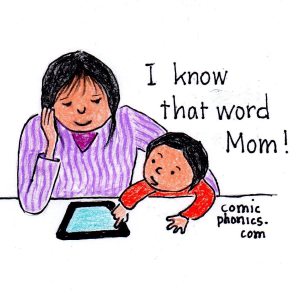
"I know that word, Mom," says the child lookin

Too often the push by teachers is to teach more words rather than to solidify the words students already “learned.”  The result is that the words practiced weeks ago don’t stick in students’ minds.

What can you do to make words stick?

Suppose one week you teach ten or twelve new words to a student.  That week you review the words daily—perhaps asking the student to draw each word’s meaning one day, or to have a spelling bee kind of review another day, or to write the words in sentences another day.

The next week you teach ten or twelve new words.  You use the same kind of daily review, but you include a few words from the previous week’s list which have caused the most problems.

For the third week of vocabulary instruction, instead of introducing new words, intensively review the combined words of the previous two weeks.  Perhaps you could offer fill-in-the-blank worksheets with a bank of vocabulary words at the top of the sheet.  Or during a writing lesson, suggest composing a paragraph using ten of the words from both lists.  Offer a prize (a bell rung in a student’s honor or a sticker) if the student can find one of the new vocabulary words in the ordinary course of the day’s work.

During the fourth week, introduce another set of new words, using various strategies.  Repeat some of the words from the previous weeks during the daily review.

During the fifth week, do not introduce new words; instead focus on words from the first three weeks which are difficult to remember and which are likely to be used or encountered by the student.  Focus on useful words.

Learn new, review.  Learn new, sweeping review.  Continue this pattern, spending as much time on learning new words as reviewing old ones, and your student will remember vocabulary words.

Why are upper case letters and lower case letters called upper case and lower case?

Upper case letters mean capital letters, sometimes called majuscules.  Upper case letters all have the same height.

EPSON MFP image

A B C D E F G H I J K L M N O P Q R S T U V W X Y Z

Lower case letters mean small letters, sometimes called minuscules (from which comes the word “minus”).  The height of lower case letters varies.  Some are half as high as upper case letters, such as a, c, e, i, m, n, o, r, s, u, v, w, x and z.  Some have ascenders (parts which stick up) such as b, d, f, h, k, l and t.  Some have descenders (parts which hang down) such as g, j, p, q and y.

Years ago, when type was set by hand instead of by machine, a typesetter would take individual metal letters from a drawer or letter case.  Capital letters were stored in one case and small letters were stored in another case along with punctuation  and spacing markers.  Capital letters were stored above small letters, leading capital letters to be called upper case letters and small letters to be called lower case letters.

Sometimes both capital and small letters were stored in a single case which could be set upright.  When the case was organized, the capital letters were placed at the back of the case so that when it was set upright, capitals would be on top—hence, upper case.

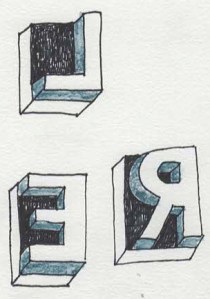
The metal letters typesetters would see in the cases were reflections of the letters printed on the page.  That means the metal letters faced the opposite direction from the printed letters.  In a case, a “b” would look like a “d.” Words and sentences would be set in a way which to us looks backwards, but the printed version would appear as we see type today.

Capital letters go farther back in history than smaller letters which were introduced in about the ninth century.  Smaller letters began as rounded, smaller versions of capitals.  They were easier for scribes to write at a time when all writing was done by hand.

Today most English writing is done in lower case letters with capitals reserved for the beginnings of sentences and for proper nouns.  Even so, capitals are often taught first to young children, perhaps because they are easier to distinguish.  Capital B and capital D are easier to figure out than “b” and “d.”