Teaching “and” and “but”

Learning new vocabulary words in elementary school is important for reading comprehension.  But vocabulary instruction needs to include a deeper understanding of words students use all the time, words they haven’t paid much attention to, such as the conjunctions “and” and “but.”

boy reading

Children know what “and” and “but” mean.  But do they realize they use “and” to connect two words or ideas which are both positive or both negative?  And do they realize they use “but” to join one word or idea they favor and another word or idea they don’t favor?

Helping students learn to read means pointing out the relationships which conjunctions create.  Here’s how.

  • Start with the word “and.” Write a sentence such as “I like ice cream and cookies.”  Point out to the student that you used “and” to join two ideas you feel the same way about.  Ask her if there are any other ways she could say “I like ice cream and cookies” without using “and.”  If she is stumped, suggest, “I like ice cream.  Additionally, I like cookies.”  Or, “I like ice cream as well as cookies.”  Or, “I like ice cream.  Also, I like cookies.”  Point out that “and,” “additionally,” “as well as” and “also” all are used to connect ideas which we feel the same way about, either positively or negatively.

Other words which mean the same as “and” include consequently, because,  moreover, and furthermore.  A semicolon between two sentences usually indicates that the idea in the first sentence continues in the second sentence.

  • Now write a sentence such as “I like ice cream but not anchovies.”    Ask her if there is any other way to say that idea.  She might say, “I like ice cream.  However, I don’t like anchovies.”  Or, “I like ice cream although I don’t like anchovies.”  Or, “I like ice cream even though I don’t like anchovies.”  Point out that “but,” “however,” “although” and “even though” all are used to connect ideas we don’t feel the same way about.  One idea we like and one idea we don’t like.  One idea usually uses a form of “not” or a prefix that means “not” such as un, im, ir, or dis.

Words which mean the same as “but” show contrast.  Some other words are though, despite and yet.

  • To reinforce the difference between “and” and “but” and their synonyms, suggest two ideas, such as summer and winter. Ask the student to say or write a sentence saying how they feel about those two times of year.  Now ask the student to change the word or words they used to connect summer and winter to a word or phrase which means the same thing.  Now do it again to another phrase or word which means the same thing.  Try another relationship, such as snakes and dogs.  Again, ask for synonyms for the connecting words.

Being aware how “and” and “but” and their synonyms create different relationships between ideas is important in reading.  If a child is reading and comes to the word “however,” she knows the thought has just changed to an opposite kind of thought.  If she comes to the word “moreover,” she knows more of the same kind of thought is coming.

Another way of teaching these ideas is to suggest that “and” is something like a plus sign, but “but” is something like a subtraction sign.  Or “and” is something like walking straight ahead while “but” is something like taking a U-turn.
What was the word of 2016, according to Oxford Dictionaries?

Post-truth” is the word of 2016, according to the Oxford Dictionaries*.  This adjective means “relating to or denoting circumstances in which objective facts are less influential in shaping public opinion than appeals to emotion and personal belief.”  Post-truth has often been paired with politics, both in the US and UK, and saw a spike in usage beginning in May (before the Brexit vote), peaking at the time of the US Presidential election in November.

Child Browsing the Web

Contenders for Oxford’s word of the year include:

  • Adulating, a noun: meaning behaving like a responsible adult
  • Alt-right, a noun: an ideological group of extreme conservatives
  • Brexiteer, a noun: a person favoring the UK’s withdrawal from the EU
  • Chatbot, a noun: a computer program which simulates human conversation on the internet
  • Coulrophobia, a noun, an extreme fear of clowns
  • Glass cliff, a noun: a situation in which a woman or minority member gains leadership and where the risk of failure is high
  • Hygge, a noun: cosiness and comfortable socializing, making a person feel well
  • Latinx, a noun or adjective: a person of Latin American descent
  • Woke, woker, wokest, an adjective: alert to injustice, especially racial injustice

*https://en.oxforddictionaries.com/word-of-the-year/word-of-the-year-2016

What was the word of 2015

Surreal” is the word of the year according to Merriam Webster Dictionary.  It is an adjective meaning “marked by the intense irrational reality of a dream.**”  The word is used to describe something shocking or surprising, something above or beyond what is real.  In 2016 it was used to describe terrorist attacks and the US Presidential election.

EPSON MFP image

Contenders for Merriam-Webster’s word of 2016 include

  • Revenant, a noun: one who returns after a long absence
  • Icon, a noun: a person who is successful and admired
  • In omnia paratus, a Latin prepositional phrase: ready for all things.  This phrase was used in the original Gilmore Girls TV show and in its revival.
  • Bigly, a phantom word thought to be used by Donald Trump. Actually, he said “big league” in debating, but it sounded like “bigly.”
  • Deplorable, an adjective used as a noun by Hillary Clinton. It means “lamentable,” “deserving censure or contempt,” “wretched” or “abominable.”
  • Irregardless, an adverb used on air by a broadcaster during the final game of the World Series. This word is nonstandard English, and the dictionary recommends using “regardless” instead.
  • Assumpsit, a noun: a legal term meaning an express or implied promise of a contract.  It was used by Rep. Joe Kennedy at the Democratic National Convention.
  • Faute de mieux, a French phrase: “for lack of something better.”  It was used by Justice Ruth Bader Ginsburg in a decision she wrote.
  • Feckless, an adjective: weak or ineffective.  Mike Pence used it in a Vice-Presidential debate.

**https://www.merriam-webster.com/words-at-play/word-of-the-year-2016

Learn vocabulary through online games

One key to reading well is to understand many vocabulary words.  Is there a fun way to learn new vocabulary words?  How about learning through online vocabulary games?

http://www.vocabulary.co.il offers many kinds of vocabulary learning games, a few of which are described below.

  • Prefixes offers matching games for various grade levels.  For third through fifth graders, four prefixes appear on the left and four meanings appear on the right.  Click on one prefix; then click on its matching meaning and a line connects them.  When all four have been matched, click on the “check answers” tab, and check marks appear in front of the correct matches.
  • Foreign-language offers matching and other games for English-Spanish, English-French, English-German, and English-Latin learners.
  • Word scrambles ask the player tot unscramble given letters to form a word. You can press “hint” for help.  A clock keeps track of your speed in finding the correct word.
  • Idiom games include matching games and choosing the right meaning of a phrase from four possible choices.
  • Spelling games include word searches, unscrambling of words and choosing the correct part of speech for a given word.
  • Syllable games ask the player to divide words into syllables.
  • SAT vocabulary games offer various kinds of word-building games for older kids.

Twenty-four different kinds of vocabulary learning are offered, and from them, usually there are many choices in kinds of games to play and age or grade level choices.

Bookmark gifts for child readers

Books make great holiday gifts for children, and so do special bookmarks tucked inside.  If you search online you will find hundreds of bookmarks, some to buy and some to make.  Here are a few that caught my eye, plus some “handcrafted” ones.

photo-of-book-mark-of-pen-pointPage Nibs are tiny metal book marks (one inch by ½ inch) shaped like the points of fountain pens. Children can move the bookmarks up and down a page as they read.  If children forget which line of text they have just read, using one of these line markers makes it easier to remember.  They’re also good for adults who want to know precisely where they left off reading on a given page.  Click on the “nibs” photo for more information.

pointing-finger-on-rubber-band-like-bookmark

Fingerprint Bookmark Bands are large rubber band-like book marks including a hand as part of the band. The hand’s index finger is pointed.  The whole thing can be slipped around an open book with the finger pointing to the line where the reader stopped.  Click on the “fingerprint” photo for more information.

houses-of-hogwart-bookmarksMetal bookmarks featuring the four houses of Hogwarts might thrill your Harry Potter readers. They along with other Harry Potter bookmarks are available from Amazon. Click on the “Harry Potter” bookmarks photo for more information.

photos-of-children-bookmarksFor the do-it-yourselfer, click on the photo at the left to find easy directions on how to create a bookmark out of a photo of a child.

Another do-it-yourselfer is a piece of cardboard (a cut up manila file will do) on which you write the child’s name and date at the top (for example, winter 2016-2017) and “Books read.” Underneath draw lines where the child can write the names of books read.  When filled in, save it in the child’s baby book.

Still another do-it-yourselfer is to trace the hand of your child at the beginning or end of every year or on every birthday. Trace the hand onto cardboard, write the date and the child’s name, and laminate.  Punch a hole through the top, and add a tassel.  Children love to measure their growth.

The child’s own signature on a card can make a great bookmark.  Laminate the card, and if you like, punch a hole and add a tassel.

How to make kids better readers

Renaissance Learning offers many ways to make children better readers.  Here are some of their suggestions.

“Give your students more choices.” Let children choose which books to read from a huge selection, both fiction and nonfiction.Young girl 's reading choices include a print book and an eBook.Young girl 's reading choices include a print book and an eBook.

Make sure the reading level is just right.”  A useful gauge is to count the number of words a student misses on a single page.  If it is five or more, that book is probably too hard and will discourage children from reading.

Devote time to reading practice.”  Designate a certain time every day—before bed, before the morning school bus or during the school day—for reading.  Children will look forward to this time, especially if it is part of a routine.boy reading on the floor

Build relationships with daily check-ins.” During reading time, talk to your child.  Comment on what he is reading.  Let him know you care.

Make reading practice a social experience.” Read together with a child, one page for her, one page for you.  Or after you read, discuss what you and the child like and don’t like.

Create a book-store style display.” On the bookshelf, show off books by their jackets or front covers to encourage a child to choose that book.  Display books you have read so you can talk to the child about why you like the book and why he might.girl reading Junie B. Jones

Read aloud to students of all ages.” When you read to a younger child, you expose him to books whose ideas he can grasp even though the vocabulary might be difficult for his reading level.  When you read to an older child, you introduce genres which the child might not choose, and you model comprehension strategies such as predicting, asking questions and summarizing.

Acknowledge and celebrate success.” Praise your child for his reading.  Create a spot to post his reading accomplishments—names of books and articles read, or number of pages read.

For more detailed information, go to http://doc.renlearn.com/KMNet/R60386.pdf.

Reading tips from Scholastic

Scholastic, the publisher of so many children’s books, offers seven tips to increase reading opportunities for children on its website, http://www.scholastic.com/parents/resources/article/more-reading-resources/reading-tips-parents.  I have paraphrased them below.

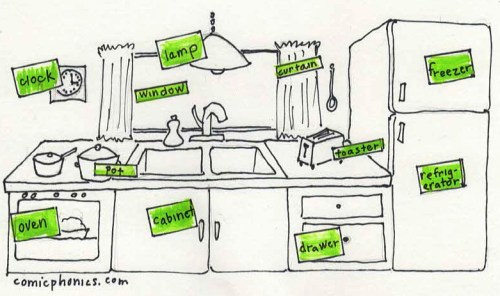
  • Label everything in your home with masking tape or Post-it notes.  This is a great way for young children to learn vocabulary, including long words such as refrigerator and calculator.
  • Find a book that is “just right” for your child.  Have the child read the front cover, the back cover, and the first page of a book.  If the child can read all the words, the book might be okay or it might be too easy.  If the child can’t read five of the words, the book is probably too hard.
  • Teach the child how to read a street map of your neighborhood.  Reading diagrams, maps and graphs is an important skill in Common Core curriculum.  Have the child translate the diagram into word directions.  “Go down the front steps.  Turn left.  Walk to the end of the street.  Turn left onto Delaware Avenue and keep walking until you get to Lincoln Park.  Be careful crossing the street.”
  • Read greeting cards together.  Go to the grocery store or drug store’s birthday card section.  Read the cards together and vote which one is best.
  • Take pictures during an outing or vacation.  Later, ask the child to create captions for each photo and gather them into a photo album.  Or make a booklet of photos and words.
  • Read the Sunday comics with your child.  Cut out good ones to hang on the refrigerator.  Reread them.  [Inference can be learned from this activity, looking at facial expressions where words are not used.]
  • Help your child write a letter to his favorite author.  Most authors have a website which will accept emails.  Or you can find a mailing address on the publisher’s website.

How to encourage multiple perspectives on a reading topic

When students take Advanced Placement (AP) courses, they must read and analyze several documents on a given topic.  Those documents come from various sources, such as diaries, government publications, laws, news reports, emails and speeches.  The documents approach the topic from various perspectives, such as a private citizens, columnists, people with a grudge, historians and mental health experts.

EPSON MFP image

From all these documents students are asked to understand a complicated issue and to make sense of it.

Can we work with young readers, even beginning readers, to encourage a similar wider, multifaceted understanding of a topic?  Can we help children to identify important ideas and then help them to compare and contrast those ideas through various reading sources?  Can we help our earliest readers to become critical thinkers?

Yes.  One way is by choosing several books or other reading sources which approach a topic from different perspectives or genres.  First, decide on a question you would like the student to explore, such as, What was it like to take the Oregon Trail? or Why do polar bears need ice?  To have the greatest impact, the topic should be one the student is studying or a seasonal or timely topic.  Together the sources should give a wider and more profound understanding than any one source alone can give.

Here are some examples for primary grade students.

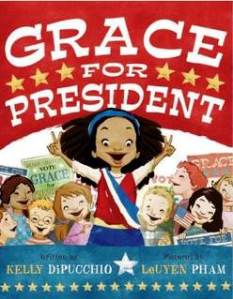
graceforpres

The question might be, Can a girl be President?  Show the student a copy of The Constitution and explain what it is.  Then have reproduced the appropriate lines from Article II defining the President’s qualifications.  Discuss what they mean.  Then have the student read Grace for President by Kelly S. DiPucchio, about a little girl who decides to run for president at her school.  Discuss how hard it is to become President.  Finally, your child could read a biography of Hillary Clinton, such as Hillary Rodham Clinton:  Some Girls Are Born to Lead by Michelle Markel or Who is Hillary Clinton? by Heather Alexander.  Discuss whether Mrs. Clinton has the qualifications needed, and what other strengths might be needed to be a President.

If the question is What’s an idiom? your student could start with In a Pickle: And Other Funny Idioms by Marvin Terban. This book explains what an idiom is and then illustrates well-known idioms with funny drawings.  Next, your child could read Raining Cats and Dogs: A Collection of Irresistible Idioms and Illustrations to Tickle the Funny Bones of Young People by Will Moses.  This book illustrates common idioms, but goes one step further:  it explains how the idioms came to be.  My Teacher is an Idiom by Jamie Gilson shows what happens in a fictional second grade when a new student from France misunderstands English idioms, and when the English-speaking kids misunderstand French idioms.  The reader learns that all cultures have idioms, but sometimes they do not translate into another language.

If the question is What is the water cycle? you could explore Water is Water:  A Book about the Water Cycle by Miranda Paul.  With poetry and evocative art, readers follow two children as they pass through the water cycle as water goes from rain outside to steam in the tea pot to evaporation into clouds.  In The Drop in my Drink: The Story of Water on Our Planet by Meredith Hooper, readers travel back to a young planet Earth to find out where water came from and to learn about erosion and how all living things depend on water.  National Geographic Readers: Water by Melissa Stewart shows more about the water cycle through beautiful photography and easy reading words.

Do you multitask when you teach your child?

Do you multitask when you oversee your children’s work?  Do you listen to little Sia read while stealing glances at your smart phone for text messages?  Do you cut away from little Andy writing his ABCs to check your Facebook page?

EPSON MFP image

According to research, those little breaks in concentration — just two or three seconds — can double the number of errors a person makes in his or her work.  When your work is supervising your child’s work, you can miss your child’s victories and mistakes and miss opportunities to intervene.

All the technology around us and our speed in using it encourages us to multitask.  We run the treadmill while watching TV.  We drive with buds in our ears.  We push the baby carriage while texting.  We make dinner while we supervise the children’s homework.  It’s not possible all the time to stop multitasking, but when it is possible, we should.  Research shows that multitasking is just another word for doing two things poorly. Single tasking, or as Grandma used to say, “paying attention” is the way to do work well.

I have seen parents on their laptops or cell phones or both while their preschooler works a puzzle in a doctor’s waiting room.  The child looks up for affirmation, but no one notices: an opportunity to show the child how important he is — wasted.

When your work is teaching children to read or write, turn off the electronics.  Put the tablet and cell phone out of sight.  Sit close so your child can see he has your full attention.  When he speaks, respond not with “uh-huh” or “um” but with specific words that show you are listening.  Look at your child’s body language.  When her grimace shows you she is confused or needs help, offer encouragement.  When she pronounces a word well or writes a big kid word like “irritable,” say how proud you are of her work.

If you must take a call, answer an email, or mix the meatloaf, tell the child you will work with her in four or twelve or however many minutes.  Then set the kitchen timer so the child can see it, and when it rings, give her your undivided attention.  Let her know some of your time is just for her.  Make her feel treasured.

For more information on the ineffectiveness of multitasking, read an article in The New York Times, at https://goo.gl/m33dNg.

My son’s kindergarten reading teacher says he won’t talk. He talks at home, but he is really shy. What’s going on?

It helps to know the reason for the speechlessness so that your son’s teacher will know how to modify her teaching style to make the student and teacher comfortable.  Since he has normal speech at home, perhaps he is selectively mute.

EPSON MFP image

Selectively mute children might be speechless all the time or only in social situations which make them afraid.  They might show anxiety, excessive shyness, fear of social embarrassment and withdrawal.  Symptoms* include

  • “consistent failure to speak in specific social situations (in which there is an expectation for speaking, such as at school) continues despite speaking in other situations.
  • “not speaking interferes with school or work, or with social communication.
  • “not speaking lasts at least one month (not limited to the first month of school).
  • “failure to speak is not due to a lack of knowledge of, or comfort, with the spoken language required in the social situation
  • “not speaking is not due to a communication disorder (e.g., stuttering).”

Ask that your son be evaluated by a speech pathologist.  But also have his hearing tested.  Sometimes persistent middle ear infections can make hearing hard.

After you have pinpointed the problem as much as possible, then you can plan how to make your son verbal in school.  This may take several professionals working together—the school psychologist, the speech pathologist, his teacher, you and possibly his pediatrician.

In the meantime, inform his reading teacher that you are following up on her observation.  Ask her to accept that this behavior is normal for him right now.  Ask her to find nonverbal ways for him to respond and participate in group activities until an intervention plan gets underway.

*According to the American Speech-Language-Hearing Association.