The place of phonics in reading instruction

True or false?

  1. Speaking is natural. Reading is not.
  2. All students learn to read differently.
  3. Kids in early grades should receive explicit phonics instruction.
  4. About 2/3 of US fourth graders can read proficiently.

(The answers are at the end of this blog.)

How kids learn to read, how reading should be taught, and how teachers of reading should be taught are still controversial in the US. This is despite an 18-year-old exhaustive study of research on reading—the National Reading Panel— authorized by Congress in 2000 which found that phonics should be the basis of reading instruction.

Even with overwhelming research, many teacher training colleges do not teach would-be teachers how to teach phonics.  And so the graduates of those schools do not teach their students through a phonics-based approach.  As a result, 60% of US fourth graders are NOT proficient readers, according to the National Assessment of Educational Progress.

Students who don’t read well by fourth grade

  • Are more likely to fall behind in other subjects.
  • Are less likely to finish high school.
  • Are more likely to be poor readers their whole lives.
  • Are more likely to be poor.
  • Are more likely to be imprisoned.

Scientific research shows that a phonetic approach to reading is crucial.  Our brains are wired to learn to speak and walk without instruction, but we cannot read without instruction.

Yet in 2016, the National Council on Teacher Quality, after reviewing the syllabi of US teacher training programs, found that only 39% are teaching their would-be teachers how to teach reading based on phonics.  This is 18 years after the US study was published!

In other words, teacher training school are either ignoring the research about how children learn to read or are willfully disregarding it.  And as a result, many students are not learning to read.

When I studied for my master’s degree in education in the early 1990’s, I took a reading course in which the instructor belittled the role of phonics in learning to read.  She said it was one of many factors, all about equal.  I thought phonics was fundamental, but I didn’t have the scientific research to back up my position.

But for the past 18 years we have had overwhelming research that shows that a phonics-based approach to teaching reading is what works best.

If your child is struggling to read, find out if his or her teacher is teaching reading using a phonics-based approach.  If you are taking your child to a tutoring center to learn reading, make sure the center is using a phonics-based approach.  If you are teaching your child to read, use phonics.

What do I mean by phonics?

  • Identifying the sounds of English. Sounds, not ABC’s, come first.
  • Matching those sounds with symbols (letters) which represent those sounds
  • Merging those sounds and symbols to form words.
  • Identifying patterns among the symbols (for example, an “e” at the end of a one-syllable word) which change or influence the sounds letters make.

(The answers are true, false, true and false.)

Teaching VC and VCC words beginning with short vowels

Many beginning readers have trouble pronouncing two- and three-letter words which begin with a short vowel such as at and ink.  Children can pronounce “cat” yet not “at.”

Just as it is easier for children to learn consonant sounds, it seems easier for them to learn words which begin with consonants than to learn words which begin with vowels.

As a result, I teach CVC words first, including words with beginning and ending blends.  Then I teach VC or VCC words.  Many one-syllable short-vowel, words begin with a vowel and end with consonant blends.  I teach such CVCC words before I teach VCC words.

First I introduce two-letter words, some of which (in, on) children have already learned as sight words.  Other two-letter words include Al, am, an, at, ax,  Ed, ex if, it, ox, up and us.

One problem in teaching such words is that many of these words don’t have pictures which form a meaningful association for children.   How do you picture “us,” for example.  Two girls, arm in arm?  The student will say “girls” or “friends” or “sisters” but not “us.”  Another problem is that some of these words, such as “ex” and “ox” are not familiar to children.  When I can, I find pictures and make flash cards to help children associate words with pictures.  But that is hard.

After I teach two-letter VC words, I teach three-letter VCC words, including add, alp, ant, app, ask, asp, act, aft, and, egg, elk, elm, elf, end, egg, imp, ink, and off.  By teaching, I mean making words of letter tiles for children to read, and then asking them to make the words I say, again using letter tiles.  I also play BINGO using cards with these words on them.  I  make lists to read (boring but necessary).  We review these words often.  I write sentences using these words for children to read, sometimes in the form of a question which they must answer with a yes or no.  (Can an ant ask an egg to sit?  Can an elk add 2 + 2?  The sillier, the better.)

You can’t assume that because a child can read “cat,” she can also read “act.”  Tiny words beginning with short vowel sounds should be taught explicitly and should be reviewed until you are sure the child can sound them out properly.

Sports and good grades

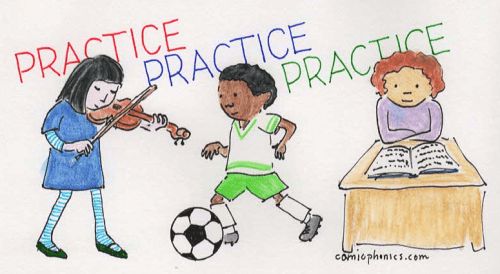
The time while your children are little—preschoolers or in early primary grades—is a good time to think about the competing place of academics and sports in their lives, and what you are willing to sacrifice in one area in order to bolster the other.


In the US, sports are an important part of child development.  Participation in sports leads to healthier bodies, better thinking brains, better sleep, friendships, teamwork, popularity, and discipline.  Colleges want to see that students have been active in sports.

The problem isn’t sports per se, but the balance between sports and schoolwork.  Some students can handle a rigorous sports practice schedule and keep high grades; others can’t.  When students can’t, what is the priority—team sports, academics, or some compromise?

I teach a sixth grade student who plays fall football.  He has three-hour practices three evenings a week, after which he showers, eats and then starts homework after 9 p.m.  He also has a game on Saturdays—another four hours devoted to football.  Football season starts in August and lasts until Thanksgiving—three and a half months of the school year.  At mid-semester this fall, this student’s grades in reading and writing are in the low 70’s.

The mother knows football is partly to blame for her son’s mediocre grades, but she is reluctant to pull him from a sport he loves.  She is also reluctant to limit her son to less practice time on school nights. If the coach says three hours, then three hours it is.

I have another sixth grader who plays year-round tennis.  He practices several times a week with and without a coach.  When he has a tennis match which conflicts with a reading/writing lesson, tennis wins.  He is carrying a grade of 65 in ELA.  The mother says he needs something which makes him feel good, and tennis is it.

In the past, I had another student who did gymnastics for three hours, four evenings a week.  During the winter this student traveled to meets, sometimes taking  whole weekends.  Yet this student maintained a B average and won an academic scholarship to college.

If your child is still at the CVC stage of reading, then consideration of the place of sports in her or his life might seem premature.  It’s not.  You should decide ahead of time what grades you expect from your child and what you are willing to do to achieve those grades.  Are you willing to commit to a sport which takes up many school evenings when your child could be doing homework?  Are you willing to allow your child to participate many hours a week in a sport even though his grades are low?  Where do you draw the line, if ever?

I recommend that when your little boy or girl signs up for T-ball or dance, that you appraise carefully the time commitment it entails.  How will such a time commitment affect schoolwork?  Talk to your child about your expectations and how your child can or cannot meet those expectations while still doing that sport.  Then act accordingly.

Organized sports are optional.  Doing well in school is not.

How do you know if your preschooler will do well in school?

A new study correlates traits of high achieving fifth graders with those of 54-month-old children.  The study found important traits in preschoolers which can help predict fifth grade achievement levels.

The most important trait was social competence.  Children with high social competence at four-and-a-half years old tended to be high achievers in fifth grade.  Social competence is an umbrella term meaning that a child possesses the social, emotional, and intellectual skills and behaviors needed to succeed.

Working memory is another essential trait.  Working memory means the ability of children to pay attention, remember important information and keep track their progress as they work on a given task.

Complete results of the research are available in the July/August issue of Child Development, an academic journal.

Does early childhood reading cause myopia?

Video games are leading to more myopia in children, according to the President of China, who has called for restricted access to video games among children.

girl reading Junie B. Jones

Whether China’s President Jinping Xi is right or wrong, he reminds me of another possible cause of myopia:  reading as a young child.  But is there any proof that reading leads to nearsightedness?

Some eye doctors think so, but the evidence is not conclusive.  Many causes might lead to nearsightedness.

Heredity plays a role, but how much of a role is not understood.  In my case, my mother wore glasses, and when I was in fourth grade, I too needed glasses.  Some of my brothers and sisters also needed glasses as children, but others didn’t.  My husband didn’t wear glasses until he was 50, and both of our sons  don’t need glasses.  Yet our daughter, like me, needed glasses as a child.

If a child reads a lot, the strain of deciphering small type and of focusing on tiny symbols for long stretches of time might lead to nearsightedness.  But for other children, it might not.  All of my brothers and sisters read a lot, but only some of us needed glasses in childhood or early adulthood.  It could be that a child who prefers to read does not get enough exercise or enough time in natural sunlight.  Research is needed to show whether reading is a cause of myopia.

Researchers have learned that children who are prescribed eye glasses for myopia tend to have their eyesight worsen in childhood.  But this finding has led to research on how to stop the reversal or even to backtrack it.

Atropine eye drops can help slow down myopia progression for about a year or so, but after that the effect of the drops diminishes.  These drops dilate the eye and relax the eye’s focusing process.

Gas permeable contact lenses worn at night can temporarily relieve myopia the following day.  Over time, researchers think wearing these lenses might slow myopia progression.

Doctors using multifocal contact lenses on children find these lenses help with myopia.  These lenses have different powers in different zones of the lenses.

Multifocal eyeglasses worn by children have also helped slow the progression of myopia, but they are less effective than multifocal contact lenses.

Can you prevent myopia in your child?  We don’t know, but eye specialists recommend these actions:

Make sure your child’s eyes are tested annually by an eye doctor even if the child is not complaining of eye sight problems.

When the child reads or does other highly focused eye activities, make sure the child takes breaks and uses the eyes for longer distance activities before he or she returns to focused activities, like reading.

Choose high index (thinner and lighter) eyeglass lenses.  Have them made with an anti-reflective coating.  Photochromic lenses will protect eyes from UV and blue light.

I would add, seek out larger type children’s books which are easier on the eyes.  Limit the time your child reads from backlit electronic equipment (monitors, tablets and smart phones, Kindles and Nooks).  Have the child read in good lighting.  Have your child wear sunglasses outdoors, and weather permitting, insist that your child spend time outdoors playing.

And make sure your bookworm doesn’t take a flashlight to bed and sneak extra reading time under the covers.


How does an almost two-year-old read?

How does an almost two- year-old “read”?  What does such a tiny child “read”?  How can we encourage the reading habit in such a tike?

I spent a week in early September with a 21-month-old who wanted me to “read” to him many times daily.  He taught me:

Toddlers love to hold books, turn their pages, point to objects they recognize and name those words.

They do not like to be read paragraph-long passages.

They do like to be read text if it is short. “Brown bear, brown bear, what do you see?” is an example of text that works.  Single syllable words, words the child knows, words which are repeated, tiny sentences—these hold a child’s interest just long enough before he wants to turn the page.

Pint-sized cardboard books are easy for a toddler to hold. The pages are easy to turn.  And the cardboard is able to withstand the rough handling that a tiny child gives.

“Reading” often means “studying” a picture to discover what it holds. “Balloon!” he might shout, or “Piggy eat.”

Order of pages is arbitrary to a tiny child. Sometimes he will prefer to skip some pages to head right for the picture he prefers.  Sometimes he will flip back and forth, making a connection between one page and another.  For example, he might find the moon on one page and then go back to a previous page to find the moon there.

Simple drawings are best. Bright colors with plain backgrounds help the child to focus.

Animals—especially baby animals with their mothers—fascinate many children. But one time an adult horse might be a “mommy” and another time that same image is a “daddy.”  There’s no need to correct.

Touchable books captivate toddlers. A child eagerly strokes books with inserted fabric for a sandpapery pig’s nose or a furry dog’s ear.  Books with flaps are fun to open even if the child has opened the same flap many times.  Books with cutouts—like the holes that the Hungry Caterpillar eats—are just the right size for a little one to stick his finger into.

Many times, you, the adult, needn’t read a word.  Rather you might wait for the child to take the lead.  He might point to a picture and say a word.  You might repeat his word to show you are listening or to offer correct pronunciation.

Many times all he wants is for you to listen, to share his reading time without distraction. By being willing to focus only on him, to listen wholeheartedly, you teach the child that you value what he is doing.  Your unhurried presence tells the child that this activity—reading—is important.

Bob Books author dies

The author of one of the easiest-to-read and most popular reading series has died.

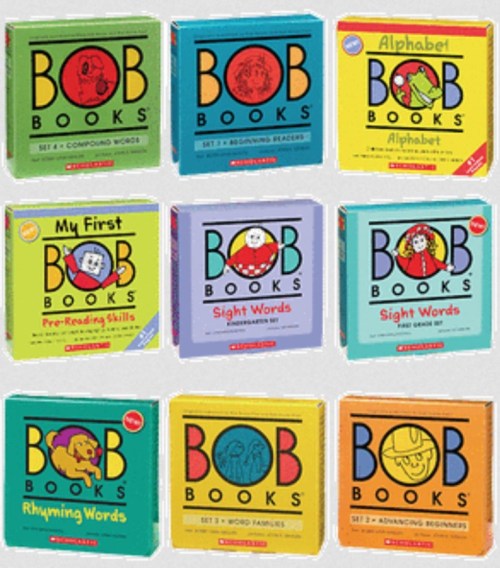
Picture of 9 Bob Book sets.

Click the photo for a link to the Scholastic selection of Bob Books.

Bobby (Bob) Lynn Maslen, 87, author of the Bob Books, died August 16 in Portland, OR, of Alzheimer’s disease.

Mrs. Madden created the first Bob Book in the 1970’s when she was teaching reading to preschoolers.  One day she took typing paper, folded it in quarters, and asked her students to help her write a story.

The result was the first Bob Book.  It comprised about 12 pages and used just a handful of letters which spelled CVC words.  “Mat sat.  Sam sat.  Mat sat on Sam.  Sam sat on Mat.”  Mrs. Maslen stapled the pages together and sent the books home with her students to reread and to color.

The illustrations were almost as simple as the stories.  Eventually, Mrs. Maslen standardized her books into three sets of 12 books each.  She printed hundreds of copies and packaged them into little sandwich bags for her students.

Demand for her books grew.  Mrs. Maslen’s husband, an artist, provided new drawings.  The books were published by Portland State University, then by the Maslens themselves, and later by Scholastic.  Today more than 16 million books are in print, according to Scholastic.

Teaching reading to children with autism

In some ways, teaching reading to children with autism is like teaching anything else to them.  It is those similarities that this blog focuses on.  Many children with autism are sensitive to light, sounds, smells, busy walls, chairs that are too big, and the feel of their clothes. Before you begin a reading lesson, make sure the environment works for the child or he will be unable to focus.

Make sure the student is paying attention before you begin and during the lesson. If he is looking away, or if his eyes have that blank look, assume he is not paying attention.  Say his name.  Say, “Look at me.”  Only when you have his attention, begin or continue on.

When you give directions, say them in short sentences. If the directions have more than one step, say the steps one at a time.  Let the student complete the first step, thank him, and then say your second direction.  For four-year-olds and five-year-olds, pictures of what behavior you expect can help.  Sometimes asking the student to repeat the direction helps.

Make your directions and comments specific. “Put the book in the desk.”  “Stand up.”  Skip adjectives, prepositional phrases and any extra words that might muddle the message.  And don’t word your directions as questions.  “Would you like to put your book away now?” to you might mean “Put your book away,” but to a student with autism, it might mean something different.

No idioms. No inferences.  No sarcasm.  No humor.  Keep your comments factual and expect factual responses.

Warn several times that an activity will end. “Ten more minutes.”  “Five more minutes.”  “One more minute.”

Many students with autism find handwriting difficult. If the student must “write,” try using a laptop, tablet or even a phone.  Or allow him to respond orally.

Praise wen the student responds appropriately.  You don’t need to gush, but say “Thank you” when the student behaves as you ask.

When a word has a single consonant between two vowels, sometimes (not often) the consonant goes with the first syllable.

Usually when a two-syllable word has a single consonant between two vowels, the consonant goes with the second syllable.  This pattern forms a first syllable ending in a long or open vowel.  Some words like this include

  • minus
  • tulip
  • pupil
  • motel

Because the majority of two syllable words with a consonant between two vowels follow this pattern, children should learn this as the rule before they learn exceptions.  Lists of words like this are available in many reading workbook series or online.

But students need to know that a few words don’t follow this rule of pronouncing the consonant with the second syllable.  Some words are pronounced with the consonant ending the first syllable and forming a CVC first syllable.

I have not found readily available lists of words like these, so I am including some here.

  • manic, panic, colic, comic, frolic, sonic, tonic
  • oven
  • Janet, planet
  • punish
  • olive
  • livid, timid, valid
  • delta
  • rebel, shrivel, level, civil, devil, hovel, Nevil
  • deluge
  • lizard, wizard
  • driven, given, Kevin, seven
  • second

To find if a word is an exception to the rule, have the student pronounce the word with the consonant starting the second syllable (following the rule).  If the student does not recognize the word, then have the student pronounce the word with the consonant ending the first syllable.  Many times this second pronunciation will make sense, but not if the student is unfamiliar with the word.  In that case, you will need to pronounce the word correctly for the student to hear and explain the meaning of the word to help the student remember it.

Kentucky initiates new law to help children with dyslexia

What is dyslexia?  What are the best research-based practices to teach reading to students with this learning disability?  What governmental supports are needed to make this possible?

The definition of dyslexia varies almost as much as the 50 US states.  Some states have no laws related to dyslexia.  Others have created task forces to study dyslexia.  Still others mandate a specialist in this field in the state department of education.

But now Kentucky seems to have developed the gold standard to respond to dyslexia with the passage of House Bill 187 which went into effect a month ago, on July 14, 2018.  That law mandates the following:

  • A comprehensive definition of dyslexia (developed by the International Dyslexia Association) will govern discussions of dyslexia in Kentucky. Other states have adopted this same definition, but still others have less comprehensive definitions.
  • By January 1, 2019, Kentucky’s Department of Education will develop and provide a “toolkit” that includes guidance on the training of staff in any school district so that the staff can use practices backed by research in the teaching of students with dyslexia.
  • This “toolkit” will be designed to teach children in grades K through 3.
  • Kentucky’s Department of Education will work with colleges and universities to be sure teacher training includes information on how to identify and teach children with dyslexia.
  • Each local board of education is asked to develop a plan to identify and teach children with dyslexia, and to report to the state each year data demonstrating how many children have been identified and what efforts have been made to teach them.
  • Using three distinct school districts, the Department of Education will study the screening and teaching of students with dyslexia for three years beginning with the 2018-2019 school year. Data from this study will be used to determine the effectiveness of early intervention for children identified as dyslexic.