Category Archives: vocabulary

Is recognizing patterns important for little kids?

I was working with a rising first grader over the weekend, using a hands-on parts-of-speech activity to help kids learn nouns, verbs, article adjectives, etc. The student’s job was to manipulate the parts of speech words over the appropriate words in printed sentences. For example, in the sentence, “The stinky dog farts,” the student put the word “article adjective” over the word “the,” “adjective” over “stinky,” “noun” over “dog,” and “verb” over “farts.”

Young boy sorting buttons.

Click graphic to enlarge it.

In a few minutes, however, my student did what all my students seem to do: she organized piles of the word “noun,” piles of the word “verb” and piles of other parts of speech. “That’s not important right now,” I told her, but she persisted as if the organizing of like words became as important to her as identifying parts of speech.

So what?

Recognizing patterns is a skill all human beings do. When doctors listen to the complaints of patients, they hope to find patterns to identify ailments. Quilters repeat sizes, shapes and colors to create pleasing arrangements. Mozart repeated patterns in his music for harmony and to tie elements together. When I was a three-year-old, I would sort my grandmother’s box of buttons by color, or by size, or by the number of holes in each button. There is something about being human being that seeks out patterns.

Finding patterns in groups of words helps children to read. I was working with a four-year-old this weekend, using letter tiles to construct letter sounds which when moved close together, created words. I said the sounds for “c,” “a,” and “t,” slowly moving the letters representing those sounds closer and closer until the child could say “cat.” When I took away the “c” and put a “b,” the child quickly said “bat.” For other words—“hat,” “rat,” and “sat,” she was even quicker. She had recognized a pattern in those words and realized she didn’t need to figure out the middle or ending sounds because they stayed the same.

Later a child will learn how patterns are important in alphabetic order; or how words with the same roots show a pattern in meaning; or how most words which end with –ly are adverbs. He will learn that stories show a familiar pattern—beginning, middle, and end, or that in fairy tales with princesses, “they all lived happily ever after.” He will learn that pronunciation of words follows patterns as do spelling rules most of the time.

If you are looking for fun pattern-building activities to do with your child, I recommend you check out the Reading Rockets website which suggests four easy activities to do with your preschooler to develop pattern thinking. This site also lists and describes five picture books which focus on pattern thinking. While you’re there, look at some of the other great information Reading Rockets provides for parents and teachers of young children learning to read.

Eye-tracking affirms the importance of vocabulary in learning to read

Eye tracking studies confirms importance of vocabulary building. In a previous blog (Is a child’s vocabulary destiny? From July 25, 2013), I pointed out that vocabulary acquisition is the single greatest predictor of reading success. Children from professional families grow up hearing 32 million more words than children from poor families by the time they are four years old. Most of these words are repeated words, but even so, the number of familiar repeated words is enormous for some children who begin to read with that oral vocabulary advantage.

Research using eye-tracking technology confirms how important a rich vocabulary is for good reading skills. With eye-tracking, the child’s eye movements are monitored using state-of-the-art technology. This technology records the jumps the child makes between words and the pauses the child makes while figuring out meaning.

Eye-tracking technology has confirmed ideas about how children read.

–When children encounter words they know well, the eye skips along briskly.

–When children encounter new words, or words used in unfamiliar ways, the eye pauses.

Researchers have concluded that children seem to have reading word banks in their brains. These word banks are organized by how frequently the child has encountered a word. The more often a child has encountered a word (e.g. “cat”), the quicker the child can understand the word. The less often the child has encountered a word (e.g. “waltz”), the more skills—and time—the child needs to identify it.

Eye-tracking technology reaffirms for me the importance of reading to our young children so that they will hear a wide variety of words. It reaffirms the importance of talking to our children frequently, using adult vocabulary right from birth, and helping children to use specific vocabulary as soon as they are able.

It also shows that there is so much more to learn about how children read, and that technology will be important in that research.

Will watching TV help my child learn vocabulary or do better at reading?

Most studies of the effects of television viewing by young children show negative effects, but it is hard to single out effects on only vocabulary or reading readiness.

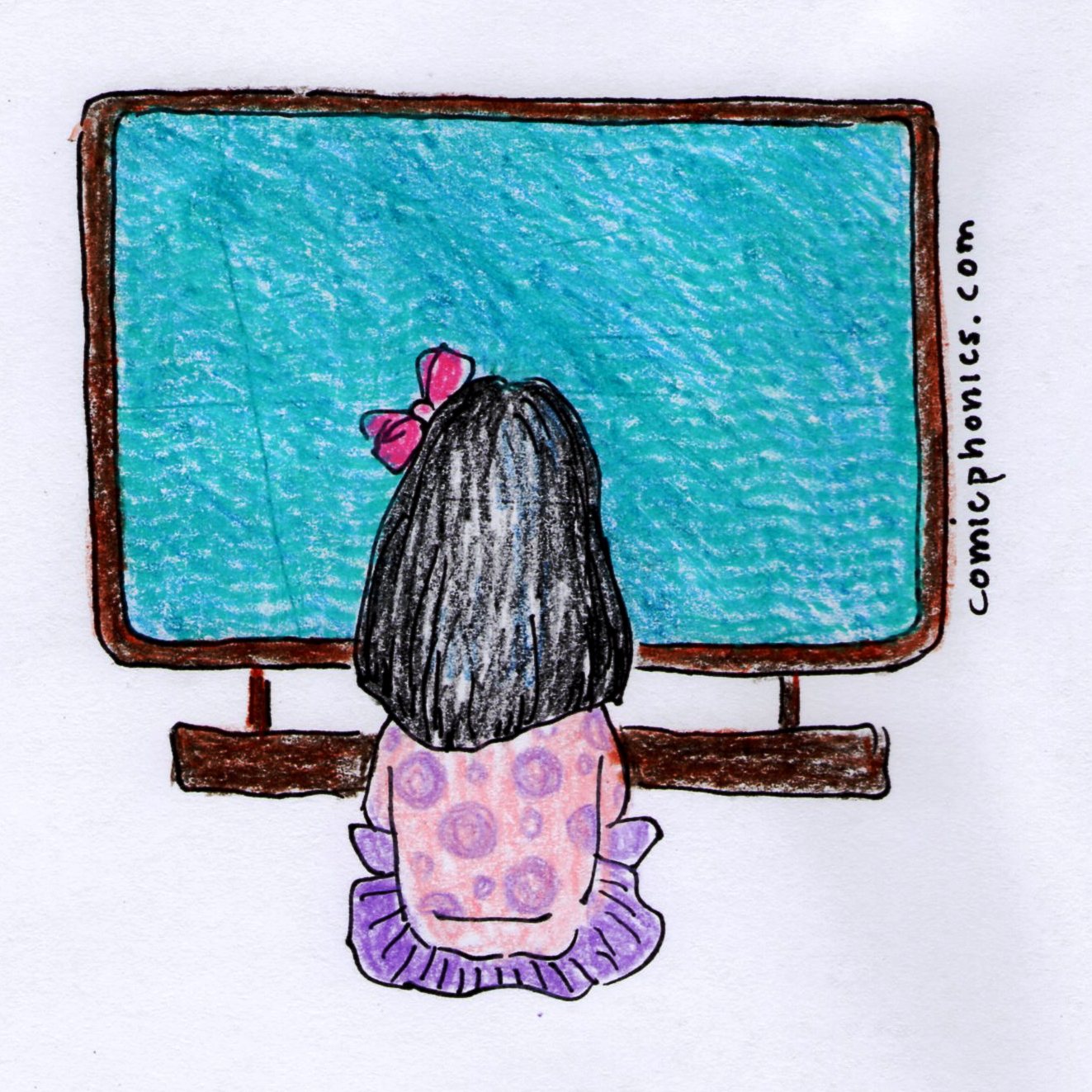
Child sitting in front of a large screen tv.

  • Kids two to five years old spend 32 hours a week—almost five hours a day—watching TV, DVD’s, DVR’s, videos, game consoles, tablets, and smart phones. Most of that time is spent watching live TV programs.
  • Toddlers 29 months old who spend two hours daily watching TV risk lower vocabulary and math skills, and by the time they go to kindergarten, have lower attention spans and are physically weaker.
  • Many homes (as many as 51%) report a TV on in the background most of the time. In such situations, children watch more TV and read less often than other kids. They are less likely to be able to read. One, two, and three-year-olds have shorter attention spans. Parents and children interact less frequently than in homes without constant TV. (the University of Michigan)
  • When the TV is on, adults speak 75 fewer words per hour compared to when the TV is off. Children speak 25 to 50% less when the TV is on. (the Seattle Children’s Hospital Research Institute)

What can you take away from this research?

  • The more time children watch TV, the less time they devote to reading, academic work, physical play and social interaction—all important for a healthy, well-rounded childhood.
  • The more time the TV is on, the less time adults talk to children, and the less time the children talk—all detrimental to healthy, developing children and especially to vocabulary building which is so important for learning to read.

What are high/low books?

High interest / low reading level books are books that appeal to children who are older than the reading level of the book.

High/low books in a way are a mismatch: the reading level is lower than the age of the child to whom the book appeals. A good example is the Fudge series by Judy Blume. The early books are written at a second grade level but appeal to third or fourth grade children because the narrator begins as a fourth grader and grows older in the series.

Too many words on a page make reading hard.These books appeal to children who are struggling to read. The stories are about kids their age doing activities they do. These books are also good for ESL students whose age might not align with their reading level in English, and for disabled children, including those with dyslexia, who are behind their peers in their reading level.

What makes these books different? They share many of these qualities:

  • Shorter, everyday vocabulary words with concrete meanings
  • Short sentences
  • Short paragraphs
  • Large margins
  • Unjustified right margins (margins that look ragged)
  • Larger type size (minimum 11 point) in clear fonts
  • Realistic characters who are the same age as the reader
  • Easily differentiated characters
  • A fast moving plot which is low on description
  • Compelling stories
  • Chronological order (no flashbacks)
  • One point of view, not two
  • Illustrations, photos, graphs and maps
  • Tight, concrete writing

Many lists of these books can be found online.

A long list can be found at http://www.schoolonwheels.org/pdfs/3328/Hi-Lo-Book-List.pdf. This list gives the reading level (RL) and the interest level (IL) plus a one sentence description of the book. All the books on this list are fiction.

Some small house book publishers are known for publishing books for reluctant readers who often happen to be high/low readers. At http://www.nbss.ie/sites/default/files/publications/READ_-_hilow_books.pdf you can find the books of several publishers which are geared to students older than their reading level suggests. These books are mostly appropriate for high schoolers.

At http://www.booktrust.org.uk/books/children/bookmark/booklists/141/ there is a list of 14 books for various age levels written below age level.

http://specialeducation.answers.com/english-and-math/10-high-interest-low-reading-level-books-for-teens-with-reading-difficulties gives information about ten books, some nonfiction, which are written at low reading levels but which would still appeal to kids in their teens.

The largest teachers’ union in Britain has a listing of book publishers and book series appropriate for high/low readers. Go to http://www.teachers.org.uk/node/12418 .

Seven publishers of high/low books are listed at http://www.writing-world.com/children/foster03.shtml. Included are hyperlinks to those publishers. –Mrs. K


Is a child’s vocabulary destiny?

Consider this:

  • Three-year-old children from professional families already have bigger English vocabularies than parents in lowGirl is looking at a list of words she can read.-income families.
  • Children from professional families hear 300 more spoken English words in an hour than children of parents on welfare.
  • By the time children are four-years-old, children of professional parents will have heard 32 million more words than children from poor families.

What does this research by Betty Hart and Todd R. Risley (1980’s and 1990’s) mean?  Combined with more recent research that shows that vocabulary acquisition is the single greatest predictor of reading success, it means that children of professional parents are far ahead of children from low income families as they start preschool.  Other studies show that as a child moves through school, this vocabulary gap increases, directly correlating to a child’s achievement in reading comprehension.

So what can you do with your preschooler, primary grade child, or ESL learnerto increase his vocabulary?  Quite a bit.

A young girl uses the word odiferous to describe a stinky diaper.

  • Use “big” words when you talk to your child.  Provide a rich vocabulary for your child to hear.  “Baby” words are no easier to learn than adult words, so use adult vocabulary with your child.  For example, when I was a child, my father used to come home from work and ask us children, “Is everything copacetic?”  Of course, we didn’t know what he meant, but he explained, and within a short time we were asking one another the same thing.
  • Define new words when you know your child doesn’t understand.  Give an example you can refer to again and again.  Try to give an image to keep in mind if you can.  “Shutters are those door-like things on the sides of house windows, remember?”
  • Choose new words that sound somewhat similar to words the child already knows.  For example, a child knows what a computer is, but “compute” would probably be a new word.  Make the connection to how the computer can add up numbers quickly to help the child remember what compute means.
  • Encourage your child to ask you what a word means.  Don’t laugh at him because he doesn’t know.  We all learn by asking questions, so questioning is a great skill to help your child to develop.
  • Repeat new words often until the child understands.  One or two times is not usually enough.  Try six or ten uses of the word in a few days to cement the word into the child’s memory.
  • Read, read, read to children to expose them to new words.  Nursery rhymes contain old-fashioned words the child might not know.  Emails from Grandma might too.  Read from a variety of genres, but pick topics of interest to the child, so she will pay attention.  Choose books that stretch the child’s vocabulary with new words in context, but not too many.
  • When you are reading to your child, and you come to a new word, read it in context, and then ask the child what she thinks it means.  Try to find something right in her answer, even if it’s, “Well, that was a thoughtful explanation.  Well done.  Now let me explain what the word really means.”
  • Read the same book to a child several times, helping the child to conquer the words in context.  If there are many new words, don’t discuss each one.  Pick a few so the child focuses on enjoying the book.
  • Set yourself a goal of a word a day for a preschooler.  Keep a list on the refrigerator to remind you to use past words again to help with retention.  Let the child see the list growing.  As we measure the height of our children, they feel pride.  As we measure their learning, they will bask in that success, too.

How about you?  Have you come up with any ideas to help improve your child’s vocabulary?  Share your ideas by commenting on this blog.