Category Archives: vocabulary

How to overcome inference problems

If you know a child has trouble with inference (reading between the lines to come up with an idea which has not been stated but which the reader should know is true), here are some ideas to help.

child questions Rapunzel's actions

  • Go online and search for reading selections with inference questions. Make sure they are the right grade level or age for your child. Ask the child to read the selections aloud and then answer the inference questions provided. Help the child to make connections.
  • Expose your child to various times, places and cultures. Fill in the gaps in his knowledge. Together  read books or watch a TV show or go to a baseball game. Ask your child what seemed strange or unusual, and what reminded him of his own life.  ESL students need to know more about American culture to understand inferences and English language idioms.
  • Model inference-making as you read aloud to your child. “You know what I think will happen next? I think blah, blah, blah. What do you think?” Or, “Cinderella’s stepsisters are so mean. I bet something bad happens to them because they are so mean. What do you think?”
  • Expand your child’s vocabulary. If you encounter a new word or two while reading, explain the word. Use it later that day and the next day. Offer the child a reward—a high five—if he can use the word properly. Don’t baby his vocabulary. Use real words and real grammar. Let your child overhear you using an adult vocabulary, and explain a word if he looks perplexed.  Don’t wait for him to ask.
  • While reading, stop and ask about pronouns. “Who is the ‘he’ in this sentence? What does ‘it’ mean in this sentence? Problems with pronoun antecedents are common, so common that the SAT offers questions to see if high school students can figure them out.
  • Before your child starts to read a story, offer background information. Recently I was working with a sixth grader who was reading a Sherlock Holmes story. I asked who was telling the story. My student had not stopped to consider this, and when he did consider it, he didn’t know. I asked when the story took place? Again, he was clueless. Don’t assume. Provide helpful information to make a story or book clear.
  • When a student makes an inference connection, ask her how she knows. She might be guessing. Let her prove she has picked up the right clues.
Skipping long words can be a sign of a struggling reader. How can you help a child decode such words?

One way to help children decode big words is by familiarizing children with prefixes and suffixes. English is a language which creates new words from already existing words by adding a word part—usually a single syllable—before or after the original word. If the word part is added at the beginning of a word, the word part is called a prefix. If it is added after the word part, it is called a suffix.boy choosing right root for a prefix

Prefixes usually change the meaning of a word. Un + happy creates “unhappy,” whose meaning is the opposite of “happy.” Re + view creates “review” which means to view again. Suffixes usually change the part of speech of a word, the verb tense of a word or the number of a word. Music +al changes “music,” a noun, to “musical,” an adjective. Jump + ed changes the present tense verb, “jump” to the past tense verb, “jumped.” Girl + s changes the singular, “girl,” to the plural, “girls.”

If children can recognize that a long word has a prefix or a suffix or both, they can segment that word both for pronunciation and for meaning. “Unwinding” can become un + wind + ing. “Un” means not, “wind” means coil and “ing” makes the word an action.

Children should be taught prefixes and suffixes as a separate part of reading instruction. I would start with prefixes only. One way to do this is to make a game of combining prefixes with words, sometimes called roots. (I like to use materials the child can touch, but of course, this work can be done on computer using sites such as ixl.com.) Here’s how:

  • Find a list of commonly used prefixes. Many web sites list about one hundred such prefixes, but I would start with a shorter list of ten or twelve of the most commonly used ones, such as bi (two), dis (the opposite), il (not), im (not) in (not), mis (badly), non (not), pre (before), re (again), sub (under) and un (not).
  • Teach the child what each prefix means, giving her a word to help her remember each one, such as bicycle, disagree, illogical, improper, indirect, mispronounce, nonfat, prepay, resend, submarine, and unhappy.
  • When she knows the meaning of the prefixes, write each prefix on an index card. Write two or three familiar words which could be paired with each prefix. Shuffle both sets of cards separately. Match each prefix with a word which makes sense, and ask the child to read the word and tell what it means.
  • Or, you could choose two root words, one of which can be paired with a given prefix, and help the child determine which root works and why.
  • Later, you could create a list of the words she has created. See if she can segment the words and tell what they mean. If she can’t do some of them, repeat the activity until she can. Gradually remove the words and prefixes she knows and add new prefixes and words until she knows several dozen prefixes.

In a future blog we’ll talk about how to figure out suffixes.  Suffixes are trickier because they sometimes involve changes in spelling the original word.

What does sentence difficulty mean? I’ve read that Lexile scores predict the difficulty of a reading passage based on two things: word difficulty and sentence difficulty.

The number of words per sentence can be a measure of sentence difficulty. Sentences written for beginning readers usually contain a handful of words while sentences written for more proficient readers contain one, two or even three dozen words.

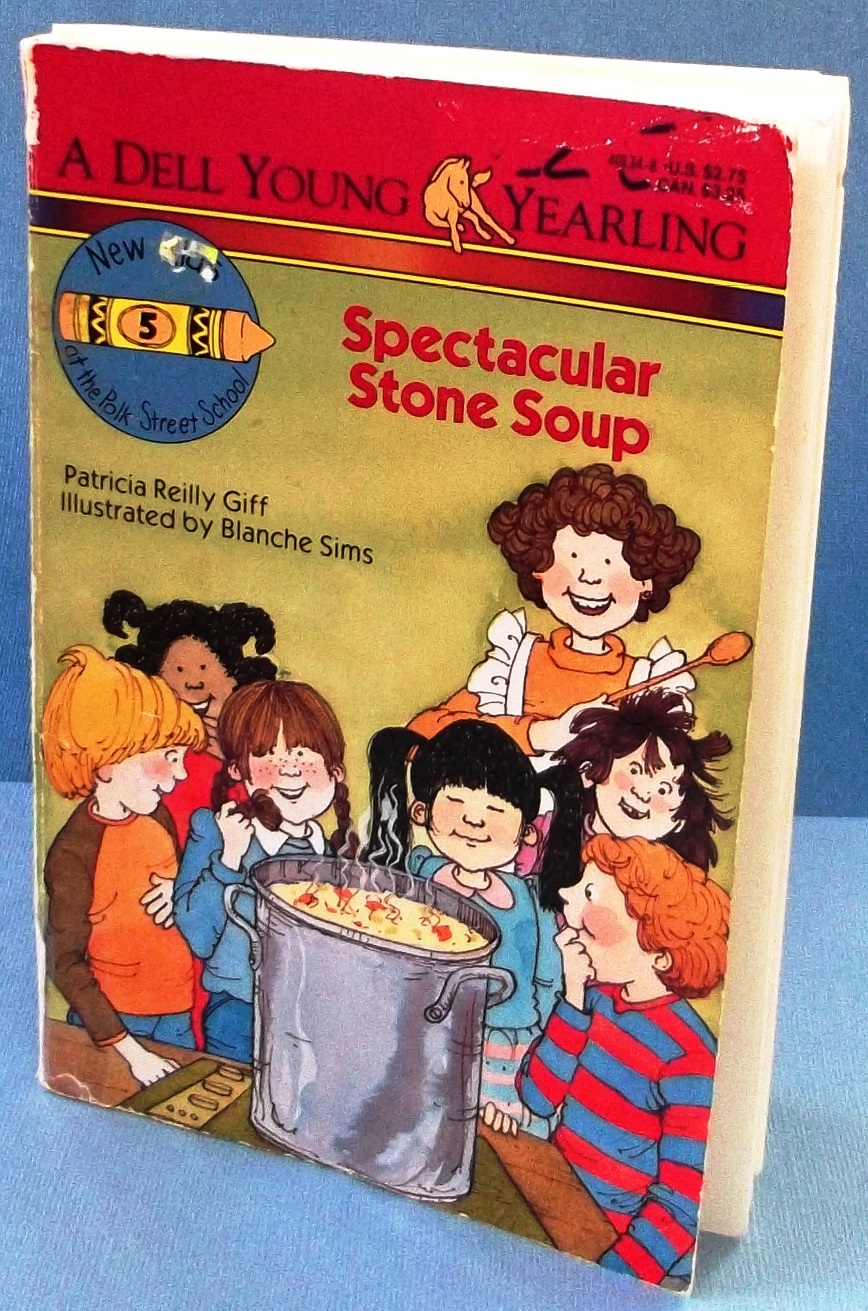
Stone Soup book cover• For example, take the first page of Spectacular Stone Soup, a novel often read in first grade. Here are the first page’s sentences and the number of words in each sentence:

Stacy Arrow hung her jacket on a hook. (8 words) Next to her Jiwon took off her coat. (8 words) Stacy pointed to a sweater on the floor. (8 words) “Whose is that?” (3 words) “No one’s.” (2 words) Jiwon shook her head. (4 words) “It’s been here all year.” (5 words)

• Now compare that novel for beginning readers to a novel for more advanced readers, Harry Potter and the Deathly Hallows.  Here are its first paragraph of two sentences:

Harry Potter book coverThe two men appeared out of nowhere, a few yards apart in the narrow, moonlit lane. (16 words) For a second they stood quite still, wands directed at each other’s chests; then, recognizing each other, they stowed their wands beneath their cloaks and started walking briskly in the same direction. (32 words)

The type of sentence (simple, compound or complex) can be another measure of reading difficulty.

• In the Spectacular Stone Soup selection, each sentence is a simple sentence with one subject and one verb. Some of the sentences have a prepositional phrase; some have adjectives; some have pronouns, but because of the short length of the sentences and the way each sentence limits itself to one idea, comprehension is easy.

• In the Harry Potter selection, the first sentence is a simple sentence but there are two prepositional phrases and an adverb phrase. The second sentence is a complicated compound sentence. Its first clause begins with a prepositional phrase followed by a subject, verb and two adverbs, followed by a noun phrase and a prepositional phrase. Its second clause (after the semicolon) begins with a participle phrase and a subject, but then begins one predicate with a verb, direct object and prepositional phrase and then begins another predicate with a verb, gerund, adverb and prepositional phrase.  Each sentence contains more than one idea.

Word order can be a measure of difficulty.

• In Spectacular Stone Soup, all but one sentence begin with a subject followed by a verb, the usual word order in English. The exception is a sentence which begins with an easy prepositional phrase.

• In the Harry Potter selection, the first sentence begins with a subject and a verb. The second sentence begins with a prepositional phrase, but the second clause in that sentence begins with a participle phrase.

Pronoun antecedents can be a measure of difficulty.

• The Spectacular Stone Soup selection uses the word “it” to refer back to the sweater used two sentences earlier.  It also uses the word “her” to refer back to each girl, but that pronoun is stated in the same sentence as its noun antecedent.

• The Harry Potter selection in the second sentence uses several pronouns (they, their, other’s) to refer back to the noun (men) used at the beginning of the first sentence.  The pronouns are father apart from their noun antecedent.

Parts of speech used can be a measure of difficulty.

• In Spectacular Stone Soup, the words are nouns, verbs, articles, adjectives, adverbs, pronouns and prepositions. Most are one syllable words but a few are two syllables.

• The Harry Potter selection includes the same types of words, but additionally uses a participle used as an adjective and as a gerund. The passage contains a three- and a four-syllable word.

Coupled with word difficulty, sentence difficulty can make reading passages easy or hard to understand. Authors consider their audiences and their reading abilities carefully before deciding how long to make sentences, whether to make sentences quite simple or complicated, whether to use pronouns or to repeat nouns and whether to write sentences in typical subject-verb word order.

As we mature we want more complicated vocabulary and sentence structure to entertain us. In fiction the story comes first, but how much we enjoy the story depends on the crafting of the sentences by the author. In nonfiction, the facts come first, but again, how willing we are to read those facts depends on the skill of the author in using the components of language, including sentence structure.

When my first grader reads aloud he plows right through periods as if they don’t exist. When I ask him about what he just read, he has only a vague idea. How do I help him?

It sounds like your son might be having a fluency problem. Fluency is one of the four components of reading and involves three skills:

  • Accuracy—decoding the words to pronounce each one correctly.
  • Speed—reading at a pace which is fast enough to connect words into ideas.
  • Prosody—reading with expression so that the words and sentences sound meaningful.

Assuring he can pronounce most written words properly is the first step. Since you don’t mention pronunciation problems, I assume he can decode just fine.

dhild running with book in handsSpeed is the next consideration. Is he reading at a normal reading pace—not too slowly because he is stumbling over pronunciation, and not too fast because he is racing? From your question, I assume he might be racing and jumbling too many words together to understand them. Insist that he stop at a comma and a period, and if he forgets, stop him and ask him to reread the sentence. Then ask him what it means.

Lastly, listen for the way he reads. Does he raise his voice at the end of a question? Does he change the tone of his voice when the big bad wolf is talking? Does he say some words louder and some words softer to show he understands the meaning behind the words? If he is not doing this, he will have a more difficult time figuring out the meaning because he is leaving out emotion.

One key for you to know that your child is comprehending what he is reading is his use of inflection, that is, altering his voice in tone or pitch. Children who plow through sentences don’t inflect. They are reading too fast to decode and to inflect at the same time.

When a child first learns to read, accuracy is most important. But it sounds like your child is beyond this stage of decoding, at least with the kind of books he is reading.

How can you help him?

  • Make sure your child is reading books just slightly beyond his level of reading, not books too advanced for him.  Does he understand the vocabulary he is reading?  Does he understand the topics?  If not, comprehension will go down.
  • Consider reading aloud to him more, modeling inflection. Just because he can read alone is no reason why you should stop reading aloud to him. He still has so much more to learn about reading—vocabulary, for example, and making conversation sound real.
  • Is he allowed to stop reading when he has finished a certain number of pages? If so, he might be racing in order to end his reading session early. Change your strategy.  Ask him to read a certain amount of time no matter how many pages he reads.
  • Let him know he is going to need to explain what he has read when he is done, and if he can’t explain it, he is going to need to reread it with you. Needing to explain or redo will force him to slow down.

Another possibility is that your child is a high functioning autistic person.  People with autism can have high intelligence, but emotions baffle them.  Because they cannot “decode” emotions in their everyday lives, they cannot “decode” emotions in books, so stopping for punctuation might add no meaning to what they read.  If your child is autistic, early intervention can help.  Contact your school counselor or your pediatrician for an evaluation.

But from what you have said, I suspect your son is in a hurry and needs to learn that speed reading without understanding is a waste of his time.

My kindergartener wants to read chapter books. What features should I be looking for so she doesn’t get discouraged?

Congratulations! Some early readers are ready for chapter books, but that doesn’t mean all chapter books are right for them. Here’s what you should be looking for.

  • Characters whom the child relates to and cares about are really important. That means child characters, ones the same age or just a bit older than the reader, or characters who behave in child-like ways, such as Toad in the Frog and Toad series. The characters in books for young readers must be encountering situations that the reader can relate to—like Junie B. Jones fearing to take the school bus, or of Nate the Great visiting his friends’ houses in search of a lost cat.
  • girl reading Junie B. JonesCharacters should be different from one another—their names, gender, and personalities. Junie B.’s friend, Lucille, is prissy and wears pretty dresses while her classmate, May, is a tattletale. Frog’s friend, Toad is a short, brown scared follower while Frog is a taller, green, organized leader.
  • If the chapter book is part of a series, familiar characters or activities should appear. Children delight in recognizing these patterns. They know that when reading Nate the Great stories, for example, Nate always takes a break to eat pancakes. His friend, Rosamond, always appears with her four black cats. Nate’s dog, Sludge, helps him solve crimes, while another dog, Fang, always makes an appearance.
  • Asian girl reading book Plots should be straightforward with no flashbacks or complicated subplots. If the story concerns finding one of Rosamond’s cats, then that becomes the whole focus of the story. Good books remind children what they have learned. A character like Nate might think about the clues he’s uncovered, and a list of them might appear as an illustration. The plots are shallow and move quickly through a series of events.
  • Good chapter books for young readers should contain illustrations. A page of text will appear harder to read than a page with a line drawing on it. The drawings should provide additional information that the text might not dwell on. For example, drawings of Junie B. show her with fly-away hair and one sock up, one sock down, telling us in pictures about her personality. Illustrations don’t need to appear on every page, but more illustrations make the book appear easier to read.  Also, illustrations lengthen the number of pages, so the child thinks she is reading more than she actually is.
  • girl looking at book displayPicture books are printed with large type, but chapter books have reduced size type. To offset this change, good chapter books for young readers will increase the space between the lines of type and increase white space by making margins larger. This makes the text easier to read and the page “friendlier.” Good children’s books use dialog too. Dialog is usually short, so more white space surrounds it. Hyphenations will not be used at the ends of lines to split words, and sentences will end on the bottom of a page rather than being carried forward to the next page.
  • Discouraged child thinks there are too many words in a book she is readingThe vocabulary of chapter books for young readers should be easy enough to read so that the child can read for enjoyment, without help. New words can be introduced, but in context, and should be repeated during the story so the child can master them.
  • Sentence structure should be normal, that is, subjects followed by predicates. When complex sentences are used, the dependent clause should come second. That is the way children speak and write, so that pattern will be easy to understand. Sentences should be shorter than adults would expect. Not all sentences need to be short, but longer sentences should make sense on the first read through.

Right now I am working with a second grader who is reading his first chapter book, Charlotte’s Web. It was assigned by his teacher. Some of the characters’ names are similar (Avery, and Mr. Arable, for example). The vocabulary is advanced. The pig is called “radiant”; he is put into a “crate”; he is watched by “goslings.” For a suburban child, these words are mysterious. The sentence structure is too sophisticated. Even though Charlotte’s Web is an excellent novel, it is not an appropriate first chapter book for my student. He is not ready to read it without help.

In my public library, chapter books for elementary school aged students are grouped together. Within those books, some are labeled on the spine, “First chap.” Those books are perfect for children reading their first chapter books. Or if you are lucky enough to have a children’s librarian, ask her what books she would suggest. Or phone or visit your school librarian and ask her for help.

Hundreds of wonderful books are appropriate for your kindergartener. Good luck!

Reading to kids is important to expand their vocabularies

We all know that reading to kids is important. Now there is more research to back up this “chicken soup for the brain” of little kids.

family reading togetherAccording to Jessica L. Montag, a researcher in the Department of Psychology of the University of California, Riverside, and her colleagues, Michael N. Jones and Linda B. Smith, reading, as opposed to talking to children, is important because reading exposes children to many more new words than they would hear from spoken language alone.

Montag took 100 picture books which appear on lists of excellent books for children. She analyzed the words in those books. Then she compared the words with spoken language of caregivers talking to little children. Her research was published in August.

What she found is that the books use more words and different kinds of words than do parents, teachers and caregivers of young children. In fact, the books use 70% more unique words than did the speech. Also, the text provides different types of sentences, sentences of varying complexity, and sentences of different lengths. The books introduce topics outside the parents’ and children’s normal lives, exposing children to new ideas and the vocabulary associated with those new ideas.

So if you’re tempted to skip the reading some days, or to just look at the pictures, think again. The text is important to growing a child’s vocabulary, and a large vocabulary is associated with successful independent reading.

One way to learn English vocabulary: Study Latin and Greek roots

When I was in high school, studying Latin, I experienced one of those “light bulb” moments when I discovered that many of the words I used every day in English came from Latin. And I realized that if I could learn Latin words, I could increase my English vocabulary exponentially!

child looking at a unicycle, bicycle and tricycle

Even young children can increase their vocabularies if they learn Latin and Greek roots. For example, suppose a child plays the game “Uno.” The child learns quickly that “uno” means one. But so do many words that begin with uni. Uniform means one kind of clothes worn every day. Unite means everybody becomes one big group. Universe means one huge collection of stars and planets. Unicycle means a bicycle with one wheel.

Teaching children new vocabulary words using Latin roots has many advantages.

  • Many ESL children who come from Latino backgrounds already are familiar with many Latin roots and the meanings of the roots because the roots and meanings are the same or similar in Spanish, Portuguese and Italian. Connections to new English words are already a part of their vocabularies.
  • Instead of children learning isolated words which bear no relationship to one another, children can learn word families which are connected by a single idea. For example, “ped” in Latin means foot. Pedal, pedestrian, and pedicure all have meanings related to feet.
  • Children can combine two roots to understand some English words which don’t need to be studied separately. For example, bicycle comes from “bi” which means two and “cyclus” which means circle.
  • Certain areas of study, such as biology and mathematics, use Latin or Greek roots for basic vocabulary. Children who are fascinated by dinosaurs can look at pictures of many different kinds and notice that many names contain the root “–saurus” which means “terrible lizard.” Others have names with the root “pod” which means foot or feet.

One way to begin learning vocabulary from Latin and Greek roots is to have children study the words for numbers, from which there are so many derivations.  Duo, meaning two, has led to duet, duel, and duplicate.  Tres, meaning three, has led to triple, tricycle and triangle.  Quator, meaning four, has led to quarter, quart, and quatrain.

Online you can find many Latin and Greek root vocabulary-building websites as well as workbooks devoted to teaching vocabulary through roots. I am mystified why this way of approaching vocabulary is not used more often. I considered it a short cut way to study for the SAT!

Teach children to predict, an important reading skill

Predicting means anticipating ahead of time what might happen in a story. As adults, we do it all the time. We read a murder mystery and we predict “who done it.” We read a romance and predict how the couple will get together. We read a thriller and predict if the characters will escape.

Predicting is more than making a guess. It is using what we already know and applying it to a new situation. When children predict, they make a connection between what they know and what they don’t know yet. They increase the likelihood that they will comprehend what they read. Wild guesses are not predictions.

Predicting from what we know to what we don't know graphic

Predicting focuses little children on what they are about to read. By looking at pictures, titles, subtitles, charts, photos, cartoons and other graphics, they grasp an idea about a story. Predicting attracts the child to a story. She wants to know if her prediction is correct. Predicting forces children to use visual or word clues to create meaning.

The Common Core State Standards include predicting in the reading standards.

However, predicting does not come naturally to all children. Children with dyslexia might be able to predict in a real life situation when there is no reading involved, but because they struggle deciphering the phonics code, they lose track of the meaning. Some children with dyslexia also have trouble sequencing. If so, predicting what will happen next is difficult.

Autistic children may also have trouble predicting since they have trouble interpreting social clues. The text might say that a character froze and was unable to talk, but the child might not know that the character is scared. How then can he predict what will happen next?

Here is a method of predicting that can be used with children of all ages. It combines vocabulary with predicting.

  • Go through a picture book or reading selection before the student reads it. Write down a dozen or more vocabulary words important to understanding the meaning of the text. Choose words which the child is likely to already know plus one or two new words.
  •  Write or type the words clearly on a paper, and then cut apart the words. Have one set of words for each pair of children if children are working in pairs. Put the words in plastic sandwich bags.
  • Explain to the child that he will be predicting what a story is about. He will be acting like a detective by using word clues.
  • Let the child pull out one word from the bag, read it aloud it and tell you what it means. If the child can’t read yet, tell him what the word says. If he doesn’t know the meaning, explain it to him. Lay the word on the desk or table in front of the child.
  •  Ask him what he thinks the story will be about based on that one word. Accept his answer.
  • Let the child pull a second word, repeating the previous two steps. Continue until all the words are read aloud. Encourage the child to change his mind about the prediction, or to become more convinced with each word.
  • Now ask the child to sort the words into categories or groups. (This step might be too advanced for some preschoolers.) Again, ask what he thinks the text might be about. Accept all answers, but gently steer the child into a prediction related to the text.
  • Now read the text. As you or the child read, note words the child pulled from the bag. Ask if the child still thinks his prediction is correct, or if he has changed his mind.
  • When the reading selection is complete, remind the child of his prediction and ask if he was correct.  Look at the words again.  Talk about what words helped and what words didn’t.  Ask what other words might have made the prediction closer to the truth.

Is the Common Core’s emphasis on nonfiction reading justified?

Perhaps the biggest change the Common Core is bringing to public school reading in the US is its emphasis on reading more nonfiction and less fiction. The reasoning behind this change is to prepare students better for the reading they need to do in their math, science and social studies classes and in their future careers, especially in STEM fields (science, technology, engineering and math).

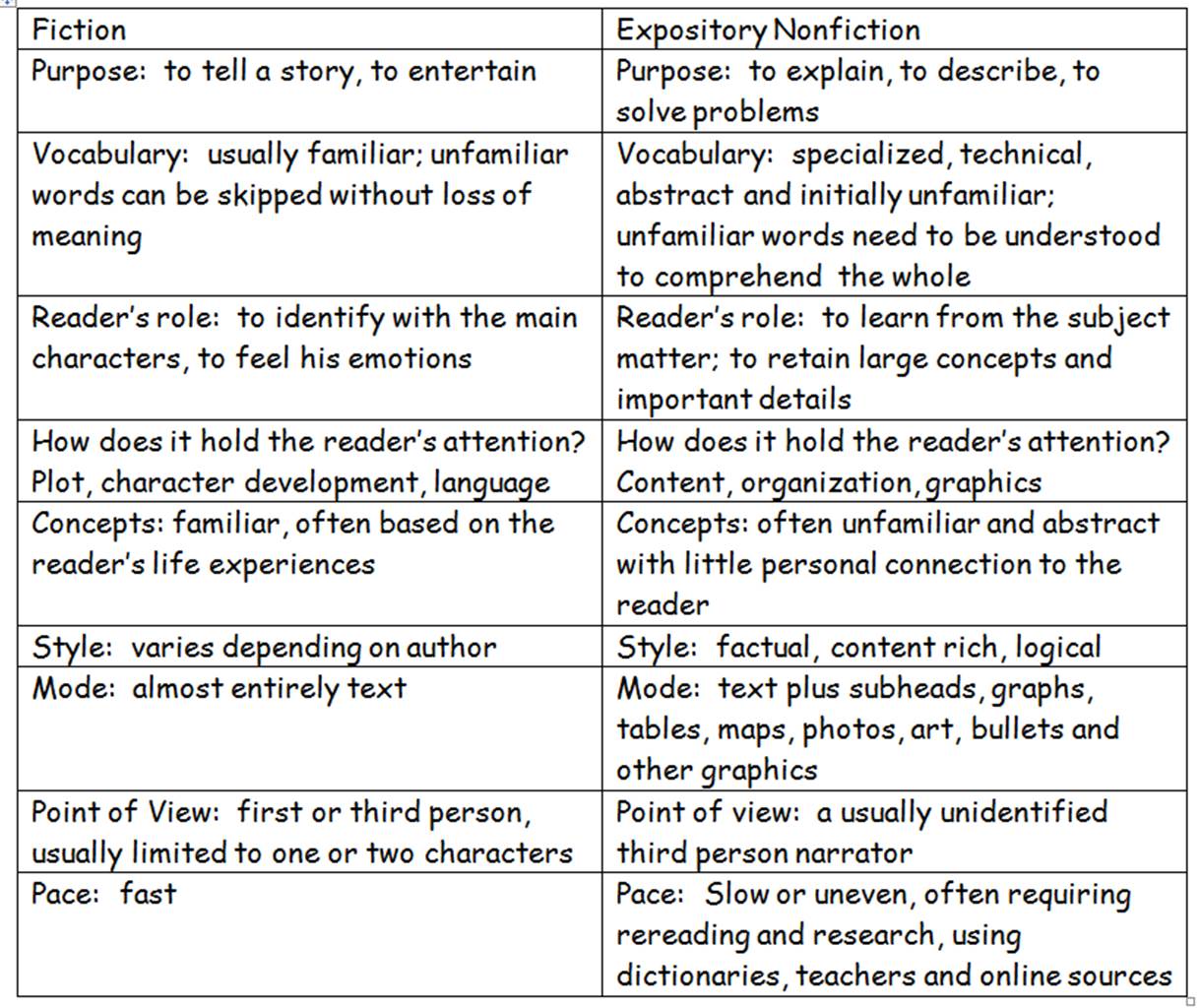
Is the change really necessary? Let’s compare fiction reading and nonfiction reading for students who are beyond the picture book stage.

chart comparing fiction reading skills with nonfiction reading skills

(Adapted from State of Wisconsin, Wisconsin Governor’s Literacy Education and Reading Network Source)

As you can see, reading nonfiction is harder than reading fiction. It often requires more parent or teacher involvement prior to the reading to make connections to what the student already knows; during the reading to explain vocabulary and concepts; and after the reading to restate the main ideas and important details or to explain complicated concepts.

Fiction, too, can be better understood with teacher involvement, but usually fiction can be appreciated (if to a lesser degree) by the student reading alone so long as the student’s reading level matches the reading selection.

If you hope your child will have a great career someday as a doctor or environmentalist or physics teacher, you can appreciate why an increased emphasis on nonfiction reading is important even in first grade. You may question the Common Core, but its emphasis on more nonfiction reading can only help our kids.

Help children determine shades of meaning

Shades of meaning can be difficult for some children to interpret. What’s the difference between “yell” and “holler” or “huge” and “enormous”?

Dr. Timothy Rasinski, a professor at Kent State University, has come up with a fun way for children to work on distinguishing between close meanings. Here’s what he suggests:

  • 3 images of a muscleman--skinny, with muscles, really builtGo to the paint store and select five paint chips which are slightly louder or softer than one another, or darker or lighter. For each student you are working with, pick several sets of these color chips. The colors themselves don’t matter, but they should show incremental differences in color.
  • Offer the student three to five words  to distinguish among, such as whisper, state, exclaim, yell, and murmur. Give younger children fewer choices.
  • Let the child choose the word with the weakest word meaning.  Ask the child to write that word on the weakest color chip. Then let the child choose the strongest word meaning and write that word on the strongest color chip. Let the child arrange the other words in order on the other chips.
  • Have the child lay the cards on a table from weakest to strongest or vice versa. Let the child discuss why he chose the order he did.
  • For really young children who cannot read yet, pictures can be used instead of words for some ideas.

What kinds of word choices work well for this exercise? I would use verbs, nouns or adjectives that are similar. Go to a thesaurus to find near synonyms such as must, ought to, should; ignore, neglect, let slide; tuba, trumpet, trombone, flute, whistle.

Provide words from varied disciplines: square, rhombus, quadrilateral, rectangle; knoll, mountain, peak, ridge, hill; quiet, silent, still, peaceful, hushed; business person, entrepreneur, magnate, tycoon, merchant; eagle, hummingbird, dove, raven, peacock.

Many times students will disagree on the ordering. What is important is not the choices they decide on, but the thinking they use to make their choices. If you have an urge to say, “No, this one should come before that one,” let the child explain his thinking, and as long as it makes sense, accept it. This is a game in which the process is more important than the end result.