Category Archives: reading strategies

Is the Common Core’s emphasis on nonfiction reading justified?

Perhaps the biggest change the Common Core is bringing to public school reading in the US is its emphasis on reading more nonfiction and less fiction. The reasoning behind this change is to prepare students better for the reading they need to do in their math, science and social studies classes and in their future careers, especially in STEM fields (science, technology, engineering and math).

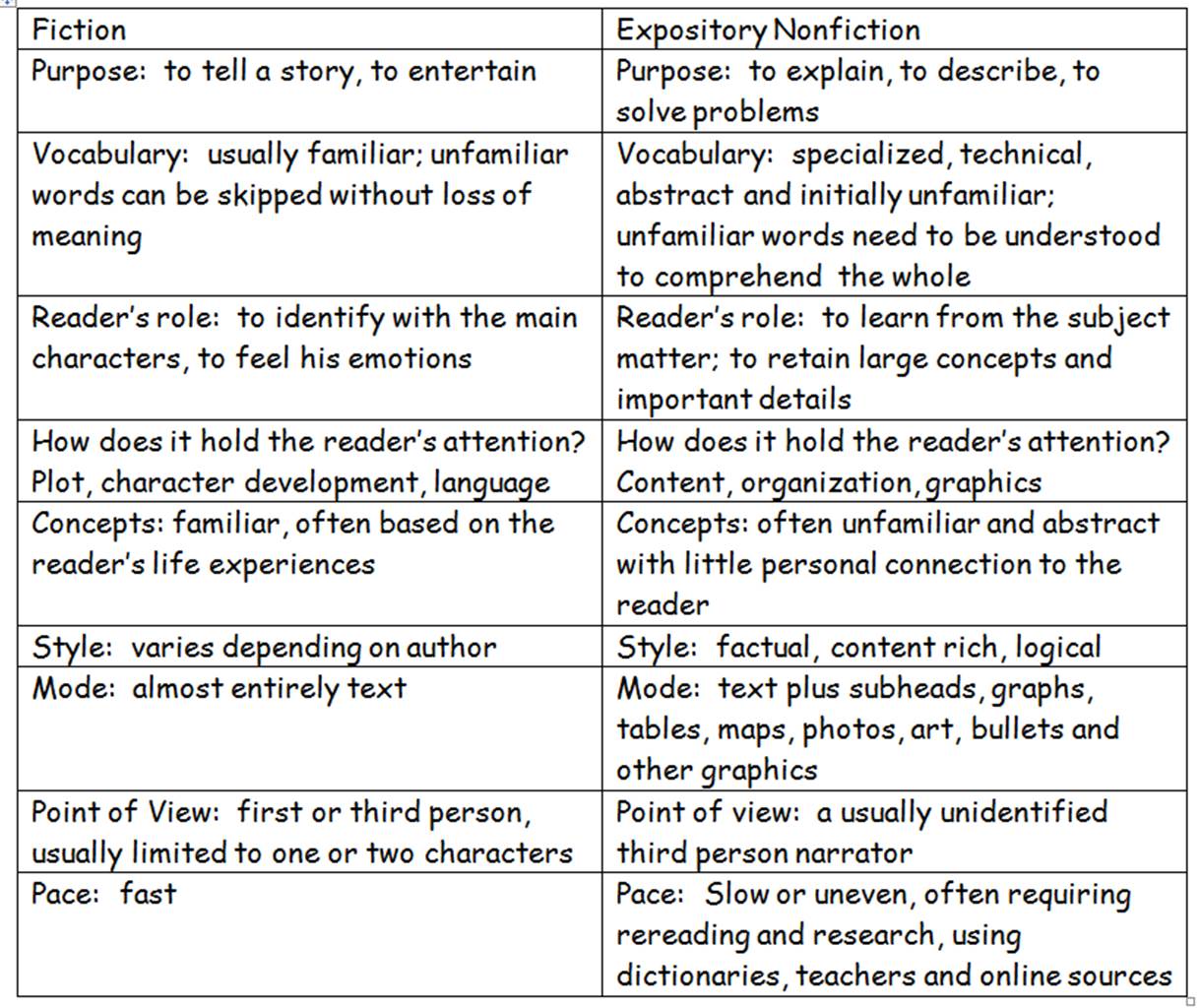
Is the change really necessary? Let’s compare fiction reading and nonfiction reading for students who are beyond the picture book stage.

chart comparing fiction reading skills with nonfiction reading skills

(Adapted from State of Wisconsin, Wisconsin Governor’s Literacy Education and Reading Network Source)

As you can see, reading nonfiction is harder than reading fiction. It often requires more parent or teacher involvement prior to the reading to make connections to what the student already knows; during the reading to explain vocabulary and concepts; and after the reading to restate the main ideas and important details or to explain complicated concepts.

Fiction, too, can be better understood with teacher involvement, but usually fiction can be appreciated (if to a lesser degree) by the student reading alone so long as the student’s reading level matches the reading selection.

If you hope your child will have a great career someday as a doctor or environmentalist or physics teacher, you can appreciate why an increased emphasis on nonfiction reading is important even in first grade. You may question the Common Core, but its emphasis on more nonfiction reading can only help our kids.

What’s choral reading?

Choral reading is reading aloud as a group, much like a choir reads the words and sings them together aloud. It is commonly done in lower grades and in ESL classes for several reasons:group of students reading together from a single book

  • Children who are less skilled readers can listen to the more skilled readers beside them, and can model their reading after their classmates’ reading. In particular, less skilled readers can hear fluency (emphasis of certain words or syllables, pauses for punctuation, speeding up and slowing down) which less skilled readers might read too slowly to use correctly.
  • Children who stumble over sight words can hear them pronounced and can say them aloud without drawing attention to themselves. ESL students can hear correct inflections and can practice copying them.
  • Less skilled readers can practice aloud with anonymity, their mistakes or hesitancies masked by the reading of the larger group.
  • Children who are poky readers, who stumble while trying to decode words, will gain comprehension which they sometimes miss.
  • Choral reading is fun for children.

Certain kinds of books or readings work well for choral reading.

  • If a book has a rhyme pattern, or a predictable rhythm, it can be a good choice. A poem or nursery rhyme makes a good choral reading selection.
  • If the book is short, so that it can be repeated several times in a few minutes, it can be a good choice.
  • If the book is at the reading level of the less skilled students, it can be a good choice.
  • If less skilled readers are familiar with the rhyme or story, it can be a good choice.

Working one-on-one with a student, the parent and student can read aloud together from the same page. If the choral reading happens in a classroom, each student should have a copy of the text or be able to see a Big Book which everyone can use. Usually the adult reads first while the students follow along, pointing their fingers at the spoken words. Then the student joins in. The student might feel more comfortable if the adult reads with gusto, drowning out the mistakes of the beginning reader. As the selection is reread, the adult can read less loudly, allowing the child’s voice to be heard. Rereading the selection several times over several days is a good way to help the less skilled reader to remember the words or to figure them out quickly.

Case study: Julie, a seven-year-old, high-achieving reader

Julie had just turned four when I began to tutor her in reading. Her mother, a native of China, had been taking Julie to a tutoring agency since she was barely three. The mother worked with her daughter daily on the reading lessons which Julie brought home.

Child looking at flash cards of two and three letter words.

.

When I met Julie, she could read many one-syllable words and some two syllable words. However, I noticed that when confronted with a new word, she could not figure it out. She had memorized the look of the words she knew but she had not learned phonics skills to sound out new words.

We began by reviewing ABC names and consonant sounds, almost all of which Julie knew. Then we spent many lessons on vowel sounds, focusing on short vowels first, and later mixing both short and long vowel sounds. We did this using pictures (pig, hat, run) which Julie would match with cards labeled ā ē ī ō ū and ă ĕ ĭ ŏ ŭ. We would spend about ten minutes of a lesson on this kind of work. Julie’s attention span was about ten to twelve minutes, so this was one of several activities in a single, hour-long lesson.

Tutor teaching a child.

When she mastered the vowel sounds using pictures, we worked on forming three-letter words using short vowels. At first I moved letter tiles around to form words, and with time, Julie made her own combinations and tested me to see if I knew what words she had formed.

Next, I added blends to short vowel words, first at the beginnings of words, and later at the ends of words. She found the beginning blends easier than the ending blends, as most children do. I made index cards with blend words on them, and when Julie would read a word on a card correctly, she would use a date stamp to mark the card—a way to make the learning fun. After a few weeks she mastered the blend words.

Late in our first year together, Julie began work on long vowel words ending with a silent “e.” She knew many of them by sight but not by sounding a word out. As our first year ended, we were working on long vowel single syllable words with double vowels such as “beat,” “fuel” and “rain.”

We were also building words using roots, prefixes and suffixes whose parts were written on little cards which Julie would push together to form words such as re-mix-ing and un-read-able. In the months which followed, when she encountered a long, unfamiliar word, she sometimes covered the prefix or suffix to figure out the middle part, and then constructed the word bit by bit as I had demonstrated.

Young girl reading a book

Julie could read many picture books. She enjoyed short paragraphs with colorful pictures on each page, but she would not try a chapter book. “Too many words,” she would say. She continued to go to the tutoring agency and do the reading homework with her mother, and to work with me once a week. When Julie was five, we began adding spelling and sentence writing to her lessons.

Julie is 7 now and has finished first grade. She is in the gifted program at her school. She reads voraciously, everything from Ranger Rick magazines to hundred-page chapter books. She has exhausted the phonics-like reading materials I have. She can read fourth or fifth grade materials as fluently as I can. She is working on expanding her vocabulary and on using more details in writing.

Julie is an example of the progress a child can make with a tutor or tutoring center augmenting school instruction. She is also an example of what studying during school breaks can do. She goes to school year round—nine months in her public school, and 12 months with tutors and her mother. Julie has a mother committed to Julie’s education, a mother who scours the library for appropriate books for Julie, subscribes to Ranger Rick, and oversees Julie’s homework and her piano practicing. She also teaches Julie how to write using Chinese pictographs.

For Julie, education is a way of life.

Julie—mischievous, hardworking and accomplished—could be your child’s classmate.

My daughter reads fast, but when I ask her to summarize, she can’t explain well. What do I do?

Occasionally a read-a-holic student will have lower than expected reading grades. The parent is baffled because the child always has a book in her hands and goes through novels voraciously. When I ask such a student to read aloud for me, she shows many of these behaviors:

dhild running with book in hands


  • She doesn’t slow down for commas or stop for periods.
  • Her sentences merge and keep going for as long as she can read without taking a breath, and when she pauses to breathe, it might be in the middle of a sentence.
  • She may skip a line of reading when moving from the end of one line to the beginning of the next.
  • When she comes to an unfamiliar vocabulary word, she bulldozes it, pronouncing it any which-way, and continues reading.
  • Her inflection is flat, like that of an auctioneer.
  • She does not self-monitor; she doesn’t pause to consider that she didn’t understand what she just read.
  • When she answers questions about the reading selection, she does not remember important details and she doesn’t take the time to search for them in the selection.
  • She misses inferences and more subtle figurative language like metaphors.When asked to restate the main idea in a sentence or two, she talks around the subject but doesn’t nail the point the author is making.

What’s going on?

For such a student, speed is the important value. Finish quickly. Move on. (Notice if she is slap-dash about her piano practicing, dressing or cleaning her room. This is a personality trait, not just a reading trait.) In reading, this behavior might develop as she reads novels of her choice. She doesn’t care if she understands every nuance; she would rather understand enough to enjoy the story without slowing down for details.

This kind of reading might work for leisure-time reading, but it doesn’t work for most school reading, especially the kind of reading being tested under the new Common Core Standards. Common Core is trying to break such bad habits by forcing a reader to name the paragraph in which the answer is found, to define a word, to distinguish between fact and opinion, to restate an idea, to infer and to summarize.

What to do to improve fluency and reading comprehension?

  • Ask your student to read aloud. She will fume because it takes longer to read aloud. But make her do it. Silently read along with her and note the kinds of errors  which she is making.
  • If she is ignoring punctuation, stop her and ask her to reread and pause appropriately. She will hate this, but making this one change is half the battle.
  • Ask her to use inflection now that she can hear the sentences correctly. Model it if necessary.
  • If she slides over longer words she doesn’t know, stop her immediately and ask her to sound out the word. If she can’t do it on her own, cover a prefix and a suffix; ask her what the root means, or if she knows another word with that root. Then reassemble the word and pronounce it.
  • Sometimes it is not the long words which stump students; it is the idioms or the secondary meanings of short, familiar words. Stop your student when she encounters such words to be sure she understands them.
  • If she skips lines of reading, have her use her finger to keep track, or an opaque book mark.
  • At the end of a paragraph or a few paragraphs, ask her to explain what she just read. If she has missed something significant, go back and show it to her and together figure out why she missed it.
  • Many times, ask what the main idea is. If she can’t nail it, have her reread while you point out clues to the overall meaning.
  • Model self-monitoring by stopping her now and then to take stock of what was read and what to expect next.  Let your student hear you talking to yourself about what you just read.
  • Lastly, let her read her leisure-time reading undisturbed, bad habits and all. You can only fight so many battles; let her win that one small skirmish.

I haven’t read to my child at bedtime. How do I start?

Dad reading to children in bedIf you haven’t been reading to your child at bedtime, but you want to establish that tradition in your family, here are some ways to begin.

You might gain your child’s approval by saying she is going to be allowed to stay up 15 minutes later every night while you read together.

You might let her choose the reading material. You needn’t read a book together. If she is into fashion, read a fashion magazine or newspaper. If he is into making things with his hands, read Popular Mechanics. The idea is to make the reading experience pleasurable for your child.

Help your child to vary the reading material. Go to the library together and poke into the nonfiction section about animals, stars, and history. Show her the biography section and read some names of famous people she might know a bit about. Let her choose so she has have a stake in the reading.

If electronic equipment will entice your child, use it. If comic books will entice your child, use them. If graphic novels will entice your child, use them.

Many children are ignorant of world news, but an evening read of a news story can make children aware of the wider world. With you there to interpret, the child can become more sophisticated.

If your child is reading too, and he is a reluctant reader, suggest that he read one page and you read another, or he read one paragraph and you read another. But at first you might want to do the reading yourself, to attract your child to the idea of bedtime reading. If he thinks he has to work, he will balk.

If you read a book for which there is a film, suggest that you watch it together after you finish the book. Heidi, Treasure Island, Tom Sawyer and so many more children’s books have been turned into films. You can discuss how the book and movie differ, and which she likes better.

If there is a special TV show one night or you are on vacation, you might suggest skipping the evening read for that special event. You might be surprised to see disappointment on your child’s face. If so, suggest that you could read, but just a bit later or during the baby’s nap. For the chance to cuddle up with Mom or Dad, most children will want to read.

Keep this time stress free. If your child is relaxed, she might raise questions about matters she is tossing around in her mind. Let that be her choice though.

Stick to the time you set—15 minutes, 20 minutes or whatever you decide on. If necessary, set a timer. The child must learn that this is a limited happy experience that she can look forward to again tomorrow evening.

Good luck!

Teach art literacy when sharing picture books

When children start to “read” picture books, generally they are reading the pictures; that is, they are trying to get meaning from the pictures since they can’t read the words yet.

They might study the appearance of a character, noting if it is a boy or girl from the clothes. Or they might look at the dark swirling clouds or the beaming sun to discover the atmosphere of the story. They might look at the colors the illustrator uses. Bright colors and pastels might indicate a happy or peaceful theme; dark colors or colors tinged with greys and blacks might indicate danger. Horizontal lines or smooth lines might indicate calm while jagged or diagonal lines might indicate action.

children looking at picture of Lincoln and Mrs. Lincoln

Some children perceive these clues without explicit instruction, but many children need someone to point out how colors, lines, and facial expressions tell the story too.

According to research by Kathleen Ellen O’Neil, illustrations can interact with the text in four different ways.

  • The art can reinforce the text, “showing” the text. For example, in “The Mitten,” adapted and illustrated by Jan Brett, a boy loses a mitten which his grandmother has just knit. One by one, we see animals from a tiny mole to an adult bear squeezing in to the mitten. The illustrations show the hedgehog’s quills and the badger’s nose poking through the wool.
  • The art can supplement the text, providing description which the text either skimps on or doesn’t describe at all. For example, also in “The Mitten,” we see the boy dressed in a Ukranian tunic, leather pants and boots with folk art borders. The book doesn’t mention where the setting is, but the art shows.
  • The art can provide far greater detail than the text, offering new insights which a literally-minded child might miss. It can illustrate nuances, inferences, humor and irony, adding depth to the text. In “The Mitten,” for example, the boy finds his mitten after the animals have left it behind, and he brings it home. The last page of the story shows the grandmother holding both mittens and noticing how much bigger one is than the other. No words are used, but we can hear her wondering, “How in the world?”
  • The art can convey a parallel story which either expands the text or contradicts it. Still in “The Mitten,” to the left side of almost every page we see the boy playing in the snow—hopping on a log where the rabbit lives, poking with a stick above the hedgehog’s burrow, looking in a tree’s knothole where the owl lives and climbing atop a woodpile where the fox lives. To the right side of those pages we see an animal leaving its disturbed home, and on the next page that animal squeezes into the mitten. Nothing in the text says that the boy disturbed the animals, forcing them to seek shelter elsewhere. A discerning youngster might notice it, but many children will need this part of the story explained.

For more information and other examples of books which clearly show the four different kinds of art interaction with text, go to the November 2011 issue of “The Reading Teacher,” page 214, for the article by Ms. O’Neil.

My child knows how to read pretty well for a first grader. Should I still read aloud to her?

Yes! Here’s why:

  • A child’s reading level doesn’t catch up with a child’s listening level until eighth grade, according to Jim Trelease, author of The Read-Aloud Handbook. A younger child can appreciate a book she cannot read yet—the plot, the descriptions, the characters and the vocabulary—if an adult reads it aloud to her.

    Father reading to child and child asks, 'How old is Old McDonald?"

    To enlarge, click on the picture.

  • Reading aloud to a child attracts him to reading by himself. He takes pleasure from being read to, and will want more of that pleasure even if an adult is not available to read to him. He will delight in life-long reading.
  • Books contain rich vocabulary, words more numerous than what we parents say on an everyday basis to our children. Children learn the vocabulary from the books we read aloud because we pronounce the words properly and because we explain them to our children. With such a rich vocabulary they are better prepared to understand their teachers and the reading they do on their own.
  • In books read aloud, children hear more sophisticated grammar than they read in grade-level books. Subconsciously they learn good grammar.
  • Good books contain the kind of values we want to pass on to our children. Reading these books aloud offers opportunities to discuss these values with our children.
  • Reading to fidgety children increases their attention span. It gives them practice sitting and listening which they need to do in school to succeed since so much school instruction is verbal.
  • Read-aloud time is bonding time. Do you remember in To Kill a Mockingbird how first grader, Scout, would sit on her father’s lap while he read legal papers aloud? She didn’t care what he read. It was their special time together.

Strategies good readers use

Suppose you need to read something new to you, something you find hard to understand. What would you do?Discouraged child thinks there are too many words in a book she is reading

  • Would you slow down?
  • Would you start over?
  • Would you look for help on the page, using headlines, boldfaced words, diagrams, photos or highlighted words explained in the margins?
  • Would you underline main ideas as you go along?
  • Would you mark unknown vocabulary words to look up later?
  • Would you look up those words now and write the words in the margins?
  • Would you realize you recognize a word but not the way it is used, and look up this other meaning?
  • Would you take away prefixes and suffixes to see if there is a root word you understand?
  • Would you draw a diagram, sketch, or chart to make sense of relationships?
  • Would you read the whole thing from beginning to end to get a gist of the passage, and then go back to figure out individual parts?
  • Would you write paragraph summaries in the margins or on post-it notes?
  • Would you ask for help from someone who might understand it?
  • Would you seek out an easier version (assuming one exists), read it, and then try reading the harder version again?
  • Would you try to explain what you read to someone else to see if you really understand it?
  • Would you monitor your own struggle, trying to figure out why the reading passage is hard for you?
  • Or would you read until you are totally bewildered and then give up?

Good readers use many strategies as they read in order to figure out the meaning of what they are reading. They don’t use all the above strategies at the same time, but good readers “attack” difficult reading using many approaches.

Poor readers might just read the words as they appear, plodding along, hopelessly lost. Or they might try one strategy, and when they find it doesn’t help much, then give up.

In future blogs, we will discuss some of these strategies that good readers—even beginning readers—use to gain meaning from difficult texts.