Category Archives: reading strategies

How to Raise a Reader, according to The New York Times

The New York Times published  an excellent article last month entitled, “How to Raise a Reader.”  You might find the article at your library in the Book Review section.  It is worth the effort.  Here are some highlights from “How to Raise a Reader.”
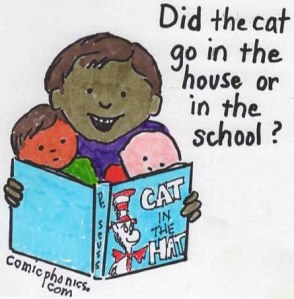
Become a reader yourself.  If you have let your reading habit slip, reacquaint yourself with the print world.

Read aloud to your infant.  Your reading material might be a medical journal or Dr. Seuss.  The content doesn’t matter to an infant.  What does matter is that you make eye contact with your child, use voice inflection, and read in the normal rhythms of your language.  If the baby responds with baby sounds, respond in kind.

Read aloud to your toddler.  Encourage your child to link the sound of your voice reading to him with strong, positive emotions.  Read at bedtime and during daytime too.  Offer your child variety in picture books, but respect his or her preferences, even if that means reading “Go, Dog, Go” night after night.  When the child interrupts, that shows he is engaged.  Stop and respond.  Finishing a book isn’t all that important at this age nor is reading every word.

Continue to read aloud to your emerging reader.  Once your child shows interest in letters and words, keep reading to him or her.  Encourage her to join in, but don’t pull back now.  She shouldn’t think of reading as work.  She should think of it as fun.  Allow your child to develop reading skills at her own pace, but if you suspect problems, follow through with her teacher.

Continue to read aloud to your early reader.  Take him or her to the library or book store.  Expand his selections from fiction to nonfiction.  Ask him and his friends what they are reading and discuss their preferences.  Let your child stay up a bit later if she reads in bed.  If your child prefers comic books or graphic novels, or if he wants to read about his favorite video game, be thrilled.  He’s reading.

Stash reading materials throughout the house. On the coffee table, in the bathroom, or in the bedroom, show off books, magazines and other reading materials to encourage reading.

Help your child build a personal library.  Make a bookcase part of the child’s bedroom or a children’s section of books part of your home library.  Give books as gifts and rewards.  Bring home armloads of books from the library.  Celebrate your child’s first library card with family stories of other first library cards.

This wonderful New York Times article goes on to describe the kinds of books children are ready for at different times in their lives.  Enjoy.


My middle grader needs to read Romeo and Juliet next fall. It is so HARD to understand. How can I help?

Reading Shakespeare is reading a foreign language to 21st Century English speaking people who struggle with 400 years of changes in pronunciation, meaning, and even the existence of many words.

Reading a children’s version of a classic can help establish the main ideas and character relationships.

Even so, educated English-speaking people are expected to know Shakespeare.  Words from his plays are quoted or alluded to more often than anything except the Bible in Western literature.  Shakespeare is to the English language what Lincoln is to American democracy.

So how can you help a student to read Shakespeare?

  • Buy your son his own copy of Romeo and Juliet so he can write in it. The No Fear Shakespeare series which prints the original Shakespearean version on the left and a modern paraphrasing on the right, is good.  So are other annotated versions.
  • Keep and annotate a list of characters which your son can use as a bookmark. Shakespeare populates his plays with many characters.  List Romeo and his friends, for example, and identify them (hot-tempered, funny, talks in puns, or mixes up words).
  • Read Shakespeare as you would read poetry, with pauses at punctuation, not at the ends of lines. Shakespeare wrote in verse.  Some of the lines end with a period or comma, and you should pause there.  But many lines end without punctuation and should be read without a pause until the next punctuation mark, usually in the next line.  Reading this way will help with understanding.
  • Rewrite the words in normal word order if they don’t make sense the way they are written. In English, we usually have a subject–verb-direct object word order.  But Shakespeare sometimes uses a direct object-verb-subject word order.  “Never was seen so black a day as this:” (Romeo and Juliet, IV, v) puts the verb before the subject.  The quote makes more sense if you read it as “No one has ever seen a day as black as this.”   If there is not room in the margin, rewrite on tiny post-it notes.
  • Supply missing words. Just as we leave out words today (Haven’t seen y’in a while), so did Shakespeare.  Since his original audiences left out or shortened the same words he did, there was no problem to understand what he meant then.  But now, 400 years later, you need to write in the missing words or parts of words. Shakespeare contracted words to keep the meter of the verses and because his generation used those contractions.
  • Identify pronoun antecedents. Identifying who or what the pronouns refer to helps with understanding.  If your son owns the copy of the play he is reading, he can draw arrows to show relationships.  Or you can highlight using matching markers.  Take, for example, this quote from Romeo and Juliet (the boldface is mine):

But, soft! what light through yonder window breaks?
It is the east, and Juliet is the sun!
Arise, fair sun, and kill the envious moon,
Who is already sick and pale with grief,
That thou her maid art more fair than she:

“It” refers back to light.  “Who” refers to the moon.  “Thou” refers to Juliet.  Both “her” and “she” refer to the moon.  Drawing arrows helps.

  • Paraphrase confusing verses. The above quotation can be rewritten as, “But wait.  What is that light starting to come through the window from the east?  That light is Juliet, the sun.  Rise up, beautiful sun, and overshadow the envious moon which is already growing dim. The moon realizes that you, Juliet, are more beautiful than it is.”  Not as elegant as Shakespeare’s words, for sure, but the rewrite in modern English is easier to understand.
  • Figure out metaphors. Shakespeare used lots of them.  Encourage your son to write them in the margins of his book.
  • Identify allusions. Just as authors today refer to Shakespeare, Shakespeare referred to the Bible, to British history and to ancient Greek and Roman myths.  Again, annotate.
  • Untangle wordplay. Shakespeare delights in puns and words with double meanings, especially words whose secondary meanings are sexual.  Some children need help understanding the secondary meanings.  Write the meanings in the margins.
  • Use a dictionary to look up unfamiliar words. Even though almost all of Shakespeare’s words are still in use today, some are not, or their meanings have changed over the centuries.  In dictionaries, such meanings might be listed as archaic.  A long list of such words can be found at shakespearehigh.com
  • Reread some parts several times. Once your son has analyzed words, phrases and verses, another reading will make more sense.  And if he reads aloud, the play will make even more sense.
  • Watch a good film or stage play after you have analyzed the written play. Even then it might take some getting used to the British accents (if it is a BBC production) and to the unfamiliar word patterns.  But Shakespeare’s plays were meant to be acted out, not read on a page, and will come to life when acted.

10 picture books with simple illustrations

Picture books with simple illustrations and bland backgrounds—the kinds which appeal to toddlers and children with sensory integration problems—can be hard to find if you search online or on shelf.  Even harder to find are such books which tell a story.

But they are great books for reading aloud to sensitive children.  And they are equally valuable for suggesting story ideas for children to write.

Here are ten such books from all over the world which your child might enjoy.  Many have won awards.


Why Mosquitos Buzz in People’s Ears by Verna Aardema

The Enormous Crocodile by Roald Dahl (the version illustrated by Quentin Blake)

The Snowman by Raymond Briggs

Puss Jekyll Cat Hyde by Joyce Dunbar

The Farmer and the Clown by Marla Frazee (wordless)

Flora and the Penguin by Molly Idle (wordless)

The Great Paper Caper by Oliver Jeffers

The Snowy Day by Ezra Jack Keats

Snow White and the Fox by Niroot Puttapipat

Lon Po Po:  A Red Riding Hood Story from China by Ed Young

Can listening to music help kids to focus?

Yes, it can if it is the right kind of music.

For work requiring focus and concentration, children should listen to instrumental music with no voices or lyrics.  Such music works even better than ambient noise, such as a ceiling fan or hair dryer in the background.

If listeners become accustomed to hearing the same kind of music when learning, they respond repeatedly in the same way, much like Pavolov’s dogs in his famous experiments.  Children learn to associate a particular stimulus—the instrumental music—to a particular behavior—focused attention.

On the other hand, for work requiring little thought but a great deal of energy, children should listen to music with a quick beat and energizing lyrics.

Why does music help?  Listening to music releases a chemical called dopamine which turns on different parts of the brain known to be important for learning.


Maintain reading skills during the summer

Students loose reading skills during the summer if they don’t continue reading.  Educators call this loss the “summer slide.”  It is most severe among low-income students who lose up to two months of reading skills.  Yet it is sometimes nonexistent among middle class students who make slight gains in reading during summer months.  Why the difference?

Summer slide (decline) of reading scores.

  • A study of 3000 sixth and seventh graders in Atlanta Public School showed that students who read at least six books during the summer maintained or improved their reading skills.  But students who didn’t read lost up to a whole grade of reading skills.  (B. Heyns, 1978)
  • A study of Baltimore students over 15 years found that By the end of fifth grade, Baltimore students who didn’t read during the summer measured two years behind their classmates who did.  They concluded that 2/3 of the reading difference in ninth graders can be attributed to reading or not during summer school breaks.  (K Alexander, D. Entwisle and L. Olson, 2007)
  • A study of students completing third grade who took part in their local libraries’ summer reading programs scored 52 Lexile points ahead of their classmates who did not. (Dominican University)
  •  Children’s absence from reading during the summer is a major hurdle for achieving good reading skills by the end of third grade.  (The Campaign for Grade-Level Reading)
  • The summer slide is cumulative.  Some estimate that by the end of high school the summer slide can account for up to a four year lag in reading achievement, and it can have an effect on high school graduation rates.  According to the Annie E. Casey Foundation, “one in six children who are not reading proficiently in 3rd grade do not graduate from high school on time, a rate four times greater than that for proficient readers.”

So how can you combat the summer slide?

  • Sign your child up for your local library’s summer reading program, and make sure your child completes the reading.
  • Go to the library regularly and let your child select books she will enjoy.
  • Help your child to read a chapter book a week, or a picture book each night.
  • Encourage your child to read the newspaper, television guides, magazines and online articles.
  • Reward your child with a trip to the book store to select her very own book.
  • Read to your child every evening, and let him read to you.  Your reading will teach fluency and pronunciation, and establish the notion that reading for pleasure is fun.

(This blog first appeared on May 16, 2014.)

How to help children figure out new vocabulary words when they read

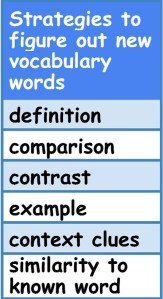
Children need strategies to learn new vocabulary words when they encounter such words in their reading.  Here are several strategies:

Definitions: Sometimes, definitions are given immediately after a new word.  Definitions can be separated from the word with a comma (An avalanche, a quick moving mass of snow,), with a dash (An avalanche—a quick-moving mass of snow—), with the words “that is” (An avalanche, that is a quick-moving mass of snow) or with the Latin abbreviation for that is, i.e. (An avalanche, i.e. a quick-moving mass of snow,).

Comparisons: Sometimes a word is compared to another word or idea which is similar.  “A zebra is similar to a wild horse but with different markings.”

Contrasts: Sometimes a word is contrasted with another word or idea which is different from the new word.  “A mug differs from a tea cup because the mug is taller and contains more liquid.”

Context clues: Sometimes a new word can be learned from other words in the same sentence or nearby sentences.  “The car crash caused one fatality.  A woman not wearing her seat belt died.”

Examples:  Sometimes a word is explained by the example which follows it.  “Academic vocabulary is the kind tested on the SAT and ACT.  Some examples include obstacle, complement and mollify.”

Similarity to a known word: Sometimes a word will sound like or remind a student of another word.  “The child clasped her mother’s hand.”  Clasped sounds like “grasped.”

How to recognize these clues to the meaning of new words needs to be taught to children, and they need practice using each clue.  Knowing the clues will improve children’s reading comprehension, since comprehension depends so much on understanding vocabulary.

How to make reading anything easier

boy reading on the floorBefore you read:

  • Read the title and look at the photos, drawings, charts, and maps. Try to figure out what they mean without reading  the text.
  • Read the subheadings. Ask yourself, “What is this about?”  Try to predict the topic you will be reading about.
  • Read vocabulary words out loud, find out how to pronounce them (ask an adult) and ask or look up what they mean.  If there are vocabulary words in the margins, or if words are highlighted in the text, they are there because they are important and because you might not know them.

girl with ipad in bed

While you read:

  • Figure out the main idea. Usually in nonfiction it is named at the end of the first paragraph.  If you own the book, underline the main idea.  If not, start a mind web with the main idea in the middle.
  • Figure out what details are important. Add those to your mind web.  It’s easier to study a mind web than it is to study a whole lot of paragraphs.
  • Highlight or write down every word you don’t understand.
    • Look for clues in the nearby words.
    • Ask an adult to help you.
    • Or look up the words in a dictionaryWrite down what they mean, and read over the words and meanings until you know them.
  • If something is difficult or confusing, ask an adult to explain it.
  • Define important words on your mind web.
  • Summarize each paragraph into one or two sentences to be sure you understand it.  If you can write down what it means, you understand.

Teaching “and” and “but”

Learning new vocabulary words in elementary school is important for reading comprehension.  But vocabulary instruction needs to include a deeper understanding of words students use all the time, words they haven’t paid much attention to, such as the conjunctions “and” and “but.”

boy reading

Children know what “and” and “but” mean.  But do they realize they use “and” to connect two words or ideas which are both positive or both negative?  And do they realize they use “but” to join one word or idea they favor and another word or idea they don’t favor?

Helping students learn to read means pointing out the relationships which conjunctions create.  Here’s how.

  • Start with the word “and.” Write a sentence such as “I like ice cream and cookies.”  Point out to the student that you used “and” to join two ideas you feel the same way about.  Ask her if there are any other ways she could say “I like ice cream and cookies” without using “and.”  If she is stumped, suggest, “I like ice cream.  Additionally, I like cookies.”  Or, “I like ice cream as well as cookies.”  Or, “I like ice cream.  Also, I like cookies.”  Point out that “and,” “additionally,” “as well as” and “also” all are used to connect ideas which we feel the same way about, either positively or negatively.

Other words which mean the same as “and” include consequently, because,  moreover, and furthermore.  A semicolon between two sentences usually indicates that the idea in the first sentence continues in the second sentence.

  • Now write a sentence such as “I like ice cream but not anchovies.”    Ask her if there is any other way to say that idea.  She might say, “I like ice cream.  However, I don’t like anchovies.”  Or, “I like ice cream although I don’t like anchovies.”  Or, “I like ice cream even though I don’t like anchovies.”  Point out that “but,” “however,” “although” and “even though” all are used to connect ideas we don’t feel the same way about.  One idea we like and one idea we don’t like.  One idea usually uses a form of “not” or a prefix that means “not” such as un, im, ir, or dis.

Words which mean the same as “but” show contrast.  Some other words are though, despite and yet.

  • To reinforce the difference between “and” and “but” and their synonyms, suggest two ideas, such as summer and winter. Ask the student to say or write a sentence saying how they feel about those two times of year.  Now ask the student to change the word or words they used to connect summer and winter to a word or phrase which means the same thing.  Now do it again to another phrase or word which means the same thing.  Try another relationship, such as snakes and dogs.  Again, ask for synonyms for the connecting words.

Being aware how “and” and “but” and their synonyms create different relationships between ideas is important in reading.  If a child is reading and comes to the word “however,” she knows the thought has just changed to an opposite kind of thought.  If she comes to the word “moreover,” she knows more of the same kind of thought is coming.

Another way of teaching these ideas is to suggest that “and” is something like a plus sign, but “but” is something like a subtraction sign.  Or “and” is something like walking straight ahead while “but” is something like taking a U-turn.

How to make kids better readers

Renaissance Learning offers many ways to make children better readers.  Here are some of their suggestions.

“Give your students more choices.” Let children choose which books to read from a huge selection, both fiction and nonfiction.Young girl 's reading choices include a print book and an eBook.Young girl 's reading choices include a print book and an eBook.

Make sure the reading level is just right.”  A useful gauge is to count the number of words a student misses on a single page.  If it is five or more, that book is probably too hard and will discourage children from reading.

Devote time to reading practice.”  Designate a certain time every day—before bed, before the morning school bus or during the school day—for reading.  Children will look forward to this time, especially if it is part of a routine.boy reading on the floor

Build relationships with daily check-ins.” During reading time, talk to your child.  Comment on what he is reading.  Let him know you care.

Make reading practice a social experience.” Read together with a child, one page for her, one page for you.  Or after you read, discuss what you and the child like and don’t like.

Create a book-store style display.” On the bookshelf, show off books by their jackets or front covers to encourage a child to choose that book.  Display books you have read so you can talk to the child about why you like the book and why he might.girl reading Junie B. Jones

Read aloud to students of all ages.” When you read to a younger child, you expose him to books whose ideas he can grasp even though the vocabulary might be difficult for his reading level.  When you read to an older child, you introduce genres which the child might not choose, and you model comprehension strategies such as predicting, asking questions and summarizing.

Acknowledge and celebrate success.” Praise your child for his reading.  Create a spot to post his reading accomplishments—names of books and articles read, or number of pages read.

For more detailed information, go to http://doc.renlearn.com/KMNet/R60386.pdf.

When I work with my son on reading, should he read silently or should I interrupt and ask questions?

If you are working with your son, you should be involved.  What does an involved reading teacher do?

  • Before he reads a selection, you could read it, understand it, and preview it with your son. That does not mean giving away the ending if it is a story.  But it might mean explaining the setting or motivation of the main character.  In nonfiction, it might mean showing him a map or other graphic to make the reading easier to comprehend.

Tutor teaching a child.

  • Before reading, you and your son together could look at any graphics accompanying the article. You could ask him to interpret the graphics to be sure he understands the data.  You could ask him to read headlines and subheadings, and then ask him to predict what he is about to read.
  • If he has trouble pronouncing words or if he slurs big words, ask him to read a short section at a time aloud. Go back to the words he missed and discuss them, asking him to pronounce them, writing the words in syllables on notebook paper so he can see the structure of the word, explaining prefixes, suffixes or word roots.  If there are vocabulary words you suspect he might not know, ask him the meanings, and if he can’t explain them correctly, discuss their meanings.  Then ask him to read that part of the selection again.
  • Now ask him what it means. Don’t accept, “It’s about a farm,” but ask for more specific meaning.  “It’s about a small baby pig that a farmer is going to kill.”  Ask him if his prediction was right or should he change it.
  • Fluency can only be judged by a teacher if the child reads aloud.  Listen for pacing, inflection, changing of voice tone, loudness or softness.  If you know your child is a fluent reader, you needn’t have him read aloud often for fluency.  But if he is not a fluent reader, you might want to read a sentence at a time using fluency and have your child mimic you.
  • If you read along silently, and your child finishes a selection long before you do, probably he is racing. Ask him about the meaning.  If his answer is vague, ask him to read again but slower.
  • If your child is a competent reader, your job might consist of asking for feedback—orally or written. If your child is reading fiction, you might ask about setting, characters, theme, ups and downs in the story and the climax.  If he is reading nonfiction, ask for the thesis and organization of the article.  Ask a question which the article answers and let the student find and read the part which answers your question.
  • If you can’t be engaged with your child during the reading, you could leave questions to answer so you know the child has paid attention.

Good teachers interrupt when they hear mistakes or hesitancy.  They ask questions if they suspect the student is not understanding.

But if your son is reading strictly for his own pleasure, back off.  Maybe when the day’s reading is done, ask him what his reading selection was about or what he liked, but don’t pressure him.  If he is asking you questions like, “Hey, Mom, what does contentious mean?” or “Why do hunters want elephant tusks anyway?” he is doing what you want—consulting an expert when he doesn’t understand.