Category Archives: reading research

Does having a small number of books in my child’s kindergarten classroom make a difference as long as there is a media center in the school?

girl looking at book displayYes.  It makes a big difference.

Research shows that if children have easy access to reading material, they are more likely to read.  In a classroom with few books, children will read less.

A classroom that encourages reading is bursting with books, magazines, comic books, tablets or whatever will entice children to read.  Some classroom teachers allocate a box per student that at all times is full of books for the child to read.  The box is on the child’s desk or at the child’s feet, but within reach of the child.

Most teachers have a classroom library full of age-level, appropriate books of all kinds.  Before morning classes begin, it is the student’s responsibility to get a book or two for her desk, so if she finishes an assignment early, she can pull it out and read quietly.

Why does your child’s classroom have few books?  Depending on the reason, there are many remedies.

New teachers right out of college usually don’t have a stockpile of children’s books for their classrooms.  Sometimes retiring teachers pass along their classroom books to new teachers, but many times the new teacher depends on her own resources to develop a classroom library.  Some schools offer books to new teachers, but usually not enough to suffice.

So how can you help a teacher to create a classroom library?  You could

  • Contact neighbors to ask for books their older children are no longer reading.
  • Contact used book stores or Goodwill to get boxes of books at a huge discount.
  • Attend garage sales or estate sales and pick up books there for a slight cost.  If you go at the last hour on the last day, you might be able to obtain books free if you will just haul them away.
  • Convince the PTSA to donate money so the teacher could buy books she would like in the classroom.

The books don’t need to be new.  If you go in any classroom with its own library, you’ll see that the books are dog-eared, the bindings are splitting, and pages are taped.  New books are great, but the point is to have many, many books, new or old, for the children to pick up, sample, and read.

Another reason a classroom teacher might not have many books is the socio-economic status (SES) of the community in which the school is located.  A study of 20 first grade classrooms in low SES communities showed these classrooms had fewer books and fewer types of books, and children there used books less than in schools located in wealthier communities.

What can you do to help a classroom teacher in such a school?

  • If the school is a Title 1 School, money might be available to buy classroom books.  Check with your principal to see if some money could be allocated for classroom book purchases.
  • You could ask your PTSA for a “grant” to buy books for your child’s classroom.
  • You could pair up with the PTSA of a school in a wealthier community, which might be willing to donate books to your school.
  • You could find out the names of kindergarten and elementary teachers who retired recently, contact them, and see if they have any books they might be willing to donate.
  • You could contact your local library and see if they have children’s books which they are “retiring” due to multiple copies or the need for more space on the shelves.  Or perhaps they have books that will be tossed because they are torn, soiled or less than perfect.  You could offer to fix them for your child’s classroom.
  • If your community has a city council or neighborhood groups, you could go to meetings and plead for books for the classrooms of the local school.  Chambers of Commerce, church groups and fraternal organizations sometimes have money available.  Or they might have wealthier members who would make a donation in exchange for a tax write-off.

A lot of work?  Yes, but keep in mind your goal:  a print-rich classroom that will encourage children to read.  –Mrs. K

Assessing reading comprehension by using multiplication

Are you looking for a simple way to assess your child’s reading comprehension skills?  Take a look at the “Simple View of Reading.”

Although a “Simple View of Reading” (SVR) was proposed in 1986, its simplicity and success make it a useful tool to assess reading comprehension today.  Almost thirty years ago, two researchers, P. Gough and W. Tunmer, suggested that reading includes two primary steps, decoding words (using phonics skills to figure out words) and language comprehension (knowing the meaning of words especially when words are strung together to form sentences).

They represented their Simple View of Reading with a math equation:

Decoding x Language Comprehension = Reading Comprehension

(This formula uses scores from tests in decoding and language comprehension.  For this formula to work, all scores for decoding and language comprehension must be between 0% and 100%.)

What does this simple formula mean?

  • Reading comprehension requires the child to master two areas, decoding words and language comprehension.
  • If a child can do one but not the other, or can do one better than the other, his reading comprehension score will be only as high as the lower of the two other scores.

How can you use this Simple View of Reading to identify your child’s reading comprehension skills or lack of them?

  • First, ask yourself:  Is my child’s reading problem decoding?  Is his problem language comprehension?  Is he having problems in both areas?
  • If you are not sure, test the child in both areas.
  • You can test decoding by having a child read lists of real and nonsense words.  Lists are available online.  Having the child read nonsense words (e.g., zups, thab, slig) is important because some children memorize the look of a word without being able to sound it out.  Also, to assess decoding, don’t use words from a reading passage because the child might figure out a word from the context.  To test decoding, you must remove context.
  • You can also test decoding by reading an unfamiliar passage aloud and asking the child questions about facts, main ideas, sequencing and paraphrasing .  If he can respond accurately when he is the listener, yet he cannot do that when he is the reader, his problem could be decoding.
  • You can test both decoding and language comprehension by having the child read aloud to you.  (If he can pronounce words correctly, or in a few cases, use phonetic pronunciation for unfamiliar words, decoding is not his issue.)  Stop and ask the child what various words mean.  Ask the child to paraphrase a difficult sentence.  Ask the child to paraphrase the passage.  Ask the child to predict what might happen next.  If the child can decode, yet he cannot explain what he has read, his problem is likely language comprehension.  Teachers often see this situation in ESL students who learn the rules of phonics well but whose vocabulary in English is not extensive.
  • To make the evaluation easy, use a scoring method of high, medium, and low based on your own mental tally from working with the child.  If the child scores high in both decoding and language comprehension, he probably does not have a reading comprehension problem.  But if he scores medium or low in decoding or language comprehension, he has a reading comprehension problem.
  • A medium or low score in decoding means he needs more work in phonics.
  • A medium or low score in language comprehension means he needs vocabulary building, work on pronunciation, time listening to a native speaker read a text aloud, and strategies to gain meaning from sentences and passages.

Do you know how many pages a day your child reads?

Research shows that the more pages a student reads each day, the more likely it is that the student will do well on reading tests at school.  Some students will breeze through pages while others will snail-read.  What is important is that they keep reading.  Eventually, the slow reader will read faster if the reading level is appropriate and the genre alluring.

Girl looking at a chart of the number of pages she's read in the week.If you are not sure how much reading your child is doing daily, you might start a chart on which the child logs in the number of pages read after every reading session.  Over several weeks a pattern will emerge, so that you can assess how many pages your child is reading daily.  This can be helpful to get an accurate understanding of your child’s reading.  Sometimes the numbers tell a different story from what we assume.

How many pages are enough?  How many are too little?

Since books vary in the number of words per page, these are questions without solid answers.  But there is a way to find out if your child’s reading is improving.

  • Look up the Accelerated Reader level of the books your child is bringing home from the school media center.  Often books from school libraries have the reading level coded onto the spine or onto a front or back cover.  Your child should be reading books at the reading level appropriate for his skills.  If he is consistently reading books at the same reading level, or moving from one level to a higher level, and the number of pages he reads is increasing, that is a positive clue.
  • If he is reading for about the same amount of time each day (20 to 30 minutes for a kindergartener, 30 minutes for a first grader), and the number of page read is increasing, that is another positive clue.

On the chart you want to see an increase in the number of pages read if the child reads at the same level and for the same amount of time.  Then you can suspect that your child is improving.  But to be sure, ask the child about the story or nonfiction topic.  Ask what the book is about (main ideas).  Ask the child to put the ideas of the story in order (sequencing).  If the child can do that, the child is probably grasping the story line and is improving in his reading skills.

To encourage the child, display the chart prominently, and point out the improvement.  If a child needs external motivation, offer a reward when she reads a certain number of pages a day for a week.  But for many children, just seeing the number go up and the pleasure this brings to you will be enough reward.

Can my child become smarter? If so, how?

According to Annie Murphy Paul, the author of The Brilliant Report, a blog about the science of learning, intelligence is a somewhat fluid quality which can be increased. In a recent blog, Eight Ways of Looking at Intelligence, she gives eight insights into how intelligence can change. I have paraphrased her ideas as they might apply to children, and I have added information about how her insights might apply to teaching children how to read.child who's tired,cold, hungry, tells his mother he probably won't learn much in school the way he feels.

1. Situations can make children smarter. Children’s intelligence is not a locked-in trait; it is a fluid condition than can improve over time. Genes probably play the biggest role in creating intelligence, but environment has a powerful effect too.

For example, if a child is in an angry mood, or is bothered by itchy clothes, or needs a nap, or is hardly ever read to, or gets little exercise, that child will not be receptive to working on reading skills. But if the child is alert and rested, in comfortable clothes, and gets regular daily exercise, the child is ready for that “teachable moment.”

2. Beliefs can make children smarter. If a child thinks, “I can’t read that. It’s too hard,” this self-imposed limit becomes a fact. On the other hand, if a child thinks, “I can do that,” her openness to success becomes a fact too.

So how can you help a child who puts up barriers to learning? Analyze your child’s reading level and then find books at that level or just below, so that the child encounters success. For example, if your child can read some short vowel words (hat, can, did) but hasn’t yet learned about silent e (cake, kite, bike), find books with mostly short vowel words. As he reads aloud, you jump in and read the difficult words to give him a sense of mastery.

3. Expertise can make children smarter. Experts in any area think differently from nonexperts. Yes, they know more, but they also think deeply, and almost unconsciously, like an athlete who has done a particular dive or dance routine thousands of times. What we would have to focus intently on, they can do almost thoughtlessly because the knowledge has been learned so well.

A kindergartener might already be an expert skier or video game winner. How did he become that expert? Practice, practice and more practice. You can help your child to become an expert reader by encouraging the same degree of practice.

4. Attention can make children smarter. Double-tasking—like watching a parade while eating an ice cream cone—means the child gives less attention to both tasks. Babies are notorious for their short attention spans, but by preschool or kindergarten, those attention spans are much longer.

Can you lengthen a child’s attention span? Sure. Work with a child on her reading for ten minutes every day this week; for twelve minutes next week; for 14 minutes the following week. If necessary, as the lesson lengthens, take a two minute break partway into the lesson, and encourage the child to move her body before resuming study. Let the child know her attention span is lengthening and that you are proud of her.

5. Emotions can make children smarter. If a child is in a positive mood, he is more apt to work at learning to read. If he is anxious, part of his brain won’t be available for learning since it is already busy being scared.

So how can you create a positive mood in your child when it’s time to read? Try turning reading time into a warm, one-on-one, special occasion between your child and you. Make reading a safe experience (no laughing at the child’s ignorance; no chiding him for not remembering how to read a word). This will allow the child to use his whole brain for learning.

6. Technology can make children smarter. Computers, tablets, digital watches, and calculators can extend a child’s mind just like a flash drive can extend your computer’s memory. But they can also make children lazy. (For example, do you memorize phone numbers any more or do you program them into your cell phone and let the phone remember for you? Can your child read an old-fashioned clock or does she need a digital one to tell time?)

A positive way for your child to use technology is to extend knowledge he already has mastered. When he knows how to read enough words to write a short message, help him to send an email to Aunt Carol. Turn off “Spell check” and let him write the words he doesn’t know phonetically. Or let him FaceTime or Skype an out-of-town relative and read a book to show what he has learned.

7. Children’s bodies can make them smarter. Compare the learning abilities of a well-fed child with a malnourished one. Compare the responses of children who get adequate sleep with those who do not.

Requiring the child to eat well-balanced meals and to go to bed at a certain hour can be hard, especially as the child grows older and more independent. Yet, if we want our children to learn optimally, we must enforce rules of behavior which are in their best interests. Call the rules “house rules” to separate them from you. “House rules: Everyone eats at 6. Kids take baths at 7. Kids go to bed at 8. Adults go to bed at 10. House rules.”

8. Relationships make children smarter. Children learn by watching, listening, helping, and asking questions. One sign of a smart kid is that she asks many questions. But to be successful gaining knowledge, the child must have an adult or older sibling who is willing to take her questions, not someone who says “Scram.”

You can encourage your child to ask questions when you are reading to her or when she is reading to you. Make asking questions as natural as turning a page. “Why does the caterpillar make a cocoon?” “Why can’t the king’s soldiers and king’s men put Humpty Dumpty together again?” Some important questions to ask for reading comprehension are “What is happening? What’s it all about? Can you tell me the story in order. What do you think will happen next?” If your child is shy about asking questions, reward her for doing so with a hug or a comment like, “Great question!”

Is your home print-rich?

Are children’s books plentiful in your home?girl looking at book display  Are magazines your child might enjoy—even for the pictures—obvious?  Do you display books on coffee tables?  Does your child have a bookcase—or a shelf—to call his own?  Do you stand up books in their attractive jackets so that your child will be lured to read them?

Research shows that the more contact children have with reading materials—books, magazines, comic books, emails, book apps—the better readers children become.

The first step to getting your child to read more is to provide more reading materials.  Take her to the library and bring home not one or two but ten books.  Then display the books where the child is likely to see them and read them.red headed girl in easy chair reading If the child has a designated reading spot—a certain chair in a window, the end of a couch near a lamp, her bed—prop up the books there to entice her.  Set aside some time every day and read with her, or let her read to you.

Is a bookstore one of your weekly stops?  Or the book section of a department store?  Even if you just prowl through the children’s section with your child, he will find books he might like to read.  If you can afford them, great, but if not, write down titles and go to your public library to request them.  Make your child aware of your determination to find the books he wants.

Studies show that having a variety of books at hand motivates kids to read.  Combine that with more time to read, and kids become better readers.  One study shows that the best predictor of reading achievement (high test scores, for example), is the amount of time kids read on their own, without pressure to read.

What have you done to make your home a place where your child wants to read?  Please share your ideas by responding to this blog.  Your email won’t be shown, nor your name.  But your ideas might spur another parent or teacher to increase the reading of her children and students.

Is a child’s vocabulary destiny?

Consider this:

  • Three-year-old children from professional families already have bigger English vocabularies than parents in lowGirl is looking at a list of words she can read.-income families.
  • Children from professional families hear 300 more spoken English words in an hour than children of parents on welfare.
  • By the time children are four-years-old, children of professional parents will have heard 32 million more words than children from poor families.

What does this research by Betty Hart and Todd R. Risley (1980’s and 1990’s) mean?  Combined with more recent research that shows that vocabulary acquisition is the single greatest predictor of reading success, it means that children of professional parents are far ahead of children from low income families as they start preschool.  Other studies show that as a child moves through school, this vocabulary gap increases, directly correlating to a child’s achievement in reading comprehension.

So what can you do with your preschooler, primary grade child, or ESL learnerto increase his vocabulary?  Quite a bit.

A young girl uses the word odiferous to describe a stinky diaper.

  • Use “big” words when you talk to your child.  Provide a rich vocabulary for your child to hear.  “Baby” words are no easier to learn than adult words, so use adult vocabulary with your child.  For example, when I was a child, my father used to come home from work and ask us children, “Is everything copacetic?”  Of course, we didn’t know what he meant, but he explained, and within a short time we were asking one another the same thing.
  • Define new words when you know your child doesn’t understand.  Give an example you can refer to again and again.  Try to give an image to keep in mind if you can.  “Shutters are those door-like things on the sides of house windows, remember?”
  • Choose new words that sound somewhat similar to words the child already knows.  For example, a child knows what a computer is, but “compute” would probably be a new word.  Make the connection to how the computer can add up numbers quickly to help the child remember what compute means.
  • Encourage your child to ask you what a word means.  Don’t laugh at him because he doesn’t know.  We all learn by asking questions, so questioning is a great skill to help your child to develop.
  • Repeat new words often until the child understands.  One or two times is not usually enough.  Try six or ten uses of the word in a few days to cement the word into the child’s memory.
  • Read, read, read to children to expose them to new words.  Nursery rhymes contain old-fashioned words the child might not know.  Emails from Grandma might too.  Read from a variety of genres, but pick topics of interest to the child, so she will pay attention.  Choose books that stretch the child’s vocabulary with new words in context, but not too many.
  • When you are reading to your child, and you come to a new word, read it in context, and then ask the child what she thinks it means.  Try to find something right in her answer, even if it’s, “Well, that was a thoughtful explanation.  Well done.  Now let me explain what the word really means.”
  • Read the same book to a child several times, helping the child to conquer the words in context.  If there are many new words, don’t discuss each one.  Pick a few so the child focuses on enjoying the book.
  • Set yourself a goal of a word a day for a preschooler.  Keep a list on the refrigerator to remind you to use past words again to help with retention.  Let the child see the list growing.  As we measure the height of our children, they feel pride.  As we measure their learning, they will bask in that success, too.

How about you?  Have you come up with any ideas to help improve your child’s vocabulary?  Share your ideas by commenting on this blog.

Can dyslexia be identified in a preschooler?

By definition, dyslexia is a learning disability characterized by difficulty reading.  There are secondary characteristics—difficulty spelling, and illegible handwriting, for example—but until a child has attempted to read, it’s probably too early to identify dyslexia.

Even so, the National Center for Learning Disabilities has listed several warning signs for dyslexia, shown in the chart below, and some of them apply to preschoolers.

Dyslexia is the most common learning disability, affecting about five percent of American children.  Its cause is unknown, although scientists think it probably has more than one cause.  About a quarter of the children who have dyslexia also have attention deficit hyperactivity disorder, though most children with dyslexia don’t exhibit ADHD.  If an older child in the family or a parent has dyslexia, then the younger child has an increased chance of having it too.

Children diagnosed with dyslexia have normal intelligence and vision, yet they cannot figure out how to read by first grade.  Eventually they do, but they often require intervention from the school system, a tutor or a dedicated parent.

Dyslexia affects information processing in the part of the brain controlling language.  Usually children without dyslexia begin to realize that sounds combine to form words or parts of words, and that those sounds can be represented by letters.  Children with dyslexia have difficulty making these connections.

Children with dyslexia do learn to read, but it takes longer.  Teachers need to repeat the phonemes or basic sounds of English (about 44) and help children recognize these sounds in words and in syllables.  “Go” for example, has two phonemes, g and long o.  Then teachers need to connect these phonemes to letters, and the letters to tiny words which follow the rules of pronunciation.

If you are concerned about dyslexia, the National Center for Learning Disabilities website offers a 40-page toolkit about dyslexia, including several pages about characteristics of children pre-K to second grade and strategies to help them learn.  Your right to have your child tested by the public schools, the type of testing done and a video from an educator who has dyslexia are included in the toolkit.

Why do we read in English from left to right?

The simple answer is that we read from left to right because we write from left to right.  And why do we write from left to right?  Written English is derived from Latin (written from left to right) which was derived from Greek (also written from left to right).  Okay, so why did the Greeks write from left to right?  There are lots of theories, but no one knows for sure.

The first Western written words were probably written in mud more than 5,000 years ago.  They haven’t survived.  However, there was also writing in stone thousands of years ago (the Ten Commandments, for example).  For a chiseler chipping away, the writing was probably from right to left.  A right-handed chiseler could chip with his right hand and brush away debris with his left hand without putting down his chisel.  Semitic-derived languages such as Hebrew, Arabic, Farsi, Yiddish and Urdu continued in a right to left pattern, and still do, except for the writing of numbers, which are usually written left to right.

Plow horse crisscrossing a field, left and then right and then left again.

To enlarge, click on the picture.

Another way of writing, called boustrophedon, meaning “as the bull walks,” alternated the direction of the writing.  One line would go from left to right but the next would go from right to left.  This kind of writing can be found in some ancient religious texts.  It was used in the oldest Egyptian, Etruscan, Greek and Latin writings.

Cuneiform writing went from left to right, perhaps so right-handed scribes would not smudge their work in clay with the heel of their hands.  For the same reason, languages that were written with brushes (Chinese and Japanese) might have been written from top to bottom.  The painter/scribe held his brush differently from the way we hold a pen, but to avoid smudges, he went down the page, giving the writing at the top time to dry before a second column was started.

That explains the top to bottom format, but not the right to left format.

As for the Greeks, they wrote on papyrus, a precursor to paper.  With most people being right-handed, a Greek writer could see what he had written without his hand smudging it or covering it if he wrote from left to right.  We inherited that tradition in the English language.  Until ball point pens came along, our ancestors wrote with fountain pens and before that with quill pens, both of which required blotting to absorb the excess ink and to prevent smudging.  Smudging was common in the past, but has become a problem we rarely have any more.

Perhaps the reason we write—and read—from left to right is as simple as to reduce smudging.

Whatever the reason, it is important to acclimate your child to reading from left to right.  More on how to do that in a later blog.

Why is reading such a complex skill?

According to an April 2000 study (www.nationalreadingpanel.org) researched by the National Institute of Child Health and Human Development (a division of the National Institutes of Health) and the federal Department of Education, there are four main components to reading, each of which can be further divided.

Chart of 4 reading components

Click on the picture to enlarge it.

The first component is systematic phonics instruction.  The study defined phonics as how a letter corresponds to a sound in English, and defined systematic phonics as planned, sequential letter-sound instruction.  Some English letters have one corresponding sound (such as most consonants like b and d).  Some letters have two sounds (hard g and soft g, for example).  And some letters have many sounds (vowels and y).  Most systematic phonics instruction begins with teaching consistent consonant sounds and later moves on to vowels with multiple sounds, and then to consonants whose sounds change in combination with other letters (th and kn, for example).

Another component is phonemic awareness.  Phonemes are the smallest units of spoken English, 41 in all, represented by one or more of the 26 letters of the alphabet.  Some words have one phoneme (oh, for example, has the one phoneme o) while most words have two or more phonemes (go, for example, has two phonemes, g and o, while style has four phonemes, s, t, i and l.).  Putting together the phonemes to form words is an important component of reading.

Fluency is the third component.  The federal study defined fluency as reading aloud with speed, accuracy and proper expression.  When a child pauses at a comma or period and changes his pitch if he is reading a quote from a mean witch or a baby duck, that child is showing fluency.  Children who ignore punctuation or who read in a monotone or who plod along do not show fluency.

Reading comprehension, the fourth component, is perhaps the most complex.  It involves understanding vocabulary in the context of a text.  At the same time, reading comprehension means a student is actively engaging with a text so that the student can draw meaning.  If a child can read “trek” but does not know the word’s meaning, comprehension is limited by the lack of vocabulary but not by phonics or phenomes.  If a child can read a text but has little interest in the subject, and reads in a monotone, the child’s comprehension may be limited by fluency or passivity.

Adding to the complexity of reading is that all four of these skills work in unison as a child reads.  When a child is reading words accurately; when that child is grouping words in phrases and sentences with proper inflection; when that child is moving at a moderate rate; and when that child is laughing or questioning or pausing to consider what might happen next, that child is truly reading.

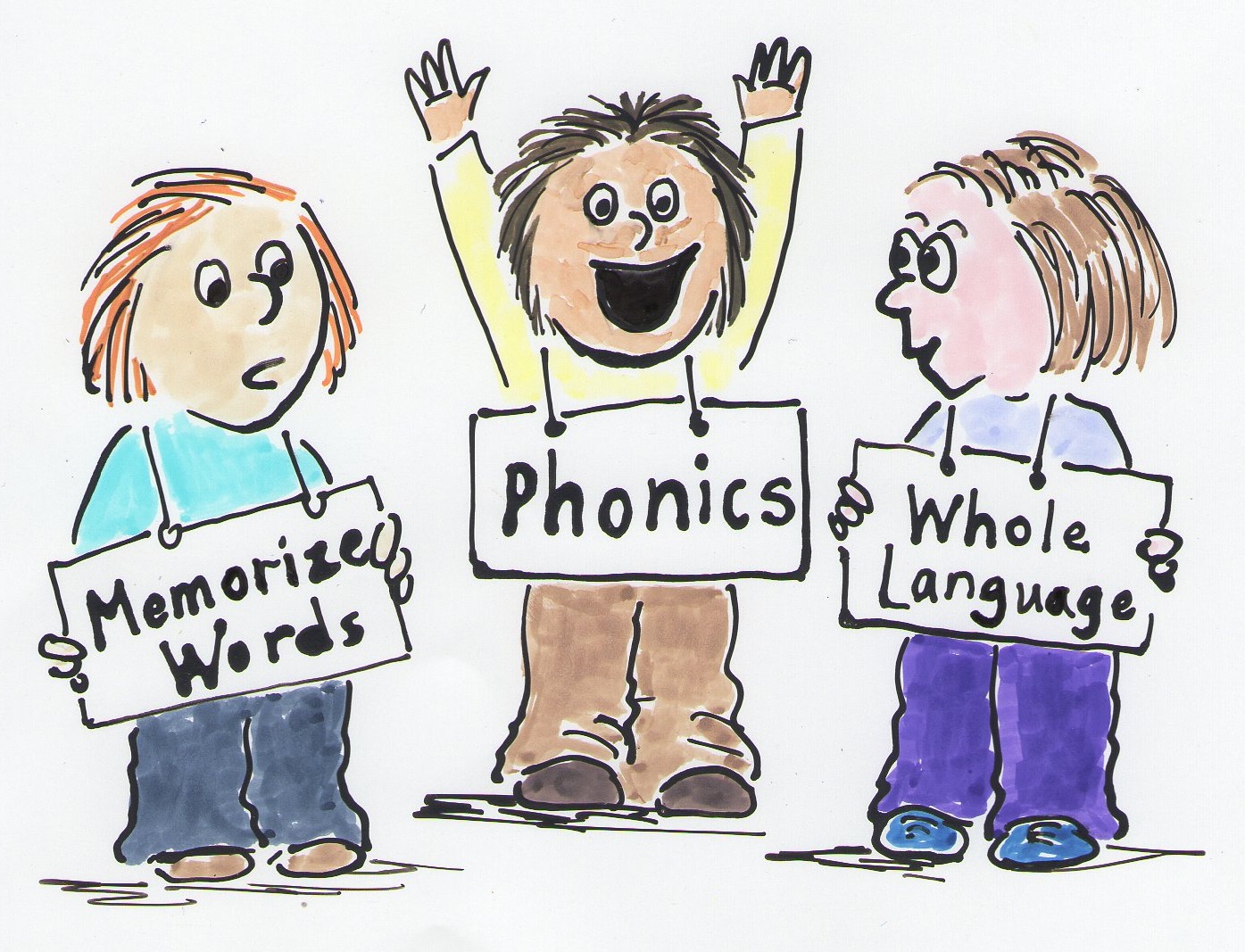
Is using phonics the best approach for teaching reading to young children?

In 1997, Congress asked the National Institute of Child Health and Human Development (a division of the National Institutes of Health) plus the federal Department of Education to investigate the best research about the teaching of reading.  This action came about to settle once and for all the “reading wars” by proponents of various ways of teaching reading.

Three children with signs around their necks that read: Meniruze words, Phonics, Whole Language

Click on the picture to enlarge it.

A panel composed of 12 university professors, one principal from an elementary school, a parent, and one language arts teacher from a middle school, reviewed thousands of experimental research results; held public hearings at which parents, teachers, students, scientists and government officials testified; and asked for input from leading educational organizations concerned with reading issues.

In April 2000, the results were published (www.nationalreadingpanel.org).  They showed that although reading is a complex process and not every child learns to read the same way, a systematic, phonics-based approach yields the best results, especially for the youngest students.  The panel said kindergarteners (the youngest children researched) gain the most reading and spelling abilities from studying phonics, but that students through grade 6 improve using this approach.

For low achieving students and students with disabilities, a phonics-based approach significantly helped them to read words compared to other approaches.  For students who were already good readers, a phonics-based approach helped with spelling.

The panel stressed that systematic phonics instruction needs to be one of four components to teaching reading.  The panel defined phonics as how a letter corresponds to a sound in English, and defined systematic phonics as planned, sequential letter-sound instruction.  The other three components (to be discussed in a coming blog) are phonemic awareness, fluency and reading comprehension.

The panel indicated that teachers and parents should not teach only phonics if they expect a student to learn to read.  Yet phonicst is a good place to begin, especially for the youngest students.