Category Archives: reading research

Survey shows number of kids reading for fun is decreasing

Fewer children are reading books for fun, according to just-released results of a survey sponsored by Scholastic, an American publisher of children’s books.Young girl reading a book

According to the survey of 1000 children aged 6 to 17, 31 percent said they read for fun in 2014, down from 37 percent in 2010.

Some of the other findings include:

    • Children aged 6 to 11 who were read to aloud, and who had their time online restricted, correlated with those children who read more.
    • Having time to read on their own at school correlated with more reading by children aged 12 to 17.
    • 17 percent of all children surveyed said they have time to read independently at school, with the percentage dropping as the grade of the children increased.
    • Children aged 6–11 who identified themselves as frequent readers read about 43 books per year. Infrequent readers aged 6 to 11 read about 21 books annually.
    • Among children aged 12–17, frequent readers reported reading about 40 books annually while infrequent readers said they read only about 5 books annually.
  • The study says there are three predictors of which children will become frequent readers:
      o Children who say they “really enjoy reading.”
      o Children who believe that reading for fun is important, and
      o Children who have parents who read frequently.

To read the report on the survey, go to http://www.scholastic.com/readingreport/downloads.htm.

Are you surprised by this survey’s findings? I’m not surprised, but I am concerned. In the past week I spent a great deal of time with more than 100 teenagers. Almost all had smart phones and ear buds which they used nonstop, even during classes. Many balked at reading passages in their text book. Some said they could not find information buried within paragraphs.

As electronic equipment grows more dominant in our lives, will the ability and willingness of our children to read anything more complicated than a text message decline as well? –Mrs. K
What research tells us about reading

What can we learn about reading from all the research that has been done over the years? Carol Gordon from Rutgers University offers many ideas.

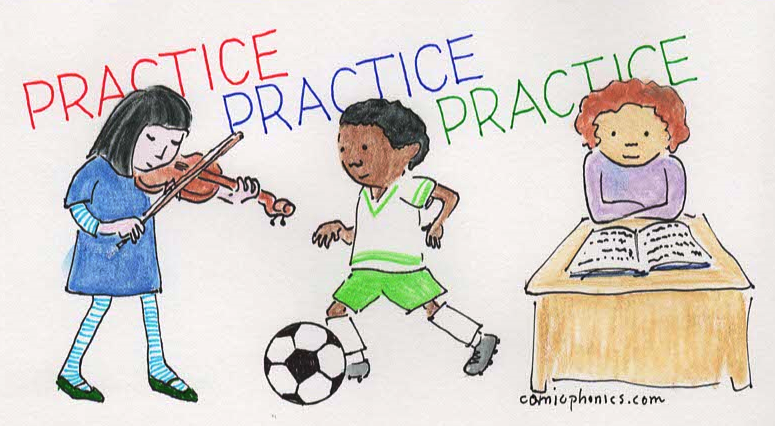
Three students practicing different activities--reading being one.
 

  • Students become better readers by reading (just like swimmers become better swimmers by swimming or pianists become better piano players by practicing). The more they read, the better they read.
  • Choice among genres and media encourages reading. Restricting reading to books only is too restricting when comic books, graphic novels, magazines, web sites, blogs, emails, chat rooms, text messaging and apps tempt students. Students will read more when they are free to choose what they want to read.
  • Teaching students how to read (once they know the basics) is often no more helpful than letting students read and read and read. If they are motivated to read, they will figure out how to do it better.
  • Students read when reading materials are easily accessible. No books in the bedroom? Is it any wonder the student doesn’t read? Piles of library books next to the bed? Of course, the student will read.
  • Summer reading programs maintain or increase reading skills. Research shows that poor children lose two months or more of reading skills if they don’t read during the summer. Better off families, meanwhile, enroll their kids in library programs or hire a summer tutor, so their children’s reading scores improve during the summer.
  • Blogs, apps, reading groups, reading buddies, student reviews and other means of making reading a social experience encourage reading.
  • The best motivator is the enjoyment or satisfaction that a student gets from reading. If a student needs an outside motivator, connect that motivator to reading—rewarding with a new comic book, for example.

For more information, go to School Library Journal, November 2010.

Eye-tracking affirms the importance of vocabulary in learning to read

Eye tracking studies confirms importance of vocabulary building. In a previous blog (Is a child’s vocabulary destiny? From July 25, 2013), I pointed out that vocabulary acquisition is the single greatest predictor of reading success. Children from professional families grow up hearing 32 million more words than children from poor families by the time they are four years old. Most of these words are repeated words, but even so, the number of familiar repeated words is enormous for some children who begin to read with that oral vocabulary advantage.

Research using eye-tracking technology confirms how important a rich vocabulary is for good reading skills. With eye-tracking, the child’s eye movements are monitored using state-of-the-art technology. This technology records the jumps the child makes between words and the pauses the child makes while figuring out meaning.

Eye-tracking technology has confirmed ideas about how children read.

–When children encounter words they know well, the eye skips along briskly.

–When children encounter new words, or words used in unfamiliar ways, the eye pauses.

Researchers have concluded that children seem to have reading word banks in their brains. These word banks are organized by how frequently the child has encountered a word. The more often a child has encountered a word (e.g. “cat”), the quicker the child can understand the word. The less often the child has encountered a word (e.g. “waltz”), the more skills—and time—the child needs to identify it.

Eye-tracking technology reaffirms for me the importance of reading to our young children so that they will hear a wide variety of words. It reaffirms the importance of talking to our children frequently, using adult vocabulary right from birth, and helping children to use specific vocabulary as soon as they are able.

It also shows that there is so much more to learn about how children read, and that technology will be important in that research.

Will watching TV help my child learn vocabulary or do better at reading?

Most studies of the effects of television viewing by young children show negative effects, but it is hard to single out effects on only vocabulary or reading readiness.

Child sitting in front of a large screen tv.

  • Kids two to five years old spend 32 hours a week—almost five hours a day—watching TV, DVD’s, DVR’s, videos, game consoles, tablets, and smart phones. Most of that time is spent watching live TV programs.
  • Toddlers 29 months old who spend two hours daily watching TV risk lower vocabulary and math skills, and by the time they go to kindergarten, have lower attention spans and are physically weaker.
  • Many homes (as many as 51%) report a TV on in the background most of the time. In such situations, children watch more TV and read less often than other kids. They are less likely to be able to read. One, two, and three-year-olds have shorter attention spans. Parents and children interact less frequently than in homes without constant TV. (the University of Michigan)
  • When the TV is on, adults speak 75 fewer words per hour compared to when the TV is off. Children speak 25 to 50% less when the TV is on. (the Seattle Children’s Hospital Research Institute)

What can you take away from this research?

  • The more time children watch TV, the less time they devote to reading, academic work, physical play and social interaction—all important for a healthy, well-rounded childhood.
  • The more time the TV is on, the less time adults talk to children, and the less time the children talk—all detrimental to healthy, developing children and especially to vocabulary building which is so important for learning to read.

When is the best time to prepare babies for reading?

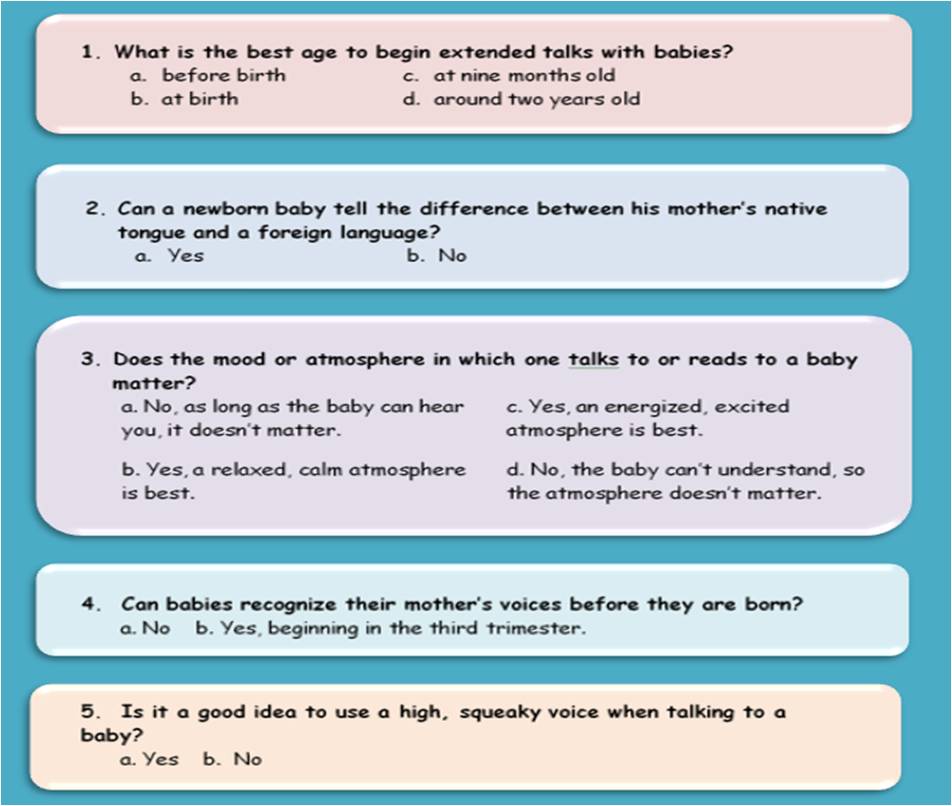
Click on the graphic below to enlarge it.Questions

Anwsers:  Question 1, Question 2, Question 3, Question 4, Question 5  (each answer will open a browser tab)

Pregnant mom talking to baby in womb.What has this to do with reading?  Babies who have been spoken to often pick up the sounds of their native language.  They learn the patterns of sound that make words and sentences.  They learn that when there is a pause in the sounds, that is a good time for them to respond (with babbling at first).  They learn vocabulary.  When the time comes for them to connect sounds, intonations, pauses and vocabulary with written letters, they are way ahead of children who have limited exposure to oral language.

It’s fair to say that the groundwork for teaching a child to read begins in the womb.  –Mrs. K


What does it mean to be literate? Part 2: Details on American achievement on PISA reading tests

Results of the every-three-year PISA reading tests (Program for International Student Assessment) were announced on Dec. 3, showing that U.S. 15-year-olds again scored average compared to their peers in 64 other countries.

Eight percent of American students who took the test scored in the top ranges; 17 per cent scored at the baseline low range; most scored at the average range.  In the U.S., Massachusetts and Connecticut had more students scoring in the top ranges than did South Korea while Florida scored just a bit below the total U.S. average.  Massachusetts, Connecticut and Florida paid to have more of their students tested so that they could have a representative sample to use to compare their students.

Compare the U.S. scores with those of the best scoring countries:

US literacy rank among other high ranking countries.

What does all this mean?

    • Since the reading testing began in 2000, the U.S. has consistently scored in the average range in years in which comparisons can be made (2000, 2003, 2009 and 2012.


  • Despite the increase in testing of U.S. students, and despite publicizing the results of those tests, and despite shaking up public education with charter schools and other statewide initiatives, U.S. education is stagnating, according to Education Secretary Arne Duncan.

Why the mediocre showing by U.S. students?  Various reasons are proposed, especially the effects of poverty.  Dennis Van Roekel, president of the National Education Association, emphasized the corrosive effects of poverty. The U.S. has one of the highest child poverty rates in the world, double or triple the rate in PISA leading countries such as South Korea, Germany, Finland, Estonia and the Netherlands. Van Roekel called poverty “the main cause of our mediocre PISA performance.”

Do I say “red new book” or do I say “new red book”? Is there some rule to teach my daughter?

Royal Order of Adjectives SignYou say “new red book,” and yes, there is a rule. It’s called the Royal Order of Adjectives—an imperious name for an ordering system. The list below begins with adjectives placed farthest away from the noun (Determiners) to those placed nearest to the noun (Specifiers).

Determiners: Which one (the, a, an, my, her, this, that, these, those). Most singular nouns in English are preceded by either an article, a possessive noun or adjective, or a demonstrative adjective. Plural nouns do not use “a” and “an” but may use the other determiners.

Subjective description: (slow, ugly, easy, delicious) These adjectives can be considered opinions of the speaker or writer.

Size: (large, small, three-inch-long, two-liter) The hyphens are used to create words that don’t exist in English. Notice that every adjective is singular (three-inch, not three-inches) even if the word it describes is plural.

Shape: (round, misshapen, skinny, elongated)

Age: (new, antique, fifty-year-old) Notice that the adjective “fifty-year-old” does not put an “s” on year because all adjectives are singular. “My fifty-year-old brother” but “My brother is fifty years old.”

Color: (red, striped, mottled)

Nationality: (American, Asian, Indian)

Material: (cardboard, polyester, paper, metal)

Specifier: (rocking [chair], player [piano], Apple [iPhone])

Related to this idea of ordering adjectives is the question of which ones need commas to separate them. The rule is that if the adjectives fall into the same category (both colors, for example), then use a comma. If the adjectives come from different categories, no comma is necessary.

 Correct: My successful tall, willowy Korean sister travels often.

Most Americans cannot explain the rule of ordering adjectives. If they have heard the adjectives ordered correctly as children, they use that same order. They go by what sounds right, but they cannot explain it. ESL students who have not heard adjectives ordered a particular way may not know there is an order, and may order the adjectives arbitrarily. It is important for teachers and parents to point out to ESL students that there is a correct order.

Even preschoolers can be told to say “a new red bike, with the color red right next to the bike” so that they become aware that there is a right way to order words. Little children often use size and color to describe an item, so it is important to point out that size comes first, then color.

Some Americans put commas between all adjectives preceding a noun, and others don’t use any commas. More and more the practice in the U.S. is not to use commas unless leaving them out leads to confusion.

Try this quiz to see if you understand the Royal Order of Adjectives:

Adjective test

–Mrs. K

What does it mean to be literate?

Definitions vary:

  • Reading, writing, speaking and listening (The Common Core State Standards Initiative)
  • Understanding, using, reflecting on and engaging with written texts, in order to achieve one’s goals, to develop one’s knowledge and potential, and to participate in society (The Programme for International Student Assessment)
Organization for Economic Cooperation and Development (OECD) 2010 report, Program for International Student Assessment (PISA) 2009 Results

Here’s a video on the PISA 2009 Results.

At its most basic, literacy means the ability to read. When and where did this ability begin?

  • Scientists believe symbols representing ideas first developed around 8,000 years ago in ancient Sumer, in what we call Iraq. The symbols were used by commercial and agricultural interests to keep track of the numbers of things—chickens and eggs, for example.
  • Egyptian hieroglyphics developed about 5,300 years ago; it was the first system to include some phonetic symbols, not just pictographs.
  • Written Chinese notations began around 3200 years ago.
  • Around 3500 years ago, in Canaan, in what is now Syria, a consonant system of notations was first used.
  • Later alphabets (Phoenician, Hebrew and Aramaic) using both consonants and vowels, are thought to be based on this Canaan alphabet.
  • Beginning around 2700 years ago, the Greek alphabet derived from these others.
  • Literacy was widespread among male citizens of ancient Rome, but with the fall of the Roman Empire, literacy retreated , becoming the practice of princes and priests. Over the centuries, as trade increased, so did the need for some literate citizens. The Industrial Revolution which produced cheap paper and books became a strong force for more widespread reading, but so did educational reform which required children to learn reading, writing and arithmetic.

Today in the U.S., the ability to read is not universal, even though some statistics show the U.S. has a 99% literacy rate.

  • One out of three fourth graders scored “below basic” on the 2009 National Assessment of Education Progress Reading Test, according to the Annie E. Casey Foundation.
  • More than 67 percent of all U.S. fourth graders scored “below proficient” on this same test, meaning they are not reading at grade level.
  • If a child is not reading proficiently by fourth grade, that child has a 78% chance of never catching up.

–Mrs. K

Is reading from an electronic screen just as good as reading from a paper book for my child?

Have you seen the You Tube videoAngry child thinking a book is a tablet app. in which a one-year-old child swipes the family iPad screen to make it work? Then she does the same to a magazine but it doesn’t “work.” She pinches the magazine and swipes back and forth across the picture but the image on the page does not change. In frustration she presses hard with her index finger, still with no results, and then just to be sure, she presses her finger against her leg to see if her finger is working.

Even at one-year-old, children are using electronic devices to learn. It’s a given. Does it help? Does it harm? Most of the research comparing electronic reading with old-fashioned book reading uses older children or college students as subjects, so it is difficult to apply the results precisely to younger children. Even so, here is what some of the research shows.

  • A book has a physical presence that an electronic device does not. The reader knows intuitively how big the book is, how hefty the book is, and how many pages have been turned or still need to be turned. A little child can figure this out quickly even before he can talk.
  • An ebook’s physical size, by contrast, is difficult to gauge. Is it 24 pages or 48 pages long? All ebooks books “weigh” the same. If you are at location 304-6 out of 4020, what does that mean? A bar across the bottom helps to show that 7% of the book has been read, but since you can’t “see” the turned pages, what does 7% mean? Most books for little children are not more than a couple dozen pages, but can children tell that? Do they have any sense that they are halfway done?
  • Old-fashioned books allow an intuitive navigation of the text. You read an idea on page 33 that reminds you of something you read a few pages earlier, on the top of a left-handed page.Indian girl on the floor reading a book. You can easily go back to just the left handed pages and reread the tops while holding your finger or a bookmark in the place where you left off. If a child suddenly notices a tiny frog on page ten, he can go back quickly to find out if there is a frog several pages back by flipping pages.
  • Ebooks also allow you to go back, but you need to check every page since there are no left and right-handed pages. Ebooks don’t allow for flipping back without skipping pages, or for scanning ahead. And if you forget how to go to the beginning of the book, or to chapter 2, you need to stop and go to the electronic device’s directions. Little children can’t do that. Ebooks do not allow for easy highlighting or jotting down notes, though this is not important for young children.
  • Research shows that reading from old-fashioned books leads to more serious and focused reading and more retention. Because of books’ easy navigability, older students approach handheld books seriously, and they absorb more.Boy on floor reading an ebook on his tablet.
  • Reading ebooks, on the other hand, is a more casual experience. Kids browse, scan through a document, look up keywords and tap a hyperlink before finishing a document. They often read information once without rereading it. Do little kids see this distinction between old-fashioned books and ebooks? It’s hard to say without more research.
  • Books with tiny type faces or books read in inappropriate lighting can strain eyesight and even lead to wearing glasses in young children.
  • Onscreen books’ typefaces can be increased in size, and most ebooks come with an internal light to create sharp contrast for easy reading—both real advantages. But the screens can also cause glare leading to headaches and blurred vision. Time in front of a screen needs to be monitored.

Nooks, iPads, smart phones, notepads and other electronic devices have been around for only a few years, so much more research will be done on them, including research on young children. Also, manufacturers are improving the technology to meet the shortcomings of past versions, so a newer version might be more kid-friendly than an older version. My Kindle purchased just four years ago seems like a reading machine compared to the latest Kindle Fire which downloads apps, plays games, lights up internally—and allows me to read books.

Unlike us, little children today are growing up using old-fashioned paper books and electronic screens at the same time, much like a bilingual child uses two languages interchangeably. An engaging storybook with a good story and excellent illustrations might be just as attractive as an online book if read and shared enthusiastically by Mom.

We shouldn’t fear the new technology but rather search out what it can do better than the old-fashioned book. Can it read a story aloud to a child? Can it allow the child to match rhymes with a swipe of his finger? Can it allow the child to email his voice reading a book to Grandma?

So should you encourage your child to read from a screen? Sometimes, especially if you are guiding him. Are onscreen materials just as good as old-fashioned books? Some are, some are not. Each offers real advantages.  –Mrs. K

What is a Lexile score? My daughter’s Iowa test showed a Lexile score.

A Lexile score is a number used to measure a student’s reading achievement.  Several kinds of tests can be analyzed to determine this score.  The Iowa test is one of them.

Chart of typical grade level scoresA Lexile score is not the same as a grade level score in reading.  The lowest Lexile score—zero L—corresponds to the reading level of a beginning reader.  The highest scores—1600+L—correspond to advanced readers.

These scores can be used to choose appropriate reading materials for a student.  About a half a million books have been analyzed and given a Lexile score.  A student with a score of 800L, for example, would find appropriate reading material in books with a similar score.  At such a match, the student could be expected to comprehend 75% of the reading.  Below is a sampling of Lexile scored books.

List of Lexile scored books.

Find more book lists at: http://goo.gl/hA2X0P

A Lexile score is a scientific measurement of reading based on two factors:  how often words in the test or text are used in English and sentence length.  It is a 21st century readability formula developed by MetaMetrics (www.lexile.com), an organization which “develops scientific measures of student achievement,” according to its website.

Many state departments of education and school districts have licensed Lexile to analyze their tests and to link students with appropriate reading materials.  Several testing organizations such as the Gates-MacGinitie Reading Tests, the Iowa Test, the Sanford and Iowa achievement tests and the Total Reader, an online testing site, are “translating” their reading scores into Lexile scores.  Some online reading sites offer Lexile scores for their reading material.

One shortcoming of the Lexile readability measurement is that, like many readability formulas before it, Lexile measures just a few factors, leaving out many others.  Format and design factors (length of page, length of type line, length of paragraphs, type size and font, size of margins, white space between lines, use of graphics and use of color, for example) are not measured. Neither are the age-appropriateness of the material, the child’s interest in it, or the prior knowledge the child brings to reading.

Even so, Lexile is becoming a widely used method to measure a student’s reading ability and the readability of written materials.