Category Archives: reading readiness.

Teaching inferences

If students’ vocabulary is good but comprehension lags, the problem could be inferences.

Inferences are connections between what is said in the text and what we know to be true based on our experiences.

Good students delight in bringing their own world view to their reading, enriching the reading experience. But struggling readers don’t know they are supposed to do this. They think everything must be right there on the page. If asked to answer a question based on inference, they might say, “It doesn’t say,” or “The answer isn’t here.”

How can you teach inferences? According to Kylene Beers*, using the “It says—I Say—And So” chart helps.

Suppose, for example, the students read “The Three Little Pigs.” You ask, “Why can’t the wolf blow down the house made of brick?”

It says: The third little pig made his house out of brick.

I say: Brick is strong and heavy. And it is stuck together with cement.

And so: The brick is too strong to be blown down by the wolf.”

For the “It Says—I Say” strategy to work, this strategy must be used regularly, with modeling by the teacher or by students. A good place to start is with fairy tales or other well-known stories. Later, move on to grade level texts.

*When Kids Can’t Read; What Teachers Can Do. Portsmouth, NH: Heinemann, 2004

Best picture books of 2017

As it does every year before the holidays, The New York Times has announced its best illustrated books of the year.  This year the New York Public Library has joined with The New York Times to select these books.  The winners were chosen based only on the illustrations in the books.


And those ten winners are:

Muddy: The Story of Blues Legend Muddy Waters, by Michael Mahin. Illustrated by Evan Turk.

Frida Kahlo and Her Animalitos, written by Monica Brown. Illustrated by John Parra.

On a Magical Do-Nothing Day, written and illustrated by Beatrice Alemagna.

Plume, written and illustrated by Isabelle Simler.

Ruth Bader Ginsburg: The Case of R.B.G. vs. Inequality, written by Jonah Winter. Illustrated by Stacy Innerst.

The Way Home in the Night, written and illustrated by Akiko Miyakoshi.

Town Is By the Sea, written by Joanne Schwartz. Illustrated by Sydney Smith.

A River, written and illustrated by Marc Martin.

King of the Sky, Written by Nicola Davies. Illustrated by Laura Carlin.

Feather, Written and illustrated by Rémi Courgeon.

For more information on each book, go to https://www.nytimes.com/2017/11/02/books/review/best-illustrated-childrens-2017.html


Kids need to know the facts

When I go to students’ homes to tutor them in reading and writing, I bring a pocket-sized  atlas.  That is because inevitably a geographical place is named in a reading passage, and when I ask the students if they know where “Scandinavia” or “New Zealand” is, they don’t know.

It’s not just knowledge of geography which students lack.   It’s when the American Revolution happened, or what news event happened in Egypt this past week or why it’s correct to say the sun is a relatively close star.

Kids just don’t know.

But this lack of knowledge has serious effects on their reading comprehension scores.  I was working on a reading passage with a middle schooler recently, and one of the questions was why Charles Darwin was mentioned but not identified in a passage about the Galapagos Islands.  The student shrugged.  “Who is Charles Darwin?” I asked.  The student shrugged again.  How could he answer the question if he didn’t know who Darwin is?

This problem becomes more acute when the student is from another country and from another first language (or if his parents are).  Years ago I taught two brothers, third and second graders, who were English language learners.  They were reading a passage about Halloween.  They had no idea what “Halloween” meant,  nor jack-o-lanterns nor trick-or-treating.  How could they answer the questions about Halloween in the reading passage?  I took them trick-or-treating on the next Halloween, but their parents were mystified why people would give their children candy.

Even if kids know the code of reading—the sounds of our language and how putting letters together forms words—they cannot score well on comprehension if they don’t know what the facts in the passage are, and what unstated facts are expected to be known as general background knowledge.

I was working with Georgia students using a passage from a New York State test.  The passage concerned winter, snow and sledding.  “I’ve never seen snow,” said my student.  I put the passage away.

If you have young children, read them not just fairy tales and nursery rhymes, but nonfiction—facts.  If you have middle schoolers or older, talk to them about current events, and if they don’t know where something is happening, point to the location on a map.  Use dinners or car rides to offer information.

Ignorance is no advantage in reading or in life.

Help! My daughter reads words backwards

My daughter was reading, “The cat saw catnip,” and she read, “The cat was catpin.”  She does this all the time, and she can’t tell the difference between “b” and “d” no matter how many times I teach her.  What’s going on?

Young child writing C-A-T.

There could be many causes.

Vision problems.  Some children have subtle vision problems not detected by distance charts.  You might have her vision tested by an eye doctor.

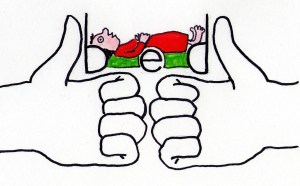
Directional confusion. This is a particular vision problem.  Can your child mimic your arm movements when she stands facing you?  Does she mix up down and up, and top and bottom?  Does she mirror write letters and numbers—writing a “b” for a “d”?Two fists with thumbs up and knuckles touching make letter "b" and "d" with a BeD visualized between the two thumbs.

Sequencing problems. Does she say “felt” when she reads “left” or “form” when she means “from”?  (I still do that when I am stressed.)

When a word ends with an “s,” does she say the word as if it begins with an “s,” such as saying “slow” when she reads “lows”?  Does she move words around in sentences, changing the word order?

Mixing up little words. Does she stick in articles (a, an, and the) where they don’t belong, or omit them entirely?  Does she substitute one small word for another, such as “and” for “a” or “for” for “from”?

Maturity.  How old is your daughter?  Every youngster I have taught reading to has had the problems you mention.  I gently correct the child when she makes a mistake, or I say “d” or “b” before she can read a word to help her.  Usually by the age of seven, these problems disappear.  If your child is four or five, these reversals are probably developmental.  However if your child is in first or second grade, you should ask to have your child tested for dyslexia.  Most public schools have reading experts who are trained to deal with these problems.

To Kill a Mockingbird banned again and reinstated again

Biloxi, Mississippi, Public Schools  banned–and then a few days later–and unbanned To Kill a Mockingbird from being taught to eighth graders.  The reason given for the ban is that some of the language in the Pulizer Prize-winning novel makes people uncomfortable.
This novel, published more than 60 years ago, concerns racism and discrimination during the 1930’s in a fictional Alabama town.

Mockingbird has been banned many times in the past, and once again joined a list of children’s books banned at one time or another.  They include

–for language:  Huckleberry Finn, Junie B. Jones and the Stupid, Smelly Bus

–for poor grammar:  the Junie B. Jones series

–for religious insensitivity:  A Wrinkle in Time

–for magic:  the Harry Potter series

–for child nudity:  In the Night Kitchen

–for potty humor:  Captain Underpants

–for exploring puberty:  many Judy Blume books

Ironically, as soon as a book is banned, many children read it on their own without the guidance of teachers and without discussion of its controversial aspects, thus defeating the purpose of the ban.  Go figure.

The illogical logic of English confounds children

Suppose you were teaching a kindergartener his numbers.  You would  start by explaining that “1” means one of anything:  one shoe, one horse, one star.  The student would get it.

But what if later you explaine that sometimes “1” doesn’t mean one.  Sometimes “1” means “two.”  Huh?

And weeks later, you explain that sometimes “1” doesn’t mean on”1” or “2” but “3”!  What?

How is the poor kid expected to learn math?

Yet that is exactly what happens when we teach sounds associated with letters.  We teach that “a” represents the sound in “apple” and “cat.”

But later, we explain that sometimes “a” doesn’t represent the sound in “apple” and “cat.”  It represents the sound in “Abe” and “cake.”

And later, we explain that sometimes “a” doesn’t mean the sounds in “apple” and “Abe” but represents the sounds in “ball” and “awful.”

And weeks later, we explain that sometimes “a” also means the sound in “aha.”

Aah!

In English, some consonant sounds have a one-on-one relationship with a letter.  The letter “b,” for example, always sounds the same.  Young children can easily learn a one-to-one relationship.

But some consonants have double sounds, such as “c” and “g,” whose sound depends on the letter that follows.  Now the child needs to learn not a one-to-one relationship, but a one-to-two relationship.  And some consonants, like the letter “t,” have a one-to-three relationship (“top,” “the,” thin”).

To little kids, a one-to-one logic makes sense.  “I’ll give you my lollipop if you give me your balloon.”  But one-to-two or one-to-three or one-to-seven logic confound children.

That is one of the reasons why learning to read in English is so hard.

When and how to teach blends

Blends are two adjacent consonants in a word which maintain the sound each has when pronounced separately.  For example the “s” and “l” in “sled” are blends, but the “t” and “h” in “that” are not blends because the usual sounds of those letters are not maintained when they are used together.

The right time to teach blends is once students master CVC words (words formed by a consonant, vowel, and consonant, such as “cat”).   Make sure students can pronounce CVC words made with every vowel before moving on.

Teach beginning-of-word blends first.   End-of-word blends are much harder for students to learn.

The letter “s” is a good letter to start with since it forms more beginning-of-word blends than any other letter.  Use real CVC words which become real CCVC words when the “s” is added, such as nap/snap, led/sled, kid/skid, top/stop and lug/slug.  Little children are concrete learners, so being able to picture the words helps with the learning.

You can write the CVC word and then put an “s” in front of it.  Or you can use letter tiles, gradually moving the “s” closer and closer to the CVC word, saying the “s” sound and the CVC word separately at first and then more quickly until the child can hear the blend happen.

The child might consider the process a game if you slide the “s” letter tile gradually while you say the “s” sound and the CVC word.  Usually the child will shout out the blended word when he figures it out.  At first this will be after you say the blended word.  But as a child learns the skill of blending, he will shout out the word before you get close to saying the blended letters.  The process needs to be repeated with many consonants and many CVC words.

Some consonant blends are easier to hear than others.  CVC words that begin with “l” and “r” are easy to hear.  

Don’t be concerned if the child adds the blended letter to the end of the word, such as saying “leds” instead of “sled.”  Remind the child that the “s” is going at the beginning of the word, and repeat the process.  This is a common occurrence and will gradually lessen as the child practices blends.

Try to teach every letter that can be blended.  These include “b,” “c” “d,” “f,” “g,” “p,” “s,” and “t.”

Don’t teach three-letter blends at  this point.  They are much harder to hear than two-letter blends.  Wait until the child is farther along in learning to read.

Advantages and disadvantages of third grade retention

Advantages of third grade retention for poor readers:

If students are young for their grade (summer birthdays), retaining will make them among the oldest students in the class, often an academic advantage.

If students cannot read at a fourth grade level, promoting them to fourth grade sets them up for problems in all subjects which require reading.  If those students are instead retained, they have another year to prepare for fourth grade reading levels.

If all students, no matter their achievement level, are automatically promoted, they learn that they will advance through school whether they work or not.  This might lead to poor work habits.  Retaining students can make them more responsible.

If poor readers are promoted with their class, parents might deceive themselves about their children’s skill levels, and might not intervene until  students are hopelessly behind.

If teachers know their students could be held back, those teachers might try harder to meet the reading needs of poorer readers.

If the retained student receives additional reading help, his chances of starting fourth grade at grade level improve.

Disadvantages of third grade retention for poor readers:

If students are retained, they might have lower self-esteem which in turn might lead to depression, a poor work ethic and continued failure.

If students are retained, they will lose friendships they have made.  They might become the victims of bullying and ridicule.

Retained students probably will be angry when they learn what is happening, seeing themselves as failures, and wanting even less to learn to read.

If poor readers are retained, they may show a temporary burst in achievement, but compared to poor readers who were promoted, they might show less achievement over time.

A retained student costs a school district more than $10,000 for that extra year of schooling.

Students’ poor reading achievement could be due to social and familial reasons, which if not improved, might keep students at a low reading level despite retention.

Students who are retained are more likely to drop out of high school.  High school drop outs are five times more likely to have been previously retained.

If poor readers are promoted along with good and advanced readers, teachers will face students with a wide variety of reading levels in the same classroom.  Teachers will need to slow down and repeat, repeat, repeat for the sake of the poor readers, lowering the achievement of the non-retained students.

Does your state require poor readers to repeat third grade?

Fifteen states plus Washington, D.C, require third graders who are not reading at a “proficient” level by the end of the school year to repeat third grade.  Those states include Arizona, Arkansas, California, Connecticut, Delaware, Florida, Georgia, Indiana, Iowa, Mississippi, Missouri, North Carolina, Ohio, Tennessee, and Washington.  Three more states are about to join the list:  South Carolina at the end of the 2017-2018 school year; Nevada on July 1, 2019; and Michigan at the end of the 2019-2020 school year.*

Eight other states allow third grade retention but do not mandate it: Alaska, Colorado, Maine, Maryland, New Jersey, New Mexico, Oklahoma and West Virginia.

States offer exemptions to some students, such as ESL students, special ed students, students who have recommendations from parents and teachers, and students who have been retained once already.

Even so, almost half of all states require or allow a student who is not reading well at the end of third grade to repeat it.

Why?

  • Educators consider fourth grade a transition year. In kindergarten to third grade, students learn to read.  In fourth grade and beyond, students read to learn.  Starting in fourth grade, students can’t learn well unless they can read.
  • Research in 2015 showed that about two out of three American fourth graders could not read proficiently, that is, at a basic level. Almost 4/5 of African American, Native American and Latino students could not read at a proficient level.
  • Down the road, about ¼ of those below basic level readers won’t graduate from high school.

In  the next blog we’ll look at some of the pros and cons concerning third grade retention.

* http://www.ncsl.org/research/education/third-grade-reading-legislation.aspx

My child can’t read CVC words after finishing kindergarten. Should I hold him back?

“It depends” is not the answer you want, but that’s the best I can do.  Let’s look at some of the factors you should consider.

Young child writing C-A-T.

  • Is your child doing poorly in reading only? Is he struggling to read but doing fine in math, for example? This kind of disconnect could signal a particular learning problem with reading.  He might need a reading specialist or a tutor to work with him in first grade so that he can catch up to his classmates.
  • Is he performing at a mediocre level in reading, math and most kindergarten skills? If so, he might not be intellectually ready to move on to first grade.  Kids’ brains develop at different rates just like their bones do.  An extra year to grow can make a great difference in a child’s ability to learn.
  • Is your son one of the youngest children in the class? Younger children in a kindergarten or first grade class sometimes are immature compared to their classmates.  Their attention span is less.  They have more difficulty sitting still.  They are more impulsive.  If your son was barely old enough for kindergarten, chances are that he is barely old enough for first grade too.
  • Is he showing signs of stress? Is he more babyish than his classmates, more apt to cry or sulk when things go wrong?  Our emotions grow at various rates too.  A student with good self-esteem will be better able to weather poor grades in reading and not blame himself compared to an insecure student.
  • Did your son miss school often because of sickness, moving, or problems at home? Is he depressed?  How motivated is he to learn?
  • What are the expectations of the kindergarten curriculum at the end of the year? (You can go online to find out your state’s curriculum requirements.)  Has he met them?  Kindergarten reading skills provide a base for first grade reading skills.  Will CVC phonics be taught in first grade or will it be reviewed quickly with the expectation that students already know that?
  • Does your son’s school have a strong intervention plan and well trained teachers for outliers like your son? If so, how will it be determined if your son meets the criteria for this special learning?  And when will the intervention begin—in September or in January?
  • Does your state have mandatory third grade retention laws, so that if your son is still doing poorly at the end of third grade, he would be forced to repeat that grade?
  • Do you have the time or the ability to work with your son to catch him up? If so, can you commit to this teaching, knowing your son will fight you?  If not, do you have the money for a tutor to catch him up while he moves into first grade?
  • Is there a younger sibling? Will both children be in the same grade if the older child repeats?   If the older child continues to do poorly, will his family status be threatened?  Will his younger sibling become a star in comparison?
  • Are grandparents pressuring you one way or the other? If so, how knowledgeable are they about your son’s skills?  Is their status threatened if your son repeats a grade?
  • Can you talk to teachers who know your child well or who have taught kindergarten or first grade, educators who can give you first hand advice?

When you weigh all these factors, one is most important:  What is best for my child?