Category Archives: reading comprehension

Strategies good readers use

Suppose you need to read something new to you, something you find hard to understand. What would you do?Discouraged child thinks there are too many words in a book she is reading

  • Would you slow down?
  • Would you start over?
  • Would you look for help on the page, using headlines, boldfaced words, diagrams, photos or highlighted words explained in the margins?
  • Would you underline main ideas as you go along?
  • Would you mark unknown vocabulary words to look up later?
  • Would you look up those words now and write the words in the margins?
  • Would you realize you recognize a word but not the way it is used, and look up this other meaning?
  • Would you take away prefixes and suffixes to see if there is a root word you understand?
  • Would you draw a diagram, sketch, or chart to make sense of relationships?
  • Would you read the whole thing from beginning to end to get a gist of the passage, and then go back to figure out individual parts?
  • Would you write paragraph summaries in the margins or on post-it notes?
  • Would you ask for help from someone who might understand it?
  • Would you seek out an easier version (assuming one exists), read it, and then try reading the harder version again?
  • Would you try to explain what you read to someone else to see if you really understand it?
  • Would you monitor your own struggle, trying to figure out why the reading passage is hard for you?
  • Or would you read until you are totally bewildered and then give up?

Good readers use many strategies as they read in order to figure out the meaning of what they are reading. They don’t use all the above strategies at the same time, but good readers “attack” difficult reading using many approaches.

Poor readers might just read the words as they appear, plodding along, hopelessly lost. Or they might try one strategy, and when they find it doesn’t help much, then give up.

In future blogs, we will discuss some of these strategies that good readers—even beginning readers—use to gain meaning from difficult texts.

How can I jump start my child’s reading comprehension

Reading comprehension—taking meaning from printed words—is the goal of all reading. Before reaching this goal, independent readers need to advance through three other stages: recognizing that the 42 sounds in English are represented by 26 letters and combinations of letters; recognizing that arranging those letters or letter pairs with other letters creates words; and being able to say the words aloud (or in the mind) in such a way that the sounds represent the way people speak English. If children can do this, then children are in a position to comprehend what they read.

Chart of 4 reading components

Click on the picture to enlarge it.

But even with all this good foundation, some children flounder when it comes to understanding what they read. There are many reasons. One of the most important, especially for ESL students and for culturally deprived children, is not understanding the vocabulary.

What can a parent or teacher do to jump start reading comprehension?

Ask the right kind of questions, according to reading expert Timothy Shanahan, a reading researcher whose views are highlighted in the February issue of Reading Rockets, an online source for excellent information about reading.  (For a link, see the end of the blog.)

According to Dr. Shanahan, three kinds of questions should be asked to guide students into understanding a text:

  • First, what are the important issues and important details raised by the reading selection? When Junie B. Jones misses the school bus, for example, the young reader should be questioned about why Junie B. didn’t want to take the school bus, not where she sat on the bus or who annoyed her. At the end of the story, why did Junie B. finally run outside to talk to the janitor? “Close reading”—the kind of reading demanded by the Common Core Standards—is not the same as trivial reading, according to Dr. Shanahan.

questions to ask when reading closely

  • Second, how has the author crafted the reading selection? These kinds of questions should be “text dependent.” That is, the child should be able to answer these questions only if the child has read the text. In Alexander and the Terrible, Horrible, No Good, Very Bad Day, for example, what kind of mood is Alexander in when he wakes up? Why is that kind of mood important for the start of the story? Is Alexander the oldest child, the middle child or the youngest child? What difference does this make in the story?
  • Since a part of crafting a reading selection is choosing the vocabulary to use, children should be asked about important vocabulary words. What is Australia? Where is Australia? What is a janitor? Why is he at school when the children have gone home?
  • Third, what are the conclusions a reader can take from the story? What are the big ideas?  What has Junie B. learned?  Why are Junie B’s mother and teacher happy and not mad at the end of the story? Will Junie B. take the school bus in the future?  Why does Alexander’s mother say again and again that some days are like that, even in Australia? Why does she say Australia and not a nearby city? Why does Alexander say that too, at the very end of the book?  The purpose of these questions, according to Dr. Shanahan, is to interpret the text.

Dr. Shanahan recommends asking questions in the same order as the information is presented in the reading selection. He says it is not important to ask a particular number of questions, or that the number of questions from each of the three categories be equal. Always there should be some questions from each category asked, but sometimes one kind of question needs to be more thoroughly investigated than the other two. In particular, understanding how a writer crafted a reading selection will demand closer reading and might require more questions from a parent or teacher.

To read the posting on Reading Rockets, go to http://www.readingrockets.org/blog/examples-close-reading-questions. While you are there, sign up for the free monthly newsletter full of good ideas about teaching reading.

How to help a child frontload information before he reads

Frontloading means preparing a child to read new material by loading his mind ahead of time with information which will help him understand the new material.

Good readers either consciously or subconsciously do this before they read something new, but many poor readers do not. For new readers and poor readers, parents and teachers need to model this activity until the child makes it his own.

But how should a parent or teacher model frontloading?

• For a work of fiction, many teachers discuss ahead of time the setting, characters, plot, and problem the students are about to read about. If any parts of it are familiar to the students, the teacher will point them out, connecting the new with what the student already knows.

Students shouting I Know to teacher

• Some teachers prepare a list of vocabulary words the child will encounter in the new reading. Often, the children write down definitions of the words and use those words in sentences so when they see them in the text, the words will be familiar.

• For stories in reading textbooks or for nonfiction information in textbooks, teachers sometimes discuss what the title could mean and what the subheadings could mean. If there are illustrations, the teacher asks the students to describe what is happening or what information is shown in the table, diagram, map or political cartoon.

According to Kylene Beers, a long-time reading teacher and author of When Kids Can’t Read; What Teachers Can Do, these prereading techniques often work with skilled readers but not with struggling or passive readers. She offers other prereading strategies to reach them.

• Because struggling readers often skip reading titles, captions, and subheadings, and rarely page through a reading assignment to see if there is any nontextual information, they need to be assigned to do what good readers do naturally, often with a teacher’s direct instruction.

• One kind of direct instruction in prereading is using an “Anticipation Guide.” Before a reading assignment is given to a student, the teacher—or parent of a young child—reads the selection and composes a short list of ideas from the reading for the child to respond to. For example, if the child is reading or being read Sylvester and the Magic Pebble, the list could include ideas like, If a child gets lost, does the mother and father stop thinking about that child? Or, Is there such a thing as a magic stone that can make people invisible? Together the adult and child can talk about these ideas which the child will encounter later in the book.

• Struggling readers often begin reading as if every reading—for school or for pleasure—is a cold read. While they are reading, they do almost no predicting what might happen next. Yet good readers do this all the time. One thing a parent can do is to pause as she is reading and to ask the child, “What do you think is going to happen next?” If the child shrugs, the parent might model some options—“Well, I think Sylvester will never come back to his family,” or “Well, maybe Sylvester will find a different magic pebble while he is invisible.” Gently encourage the child to respond, discussing the possible outcomes of those predictions.

For more ideas on prereading activities that can activate a child’s prior knowledge, see Beers, K., When Kids Can’t Read; What Teachers Can Do, Portsmouth, NH: Heinemann, 2003. This book, by the way, is one of the best I have read about how to teach reading—useful ideas that have been tested by teachers.

Use frontloading to prepare a student to read unfamiliar material

Good reading material for young children should include a wide variety of sources—nursery rhymes, the National Geographic Magazine and Laura Ingles Wilder’s stories of her childhood on the prairie, for example. But as unfamiliar subject matter is introduced—a good thing—children might have no previous knowledge with which to understand it—a bad thing.

The solution is for parents and teachers to prepare children for what they are about to read (or have read to them). Sometimes this prereading preparation is called “frontloading.”

The diagram below shows a child’s understanding of new knowledge without any frontloading. The first circle—prior knowledge—represents what the child already knows about a given subject. The second circle shows new knowledge—what the child is about to learn about the subject. If the two circles do not intersect, that means the child is making no connections between his knowledge and new information.  The child is likely to struggle to learn the new information, and without connections to what he already knows, the child is likely to forget the new information quickly.

without frontloading

With no overlap of information, the child has no way to “attach” new information to what he already knows. Little learning occurs.

Now compare the above diagram to the diagram below which shows a child’s understanding of new knowledge with frontloading. The intersection shows the overlap of what the child knows and the new knowledge. The larger this intersection is, the larger is the mental scaffold to which the child can attach the new information. The larger the intersection, the easier it is for the child to learn new information.

with frontloading

The green overlap shows frontloaded information–information which the child can use to remember new information.


Many poor readers don’t think about what they already know before they try to learn more. Sometimes they were never taught this skill in preschool or at home, and then later, teachers assume students know they should do this and the teachers don’t teach this skill. Yet rehearsing what one already knows about a topic it is an essential skill that good readers use all the time to prepare themselves for acquiring new information.

In our next blog, we’ll talk about how to help a child to frontload.

How do I help my child figure out difficult words? She stumbles, stops and looks helplessly at me.

Many reasons exist for children stumbling on difficult words.

  • It could be “the code,” the way that certain sounds correspond to certain letter patterns in English. Sometimes a review of sounds and their corresponding letters helps children to figure out new words.
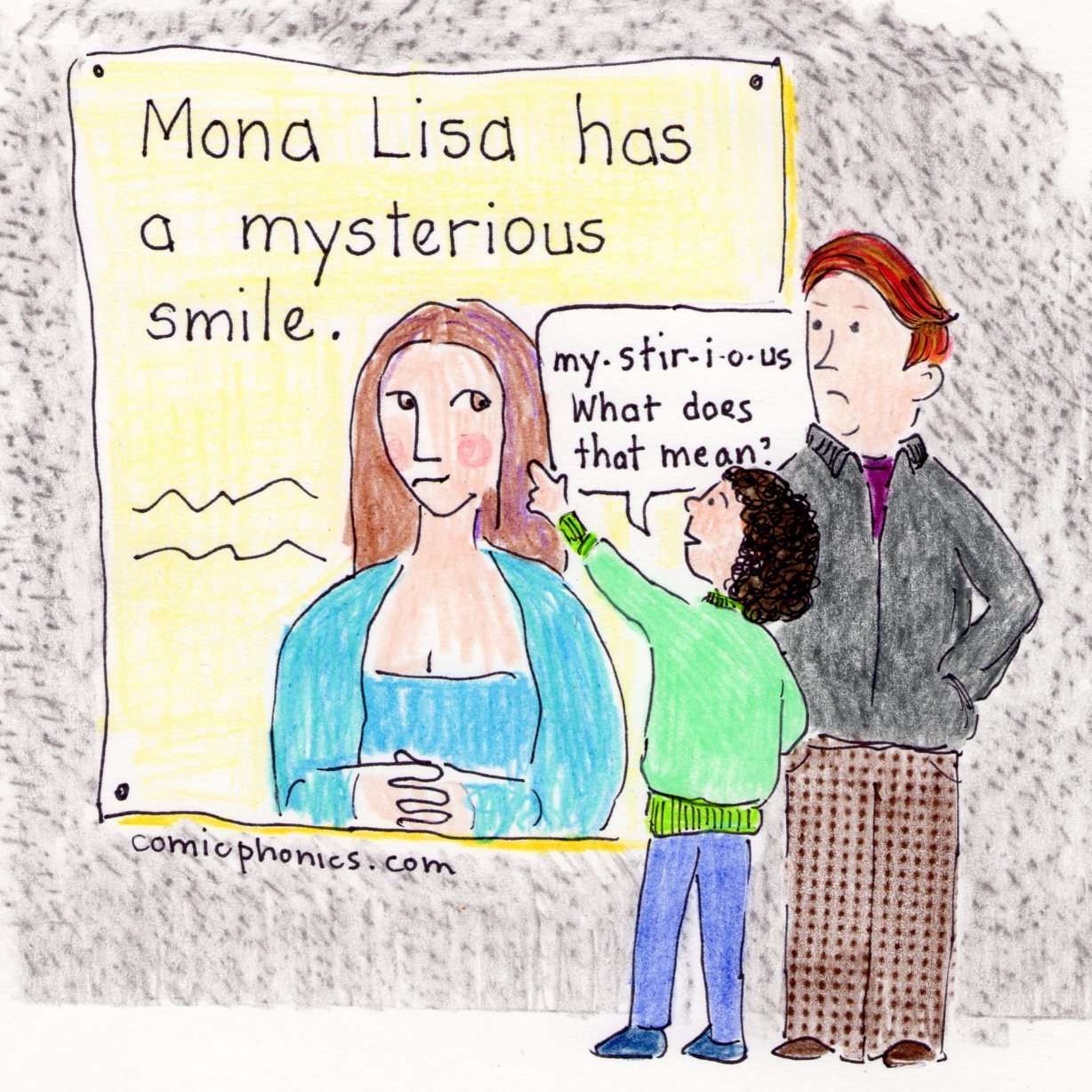
  • Young girl trying to read mysterious on a poster,It could be the number of letters (or syllables) in the word. Longer words are more difficult to read than shorter ones—more sounds, more word parts.  Covering up some parts of the word while revealing another part can help the child to focus on a little bit of the word at a time.
  • Many difficult words are actually words with prefixes and suffixes. Teach your child what prefixes and suffixes are, where to find them at the beginnings and endings of words, and what those word fragments mean.  You can find lists of words with particular prefixes and suffixes on line.  If the child is trained to look for these little parts of words, she can often figure out what a word means.
  • A word might be difficult because it has more than one meaning. The child might be familiar with a commonly used meaning, but not with secondary meanings.  When you are reading with your child and she stops, ask what that word means to her.  Then tell her there is another meaning she might not know about, and explain.  Words with the same spelling and different meanings are called homographs.  You can find common ones online.
  • Sometimes the context helps a child to figure out difficult words, but sometimes context is no help at all. Sometimes a dictionary becomes necessary.  When I tutor children, I make it a point to look up one word each lesson.  This teaches the students how to use a dictionary and that looking up words is sometimes the smart solution.
  • Too much information in context can baffle the child. What is important?  What doesn’t matter?  As an adult, you might know, so eliminate the distractors by covering them up with your fingers.  That leaves less information for the child to analyze.

Check the reading level.  The book might be too difficult for the child, replete with sentences that are long, with esoteric vocabulary words, with small type and with little white space.  If your child doesn’t have to read it, take the book away and recommend reading material better suited to her skills.  If she does have to read it, talk to her teacher about her struggles and see if there are alternative readings, especially easier ones.  Sometimes if she reads the simpler version first, she can gain confidence to tackle the harder version.  And sometimes the simpler version is good enough.

Fractured fairy tales

Being able to discuss characteristics of fiction—character, setting, motivation, and point of view, for example—is an advanced skill, something beginning readers and certainly nonreaders can’t do.  Right?

Wrong!

By using two versions of the same fairy tale, children are able to contrast the stories, telling what is the same and what is different, who is telling the story, how characters change, and where and when the story takes place.  Even writing styles of authors can be contrasted.

Another advantage of using two versions of the same fairy tale is to deepen the meaning of the original.  Just like reading one book of fiction and one book of nonfiction on the same topic deepens meaning, so does reading two differing fictional accounts of the same story.

Read about these examples and see what I mean (clicking on the cover graphic will enlarge it).

    • Mike Artwell’s Three Little Cajun Pigs Mike Artwell’s Three Little Cajun Pigs sets the porcine trio deep in Louisiana where Trosclair, Thibodeaux and Ulysse need to build homes in swampland.  Old Claude, an alligator, would like to lick his chops on couchon de lait—that’s Cajun for roast pig.  The basic elements of The Three Little Pigs are included in the story, but with changes children can easily notice, including telling the story in couplets.


    • Lisa Campbell Ernst’s Little Red Riding Hood; A New Fangled Prairie Tale Lisa Campbell Ernst’s Little Red Riding Hood; A New Fangled Prairie Tale finds Little Red Riding Hood in a red hoodie riding a bike through rows and rows of sunflowers on her way to Grandma’s.  Meanwhile, a vegetarian wolf wants to learn Grandma’s secret muffin recipe.  However, Grandma is meaner than the wolf.  Lots of details are the same, but enough differ to make finding them a treasure hunt.


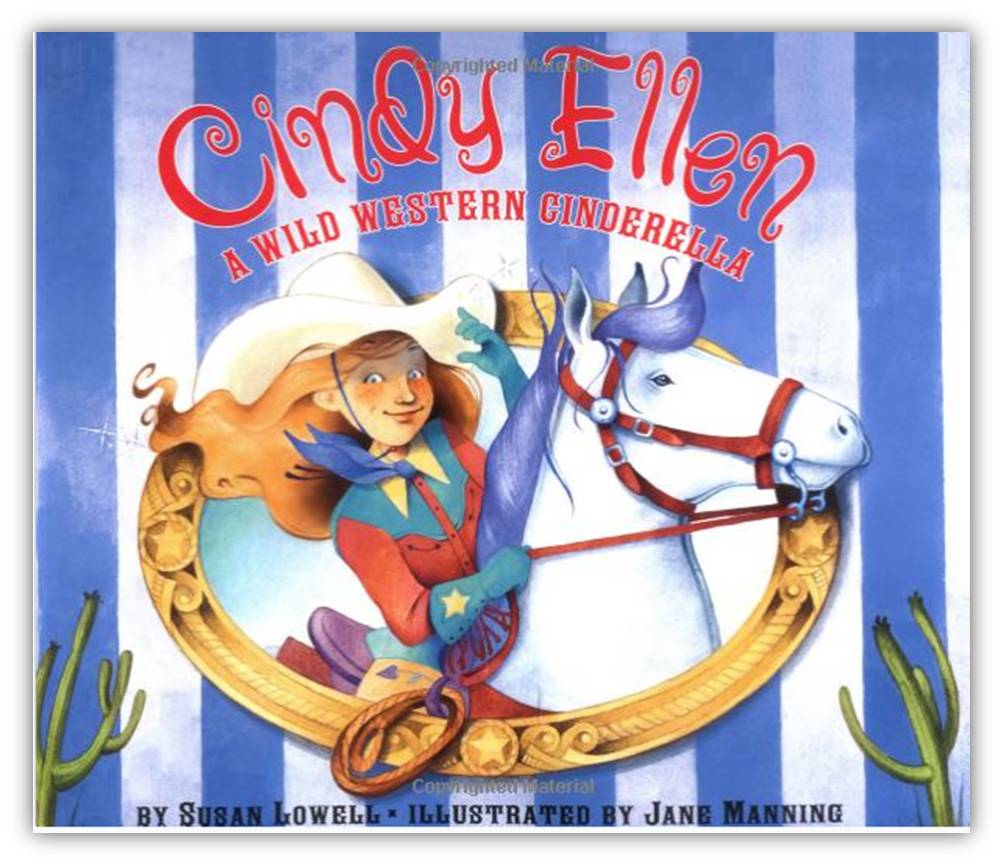
    • Susan Lowell’s Cindy Ellen:  A Wild Western Cinderella Susan Lowell’s Cindy Ellen:  A Wild Western Cinderella offers a sweet cowgirl whose father has married the “orneriest woman west of the Mississippi.”  Cindy Ellen mends fences, milks cows and shovels a corral, attracting Joe Prince, the son of a cattle king.  Lots of changes make this tale a delight, but younger kids might need help recognizing the original Cinderella in this fractured version.


    • Laura Murray’s The Gingerbread Man Loose in the School  Laura Murray’s The Gingerbread Man Loose in the School lets the sweet cookie monster loose in a school, looking for the students who baked him while they are outside at recess.  The silly story is illustrated through comic book panels, unlike a traditional fairy tale.


    •  Leah Wilcox’s Waking BeautyLeah Wilcox’s Waking Beauty focuses on a prince who will do almost anything not to kiss the snoring Beauty—hollering, jumping on her bed, throwing water at her, even shooting her from a canon.  Not your Grandma’s fairy tale.


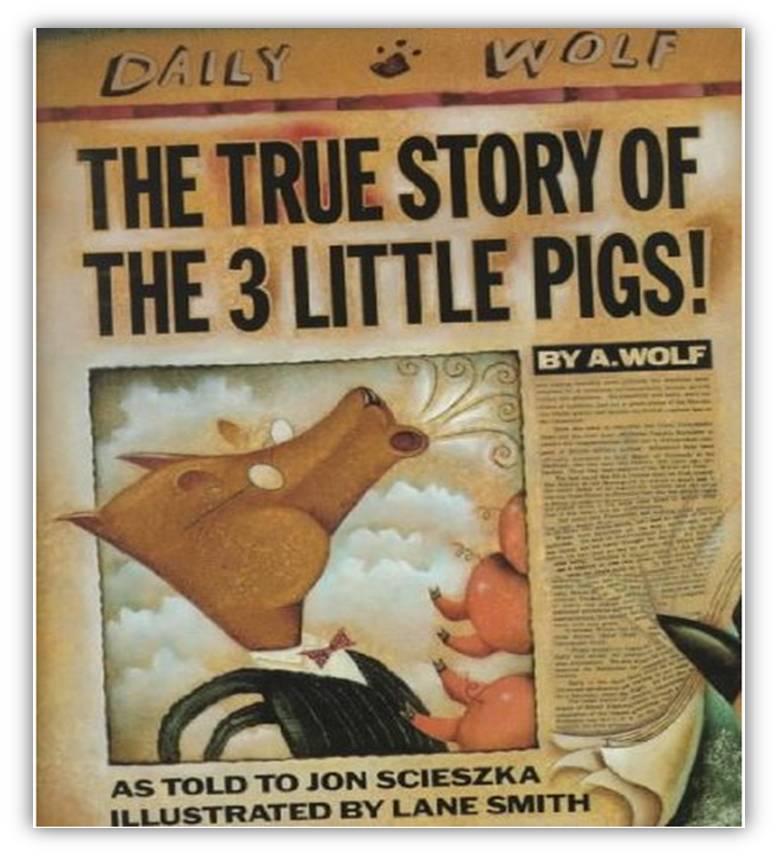
  • Jon Scieszka’s The True Story of the 3 Little PigsAnd of course Jon Scieszka’s The True Story of the 3 Little Pigs, one of the first of this type fairy tale and one of the best, tells the familiar story from Alexander T. Wolf’s point of view.

As starting points for discussion of literature with young children, these stories are great.

Eye-tracking affirms the importance of vocabulary in learning to read

Eye tracking studies confirms importance of vocabulary building. In a previous blog (Is a child’s vocabulary destiny? From July 25, 2013), I pointed out that vocabulary acquisition is the single greatest predictor of reading success. Children from professional families grow up hearing 32 million more words than children from poor families by the time they are four years old. Most of these words are repeated words, but even so, the number of familiar repeated words is enormous for some children who begin to read with that oral vocabulary advantage.

Research using eye-tracking technology confirms how important a rich vocabulary is for good reading skills. With eye-tracking, the child’s eye movements are monitored using state-of-the-art technology. This technology records the jumps the child makes between words and the pauses the child makes while figuring out meaning.

Eye-tracking technology has confirmed ideas about how children read.

–When children encounter words they know well, the eye skips along briskly.

–When children encounter new words, or words used in unfamiliar ways, the eye pauses.

Researchers have concluded that children seem to have reading word banks in their brains. These word banks are organized by how frequently the child has encountered a word. The more often a child has encountered a word (e.g. “cat”), the quicker the child can understand the word. The less often the child has encountered a word (e.g. “waltz”), the more skills—and time—the child needs to identify it.

Eye-tracking technology reaffirms for me the importance of reading to our young children so that they will hear a wide variety of words. It reaffirms the importance of talking to our children frequently, using adult vocabulary right from birth, and helping children to use specific vocabulary as soon as they are able.

It also shows that there is so much more to learn about how children read, and that technology will be important in that research.

How many books are enough books for a preschooler?

Preschooler looking at a tall stack of books.1,000 books is a great goal, according to the 1,000 Books Foundation, a nonprofit organization which has enlisted the help of libraries across the US to promote reading. Their effort, “1,000 Books before Kindergarten,” has a simple goal: Children should be read 1,000 books before they start kindergarten.

1,000 books before kindergarten? Yes. They can be all different books or some of the same books read over and over to a child. The reading can begin in utero, or when the child is an infant or toddler, but the counting must stop by the day the child starts kindergarten. Parents are encouraged to write down the name of every book and the date it was read (Log sheets are available at 1000 books).  Writing down the names promotes accountability, and the growing list encourages persistence.

1,000 books might sound daunting, but if a parent reads one book a day for three years, that is more than 1,000 books. Many parents read more than one book a day, making the feat even easier. And if a parent reads a book to two or three children at a time, that counts as a book for each of them.

Some libraries provide their patrons with a journal in which they can list the titles. Some libraries offer stickers to children for meeting benchmark goals. Some local newspapers publish the picture of all children who reach 1,000 books.

Have you participated? Were you able to reach 1,000 books? Let our readers know. –Mrs. K

Of course there are some parents who may be turned off by the idea of listing the title of every book read every day. I know that would become tedious for me. It reminds me of diets where you list every food eaten every day. After a few weeks, most of us cannot maintain the daily log. But how about just a check mark or a number on the calendar…adding up the total at the end of the month and then adding on as the year continues. –Mrs. A

How can I increase the impact of books when I read to my young son?

  • Have you considered pairing two books about the same subject, one facts, one fiction?
  • Or have you considered following a book with a related film?
  • Or have you considered reading a book about the making of a work of art (a cathedral, for example), and then visiting a cathedral with your child?
  • Have you considered reading about the creation of a piece of music and then listening to the actual piece with your child?

This slideshow requires JavaScript.


The example above pairs a picture book, sheet music (on page 78), a youtube piano tutorial, and a youtube video of an orchestra playing Gershwin’s Rhapsody in Blue. Click on these underlined links to see more details or to view the videos.

All too often, we read nursery rhymes, fairy tales and other fiction to our children without considering related nonfiction books, films, music, and paintings. Boys, in particular, might prefer additional factual information.

When my daughter was a third grader, she read Mr. Popper’s Penguins by Florence Atwater. I found some National Geographic Magazine articles on penguins, and together we read them, deepening her understanding of penguins. For a school assignment, she wrote her own penguin book, dedicating it to National Geographic. She could also have read Penguins and Antarctica by Mary Pope Osborne and Natalie Pope Boyce, a nonfiction companion book to Eve of the Emperor Penguin, part of the Magic Tree House fiction series by Mary Pope Osborne. A documentary film about penguins, March of the Penguins, would have told her about the brutal lives of penguins on Antarctica. The animated Happy Feet, though less factual, would have offered another perspective.

Is there a new baby coming into the family? Big Brother Dustin by Alden R. Carter follows a child with Down Syndrome as he anticipates becoming a big brother. A funny companion book might be Junie B. Jones and a Little Monkey Business by Barbara Park, a novel about a kindergartener’s belief that her newborn brother is really a monkey. Many child-oriented nonfiction books are available about pregnancy and birth.

When you read two different types of books on the same subject, often you investigate the subject from two different vantages. Little children need to learn that there are many ways of looking at the same information and that they all might be good, or that one might be real and the other entertaining.

Sometimes the child makes connections between the two books, but sometimes the adult needs to point out similarities and differences to obtain the most impact. For example, you could explain what the words “fiction” and “nonfiction” mean, and how Clifford is a pretend dog while a book about dog breeds shows pictures of real dogs. “Real” and “make believe” are concepts a child needs to learn.

Some children prefer fiction while others prefer nonfiction. By pairing them, the child is exposed to both genres. But of course the main reason for pairing is to deepen meaning for the child. Your child will gain the most impact if you discuss the books with him. –Mrs. K

When I was a child, my favorite book was Black Beauty.  Unfortunately, I never ventured to the nonfiction section of our library.  Was I unaware of it or just stubborn, refusing to step out of my comfort zone?  I certainly would have enjoyed learning more about horses.  My favorite TV horse was a dappled horse ridden by Little Joe on the TV show, Bonanza.  The nonfiction books would have given me opportunities to look at pictures or to read the captions, even if most of the content was too advanced for me. –Mrs. A

How about you? Have you found pairing books or books with other medium to be a good way for your child to learn more? Let us know.

My child is a reluctant reader. How can I encourage him?

First, commit to working with your child every day for many months or even years.  He will not become an eager reader without your help, or the help of a dedicated tutor who works with him several times a week.

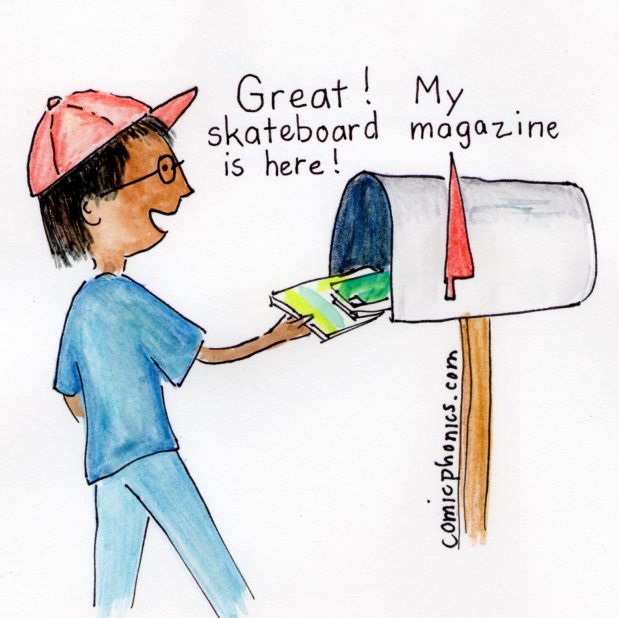
Boy at mailbox discovering skateboard magazineNext, find reading material that your child enjoys.  Boys—and most reluctant readers are boys—prefer nonfiction—how an engine works, for example, or how to build a bird house, or sports stories.  Nonfiction offers certain pluses:  illustrations (photos, charts, and diagrams), subheadings, a separate introduction, and maybe a summary.  Tempt your child with a skateboard magazine or a comic book or graphic novels.  Find online sites too.  Then:

  • Build on past success.  Ask your child to reread material he has mastered, but which he couldn’t read a short time ago.  Remind him of his gains.
  • Introduce new reading material which you suspect your child can read with 90% success.  Increase the difficulty level in tiny, tiny increments so the child has a growing feeling of success, not failure.
  • If a child stumbles through a sentence, focusing on individual words and not on the sentence, repeat the sentence for him with fluency, so he knows what the sentence means.
  • Stop the child after a passage and ask what it means.  Don’t let him move on until he knows the meaning of what he has already read.
  • Take turns reading.  You read one page; he reads one page.  Or for older students, you read one paragraph; he reads one paragraph.
  • Let him read to you without distractions.  No TV calling from another room.  No cell phone in your hand, or tablet in your lap.  No brother on a video game in another room.  Give him your undivided attention.
  • Read to your child—maybe at bedtime?—without any expectation that he will join in.  Let him enjoy reading as pure entertainment.
  • If he has only one reading strategy—such as guessing at a word—model other strategies.
  • Cover part of the word to show a part he can read.  Reveal more of the word.
  • Point out prefixes and suffixes, and cover them so the child can see the basic word unit.
  • Ask him to read a sentence leaving out a difficult word.  Together discuss what that word might mean.
  • Ask him if a word looks like any other word he knows.  Talk about word families or rhyming words which often sound the same.
  • If the child’s attention span is short, have more reading sessions but limit their time, and use a timer so the child can monitor how long the reading session will go on.
  • Praise his efforts.  Point out successes like
    • Knowing a word he missed in the past.
    • Sounding out a word.
    • Pronouncing a word using correct syllable breaks.
    • Putting inflection into his reading.
  • Talk to your child’s teacher.  She might know appropriate reading materials to recommend.  She can keep you abreast of reading skills the class is working on so you can work on them at home.  She will carefully watch your child for reading problems or successes if she knows you are working with him too.

My son was a reluctant reader, way behind at the end of first grade.  I consulted an expert and followed his advice.  I worked with my son for at least a half hour every day over summer vacation, asking him to read lists of words (for phonics) and easy reading books (for comprehension).  He hated it.  Every session was a struggle.  Yet he started second grade reading on grade level and was an eager reader after that.  By sixth grade he was devouring a chapter book a week, anticipating the publication dates of books in series he enjoyed.

The sooner you can intervene with a reluctant reader, the more likely you are of success.  Analyze your kindergartener’s or first grader’s reading habits.  If he is a reluctant reader, commit yourself to working with him now, before he becomes discouraged or evasive.  –Mrs. K