Category Archives: phonics

One example of how to teach a four-year-old to read

For several weeks I have been tutoring a four-year-old, teaching her to read.

  • I started with letter tiles, placing one before her at a time and asking her what sound each letter represented. She knew many of them, but not all of them.  As I expected, she couldn’t sound out “e” and “i” and was vague on “u” too.  The consonants “d,” “j,” “q,” “x,” “y” and “z” also were mysteries.
  • On a paper I had written all the sounds associated with individual letters, and as she said them properly, I crossed them out, to know which letters we needed to focus on.
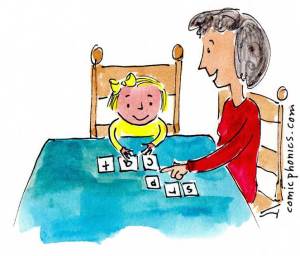
  • Reading tutor with 4-year-oldSince she was confident about “o” and “a,” I used those letters to form CVC words, real and imaginary, spelling them phonetically. With the letter “a” I sandwiched two consonants, one on either side, separating the tiles and then moving them closer and closer until they looked like a word.  All the time I was pronouncing the sounds, such as “c” “a” and “t.”
  • Since the hardest letter sounds for beginning readers to hear are the middle sounds in CVC words, I kept using the same vowel sound, the letter “a,” for one half-hour lesson. I put a “t” after the “a” and kept it there for several minutes, exchanging one beginning consonant for another as she read the words.
  • My little student caught on quickly that the sound in the middle and at the end of the word didn’t change, so all she had to focus on was the beginning sound. When we encountered one of her difficult letter sounds, I would say it and then she would.
  • At our next lesson, I repeated much of the first lesson, asking her to pronounce the sound for each letter tile. This time she sounded the “q” consistently correct, so I crossed out that letter sound on my list.
  • I made CVC words using the letter “o.” Some words were real; some were nonsense words or real words spelled phonetically.  What she showed me was that she knows the sounds of various letters.
  • The next week I used both “a” and “o” words. This was more difficult because my student needed to keep track of two sounds in CVC words.
  • This past week I used “u” as the vowel. At first, my student would forget the sound “u” represents, but by the end of the lesson, she was remembering it.

Because the lesson lasts just 30 minutes, this student hangs in there, but by the end of a half hour she is losing interest.  I compliment her work often, telling her, “You didn’t know that letter last week, and now you do!” or “You figured out that word all by yourself.”  Sometimes she acts out a word or tells me what it means, and I compliment her on that too.

These early lessons focus on letter sounds and how combining sounds gives us words.  It might seem boring to an adult, but brain research shows that there are no built-in pathways in our brains for reading, the way there are for movement and speech.  A novice reader, like my student, must activate much more of her brain to read “cat” than an experienced reader like me.  Over years of reading, my brain has built shortcuts to figuring out words that this child’s brain hasn’t done yet.

At our next lesson, we will do more CVC words using “u” as the vowel, and then exchange the “u” for “a” and “o.”  We will focus on letter sounds my student is still learning.  Her progress may seem slow, but it is steady.
My child is a reluctant reader. How can I encourage him?

First, commit to working with your child every day for many months or even years.  He will not become an eager reader without your help, or the help of a dedicated tutor who works with him several times a week.

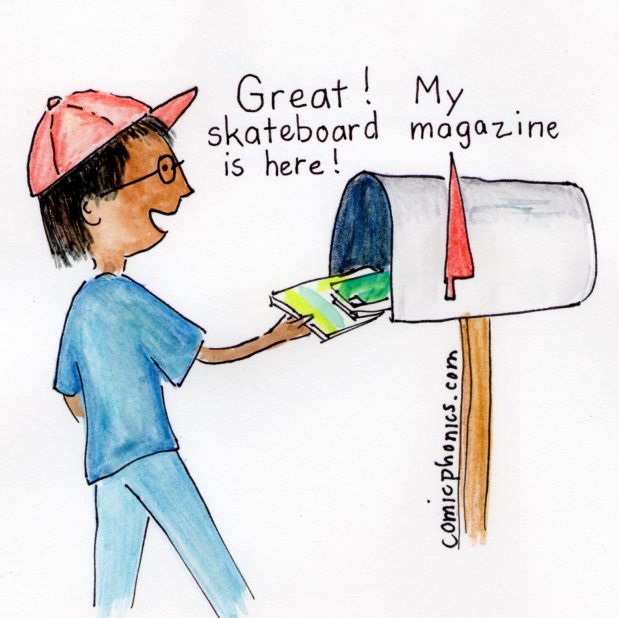
Boy at mailbox discovering skateboard magazineNext, find reading material that your child enjoys.  Boys—and most reluctant readers are boys—prefer nonfiction—how an engine works, for example, or how to build a bird house, or sports stories.  Nonfiction offers certain pluses:  illustrations (photos, charts, and diagrams), subheadings, a separate introduction, and maybe a summary.  Tempt your child with a skateboard magazine or a comic book or graphic novels.  Find online sites too.  Then:

  • Build on past success.  Ask your child to reread material he has mastered, but which he couldn’t read a short time ago.  Remind him of his gains.
  • Introduce new reading material which you suspect your child can read with 90% success.  Increase the difficulty level in tiny, tiny increments so the child has a growing feeling of success, not failure.
  • If a child stumbles through a sentence, focusing on individual words and not on the sentence, repeat the sentence for him with fluency, so he knows what the sentence means.
  • Stop the child after a passage and ask what it means.  Don’t let him move on until he knows the meaning of what he has already read.
  • Take turns reading.  You read one page; he reads one page.  Or for older students, you read one paragraph; he reads one paragraph.
  • Let him read to you without distractions.  No TV calling from another room.  No cell phone in your hand, or tablet in your lap.  No brother on a video game in another room.  Give him your undivided attention.
  • Read to your child—maybe at bedtime?—without any expectation that he will join in.  Let him enjoy reading as pure entertainment.
  • If he has only one reading strategy—such as guessing at a word—model other strategies.
  • Cover part of the word to show a part he can read.  Reveal more of the word.
  • Point out prefixes and suffixes, and cover them so the child can see the basic word unit.
  • Ask him to read a sentence leaving out a difficult word.  Together discuss what that word might mean.
  • Ask him if a word looks like any other word he knows.  Talk about word families or rhyming words which often sound the same.
  • If the child’s attention span is short, have more reading sessions but limit their time, and use a timer so the child can monitor how long the reading session will go on.
  • Praise his efforts.  Point out successes like
    • Knowing a word he missed in the past.
    • Sounding out a word.
    • Pronouncing a word using correct syllable breaks.
    • Putting inflection into his reading.
  • Talk to your child’s teacher.  She might know appropriate reading materials to recommend.  She can keep you abreast of reading skills the class is working on so you can work on them at home.  She will carefully watch your child for reading problems or successes if she knows you are working with him too.

My son was a reluctant reader, way behind at the end of first grade.  I consulted an expert and followed his advice.  I worked with my son for at least a half hour every day over summer vacation, asking him to read lists of words (for phonics) and easy reading books (for comprehension).  He hated it.  Every session was a struggle.  Yet he started second grade reading on grade level and was an eager reader after that.  By sixth grade he was devouring a chapter book a week, anticipating the publication dates of books in series he enjoyed.

The sooner you can intervene with a reluctant reader, the more likely you are of success.  Analyze your kindergartener’s or first grader’s reading habits.  If he is a reluctant reader, commit yourself to working with him now, before he becomes discouraged or evasive.  –Mrs. K

Assessing reading comprehension by using multiplication

Are you looking for a simple way to assess your child’s reading comprehension skills?  Take a look at the “Simple View of Reading.”

Although a “Simple View of Reading” (SVR) was proposed in 1986, its simplicity and success make it a useful tool to assess reading comprehension today.  Almost thirty years ago, two researchers, P. Gough and W. Tunmer, suggested that reading includes two primary steps, decoding words (using phonics skills to figure out words) and language comprehension (knowing the meaning of words especially when words are strung together to form sentences).

They represented their Simple View of Reading with a math equation:

Decoding x Language Comprehension = Reading Comprehension

(This formula uses scores from tests in decoding and language comprehension.  For this formula to work, all scores for decoding and language comprehension must be between 0% and 100%.)

What does this simple formula mean?

  • Reading comprehension requires the child to master two areas, decoding words and language comprehension.
  • If a child can do one but not the other, or can do one better than the other, his reading comprehension score will be only as high as the lower of the two other scores.

How can you use this Simple View of Reading to identify your child’s reading comprehension skills or lack of them?

  • First, ask yourself:  Is my child’s reading problem decoding?  Is his problem language comprehension?  Is he having problems in both areas?
  • If you are not sure, test the child in both areas.
  • You can test decoding by having a child read lists of real and nonsense words.  Lists are available online.  Having the child read nonsense words (e.g., zups, thab, slig) is important because some children memorize the look of a word without being able to sound it out.  Also, to assess decoding, don’t use words from a reading passage because the child might figure out a word from the context.  To test decoding, you must remove context.
  • You can also test decoding by reading an unfamiliar passage aloud and asking the child questions about facts, main ideas, sequencing and paraphrasing .  If he can respond accurately when he is the listener, yet he cannot do that when he is the reader, his problem could be decoding.
  • You can test both decoding and language comprehension by having the child read aloud to you.  (If he can pronounce words correctly, or in a few cases, use phonetic pronunciation for unfamiliar words, decoding is not his issue.)  Stop and ask the child what various words mean.  Ask the child to paraphrase a difficult sentence.  Ask the child to paraphrase the passage.  Ask the child to predict what might happen next.  If the child can decode, yet he cannot explain what he has read, his problem is likely language comprehension.  Teachers often see this situation in ESL students who learn the rules of phonics well but whose vocabulary in English is not extensive.
  • To make the evaluation easy, use a scoring method of high, medium, and low based on your own mental tally from working with the child.  If the child scores high in both decoding and language comprehension, he probably does not have a reading comprehension problem.  But if he scores medium or low in decoding or language comprehension, he has a reading comprehension problem.
  • A medium or low score in decoding means he needs more work in phonics.
  • A medium or low score in language comprehension means he needs vocabulary building, work on pronunciation, time listening to a native speaker read a text aloud, and strategies to gain meaning from sentences and passages.

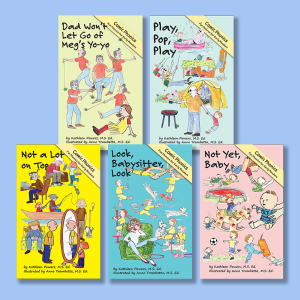
Mrs. K and Mrs. A publish fifth book, “Not Yet, Baby”

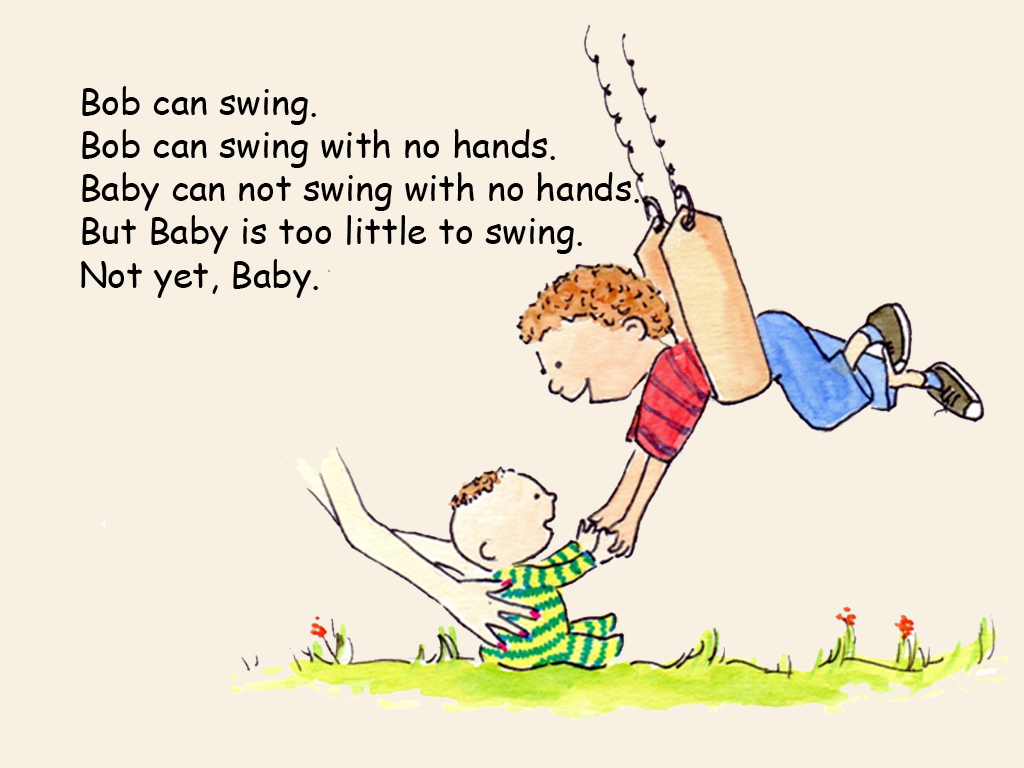
Our fifth book for children learning to read was published this past week as an app on Apple products.  Not Yet, Baby is the story of a big brother and the family baby.  The little one wants to do whatever the big brother does.

This slideshow requires JavaScript.

If big brother swims, baby wants to swim.  If big brother eats a hot dog, baby wants to eat a hot dog.  If big brother kick-boxes, baby wants to kick box.  Often in danger, the baby is dragged away just in time by two arms.

Like our other books, Not Yet, Baby illustrates typical yet humorous situations that a four, five, or six-year old would understand.  The book uses mostly one syllable, short vowel words appropriate for beginning readers.  Interactive activity pages follow—word searches, matching rhyming words, filling in the correct vowel and answering yes and no questions.

This slideshow requires JavaScript.

The idea came to me as I was traveling through national parks in Utah and Arizona last summer.  Occasionally I would get a text or a picture from my son, Tom, the dad of two little boys.  The younger one was walking and following his three-year-old brother everywhere.  Whatever the older boy had, the baby wanted.  Whatever the older boy was doing, the baby was underfoot.

I reminded Tom that he too, had been a younger brother and had been a pain in the neck to his big brother, Lou.  Lou would build elaborate corrals with wooden blocks, enclosing a dinosaur in "Not Yet, Baby" sketch bookeach compartment.  Tom would totter across the rug, destroying the entire habitat.  On the tour bus in the Rockies, as I remembered spending hours restraining the rambunctious Tom, the ideas flowed, and within a few days I had a book full of sketches!

As you read Not Yet, Baby, you may remember being the older child trying to understand the limitations of a younger one.

Page 13 of "Not Yet, Baby"

Here’s page 13 of “Not Yet, Baby” from the sketch book idea.

Or maybe you can relate to a baby trying to keep up, or the adult who works tirelessly to keep one child safe and another one happy.  Maybe the story will lead to talks with your child about your childhood or his.  There’s so much to talk about in Not Yet, Baby.  You can find the “Not Yet, Baby” iTunes app at http://goo.gl/CVTFZx.

Mrs. A

More tips to help a child read bigger words

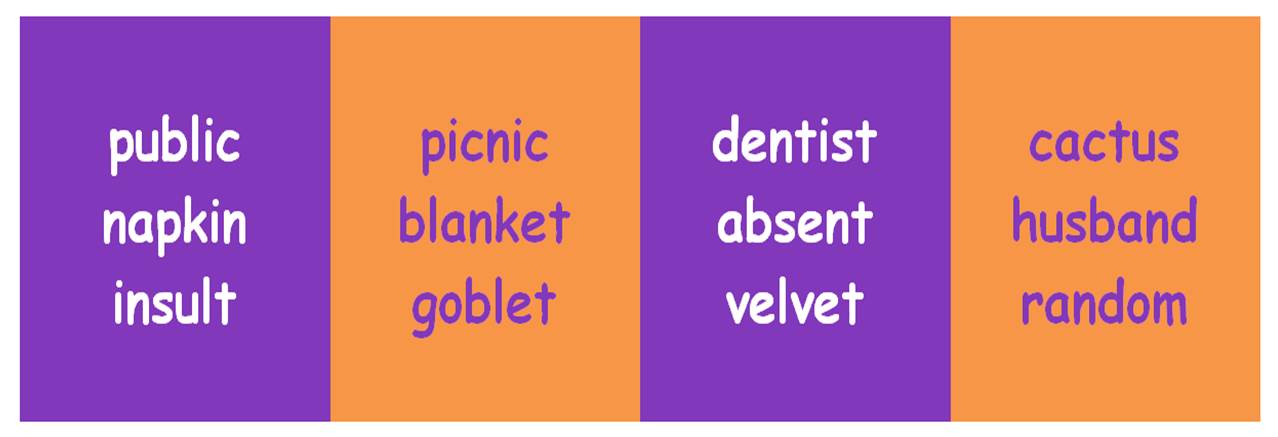
  • The same rule that applies to CVC/CVC words applies to CVC/CVCE words; that is, to words of two syllables which have (usually) a short vowel in the first syllable, two consonants in the middle of the word, and a long vowel in the second syllable controlled by a silent “e” at the end of the word.  The syllables split between the middle two consonants unless there is a blend, in which case the syllables split before or after the blend.
  • To teach these words, it might be easier to find some compound words that form this way, such as “tadpole,” “backbone” and “pancake.”  Make a list and let the child circle the two separate words which form the compound word.  Then ask the child to put the separate words together to form a new word.  Some words you might use are
     
    Two words that together make one word
  • When these words are mastered, move on to CVC/CVCE words which are not compound words such as “membrane,” “umpire” and “pollute.”  The same rule applies as above.  Have the child divide the word between the syllables.  If the child has trouble deciding where to divide, remind her that usually one syllable ends and another one begins between the two middle consonants.  Help her to identify blends that need to stay together in the same syllable.  Some words you might use are
     
    two syllables divided by middle consonants
  • When your child understands the pattern, you might explain that some bigger words follow the same pattern.  Introduce three syllable words with the CVC/CVC/CVCE pattern, such as “illustrate,” “vaccinate” and “indispose.” But if the child is struggling to understand the previous CVC/CVCE words, hold off on three syllable words.  Some words you might us are
     
    Introduce three syllable words.

Our blog will continue to teach multisyllabic words in the near future.  Let us know if you find this information useful or if you have particular problems teaching your child reading.  We will investigate for you and offer the best advice we can find.  –Mrs. K and Mrs. A

My granddaughter can read small words, but she stumbles over bigger words when we read together. How can I help her?

Here are some tips to help with bigger words:

  • If you are reading for sheer enjoyment, anticipate the words she might not know and say them quickly, so she can keep reading and not lose her thought.  Don’t worry that she might not be learning new word attack skills in your reading session; she is learning other aspects of reading such as fluency and comprehension which are often hard to learn when she stops to consider every new word.  Also, if she is tired or ornery, this kind of reading lesson gets her to read without causing frustration.grandparent reading with grandchild.
  • But if you are reading with your granddaughter to help her decipher words, and if she is in a receptive mood, you might cover parts of the word (usually syllables) and then uncover them, so she can join them together.  For example, if the word is “continent,” cover the “tinent” part with your thumb and let her say “con.”  Then cover the “con” and the “ent” parts and let her read “tin.”  If she mispronounces “tin,” pronounce it correctly.  Then cover all but the “ent” and let her figure out those four letters.  If she can put it together, fine, but if not, you do it while covering and exposing parts of the word as you say it.  Then move on to another word.  The goal should be to teach her a method of figuring out words, not mastering every word you encounter in a particular lesson.
  • If you own the book, and don’t mind marking it, you could highlight every word she can read correctly.  She will see that the number of words she can read far outnumbers the few she can’t.  You might ask her what she notices about the words that are not highlighted.  She might say, “They are long,” or “They have lots of letters.”  Tell her there are ways to figure out those words just like there are ways to figure out three-letter words, and you will work with her on those long words.
  • A good place to begin is with compound words.  They can be easy to decipher if the child looks for small words inside big words.  Try some with her such as “pancake,” “popcorn” and “forget.”  Make a list of such words and let her be the detective, discovering the small words inside the large words.  Have her circle each of the small words and then pronounce them together.  Some words you might use are:compound words are small words inside big words
  • Some longer words have pronunciation rules that are easy for a child to remember.  For example, if a six- or seven-letter word has double consonants in the middle (biggest, kitten, flabby), that means the word usually has two parts, or syllables, and the first syllable ends between the “twin” letters.  (Use the word “syllable” since this is a term your granddaughter will need to learn anyway.)  Phonics books sometimes refer to these words as VC/CV or CVC/CVC words since they generally have short vowel sounds in both syllables.  You could practice a handful of those words, writing them on notebook paper for your granddaughter to pronounce.  Choose words whose letters follow the rules of phonics so she is not confused.  Have her draw a line between the double consonants and then pronounce each syllable.  Some words you might use are:"twin" letter words have double consonants in the middle.
  • Some other six- or seven-letter words have one vowel near the beginning, another vowel near the end, and two or three consonants in the middle.  These are a variation on VC/CV or CVC/CVC words with twin conconants.  Show her words like “contest,” “nutmeg” and “insect.”  Explain that the words have two syllables, and that the first syllable ends between the two consonants.  Have her draw a line between the middle consonants and then pronounce each syllable.  Some words you might use are:two syllable words with vowels in the first and last syllable

Our blog will have more on how to teach multisyllabic words in the near future.  Let us know if you find this information useful or if you have particular problems teaching your child reading.  We will investigate for you and offer the best advice we can find.  –Mrs. K and Mrs. A

How do I teach CVC words that end in –ck and words that end in –ook without confusing my son?

When a child is learning to read, and is at the short vowel, one-syllable, consonant-vowel-consonant (CVC) word stage, the child often encounters words from the word family –ook (book and look, for example) or words that end with –ck (sock and truck, for example).  Strictly speaking, these word don’t follow the CVC rule for pronunciation, so they should be taught separately, starting with the –ck family words.

CVC words that end in _ch and _ook.

To enlarge, click on the picture.

Usually there is no problem reading CVC -ck words once the child understands that –ck is a single sound.  But reading, pronouncing and spelling the –ook words can be a problem.  How can you help your child?

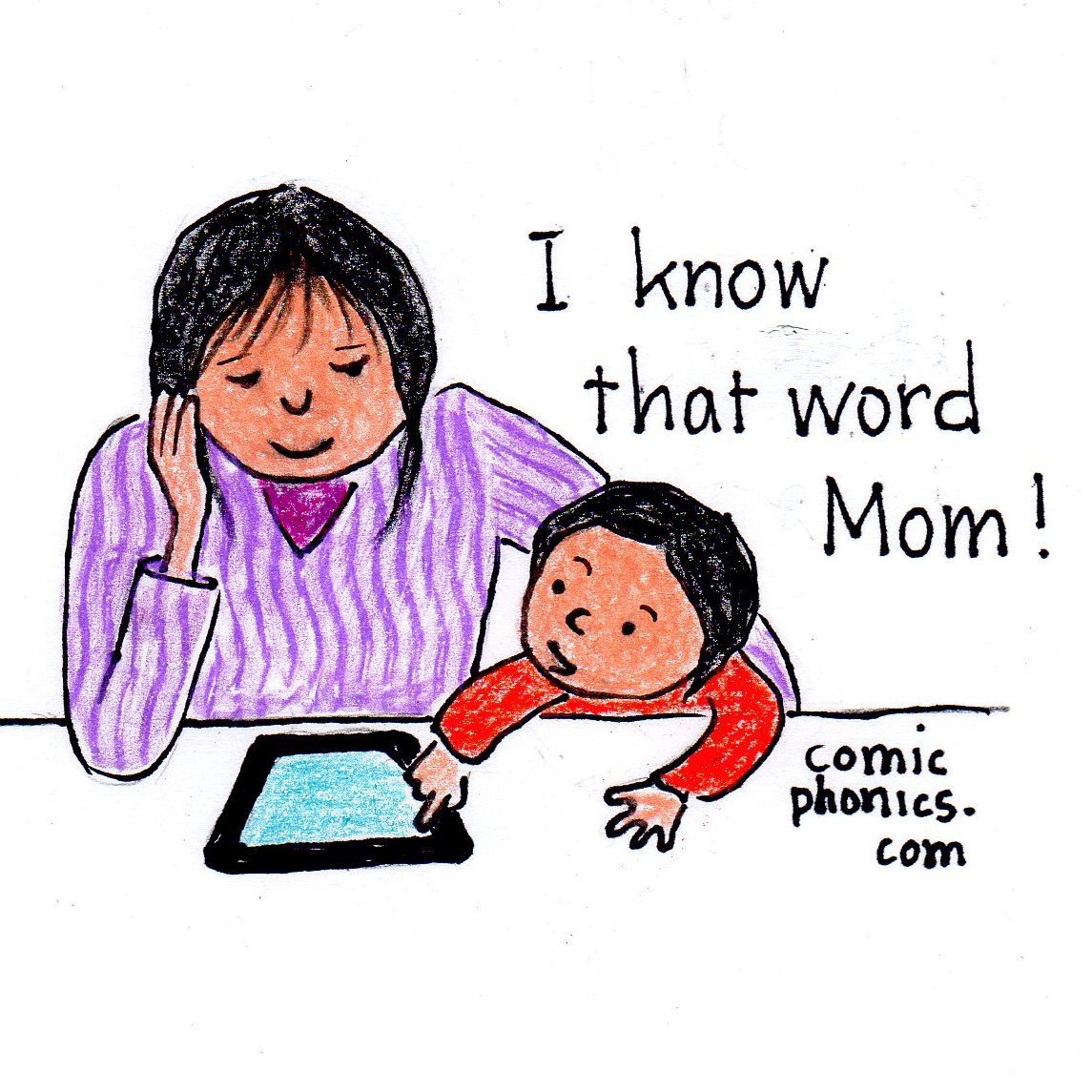
"I know that word, Mom," says the child lookinFirst, wait until your child is comfortable with CVC –ck words (see list above) to explain this difference.   Teach the CVC words that end in –ck first and make sure the child understands how to read, pronounce and spell those words.  Then introduce –ook family words.

  • Point out to your child that the –ook sound is not the same as the short –ock or short –uck sound.  Say the sounds aloud so the child can hear the difference, and ask the child to say the sounds too.  Don’t show letters at this point since it is the sound that guides the child as to which letters to use.  The child needs to be able to hear the difference.
  • If you have pictures of words that end in –ock (clock, dock, flock, knock,), in -uck (buck, puck, suck, tuck, truck) and –ook (book, cook, crook, hook, rook) you could create a set of flash cards for the child to sort by sound.  As the child sorts, ask the child to pronounce the word to be sure she is hearing the word correctly.
  • Tell your child that after a word with the –ook sound, just a “k” is used, as in book and look, two words the child might already know as sight words.  You could create a set of flash cards with the –ook family words on them and use them as sight words if that helps.
  • If you have letter tiles, practice moving them to show –ook family words and ask the child to read them after your example.
  • When the child seems comfortable with the difference in sound, practice moving tiles to show the difference in spelling.  For example, construct l-o-ck, and under it construct l-oo-k.  Say each word and ask the child to tell what he notices.  Do the same with other word pairs such as cr-o-ck and cr-oo-k; h-o-ck and h-oo-k; r-o-ck and r-oo-k; and t-o-ck and t-oo-k.
  • Practice moving tiles so that just one word—lock—appears.  Ask the child to pronounce it.  Take out the -ck and put in –ook and ask the child to pronounce the new word.  Keep moving tiles around until the child grasps the correct pronunciation of each word.
  • When you are reading –ck and –ook words, reinforce the spelling.

At this point the child usually hasn’t learned how to read long vowel sounds, so there is no need to add to confusion by introducing words like bake and smoke now.

How many letter sounds are there in English?

That depends.

The International Phonetic Association (IPA) which devised a method to categorize spoken sounds, says American English has 44 sounds—20 vowel sounds and 24 consonant (and digraph) sounds.  The IPA has devised symbols for each of these sounds—most of them letters of the Latin alphabet with some Greek letters and other symbols thrown in.  Speech pathologists use these symbols to write down the exact sounds a student speaks when they are identifying speech problems.

The International Phonetic Association (IPA) says American spoken English has 44 sounds—20 vowel sounds and 24 consonant sounds.

Click on the chart for an enlarged version.

In general, American English has fewer sounds than British English.  Standard English (usually considered the way English is spoken by someone from the Midwest) has 16 vowel sounds, at least four fewer vowel sounds than standard British English.  Since accents vary from region to region, some parts of the US might have more or fewer vowel sounds.

When a child is learning to read in English, making a sound is not the problem; it is the many ways a single sound can be shown in letters.

Some teachers have tried to help students, especially ESL students, to master the sounds by adding symbols to letters with multiple sounds:  a curve over a short vowel, a horizontal line over a long vowel, and printing two letters that have a single sound as one letter without a space between them.  This does make it easier for the student to associate sounds with symbols, but teachers have found the students grow dependent on the symbols and cannot shift to reading letters without those symbols.

Because students have so much trouble matching a sound to a letter, many reading methods have developed.  However, a study by the U.S. government a few years ago found that a systematic phonetic approach works best with young children learning to read.

My child is struggling to learn short vowel sounds. What can I do?

As a temporary help, you could create word lists or flash cards using color-coded letters for the vowels.

Colors for vowel soundsIn Tutoring is Caring, Montessori teacher Aline D. Wolf suggests printing the letter representing the vowel sound in a particular color to help the child remember the sound.  She suggests using colors whose name has the letter sound that the child is trying to say.  So for example, short e words would be written with red e’s.  Since vowels are the most difficult sounds for the child to master, the color would alert the child that the colored letter is a vowel, and the color would also give the child a clue as to the letter’s pronunciation.

The colors Wolf suggests are

  • Red for the short e sound since red’s vowel sound is short e.
  • Rust for the short u sound since rust’s vowel sound is short u.
  • Silver for the short i sound since silver’s vowel sound is short i.
  • Tan for the short a sound since tan’s vowel sound is short a.
  • Olive for the short o sound since olive’s vowel sound is short o.
  • Black for all consonants.

Wolf says it is important that the child recognize the colors using their specific names.  If a child sees olive and says green, then the clue that the sound of “ol” gives would be lost.  She recommends beginning with “e” and then “u” because they are easier.

Wolf wrote her suggestions in 1981, before personal computers, so today we have other options.  Using a computer, it is easy to duplicate these colored letters in words, just as using crayons or colored pencils makes it easy by hand.

Another suggestion she makes is to use broken lines for silent letters, a signal to the student that the letter is necessary but it is not pronounced.  This is easy to do if you are handwriting the letters, but I could not find a broken letter type face on my computer.  However, the computer offers other options such as outlined letters or highlighted letters, either of which could indicate silent letters.

With her lists of color-coded words, Wolf puts a drawing of a word that begins with that letter at the top of the list as an extra reminder of the letter sound.  So for short e, there is a drawing of an elephant; for u, an umbrella; for i, an igloo; for a, an alligator; and for o, an olive.

Cautioning that color-coding is a crutch, Wolf says it should be used as long as necessary, but that gradually the child should be weaned from the colors.  For children who don’t need the extra boost that colored letters give, they should not be used at all.

How to wean a child?  Wolf suggests that the child could match color coded words with the same words printed in black.  Or the child could match words printed in black with objects around the house or at school such as milk, pan and egg.  The child could also match words with pictures.

Check out our newest beginning reader book app, “Dad Won’t Let Go of Meg’s Yo-Yo.”

Like our previous app books, Dad Won’t Let Go of Meg’s Yo-Yo is written in easy, one-syllable, mostly short-vowel words that beginning readers can sound out.  The story is silly—a father gives his little girl a yo-yo for her birthday, and becomes so engrossed in showing her how to do tricks that little Meg can’t play with her yo-yo.  Eventually the father realizes his mistake, apologizes, and cuts the string to fit Meg.

Dad won't let go of Meg's yo-yo.

Our fourth book app for early readers is at http://goo.gl/XDZoy1

Our app books are genuine literature, that is, real stories with a beginning, middle and end.  Yet very early readers—those who know consonant and short vowel sounds—can read the books and appreciate the story.  The art is humorous, meant to appeal to the child’s funny bone, yet the message at the end—an apology—teaches the child an important value.

In addition, because Dad Won’t Let Go of Meg’s Yo-Yo and other books are apps, they are interactive.  At the end of each book are ten pages of activities which take advantage of technology.  Students can draw lines with electronic crayons; they can swipe words with a highlighter; they can draw letters or circle yes or no.  When they are done, they can erase and start over, or save, or email to Grandma.

Dad won't let go of Meg's yo-yo vocabulary exercise.If you are a teacher with a white board, and you have an iPad or iPhone and a computer compatible with Apple products, you can show the book on your white board and let the whole class participate.  Right now you need to be able to download our app on an Apple device, but eventually we will have our books available for Android products.

To preview Dad Won’t Let Go of Meg’s Yo-Yo, go to http://goo.gl/XDZoy1.   To preview our other books go to http://goo.gl/JMrT3, http://goo.gl/ClVyM, and http://goo.glK1HcU.