Category Archives: letter sounds

My third grader skips over long words when she reads aloud. When I ask her to pronounce them, sometimes she can if she segments them, but many times she can’t. How can I help her?

Lots of children do this, thinking they can gain enough meaning from the rest of the words. And sometimes they can. But usually this is a sign of a struggling reader.

Your daughter needs to learn strategies to figure out new words.
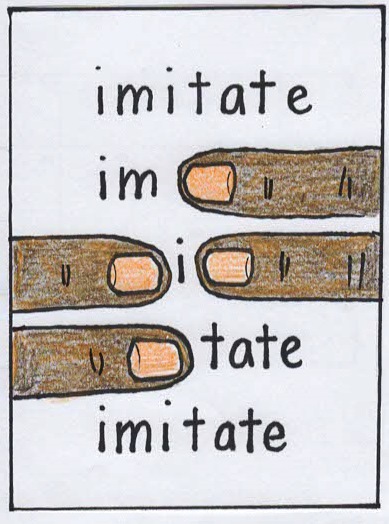
fingers covering parts of word, then revealing themWhen she reads aloud to you and encounters a word she skips, stop her and cover parts of the word to help her figure it out in small chunks. For example, in a word like “imitate,” cover over all but the “im” part. Ask her to pronounce “im.” Then ask her what a short i sounds like. Show her the “i” in the middle of the word and ask her to put those sounds together. Then show her the “tate” which should be easy to pronounce. Now reveal the word bit by bit as the child says it. You say it too to be sure she hears it pronounced correctly.

But she still might not know what the word means. Help her to understand it. Use it in a couple of sentences. My experience working with children is that many times they can remember the meaning of words, but they cannot use them properly in sentences. Ask her to create her own sentence using the word.

I would make a list of words she has learned this way, and later in the day or the next day, go back to them. Ask her to read the words and tell you what they mean. Return to these words from time to time to reinforce them.

I would also try to find ways to use the words in your everyday conversations with your daughter.

Perhaps your daughter needs more phonics education. You could quickly go over CVC rules of adding suffixes. You could instruct her about prefixes and what they mean and rules for adding them to root words.

Letting your child slide over long, unfamiliar words sets up a bad habit. Eventually, when she gets into middle school classes, she’ll encounter such words routinely and will need strategies to figure them out. Talk to her teacher about the situation. Perhaps there is a reading specialist in your school who could come to her classroom from time to time and help the students decode longer words.

And I will provide more information about how to decode longer words in upcoming blogs. Keep tuned.

My child is almost four. She wants to learn to read. Where do I begin? Or does it matter?

It matters, according to research. You should start with teaching her “the code,” that is, the connection between the sounds of the English language and the letter symbols we use to mean those sounds. Here’s how. (Look for more information on all these ideas in previously published blogs at comicphonics.com.)

  • children moving letter tilesFirst, make sure she can pronounce all 42 sounds of English. Listen to how she pronounces everyday words and make sure she is saying the sounds correctly. Help her with pronunciation.
  • Then connect sounds with letter symbols, a few at a time. Start with the beginning sounds of a few key words such as the child’s name, m for mom, d for dad, b for baby. Help her to hear those sounds in the beginnings of other words. For example, if you are pouring her milk, ask her what sound milk begins with. Then show her an “m” and explain that is how we show that sound.
  • Beginning sounds are always the easiest to hear, so focus on them.
  • Help her to write the initial of her name and a few other meaningful letters.
  • child on floor reading picture bookSince each vowel has many sounds, teach her to associate each vowel with a word and an image that begins with a “short” vowel sound such as apple, egg, igloo, octopus and umbrella. Later, she can compare the vowel sounds in new words to those vowel sounds.
  • In speaking, start putting letter sounds together to form one-syllable short-vowel (CVC) words she knows, like “cat” and “dog.” When she can hear how words are formed (phonics) by combining sounds, use letter tiles to show her what the combining of sounds in words looks like using letter symbols.
  • When you are reading stories to her, point out words she might be able to decipher, and help her to sound them out.
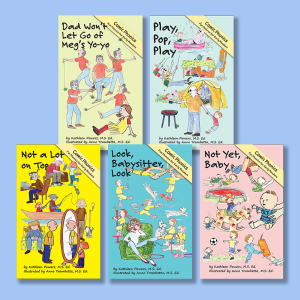
  • When she knows most of her sound – letter matches, she is ready to start reading books which use one-syllable, short-vowel words. Unfortunately, few good ones exist. We at comicphonics.com have written five humorous books for new readers. (See the links to the right of this blog.) Your librarian can point out where other books are shelved, but many labeled “first” readers contain difficult words. Margaret Hillert has written some good beginning books, and so has Dr. Seuss. Good illustrations can help the child figure out the meanings of difficult words, but she will probably need your help as she begins.

Figuring out the code of written English is how a child begins to learn to read. There are lots of commercial methods to do this, but the best I have found is the Explode the Code series. Children find its combination of goofy pictures and sequenced phonics instruction fun.

Later you can focus on other aspects of reading including fluency and comprehension. But the place to begin is demystifying the code by connecting the sounds of our speech to individual letters and pairs of letters, and then combining them to form words.

Case study: Julie, a seven-year-old, high-achieving reader

Julie had just turned four when I began to tutor her in reading. Her mother, a native of China, had been taking Julie to a tutoring agency since she was barely three. The mother worked with her daughter daily on the reading lessons which Julie brought home.

Child looking at flash cards of two and three letter words.

.

When I met Julie, she could read many one-syllable words and some two syllable words. However, I noticed that when confronted with a new word, she could not figure it out. She had memorized the look of the words she knew but she had not learned phonics skills to sound out new words.

We began by reviewing ABC names and consonant sounds, almost all of which Julie knew. Then we spent many lessons on vowel sounds, focusing on short vowels first, and later mixing both short and long vowel sounds. We did this using pictures (pig, hat, run) which Julie would match with cards labeled ā ē ī ō ū and ă ĕ ĭ ŏ ŭ. We would spend about ten minutes of a lesson on this kind of work. Julie’s attention span was about ten to twelve minutes, so this was one of several activities in a single, hour-long lesson.

Tutor teaching a child.

When she mastered the vowel sounds using pictures, we worked on forming three-letter words using short vowels. At first I moved letter tiles around to form words, and with time, Julie made her own combinations and tested me to see if I knew what words she had formed.

Next, I added blends to short vowel words, first at the beginnings of words, and later at the ends of words. She found the beginning blends easier than the ending blends, as most children do. I made index cards with blend words on them, and when Julie would read a word on a card correctly, she would use a date stamp to mark the card—a way to make the learning fun. After a few weeks she mastered the blend words.

Late in our first year together, Julie began work on long vowel words ending with a silent “e.” She knew many of them by sight but not by sounding a word out. As our first year ended, we were working on long vowel single syllable words with double vowels such as “beat,” “fuel” and “rain.”

We were also building words using roots, prefixes and suffixes whose parts were written on little cards which Julie would push together to form words such as re-mix-ing and un-read-able. In the months which followed, when she encountered a long, unfamiliar word, she sometimes covered the prefix or suffix to figure out the middle part, and then constructed the word bit by bit as I had demonstrated.

Young girl reading a book

Julie could read many picture books. She enjoyed short paragraphs with colorful pictures on each page, but she would not try a chapter book. “Too many words,” she would say. She continued to go to the tutoring agency and do the reading homework with her mother, and to work with me once a week. When Julie was five, we began adding spelling and sentence writing to her lessons.

Julie is 7 now and has finished first grade. She is in the gifted program at her school. She reads voraciously, everything from Ranger Rick magazines to hundred-page chapter books. She has exhausted the phonics-like reading materials I have. She can read fourth or fifth grade materials as fluently as I can. She is working on expanding her vocabulary and on using more details in writing.

Julie is an example of the progress a child can make with a tutor or tutoring center augmenting school instruction. She is also an example of what studying during school breaks can do. She goes to school year round—nine months in her public school, and 12 months with tutors and her mother. Julie has a mother committed to Julie’s education, a mother who scours the library for appropriate books for Julie, subscribes to Ranger Rick, and oversees Julie’s homework and her piano practicing. She also teaches Julie how to write using Chinese pictographs.

For Julie, education is a way of life.

Julie—mischievous, hardworking and accomplished—could be your child’s classmate.

My first grader seems clueless when it comes to rhymes. Are rhymes important?

Yes and no. Being able to hear rhymes (sometimes called word families) helps a child to recognize that many of the last sounds in words are similar and are often spelled the same. Hat, cat, fat and sat all have similar rhymes and are spelled with the same ending letters. When a new reader figures out that many words have ending patterns and don’t need to be learned from scratch, these patterns might seem like helpful short-cuts.

A teacher says the first part of a rhyme, and the child says the rest of it.In a one-syllable word, a rhyme is considered everything but the initial sound (called by reading experts the  onset sound). So eight, bait and Kate all rhyme even though they are spelled differently.

However, reading research shows that being able to recognize rhymes is not the most important skill for a beginning reader. Other skills such as matching a sound to a letter or pair of letters, or being able to break apart a word into its phonemes (separate sounds), or blending separate sounds into words are more important skills than rhyming and predict better whether a child will learn to read.

Recent research shows that learning how to read sometimes increases a child’s ability to recognize rhymes, rather than the other way around (McNorgan, Awati, Desroches, & Booth, 2014).

Recognizing rhymes can be fun though. You might try reading nursery rhymes to your child, emphasizing the rhyming words. Or you might try singing childish songs  such as “The Itsy Bitsy Spider” or “Three Blind Mice” with your child. Sometimes replacing the second rhyming word with a nonsensical rhyming word can jolt the child into supplying the correct rhyming word. This can lead to a comment by you about finding the correct rhyming word.

Don’t fret about your child not recognizing rhymes, especially if your child is ESL. With time we all figure it out. Focus on the more important phonics skills.

Kids learn sounds from big to small

Little children who are learning about the sounds in words move from larger units of sound—phrases and words—to smaller units of sound—sounds within syllables.

Take the word “elephant,” for example.

Word: elephant
Syllables: el-e-phant
Onsets/rhymes e-l e f-int
Phonemes e l e f i n t

children pronouncing elephant

First, children learn that sentences are composed of words. (I can remember being in first grade and learning that “of the” is two words, a revelation at the time).

Next, children learn the sound of the whole word. They might mispronounce “elephant,” saying it as a two-syllable word (el-phint) as they grow accustomed to it. Eventually they say it right.

Children then learn to break the word into parts (syllables), pronouncing each syllable distinctly.

With a teacher’s or parent’s help, they learn to identify sounds within the word.

Later, they learn to match those sounds to letters.

This sequence—from a phrase to whole words to syllables to the smallest distinct sounds—provides a useful guide for adults teaching reading to preschoolers. We should make sure a child can hear the sounds of a word and can reproduce them properly before we begin to break a word into parts and associate letters with those parts.

What are some activities that help a child to master the phonological awareness sequence?

• Say a two or three-syllable word, leaving pauses of a second or two between syllables. Ask the child to combine the syllable sounds into a word.

• Ask the child to break a two or three-syllable word into its parts. This is a harder skill than combining.

• Ask the child to say (not spell) the sound before the vowel sound in a word (the onset sound). For example, in the word “dog,” the onset sound is the sound a “d” makes.

• Say tongue-twisters and ask the child to identify the alliterated sound. For example, in “Peter Piper picked a peck of pickled peppers,” the onset sound is the sound a letter “p” makes.

• Sing songs with rhymes. Ask the child to identify the rhyming sounds.

• Ask the child to say the rhyme part of a word or syllable. The rhyme part is all the sounds beginning with the vowel. So in “dog,” the rhyme is “og.”

• The hardest activity is for the child to break down a syllable into every sound (phoneme). American English has 42 phonemes, or sometimes more depending on regional pronunciations. (Sounds made by “th,” “sh” and other digraphs are considered distinct sounds, which is why English has more phonemes than alphabet letters.)

While learning the ABC’s is a skill most preschools stress, the other skills explained need to be learned first. Some kids are ready to break a syllable into phenomes at four years old, but many more are not ready until part way through first grade. Don’t rush them. Instead, spend time on all the preliminary steps.

For more details on this sequencing of learning sounds, go to http://www.naeyc.org/files/yc/file/200901/BTJPhonologicalAwareness.pdf. While you are there, check out the list of read-aloud books that emphasize sounds, and the additional activities you can do with a child who is learning sounds.

Is Why Johnny Can’t Read still used to teach reading?

Why Johnny Can’t Read is a book by Rudolph Flesch, Ph. D., a readability expert in the US from the 1950s until his death in the 1980’s. This book advocated a phonics-based approach to learning to read when most American children were learning the “look-see” approach of memorizing the look of a word. Today Flesch’s approach is out of favor if used alone, but if it is used in combination with some other approaches, it can be part of a good approach to teaching reading.

However, kids hate it.

CVC words that end in _ch and _ook.

To enlarge, click on the picture.

Flesch’s approach is to break down phonics into sounds which correspond with letters, and to teach lists of the same sound. One of the beginning lessons is a list of several columns of short a CVC words; it is followed by a page each of the other short vowel sounds. Then the short vowels are mixed together, two vowel sounds at a time. Gradually all the sounds of English are introduced through lists of words which use those sounds.

The problem is that reading lists is boring for children. They find it hard to stay focused for more than a few minutes on such a task, so if that is the only strategy, kids resist these lessons.

Other reading programs have taken Flesch’s idea and have presented the lists a different way. One of the most successful is Explode the Code. For a lesson on bl, cl, fl and gl bends, for example, there are nine pages of activities. On one page the word to be learned is to the left, and to the right are three pictures, one of which illustrates the word. The child needs to circle the correct picture. On the next page the student sees a word on the left and needs to circle the same word (one of three) on the right. On another page the student fills in the blank with a word which is illustrated to the left. On another page the student answers a question using one of the blend words. Students prefer the variety that this approach takes.

When I teach reading to beginners, I use a combination of Flesch’s ideas and others. I don’t use his long list of words, but sometimes I give my students one column of his lists. For variety, I put words on index cards which the child can hold and shuffle, so the child has more control. Again, I limit the number.

I taught my three children how to read using the lists at the back of Why Johnny Can’t Read, so I will always be grateful to Flesch, his research, and his simple, straight-forward approach to teaching phonics. As a writer, I am grateful for his guides on how to write plain English.

Is it necessary to teach “r” words like “car” and “or” separately or should I include them with short vowel, CVC words?

Although children will pick up r-controlled words as they learn to read, it is a good idea to have a separate lesson on them since they are neither short nor long vowel words, and since “ir,” “er” and “ur” sound the same.

Just like it helps to have a reference word for short vowel words, it is a good idea to teach reference words for r-controlled words. I suggest you use nouns whose image is obvious to a child, such as

ar car, jar or star
or fork, stork or sword
er Bert (from Sesame Street) or fern
ir bird or skirt
ur church or turtle

pictures of R-controlled words to use for memory

When you begin to teach r-controlled words, choose words whose spelling follows the rules, such as

far bar fir her
purr slur stir for
nor sir sort start

Don’t choose “store,” “floor” or “boar,” or other words whose spelling varies. Start with one syllable words, and then move on to two syllable CVC-CVR words with twin consonants such as

better bitter butter differ
hammer dinner ladder matter
offer pepper rubber zipper

Continue with two syllable CVC-CVR words whose middle consonants are not identical such as

timber under lantern fender
lobster master silver winter
lumber member butler monster

Then put the r-controlled syllable at the beginning of the word, using words such as

carpet organ carbon hermit
perfect serpent verdict perhaps
perfume person Vermont artist

At this point the student should be able to add consonants after the r-controlled syllable to create flirt, squirted and discard.

If your child has already learned CVC-CVC words, adding r-controlled words should be easy for the child. Even so, take small steps, and when he is ready, move on. As for “store,” “floor” and “boar,” you can tell your child that there are some variations in the spelling of r-controlled words. Rather than confuse the child at this point, when you are reading together, point out alternate spellings as you come upon them. –Mrs. K

Is there any way to know ahead of time if my child will do well in reading?

Yes. According to Prof. Maryanne Wolf, director of the Center for Reading and Language Research at Tufts University, the two best predictors of later reading achievement are

  • an awareness of separate sounds (42 in English) and
  • the ability to rapidly name objects.

Today we’ll discuss sound awareness.

When I was a high school student studying French, I used to lie in bed listening to a Montreal radio station. I would try to figure out where one word ended and the next word began.  This same skill is what babies do when they listen to adults talk to them although they don’t realize it. Luckily for most babies, their mothers or caretakers speak slowly and distinctly and repeat words over and over.

With time toddlers begin to hear parts of words and realize that some words have one part (for example, Mom) while other words have more than one part (for example, Grandma).

Still later, usually around age four, children learn their ABC’s, not understanding what they are all about. But with instruction, they learn that each sound in English corresponds to a letter or a pair of letters in the ABC’s.

How can you enhance your child’s success in reading?

Make your child aware of words, syllables and individual sounds.

  • Encourage prereaders to write using invented spelling, advises Dr. Wolf. When the child writes, he sounds out a word and uses the letter symbols which seem appropriate. The “words” might not conform to proper spelling, but that is not the point. The child is working to figure out sounds, a skill he will need in order to read.Girl reading "inventive" writing of younger sister.
  • Encourage the child to listen to someone reading nursery rhymes. Then encourage the child to say the rhymes herself, advises Dr. Wolf.  Take “The Itsy Bitsy Spider,” for example.

The itsy bitsy spider
Climbed up the waterspout.

Down came the rain
And washed the spider out.

Out came the sun
And dried up all the rain.

So the itsy-bitsy spider
Climbed up the spout again!

  • Notice how “itsy bitsy,” “waterspout” and “out,” and “rain” and “again” rhyme. Notice the repetition of the word “rain” and the emphasis on the words “down” and “out.” Other nursery rhymes show alliteration (repetition of consonant sounds) and assonance (repetition of vowel sounds). When children listen to these sounds they learn to discriminate among similar sounds, figuring out what sounds the same and what sounds different.
  • Research shows that exposure to rhymes and alliteration helps children to figure out sounds and later, to read.

In our next blog we will discuss the other predictor of reading achievement, the ability to name.

How to use spelling tests to reinforce CVC words

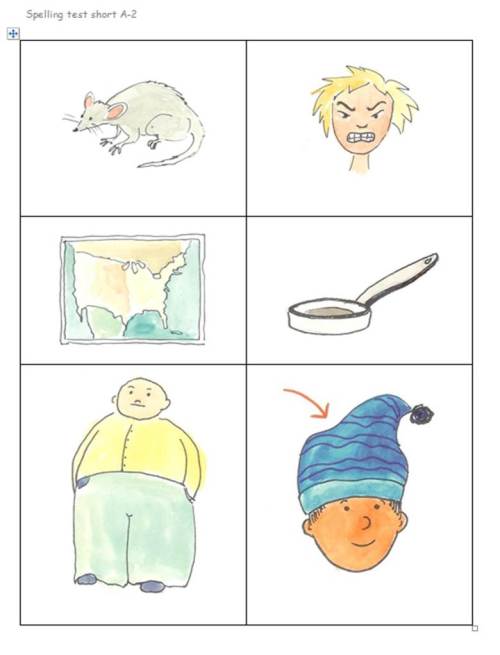
Years ago, I would cut  pictures of CVC words from various sources, paste them on index cards, sort them by vowel sound.  Then I would use them as spelling tests for beginning readers. (Now Mrs. A draws the pictures, including those below.)  This low-tech approach still works great with beginning readers and spellers.

Six drawings of short A CVC words

These drawings are samples of a packet of 12 pages of CVC drawings that can be downloaded for a small fee.  Click on the pictures for more information.  

Why use pictures for the spelling test instead of just dictating the words?

  • When the child is in charge of the pile of pictures, she can spell at her own pace, jotting down words she knows quickly and slowing down for words she is unsure of or for words she writes incorrectly and needs to repair.
  • Young children are people in motion, so the more parts of their bodies they can use to learn, the better. Taking off the rubber band, shuffling the cards, flipping them into a second pile as they are used and rubber-banding them again are fun.  Making learning fun is so important for children of any age, but especially for preschoolers.
  • Some children delight in erasing and will write a word incorrectly just so they can erase it. Spelling is a new experience for them, but it can take time, time when a tutor or mother might grow impatient. But since the child is working independently, the process can take as long as the child wants.
  • While the child is working independently, I can observe where she might need more help or prepare the next lesson, a better use of my time than dictating.
  • ESL students who might be shy about moving at a slow pace gain privacy by controlling the time it takes to complete the test.

One time I gave a preK student a short A test which he finished with pride—his first spelling test! When he found out I had more cards—more tests—he begged me to let him take the cards home and use them for the next week.  His mother later told me that  he took the spelling tests every day. What an eager learner!

How to teach short e and short i

Short e and short i are difficult sounds to distinguish for most beginning readers.  When I teach these sounds, I rely on two game-like activities that little children seem to like.

For one of the activities, I have gathered small pictures of words which either start with short e or short i or which use them in the CVC pattern.  Such pictures might include an igloo, bed, fish, elephant, mitt, pen, pin and bell.  I cut several index cards in half and paste one picture on each card.  Also on one card I write an e and on another card an i.

During the lesson, I put the e and i cards in front of the child and we practice saying those letter sounds.  Then the child sorts the deck of cards I have created, putting cards under one of the two letter sounds.  We say the word aloud to reinforce the letter sound.

For another activity, I have created BINGO-like cards of short e and short i words.  Since most children learning these sounds with me are four years old, I limit each BINGO card to nine words.  I say one of the words and the child must find and cover it, using a letter tile or a plastic marker.

Included here are several BINGO cards which you can download or use on your tablet or iPad.

This slideshow requires JavaScript.