Category Archives: fluency

My granddaughter can read small words, but she stumbles over bigger words when we read together. How can I help her?

Here are some tips to help with bigger words:

  • If you are reading for sheer enjoyment, anticipate the words she might not know and say them quickly, so she can keep reading and not lose her thought.  Don’t worry that she might not be learning new word attack skills in your reading session; she is learning other aspects of reading such as fluency and comprehension which are often hard to learn when she stops to consider every new word.  Also, if she is tired or ornery, this kind of reading lesson gets her to read without causing frustration.grandparent reading with grandchild.
  • But if you are reading with your granddaughter to help her decipher words, and if she is in a receptive mood, you might cover parts of the word (usually syllables) and then uncover them, so she can join them together.  For example, if the word is “continent,” cover the “tinent” part with your thumb and let her say “con.”  Then cover the “con” and the “ent” parts and let her read “tin.”  If she mispronounces “tin,” pronounce it correctly.  Then cover all but the “ent” and let her figure out those four letters.  If she can put it together, fine, but if not, you do it while covering and exposing parts of the word as you say it.  Then move on to another word.  The goal should be to teach her a method of figuring out words, not mastering every word you encounter in a particular lesson.
  • If you own the book, and don’t mind marking it, you could highlight every word she can read correctly.  She will see that the number of words she can read far outnumbers the few she can’t.  You might ask her what she notices about the words that are not highlighted.  She might say, “They are long,” or “They have lots of letters.”  Tell her there are ways to figure out those words just like there are ways to figure out three-letter words, and you will work with her on those long words.
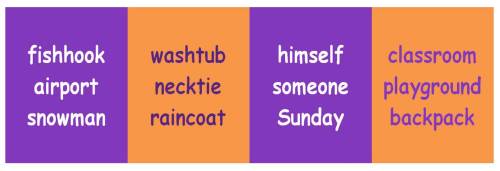
  • A good place to begin is with compound words.  They can be easy to decipher if the child looks for small words inside big words.  Try some with her such as “pancake,” “popcorn” and “forget.”  Make a list of such words and let her be the detective, discovering the small words inside the large words.  Have her circle each of the small words and then pronounce them together.  Some words you might use are:compound words are small words inside big words
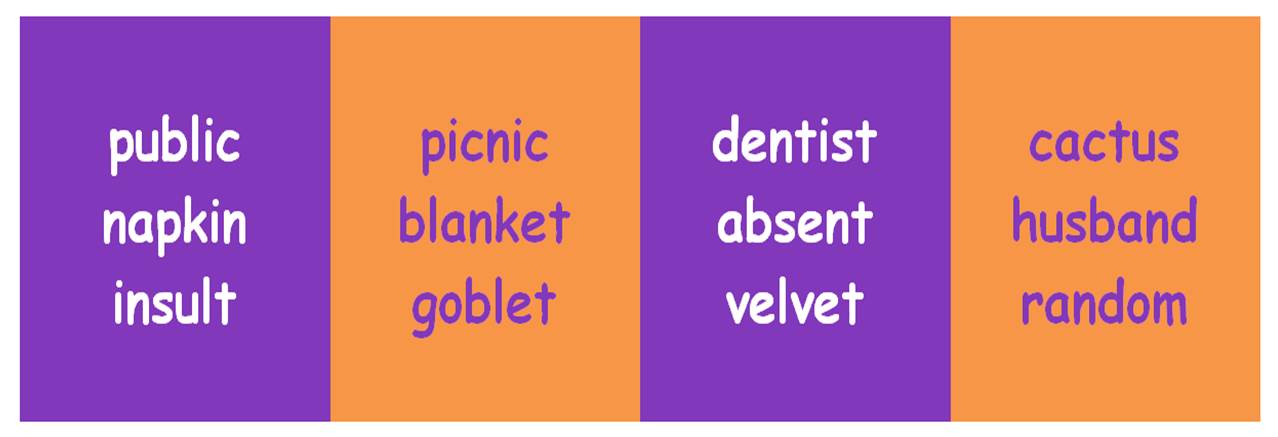
  • Some longer words have pronunciation rules that are easy for a child to remember.  For example, if a six- or seven-letter word has double consonants in the middle (biggest, kitten, flabby), that means the word usually has two parts, or syllables, and the first syllable ends between the “twin” letters.  (Use the word “syllable” since this is a term your granddaughter will need to learn anyway.)  Phonics books sometimes refer to these words as VC/CV or CVC/CVC words since they generally have short vowel sounds in both syllables.  You could practice a handful of those words, writing them on notebook paper for your granddaughter to pronounce.  Choose words whose letters follow the rules of phonics so she is not confused.  Have her draw a line between the double consonants and then pronounce each syllable.  Some words you might use are:"twin" letter words have double consonants in the middle.
  • Some other six- or seven-letter words have one vowel near the beginning, another vowel near the end, and two or three consonants in the middle.  These are a variation on VC/CV or CVC/CVC words with twin conconants.  Show her words like “contest,” “nutmeg” and “insect.”  Explain that the words have two syllables, and that the first syllable ends between the two consonants.  Have her draw a line between the middle consonants and then pronounce each syllable.  Some words you might use are:two syllable words with vowels in the first and last syllable

Our blog will have more on how to teach multisyllabic words in the near future.  Let us know if you find this information useful or if you have particular problems teaching your child reading.  We will investigate for you and offer the best advice we can find.  –Mrs. K and Mrs. A

Are nursery rhymes still important?

Yes, they are, but sadly, more and more children come to school today with little knowledge of them.

boy pretending to be Humpty

There are many reasons—busy parents without time to read the rhymes, foreign-born parents unfamiliar with the rhymes, and competition from TV and electronics for children’s time.  Yet, for many reasons, nursery rhymes should be part of a child’s education, and the earlier the better.

  • Children—even one-year-old children—can appreciate nursery rhymes, often their first encounter with books, verses and rhythmical sentences.  If they are being read to, they learn what a book is, what side goes up, how to turn a page, what words look like in print and how to get meaning from pictures.  This experience is the beginning of getting meaning from printed words, a start to reading comprehension.
  • They learn that reading books can be fun, social occasions with Grandma cuddling as she sounds out the rhymes.
  • Children can learn what English sounds like.  They hear their mother’s voice rising and falling, speeding up and slowing down, getting softer and louder, and sounding scared or full of laughter.  This can be particularly important for ESL children who might hear these rhymes from preschool teachers.
  • They develop an ear for fluency, and when they are ready to repeat the rhymes themselves, they are likely to add the inflection of a good reader.
  • Kids naturally like rhythm which nursery rhymes offer in abundance.  If Dad claps out the rhythm to “Pat-a-cake, Pat-a-cake, Baker Man,” soon the child will mimic him, picking up the cadence of English.
  • Because nursery rhymes are so rhythmical, children become aware of units of sound (called phonemes) from which words are made.  They learn to progress through the sounds in a word in a particular order (called phonemic segmentation), a necessary prereading skill.
  • Children also love rhyme (one reason Dr. Seuss is so popular).  They begin to learn patterns, expecting a rhyme every so often in the rhythm, and are rewarded when that word comes.  They begin to share in the reading of nursery rhymes aloud.
  • Because nursery rhymes are short, children need only a short attention span for a single nursery rhyme.
  • Also because the rhymes are short, children can memorize them and recite them aloud.
  • Nursery rhymes contain words the child doesn’t hear every day or in a familiar context.  “Jack and Jill went up a hill to fetch,” “eating her curds and whey,” and “Jack, be nimble” are examples.
  • Many nursery rhymes tell simple stories with beginnings, middles and ends.  The children hear of problems they might encounter—falling down and getting lost—and hear how those problems are resolved, or in Humpty Dumpty’s case, not resolved.
  • Nursery rhymes are great for group chanting and singing, sometimes called choral reading.  Think of “Mary Had a Little Lamb,” “Twinkle, Twinkle, Little Star,” and “London Bridge is Falling Down.”  Can you think about “Mary Had a Little Lamb” without singing it in your head?  The tune makes the rhyme easier to remember and makes reading fun.
  • Reading nursery rhymes to children preserves an older American culture and a connection with past generations.  Many of today’s grandmothers, as children, were read the same rhymes by their grandmothers.
  • Later on in life, the child will encounter many allusions to nursery rhymes (and allusions to Greek mythology, Shakespeare and the Bible).  But the child will only make connections—and have a richer experience—if he is familiar with the original rhymes.  For example, Agatha Christie called one of her mysteries One, Two, Buckle My Shoe.  Why?
  • Reading nursery rhymes online is a way to connect a child’s use of a tablet, phone or computer with literature from an early age.

    Father reading to child and child asks, 'How old is Old McDonald?"

    To enlarge, click on the picture.

The history of nursery rhymes in English goes back hundreds of years to a time when most people could not read or write.  Part of an oral culture, they reported events of their time for adults and children alike.  For example,

  • “Ring around the Rosy” is believed to have originated in 1347 during the Black Death in Europe.  The ring referred to a round mark on the skin which was the first sign of the bubonic plague.  The last line, “And we all fall down,” was no laughing matter.
  • “Mary, Mary, Quite Contrary,” refers to Mary, Queen of Scots, who was beheaded for her religious beliefs.
  • “Little Miss Muffett” refers to the daughter of a bug expert in Shakespeare’s day.
  • “Thirty Days Hath September” is believed to come from the 13th century, based on a similar rhyme in French to help remember how many days are in a month.

So are nursery rhymes important?  What do you think?  Did someone read nursery rhymes to you?  Can you recite any from memory?  Have you enjoyed passing along this tradition to your children and grandchildren?  Let our readers know.

How can I make reading to my four-year-old a more educational experience (not just fun)?

Children pick up many foundational skills when someone reads to them frequently.  In fact, reading to children is probably the single most important way to prepare them to read by themselves.  But you could monitor your child to be sure he is learning more subtle concepts about reading in English.  Most schools expect these skills to be mastered by the end of kindergarten:

  • Knowing that in English words are read from left to right.  (You could point to words with your finger as you read to reinforce this idea, especially if you come from another language in which words are read from right to left or top to bottom.  If you read to your child in both languages, remind the child that you are reading in English.)
  • Knowing that words are read from top to bottom.  (Occasionally, ask your child where you should begin reading on a page.  Or turn the book up-side-down to see if the child recognizes the mistake.)

    child telling grandpa he is holding the book upside down.

    Click on the picture to enlarge it.

  • Knowing that pages are turned from right to left.  (Ask your child to turn the pages for you.)
  • Knowing that words are shown in print by a grouping of letters with a space before and after.  The space before indicates a new word is to begin; the space after indicates that a word has ended.  (Point to tiny words like “a” or “I” and to big words like “dinosaur,” and comment on the size of the word.  Or ask the child to count how many words are on a particular line.)
  • Knowing that words are formed from specific sequences of letters.  (Write a “word” like xxxxxxx or abcdefg and ask your child if that is a word.  Even though a child cannot read, he begins to figure out that not every grouping of letters makes a word.)
  • Knowing that words are made from combinations of 26 letters, upper and lower case.  (Make sure your child can name the upper and lower case letters.)
  • Since understanding word families helps with reading (pig, wig, big), children need to identify words that rhyme.  (Play rhyming games with your child.  Recite nursery rhymes with your child.)
  • Since English words are made of syllables, understanding the number of syllables in a word is important.  (When you are reading, stop and say “ty-ran-a-saur-us” with a pause between each syllable.  Have your child clap the syllables and count the syllables with you.  Ask your child if you should pronounce the word “ty-ran-a-saur-us” with pauses between the parts, or “tyranasaurus.”  If your child is learning English as a second language, distinguishing syllables from words can be difficult, so for bilingual children you might want to slow down a bit until the child is more fluent in English.)
  • Knowing that rhyming words are the same at the end, but different at the beginning.  (Help a child to sound out the rhyming part and the sound beginnings for words such as bed, red and sled.)
  • Knowing that words are composed of sounds which correspond to letters.  (As you read, help the child to isolate the sounds in some three-letter words, such as sad, hop or fig.  The child doesn’t need to know the letter names that correspond to the sounds at this point, but she should gain experience reproducing the sounds.)
  • Knowing that changing a letter sound creates a new word.  (Say a word like “bag” and ask what would happen if you changed the first sound to the “r” sound or if you changed the last sound to a “t” sound.  Help the child to manipulate letter sounds to form new words.  Using letter tiles helps with this skill.)
  • Knowing that each letter usually corresponds to a sound.  (Help the child to learn the most common consonant letter sounds.)
  • Recognizing that there are long and short vowel sounds, and that adding certain letters, such as an e at the end of a three-letter word, changes the sound and the word.  (This is a more advanced skill, so if your child finds it hard, ignore it for a few months and then try again.)
  • Knowing sight words.  (Help the child to recognize more and more words by sight, and sometimes, let the child read those words when you come to them in a story.  Don’t do it every time or reading to your child won’t be fun.  But as a child gains sight word knowledge, point to the words as you read, so the child can recognize words he knows and can pick up new words.)
  • Knowing that many words are spelled almost the same, but slight differences do change the word.  (Point out “rat” and “rate” or “ball” and “bell” to show what a difference one letter can make.)

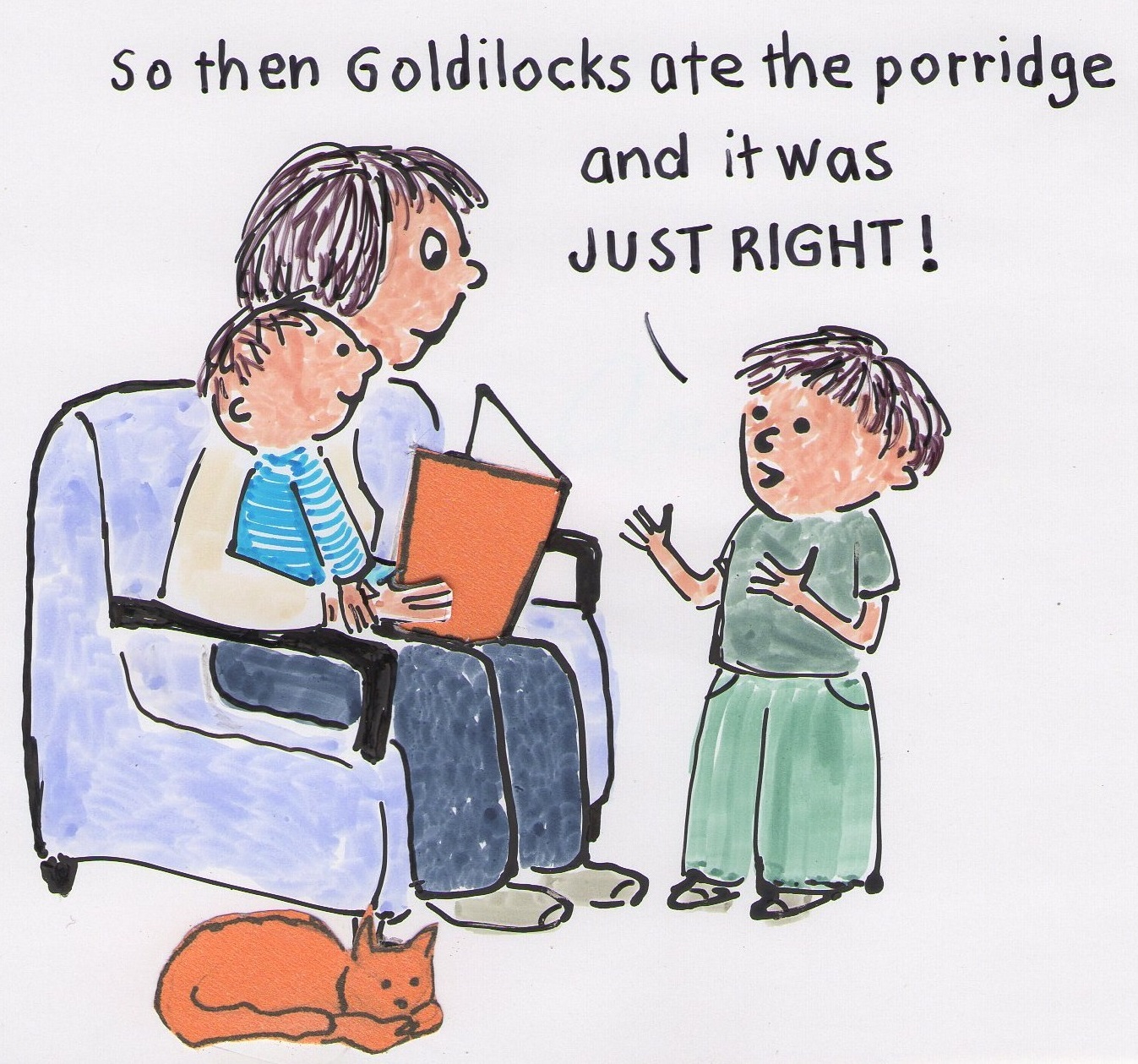
    child retelling story of Goldilocks

    Click on the picture to enlarge it.

  • Hearing sentences read fluently, with pauses at commas and periods.  Children should recognize a change in an emotional tone, or a change of voice when the big, bad wolf speaks compared to when Little Red Riding Hood speaks.  They should learn that there is meaning in stories and in nonfiction.  (Ask your child what is happening on a given page, or what the story is about.  Ask the child to predict what might happen next.  Ask the child what happened first, in the middle, and at the end.)

These ideas come from the Common Core State Standards Initiative (the suggestions in parentheses are from Mrs. K), and are intended as a standard for measuring the foundational reading skills of kindergarteners.  Most states are now using Common Core Standards.  For more information, go to http://www.corestandards.org/ELA-Literacy/RF/K.

Why is reading such a complex skill?

According to an April 2000 study (www.nationalreadingpanel.org) researched by the National Institute of Child Health and Human Development (a division of the National Institutes of Health) and the federal Department of Education, there are four main components to reading, each of which can be further divided.

Chart of 4 reading components

Click on the picture to enlarge it.

The first component is systematic phonics instruction.  The study defined phonics as how a letter corresponds to a sound in English, and defined systematic phonics as planned, sequential letter-sound instruction.  Some English letters have one corresponding sound (such as most consonants like b and d).  Some letters have two sounds (hard g and soft g, for example).  And some letters have many sounds (vowels and y).  Most systematic phonics instruction begins with teaching consistent consonant sounds and later moves on to vowels with multiple sounds, and then to consonants whose sounds change in combination with other letters (th and kn, for example).

Another component is phonemic awareness.  Phonemes are the smallest units of spoken English, 41 in all, represented by one or more of the 26 letters of the alphabet.  Some words have one phoneme (oh, for example, has the one phoneme o) while most words have two or more phonemes (go, for example, has two phonemes, g and o, while style has four phonemes, s, t, i and l.).  Putting together the phonemes to form words is an important component of reading.

Fluency is the third component.  The federal study defined fluency as reading aloud with speed, accuracy and proper expression.  When a child pauses at a comma or period and changes his pitch if he is reading a quote from a mean witch or a baby duck, that child is showing fluency.  Children who ignore punctuation or who read in a monotone or who plod along do not show fluency.

Reading comprehension, the fourth component, is perhaps the most complex.  It involves understanding vocabulary in the context of a text.  At the same time, reading comprehension means a student is actively engaging with a text so that the student can draw meaning.  If a child can read “trek” but does not know the word’s meaning, comprehension is limited by the lack of vocabulary but not by phonics or phenomes.  If a child can read a text but has little interest in the subject, and reads in a monotone, the child’s comprehension may be limited by fluency or passivity.

Adding to the complexity of reading is that all four of these skills work in unison as a child reads.  When a child is reading words accurately; when that child is grouping words in phrases and sentences with proper inflection; when that child is moving at a moderate rate; and when that child is laughing or questioning or pausing to consider what might happen next, that child is truly reading.