Category Archives: English as a second language (ESL)

Mrs. K and Mrs A publish another beginning reading book

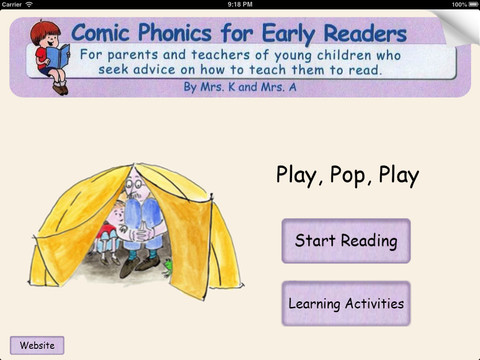
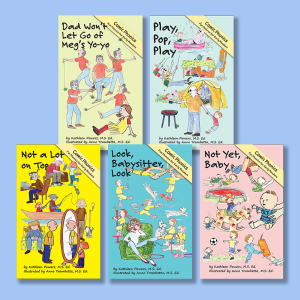
Mrs. K and Mrs. A have published our third children’s book app in three months!  Play, Pop, Play, our latest book app, resembles our prior book apps, Not a Lot on Top and Look, Babysitter, Look.  All three are written in easy CVC words for beginning English and ESL readers and have hilarious drawings featuring a little kid to attract young readers.

Play, Pop, Play iTunes App

Go to http://goo.gl/JMrT3 for more information.

In Play, Pop, Play, little Tom wants his Pop to play with him—tucked under a table, splashing in a tiny swimming pool, and pumping high on swings.  Pop tires out and wants to nap, but Tom keeps going until—well, you’ll have to read to find out.

Several activity pages follow, all using the simple vocabulary and events of the story.  Unlike paper workbook pages, these app pages are interactive, encouraging the beginning reader to draw lines with electronic crayons, swipe words in a word search, and number the story events in sequence—appropriate reading skills for new readers.  Then—poosh!—the child can erase and start over, or save, or email her work to Grandma.

Play, Pop, Play is available for $1.99 on Apple iPhones, iPads and iPods.  To preview or to buy this book, go to http://goo.gl/JMrT3.

Also, check out Not a Lot on Top at http://goo.gl/ClVyM, and Look Babysitter, Look at http://goo.gl/K1HcU.

Mrs. K and Mrs. K and Mrs. A publish second beginning reader book app: “Look, Babysitter, Look”

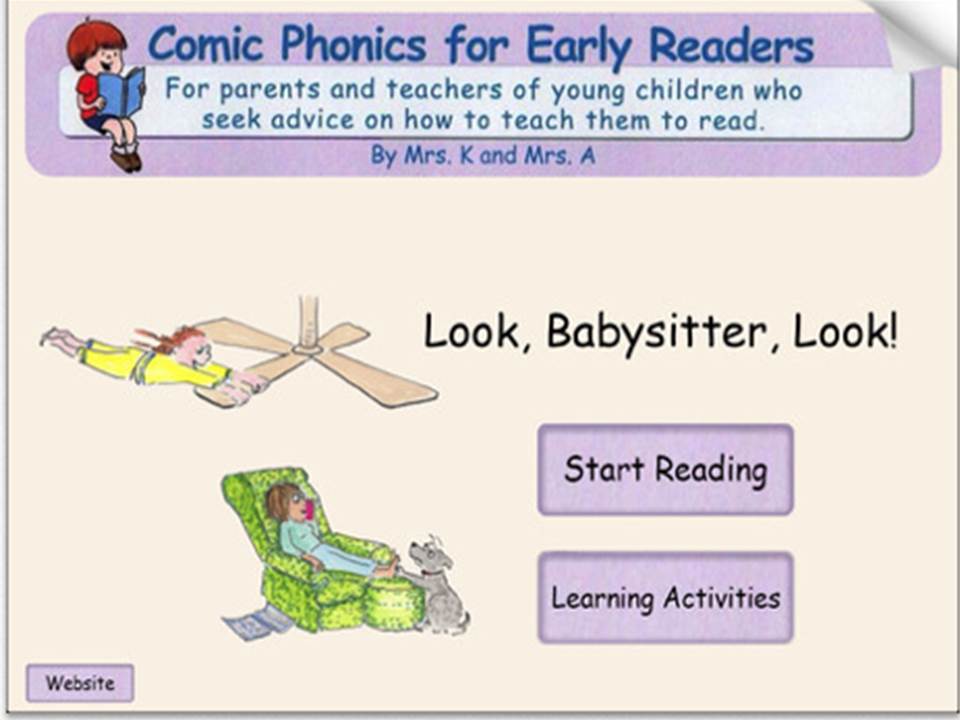
Mrs. K and Mrs. A have published our second children’s book app for beginning English readers and beginning ESL readers, Look, Babysitter, Look.

Book app for iPhone and iPad.

Available for iPhone and iPad at http://goo.gl/K1HcU

The story of Look Babysitter Look follows the antics of a little girl who cannot sleep while her clueless babysitter talks on the cell phone.  The pictures are funny, the words are easy and the cost low–$1.99 for the book and activity pages.  The book was designed as a fun method to attract beginning readers using phonics—mostly short-vowel, one-syllable (CVC) words.

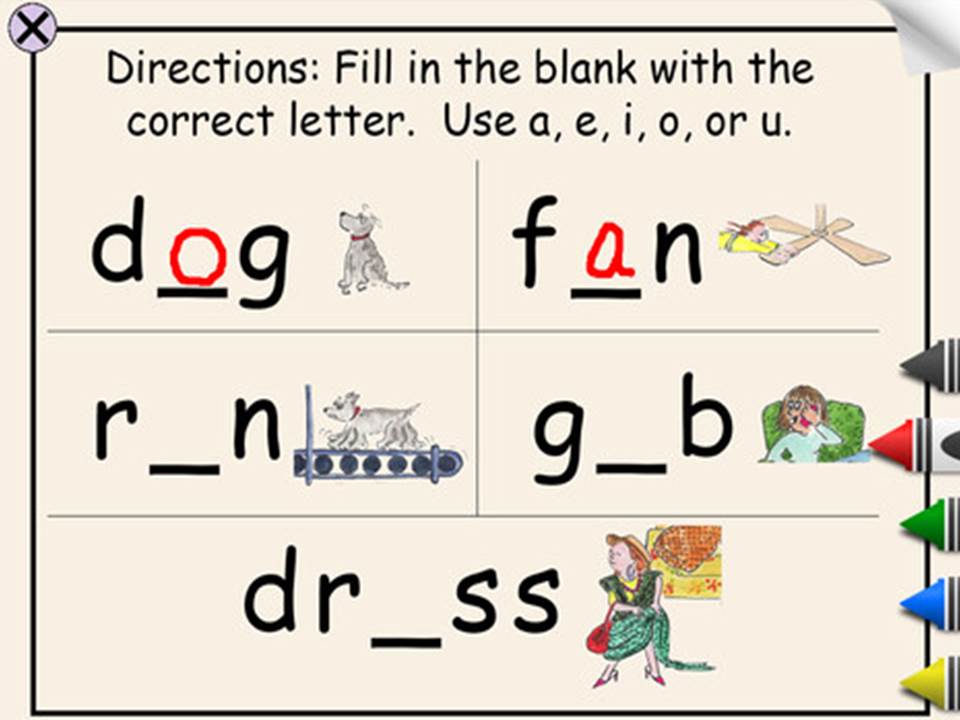
Look  babysitter look sample activity page.The activity pages resemble workbook pages except that they are interactive, which delights kids.  A child can write a letter in a blank with an electronic crayon, circle words in a word search, fill in simple crossword puzzle words or draw lines to match drawings that rhyme.  All the activities are appropriate for a beginning reader and pertain to Look, Babysitter, Look’s characters and theme.

Right now Look, Babysitter, Look is available on Apple products through iTunes books but we expect it will be available on android products.  To preview the book, or to buy it, click on http://goo.gl/K1HcU.

Also, check out our first book, Not a Lot on Top, at http://goo.gl/ClVyM.

Is there a low tech, inexpensive way to teach my children their letter sounds?

I’ve had success teaching reading to brand new readers by matching pictures to the correct letter using homemade flashcards.  Both native English speakers and ESL preschoolers have found this a fun way to learn letter sounds.  It can be done in five minutes here and there, making it a good way to teach children with short attention spans.

Child sorting picture flash cards to match with the letter B.

To enlarge the picture, click on it.

I suggest you try this method:

  • Cut some index cards in two, each about 3 by 2 ½ inches.  Or use the index cards whole if you prefer.
  • On ten or twelve blank cards, paste pictures of words which begin with the same consonant sound, such as the letter “b.”  Use pictures of a ball, a balloon, a bear, a banana, a ballerina and others until you have about ten to twelve cards with “b” pictures.
  • On another ten or twelve blank cards, paste pictures of words which begin with other letters, such as an apple, a cat, a dog, a kite and a piano until you have about the same number of cards as “b” cards.
  • On one blank card write or paste a capital B and a lower case b, “Bb.”
  • Lay the card labeled “Bb” on a table.  Shuffle all the picture cards, or let your child do that.  The more she can participate in the process, and eventually control it, the more likely she is to be eager to play the “game.”
  • Now taking one card at a time, have your child say the word of the picture.  Emphasize the “b” sound for her, and ask her if the card starts with a “b” sound.  If so, tell her to put the card next to the “Bb” card.  If not, tell her to put the card a little distance away.
  • Keep doing this until you have gone through all the cards and made two piles of picture cards.
  • With practice, your child will be able to match the words to the letter quickly.
  • After she has mastered “Bb,” make a set of cards using another consonant sound.  You can keep the same set of random cards or add to them.  Some of the random cards will eventually become the letter cards, so you need to add to that group of cards as you develop more letter cards.
  • Begin with the 16 consonants which almost always sound the same:  (Bb, Dd, Ff, Hh, Jj, Kk, Ll, Mm, Nn, Pp, Qq, Rr, Tt, Vv, Xx and Zz).  You don’t want to  do the ABC’s in order, starting with Aa.  Begin with any of the consonants I just listed.  If the child’s name is Tom, start with “Tt.”  If it is Hannah, start with “Hh.”
  • Try not to use pictures of words that start with blended sounds.  For example, don’t use “blue” or “braids” yet.  Later, after the child is sure of the single sound of a letter, you can start combining letter sounds.
  • Don’t start with a consonant that has multiple sounds, such as Gg, Ss or Cc.  For starts, choose letters and words that follow the rules of phonics.  Try to reduce confusion as much as possible.
  • Also, don’t start with vowels.  I teach vowels slightly differently.  I’ll tell you about that in my next blog.

Perhaps this sounds like too much work?  I use the cards over and over with new reading students, so for me the time it took to make the cards was well worth it.  If you have more than one child, you too can reuse the cards, and if you laminate them, they last forever.  (Laminating is expensive, but clear packing tape protects the cards well.)  And the cards are easy to make.  I made mine while watching TV.

In addition to being low tech, the cards are an inexpensive method to teach sounds.  A pack of index cards; old books, magazines or stickers to use for pictures; and tape together probably cost a few dollars and can be used to create many sets of cards.

How about you?  Were you taught your letter sounds by another low tech method?  How are you teaching your children their letter sounds?  Tell our readers by clicking the comment button.

Are nursery rhymes still important?

Yes, they are, but sadly, more and more children come to school today with little knowledge of them.

boy pretending to be Humpty

There are many reasons—busy parents without time to read the rhymes, foreign-born parents unfamiliar with the rhymes, and competition from TV and electronics for children’s time.  Yet, for many reasons, nursery rhymes should be part of a child’s education, and the earlier the better.

  • Children—even one-year-old children—can appreciate nursery rhymes, often their first encounter with books, verses and rhythmical sentences.  If they are being read to, they learn what a book is, what side goes up, how to turn a page, what words look like in print and how to get meaning from pictures.  This experience is the beginning of getting meaning from printed words, a start to reading comprehension.
  • They learn that reading books can be fun, social occasions with Grandma cuddling as she sounds out the rhymes.
  • Children can learn what English sounds like.  They hear their mother’s voice rising and falling, speeding up and slowing down, getting softer and louder, and sounding scared or full of laughter.  This can be particularly important for ESL children who might hear these rhymes from preschool teachers.
  • They develop an ear for fluency, and when they are ready to repeat the rhymes themselves, they are likely to add the inflection of a good reader.
  • Kids naturally like rhythm which nursery rhymes offer in abundance.  If Dad claps out the rhythm to “Pat-a-cake, Pat-a-cake, Baker Man,” soon the child will mimic him, picking up the cadence of English.
  • Because nursery rhymes are so rhythmical, children become aware of units of sound (called phonemes) from which words are made.  They learn to progress through the sounds in a word in a particular order (called phonemic segmentation), a necessary prereading skill.
  • Children also love rhyme (one reason Dr. Seuss is so popular).  They begin to learn patterns, expecting a rhyme every so often in the rhythm, and are rewarded when that word comes.  They begin to share in the reading of nursery rhymes aloud.
  • Because nursery rhymes are short, children need only a short attention span for a single nursery rhyme.
  • Also because the rhymes are short, children can memorize them and recite them aloud.
  • Nursery rhymes contain words the child doesn’t hear every day or in a familiar context.  “Jack and Jill went up a hill to fetch,” “eating her curds and whey,” and “Jack, be nimble” are examples.
  • Many nursery rhymes tell simple stories with beginnings, middles and ends.  The children hear of problems they might encounter—falling down and getting lost—and hear how those problems are resolved, or in Humpty Dumpty’s case, not resolved.
  • Nursery rhymes are great for group chanting and singing, sometimes called choral reading.  Think of “Mary Had a Little Lamb,” “Twinkle, Twinkle, Little Star,” and “London Bridge is Falling Down.”  Can you think about “Mary Had a Little Lamb” without singing it in your head?  The tune makes the rhyme easier to remember and makes reading fun.
  • Reading nursery rhymes to children preserves an older American culture and a connection with past generations.  Many of today’s grandmothers, as children, were read the same rhymes by their grandmothers.
  • Later on in life, the child will encounter many allusions to nursery rhymes (and allusions to Greek mythology, Shakespeare and the Bible).  But the child will only make connections—and have a richer experience—if he is familiar with the original rhymes.  For example, Agatha Christie called one of her mysteries One, Two, Buckle My Shoe.  Why?
  • Reading nursery rhymes online is a way to connect a child’s use of a tablet, phone or computer with literature from an early age.

    Father reading to child and child asks, 'How old is Old McDonald?"

    To enlarge, click on the picture.

The history of nursery rhymes in English goes back hundreds of years to a time when most people could not read or write.  Part of an oral culture, they reported events of their time for adults and children alike.  For example,

  • “Ring around the Rosy” is believed to have originated in 1347 during the Black Death in Europe.  The ring referred to a round mark on the skin which was the first sign of the bubonic plague.  The last line, “And we all fall down,” was no laughing matter.
  • “Mary, Mary, Quite Contrary,” refers to Mary, Queen of Scots, who was beheaded for her religious beliefs.
  • “Little Miss Muffett” refers to the daughter of a bug expert in Shakespeare’s day.
  • “Thirty Days Hath September” is believed to come from the 13th century, based on a similar rhyme in French to help remember how many days are in a month.

So are nursery rhymes important?  What do you think?  Did someone read nursery rhymes to you?  Can you recite any from memory?  Have you enjoyed passing along this tradition to your children and grandchildren?  Let our readers know.

With so many apps available for preschoolers, how do I know which are the best ones to use to teach my child to read?

The best apps to teach reading share many of the same characteristics as the best apps to teach math or to teach games.  Here are some traits to look for, although you will not find each of these traits in every app.

baby looking at an iPad

To enlarge, click on the picture.

  • The app should be age or developmentally appropriate for your child.  It should seem like play but allow the child to gain self-confidence both in mastering the media and in mastering the material presented on the app.
  • The app should be interactive.  Most apps are passive, limiting a child to clicking or scrolling down, but that’s about it.  The best apps allow children to solve problems or to develop curiosity.  Some apps allow coloring, drawing lines and highlighting, with the child deciding how.
  • The app should be intuitive to use.  Using computers is often hard for preschoolers since interaction depends on mastering a mouse and a keyboard.  But pads are intuitive, allowing for swiping with a single finger to move from page to page.  Once the child tries the process a few times, he understands it.
  • The app should allow for repetition.  Young children like to have their favorite books read to them over and over.  They might also like to go to their favorite apps over and over.
  • The app should take advantage of the technology.  A book about a pet might show the word “dog,” but an app might show the printed word, offer a picture of a group of dogs wagging their tails, and create the sounds of panting and barking.
  • The app should be open-ended: divergent, not convergent.  Usually an app encourages a child to hit an icon which might be right or wrong, a dead end for the child.  But if the answer allows the child to continue in a manner she prefers, or to get to an answer in a round-about way, the child has some input into the outcome.
  • The app should extend a child’s skill or make up for a child’s shortcomings.  If a child cannot print yet, or has poor printing skills, a good app would produce the desired letters without the child needing to “write.”  Or for an ESL child or a child with speech problems, a good app might “read” the words aloud so that the child can hear the words pronounced correctly.
    child taking iPad out of toy chest

    To enlarge, click on the picture.

  • The app should be fun and engaging.  Stories should move in time order so that they are easy for a young child to follow.  There should be an obvious beginning, middle and end.  The vocabulary and sentence structure should be comfortable for the child so he gets it the first time he hears it.  The art work should make the child laugh.
  • The app should foster socialization.  Apps that store child-taken photos of a trip to the zoo allow for later sharing with preschool classmates or with family.  Apps that allow a child to film a Barbie fashion show or Grandpa snoring beg to be shared.  SKYPE allows for sharing over great distances.

Spend some time investigating apps for your young children.  Teach them how to access the apps you have selected.  And next week do it again, because the apps—like your child—are always changing.

In my library, I saw some wordless picture books. What are they for?

Wordless picture books (books with no words except for the titles) and almost-wordless books (books that repeat the same word, phrase or sentence over and over) are a category of picture books that began in the 1960’s but have grown increasingly popular.  There are several kinds:

  • Concept books.  These include ABC books, counting books and pictures for infants to identify.  They also provide pictures of everyday objects for ESL students to identify.
  • Books related by a theme or a sequence.  These books show illustrations that are related, but not by a story line.  Books showing different kinds of trucks, or pictures of how the seasons change, or pictures showing a bedtime routine are examples.
  • Books showing expository content.  These books might explain how a caterpillar becomes a butterfly or show all the protection a football player puts under his uniform.
  • Books showing visual games.  Interaction is required to find a hidden object or to find subtle differences in two nearly identical pictures.  The reader might need to point to the hidden item, or circle differences in pictures.
  • Story books.  These might show simple or complicated story lines.

I assume the books you are asking about are story books.  Why have stories without words?  Let’s start by talking about two-year-olds.

baby reading a book

Click on the picture to enlarge it.

Kids who have just turned two are probably not aware of “story” as we know it, even though they might have been read to a hundred times.  When they look at a picture book, they see individual pictures, not parts of a story.  They might be interested in the boy on page 3 because of his glittery sneakers, or they might notice the funny expression on a dog’s face.  When they look at page 4, two-year-olds probably are not aware that events on page 3 have caused events on page 4.  The picture book is not so much a story with a beginning, middle and end for such young children.  Rather it is a collection of fascinating pictures.

For such children, does it matter if there is text on page 3 or page 4?  Probably not.  They are getting their meaning from the pictures.

Does it matter if the adult reads the accompanying text aloud or not?  Probably not to the two-year-olds.  The words give just one meaning—that of the author.  But the children are more interested in gaining their own meanings.  They pick up on their own clues and focus on what is important to them.  You have probably had the situation where you are trying to finish reading a story but your child doesn’t care about the story ending.  He would rather talk about one of the pictures, or leaf back through the book to see a particular picture again.

young boy reading a book

Click on the picture to enlarge it.

Yet sometime between two and kindergarten, most children realize that story books are more than a collection of fun pictures:  the pictures tell a story with a beginning, middle and end.  Do children need text to learn this?  Probably not.  As they become more sophisticated at “reading” pictures, they notice more, they make more connections, and story emerges.  It is only when children begin to read words that they need words on the page.

So back to your question.  What are these wordless story books for?

  • With no right or wrong words to explain what is happening, these books allow for wider interpretations than a text might allow.  Children can bring their own meaning to the stories.
  • Research shows that parents who tell a story based on pictures only use a richer vocabulary and more complex sentence patterns than authors usually use in picture books.  Children pick up on the vocabulary and become attuned to longer sentences.
  • Bilingual parents can mix vocabulary from two languages to make the story meaningful for their children.  Parents who don’t speak English can “read” the story in their own languages.
  • Developmentally delayed children benefit from having the reader tailor the story to their level.  Or they get the chance to tell the story from their own point of view, with no right or wrong perspective.

As children grow, these books have other advantages:

  • Children can learn the elements of story from these books—characters, setting, beginning, middle, and end.
  • Children can think creatively, coming up with various possibilities to interpret a single picture book.
  • Children can learn how to tell stories orally before they have the skills to write stories down.
  • By using recording devices and cameras as children “read” these stories, children can record their favorite stories to share with Grandma in Taiwan or with Mom waiting at the gate for her flight.
  • Once children begin to read and write, they can write their own words for the wordless story books, and read them aloud.
  • Children can use the books as models, illustrate their own stories and then supply words, perhaps dictating to an adult.
  • Children can gain success in reading, like reading and feel confident reading all before they can “read” real words.

Like all books, the quality and sophistication of wordless picture books varies.  A children’s librarian can point out some good ones.  Or you can find lists on the web.  Some classic ones include:

  • A Boy, a Dog, and a Frog by Mercer Mayer
  • Pancakes for Breakfast by Tommie de Paola
  • Time Flies by Eric Rohmann
  • Picnic by Emily Arnold McCully
  • Up and Up by Shirley Hughes
  • Free Fall and Tuesdays by David Weisner
  • board picture books by Helen Oxenbury