Category Archives: Common Core Standards

“No Child Left Behind” law overturned by House; Senate expected to follow

sstudent filling in dots for testThe 2002 law that increased the US government’s role in education and mandated testing has been scrapped by the House of Representatives. If its replacement passes the Senate, as expected, “No Child Left Behind” (NCLB) will be replaced by a law which greatly reduces the federal government’s part in education and reduces the amount of tests US kids take. President Obama has indicated he would sign such an act.

This expected change in law does nothing to interfere with the Common Core State Standards which states can adopt or not as they see fit.  However, NCLB gave rise to the Common Core, and opposition to the Common Core and all its difficult testing has, in part, led to the end of “No Child Left Behind.”

Changes the new law would make include:

  • Schools would be less accountable to the federal government and more accountable to states and local school districts which would write their own standards for schools, students and teachers.
  • The US Education Department’s role would be reduced.
  • Students in public schools would need to be tested annually in math and English/language arts, and those scores would need to be published.
  • Schools would need programs to help low achieving students and schools.
  • Title 1 money for poor schools would continue.


Soul searching in NY: Will common sense win?

In New York, the percentage of students in grades 3 to 8 who passed the statewide “Common Core” English test in 2015 was 31.3%, about the same as in other states. In math, it was 38.1%, a little better.

However, in New York 220,000 students “opted out” of taking the test in May. 220,000 students is about 20% of all students who should have taken the English exams. That is the highest percentage of students in any state refusing to take the Common Core-aligned tests.  In some school districts the opt-out students were as high as 60% of the total. With so many parents voting against these tests by stilling their children’s number 2 pencils, what is next in New York for the controversial tests?

  • The governor of New York, who has been a firm backer of the tests, is about to announce that teachers’ job evaluations will not depend on test results.
  • Scores needed to “pass” these tests might be lowered. Before the Common Core-aligned tests began in NY in 2013, students needed a grade of 65% to pass high school English courses. The grade has been raised to 79% for students taking the test in 2022 (originally in 2017) but education officials are rethinking that.
  • Teaching-for-the-test strategies might change. One New York City school has eliminated music and art for its algebra students so that there can be two teachers in algebra classes, one to teach the whole group and another to teach pockets of students needing more help. That school’s test results are higher than other schools’ results. Other schools are thinking of hiring specialist teachers for English and math in elementary grades rather than having one teacher teach all subjects.

US literacy rank among other high ranking countries.It is unlikely that the tests will be scrapped completely despite nationwide opposition to the tests. Politicians and educators know US students are not up to snuff when it comes to language and math skills. International tests results on the latest PISA reading tests (Program for International Student Assessment) show the US ranks 24th out of 65 countries, with Asian countries dominating the high scores.

Stay tuned.

Georgia Common Core test results for individual schools and counties announced

Georgia released school by school and county by county Common Core test results on November 16.

sstudent filling in dots for testResults show what everyone expected:  in most schools students scoring below grade level outnumbered students scoring at or above grade level. In third grade, for example, 60.1% of students performed below grade level in English; in fourth grade, 62.9% of students scored below grade level; and in fifth grade, 60.8% of students scored below grade level.

But a closer look at particular schools shows a bleaker picture. Many schools exceeded 60% of students scoring below grade level. Several third grades around Georgia had more than 90% of students scoring below grade level. But a few schools had 70% score at or above grade level. The biggest discrepancy I noticed in a quick review of third grade raw numbers was one school that had not quite 3% score at or above grade level, and another school which had a little over 80% score at or above grade level.

Counties also showed wide discrepancies.  Warren County, a rural county with a 27% poverty rate and a small number of college graduates, showed a mean score of 442 for third graders.  Meanwhile Forsyth County, the wealthiest county in Georgia with many college graduates and advanced degree holders, showed a mean score of 544.  That is more than 100 points higher than Warren County.   Atlanta’s mean score for third graders was 493.

What does it all mean?

  • Some schools are doing a much better job preparing their students for the kind of learning tested on the Milestone tests.
  • Where a child goes to school matters.

Milestone test results cannot be compared to the results of students in other states because Georgia created its own tests which were given only to Georgia students. This thwarts one of the purposes of the Common Core, which is to allow a comparison of educational achievement by students all over the country.

In the future, whether a child passes to the next grade will be influenced by these test scores. For tests taken in the spring of 2016, Georgia promises test results to be made known sooner.

If you are a parent or a teacher of a Georgia public school student, you can see how your child’s school did and how your county did on these tests by grade level by going to the links below.  The data displayed is raw numbers and they are inconvenient to read.  For example, column headings are not repeated throughout the data so you must scroll up and down to find out what the numbers refer to.  Also, everything is single-spaced, and there are so many columns that they do not all fit on most computer screens at the same time.  School districts smaller than a county, such as city school districts, are listed at the end of the tables.

Spring 2015 Milestone tests grades 3 to 8 by school
Spring 2015 Milestone tests grades 3 to 8 by county
Spring 2015 Milestone tests grades 9 to 12 by school
Spring 2015 Milestone tests grades 9 to 12 by county

Comparing Common Core ELA test results in different states is like comparing apples, oranges, pears, tomatoes, kiwi, quince, cherries, raspberries. . .

One of the professed goals of the Common Core curriculum is that test results of students in one state, such as Georgia, can be compared to the test results of students in another state, say Connecticut.

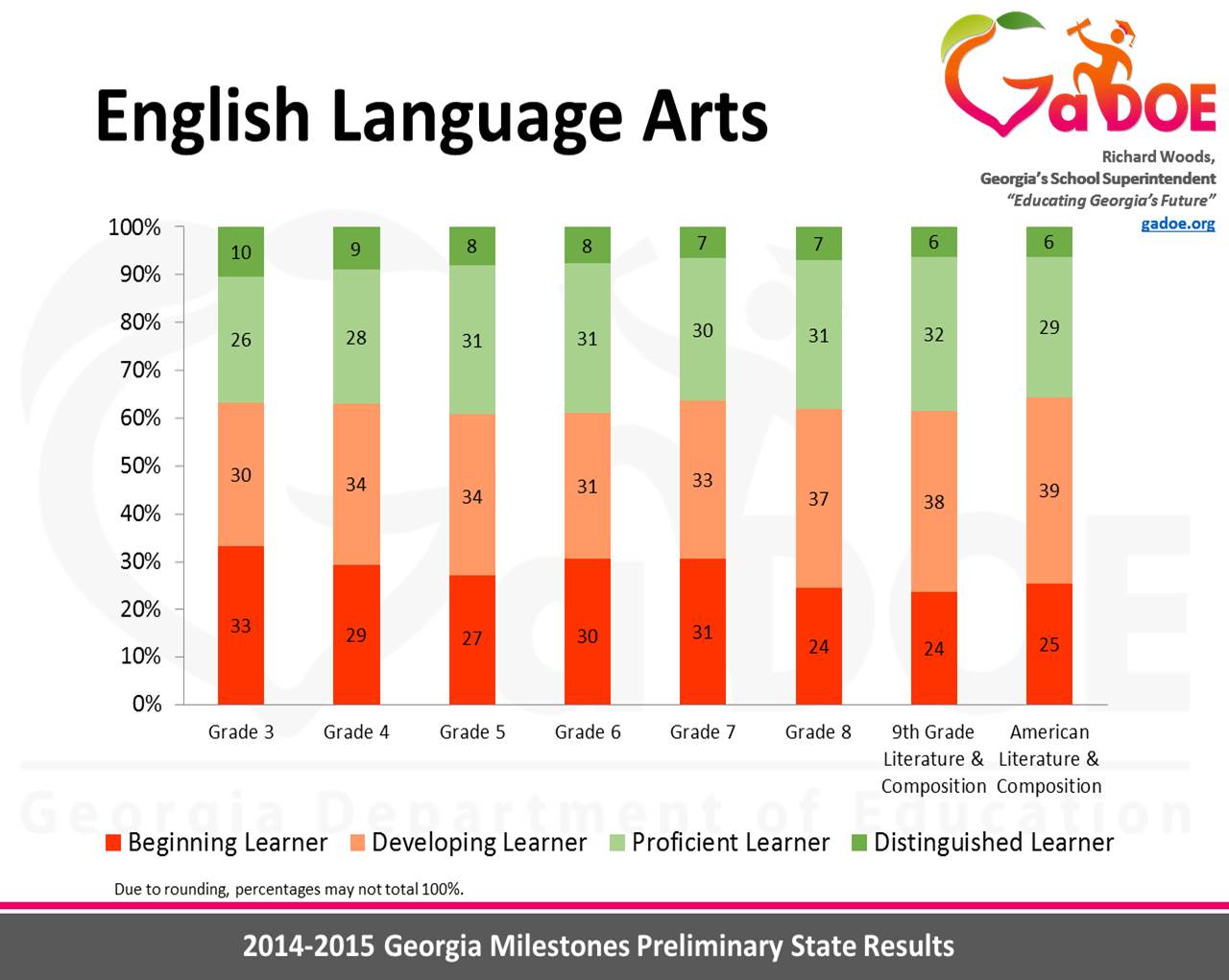
table showing ELA test results in GA by grade

Click on table to enlarge it.

But the truth is, it can’t be done. Students all over the country took more than a dozen different tests this past spring. Fourteen states’ students took the same test, so their results can be compared. So can test results for students from another seven states who took the same tests. But then there are states like New York and Georgia which wrote their own tests. Student scores from those states can’t be compared to any other state’s student scores. And maybe that is the point, considering the horrible test results dribbling forth.

The Smarter Balanced Assessment System created a test used by 14 states, mostly in the western US: Hawaii, Washington, Oregon, California, Idaho, Nevada, Montana, North Dakota, South Dakota, Missouri, West Virginia, Vermont, New Hampshire and Connecticut.  Here are the results issued to date.

  • California has delayed the release of its test results until September 9, even though, by law, results should have been published in August. California has also removed from its Department of Education website data of past years’ test results in ELA and math, the two subjects tested with new tests this past spring, so that comparisons between the old and new test scores cannot easily be made. Insiders say the new test results are dismal. The state blames the delay on revealing specific results on the launch of a new web site to showcase the data. California says it wants to ensure that the test results are accurate.
  • New Hampshire will not release results until November, saying that since many students took the test with pencil and paper, not computer, it takes longer to score and record the results. New Hampshire has announced that its high school juniors will not take the Common Core test in the future, but will instead take an SAT exam.
  • Connecticut, which released its results at the end of August, shows that 55.4 percent of students in all grades passed the ELA test. About four percent of the state’s students boycotted the test.
  • In Missouri, 59.7 percent of students passed the ELA test; however, minorities and low income students scored 13% lower scores than the rest of the students. However, in June the state legislature banned future use of the test in Missouri.
  • In Oregon, 47 percent of third graders passed the ELA test.
  • West Virginia’s Department of Education said the majority of its students scored less than 50% on the tests, except for fifth graders who scored 51%. Third graders scored a 46% proficiency rate.
  • 48 to 61 percent of Idaho students passed the Idaho ELA test. Complete results will be out in October.
  • 53 to 62 percent of Washington State’s students passed the ELA test.

The Partnership for Assessment of Readiness and Careers created a different test used by seven states: Colorado, New Mexico, Illinois, Louisiana, Maryland, New Jersey, and Massachusetts. Washington, D.C.’s students also used the test. No test results have been issued.

Twenty-three other states, including Georgia, made their own tests or decided to leave the Common Core.

  • In Georgia, 36 % of test takers passed the ELA tests written by Georgia.  On September 3, Georgia announced that of the third graders who took the ELA test, 36 percent passed. 26 percent did okay while 10 percent did better than okay. Almost 2/3 of students failed.
  • In New York, 31.3 percent of test takers passed the ELA tests written by that state. Ten percent of eligible students opted out of taking the tests, skewing the results. Gov. Andrew Cuomo, a defender of the Common Core Standards, said today he is forming a commission to revamp education in NY.
  • Arizona inaugurated its own test this past spring, but results will not be announced until October.

And five states have not taken part in the Common Core: Texas, Nebraska, Virginia, Indiana and Alaska.

Was Georgia’s test harder than New York’s or West Virginia’s? No one knows. It was a lot harder than the Criterion Referenced Competency Test (CRCT) that was given in Georgia in past years, according to the state superintendent of education, Richard Woods. In a statement, he said, “Our previous assessment, the CRCT, set some of the lowest expectations for student proficiency in the nation, and that cannot continue. Georgia Milestones sets higher standards for our students and evens the playing field with the rest of the nation.”

We will have to take Mr. Woods’ word that the new Milestones test “evens the playing field with the rest of the nation” since the Georgia test was given only in Georgia, and like apples and raspberries, cannot be compared to test results in other states.

A breakdown of Georgia results will be released by the Georgia Department of Education in October, as will the results of many other states.

Teach children to predict, an important reading skill

Predicting means anticipating ahead of time what might happen in a story. As adults, we do it all the time. We read a murder mystery and we predict “who done it.” We read a romance and predict how the couple will get together. We read a thriller and predict if the characters will escape.

Predicting is more than making a guess. It is using what we already know and applying it to a new situation. When children predict, they make a connection between what they know and what they don’t know yet. They increase the likelihood that they will comprehend what they read. Wild guesses are not predictions.

Predicting from what we know to what we don't know graphic

Predicting focuses little children on what they are about to read. By looking at pictures, titles, subtitles, charts, photos, cartoons and other graphics, they grasp an idea about a story. Predicting attracts the child to a story. She wants to know if her prediction is correct. Predicting forces children to use visual or word clues to create meaning.

The Common Core State Standards include predicting in the reading standards.

However, predicting does not come naturally to all children. Children with dyslexia might be able to predict in a real life situation when there is no reading involved, but because they struggle deciphering the phonics code, they lose track of the meaning. Some children with dyslexia also have trouble sequencing. If so, predicting what will happen next is difficult.

Autistic children may also have trouble predicting since they have trouble interpreting social clues. The text might say that a character froze and was unable to talk, but the child might not know that the character is scared. How then can he predict what will happen next?

Here is a method of predicting that can be used with children of all ages. It combines vocabulary with predicting.

  • Go through a picture book or reading selection before the student reads it. Write down a dozen or more vocabulary words important to understanding the meaning of the text. Choose words which the child is likely to already know plus one or two new words.
  •  Write or type the words clearly on a paper, and then cut apart the words. Have one set of words for each pair of children if children are working in pairs. Put the words in plastic sandwich bags.
  • Explain to the child that he will be predicting what a story is about. He will be acting like a detective by using word clues.
  • Let the child pull out one word from the bag, read it aloud it and tell you what it means. If the child can’t read yet, tell him what the word says. If he doesn’t know the meaning, explain it to him. Lay the word on the desk or table in front of the child.
  •  Ask him what he thinks the story will be about based on that one word. Accept his answer.
  • Let the child pull a second word, repeating the previous two steps. Continue until all the words are read aloud. Encourage the child to change his mind about the prediction, or to become more convinced with each word.
  • Now ask the child to sort the words into categories or groups. (This step might be too advanced for some preschoolers.) Again, ask what he thinks the text might be about. Accept all answers, but gently steer the child into a prediction related to the text.
  • Now read the text. As you or the child read, note words the child pulled from the bag. Ask if the child still thinks his prediction is correct, or if he has changed his mind.
  • When the reading selection is complete, remind the child of his prediction and ask if he was correct.  Look at the words again.  Talk about what words helped and what words didn’t.  Ask what other words might have made the prediction closer to the truth.

Common Core English/Language Arts test results becoming available

Common Core test results for students tested at the end of the 2013-14 school year are beginning to be released. The youngest readers tested are third graders. Here are the results for grades 3 to 12 from the three states which have made public their results so far for the English/Language Arts tests:

Child writing with right hand.

  • In New York, 31.3% of students scored proficient or better, meaning more than 2/3 of the one million students tested flunked the English test.
  • West Virginia’s Department of Education said the majority of its students scored less than 50% on the tests, except for fifth graders who scored 51%. Third graders scored a 46% proficiency rate.
  • In Missouri, 59.7% passed the test; however, minorities and low income students scored 13% worse than the rest of the students.

Although students in these states did not take the same tests, they were tested on the same concepts.  Comparing the proficiency rates from one state to another is not fair since students took different tests and many eligible students opted out of taking the tests.  In New York, 200,000 students refused to take the tests.  These students fit the profile of white, with lower test scores, and from less needy areas.  This means a large number of students who might have raised the overall state test results did not take the test.

More states are expected to release test results later this month.

New York released a prompt which its third graders were required to read for their test. NY also released six test questions related to that prompt. Click here to see the prompt and the questions. If you find the test questions hard, so did NY third graders.  More than half the students missed two of the questions.

Is the Common Core’s emphasis on nonfiction reading justified?

Perhaps the biggest change the Common Core is bringing to public school reading in the US is its emphasis on reading more nonfiction and less fiction. The reasoning behind this change is to prepare students better for the reading they need to do in their math, science and social studies classes and in their future careers, especially in STEM fields (science, technology, engineering and math).

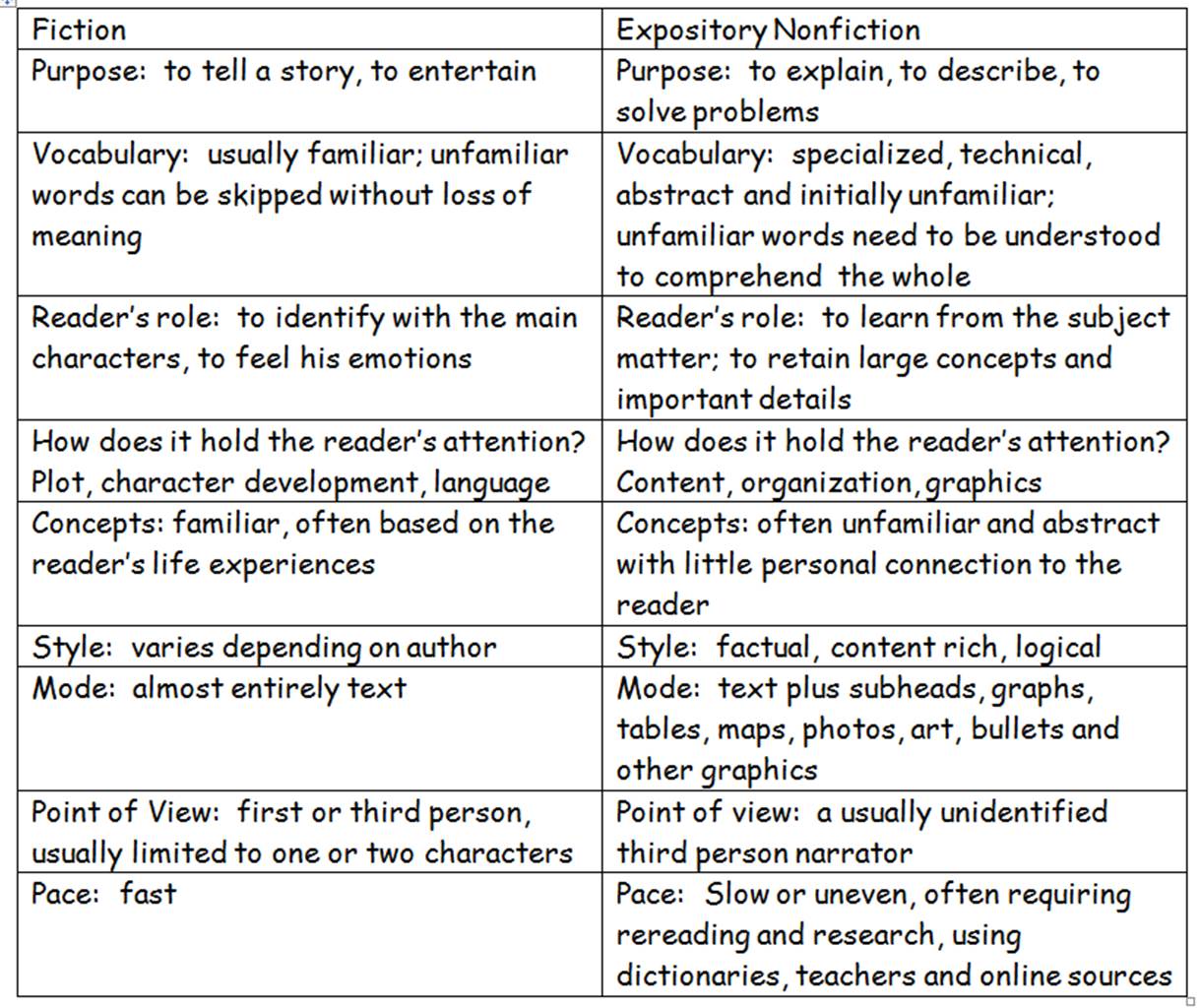
Is the change really necessary? Let’s compare fiction reading and nonfiction reading for students who are beyond the picture book stage.

chart comparing fiction reading skills with nonfiction reading skills

(Adapted from State of Wisconsin, Wisconsin Governor’s Literacy Education and Reading Network Source)

As you can see, reading nonfiction is harder than reading fiction. It often requires more parent or teacher involvement prior to the reading to make connections to what the student already knows; during the reading to explain vocabulary and concepts; and after the reading to restate the main ideas and important details or to explain complicated concepts.

Fiction, too, can be better understood with teacher involvement, but usually fiction can be appreciated (if to a lesser degree) by the student reading alone so long as the student’s reading level matches the reading selection.

If you hope your child will have a great career someday as a doctor or environmentalist or physics teacher, you can appreciate why an increased emphasis on nonfiction reading is important even in first grade. You may question the Common Core, but its emphasis on more nonfiction reading can only help our kids.

My daughter reads fast, but when I ask her to summarize, she can’t explain well. What do I do?

Occasionally a read-a-holic student will have lower than expected reading grades. The parent is baffled because the child always has a book in her hands and goes through novels voraciously. When I ask such a student to read aloud for me, she shows many of these behaviors:

dhild running with book in hands


  • She doesn’t slow down for commas or stop for periods.
  • Her sentences merge and keep going for as long as she can read without taking a breath, and when she pauses to breathe, it might be in the middle of a sentence.
  • She may skip a line of reading when moving from the end of one line to the beginning of the next.
  • When she comes to an unfamiliar vocabulary word, she bulldozes it, pronouncing it any which-way, and continues reading.
  • Her inflection is flat, like that of an auctioneer.
  • She does not self-monitor; she doesn’t pause to consider that she didn’t understand what she just read.
  • When she answers questions about the reading selection, she does not remember important details and she doesn’t take the time to search for them in the selection.
  • She misses inferences and more subtle figurative language like metaphors.When asked to restate the main idea in a sentence or two, she talks around the subject but doesn’t nail the point the author is making.

What’s going on?

For such a student, speed is the important value. Finish quickly. Move on. (Notice if she is slap-dash about her piano practicing, dressing or cleaning her room. This is a personality trait, not just a reading trait.) In reading, this behavior might develop as she reads novels of her choice. She doesn’t care if she understands every nuance; she would rather understand enough to enjoy the story without slowing down for details.

This kind of reading might work for leisure-time reading, but it doesn’t work for most school reading, especially the kind of reading being tested under the new Common Core Standards. Common Core is trying to break such bad habits by forcing a reader to name the paragraph in which the answer is found, to define a word, to distinguish between fact and opinion, to restate an idea, to infer and to summarize.

What to do to improve fluency and reading comprehension?

  • Ask your student to read aloud. She will fume because it takes longer to read aloud. But make her do it. Silently read along with her and note the kinds of errors  which she is making.
  • If she is ignoring punctuation, stop her and ask her to reread and pause appropriately. She will hate this, but making this one change is half the battle.
  • Ask her to use inflection now that she can hear the sentences correctly. Model it if necessary.
  • If she slides over longer words she doesn’t know, stop her immediately and ask her to sound out the word. If she can’t do it on her own, cover a prefix and a suffix; ask her what the root means, or if she knows another word with that root. Then reassemble the word and pronounce it.
  • Sometimes it is not the long words which stump students; it is the idioms or the secondary meanings of short, familiar words. Stop your student when she encounters such words to be sure she understands them.
  • If she skips lines of reading, have her use her finger to keep track, or an opaque book mark.
  • At the end of a paragraph or a few paragraphs, ask her to explain what she just read. If she has missed something significant, go back and show it to her and together figure out why she missed it.
  • Many times, ask what the main idea is. If she can’t nail it, have her reread while you point out clues to the overall meaning.
  • Model self-monitoring by stopping her now and then to take stock of what was read and what to expect next.  Let your student hear you talking to yourself about what you just read.
  • Lastly, let her read her leisure-time reading undisturbed, bad habits and all. You can only fight so many battles; let her win that one small skirmish.

Did the Common Core eliminate handwriting as a skill kids need to learn? I can’t believe it!

The Common Core requires legible manuscript (printing) in kindergarten and first grade, but after that there are no standards relating to handwriting. 3rd grade student writing

In fourth grade, the Common Core requires students to be able to keyboard or type a full page at one sitting.  Learning cursive writing is not required.

However, the Common Core developers have encouraged individual states and school districts to modify the standards as appropriate for their populations. Some states have included handwriting. In California, kids need to learn printing in second grade and cursive in third and fourth grade. Massachusetts requires legible handwriting of any kind in fourth grade. Private schools, which may or may not follow the Common Core, usually include handwriting as a necessary skill.

Does your state require children to practice handwriting? You can find out by going to your state’s department of education and searching for the state-required curriculum. You may find that your state has adopted the Common Core as a whole, without modification, in which case handwriting will not be taught after first grade.

But that does not mean you can’t augment your child’s learning. Teacher supply stores sell booklets on how to write in cursive. Or you can go online to buy such materials.

There is good reason to do so. Handwriting (as opposed to writing with a keyboard)

  • Develops dexterity in fingers
  • Improves hand / eye coordination
  • Activates many parts of the brain not used when keyboarding
  • Encourages children to write longer passages, and
  • Improves letter recognition.

Another reason to learn cursive is to be able to read letters and documents of the past. I have many letters from my aunt—written in cursive. I have a letter and post cards sent home from Europe by my father during World War II—written in cursive. I have copies of the Declaration of Independence, the Constitution and Lincoln’s Gettysburg Address—written in cursive.

Like much of the Common Core, the reduction in emphasis on handwriting is controversial.

The Common Core will change what your kids read in school

In the past, most English Language Arts reading material was taken from children’s literature: stories of Aesop, Judy Blume and the Brothers Grim, for example.

But under the Common Core, the amount of time children spend reading and discussing literature in the public schools will steeply decline in most states. In its place students will read more informational and persuasive reading, such as Lincoln’s second inaugural address, a letter home from a Vietnam War soldier, or an article showing the pros and cons of taking music lessons.

boy reading bookFor younger children, reading material will be divided roughly into thirds: one third persuasive reading, one third expository reading, and one third narrative reading. But as children become high schoolers, the amount of time they spend on literature could drop to about one fifth of the total.

The point of this shift is to make students better prepared for the rigor of a college education and the kind of jobs that someday await them.

In the United States’ best universities, the number of English literature majors has dropped noticeably in the past thirty years, while at the same time science, technology, engineering and math (STEM) majors have been attracting more students. Yet many college freshmen are not prepared to understand college science, technology, engineering or math texts. Nor are they prepared to write essays in those fields using logic and critical thinking.

To compete on the world stage, believe the developers of the Common Core, students need a radically different kind of education than their parents received—even in English Language Arts. So out with Huck Finn (or maybe read just an excerpt) and in with primary documents; out with Romeo and Juliet and in with two-sided arguments on the place of women in combat troops.