Yearly Archives: 2014

Will watching TV help my child learn vocabulary or do better at reading?

Most studies of the effects of television viewing by young children show negative effects, but it is hard to single out effects on only vocabulary or reading readiness.
Child sitting in front of a large screen tv.

  • Kids two to five years old spend 32 hours a week—almost five hours a day—watching TV, DVD’s, DVR’s, videos, game consoles, tablets, and smart phones. Most of that time is spent watching live TV programs.
  • Toddlers 29 months old who spend two hours daily watching TV risk lower vocabulary and math skills, and by the time they go to kindergarten, have lower attention spans and are physically weaker.
  • Many homes (as many as 51%) report a TV on in the background most of the time. In such situations, children watch more TV and read less often than other kids. They are less likely to be able to read. One, two, and three-year-olds have shorter attention spans. Parents and children interact less frequently than in homes without constant TV. (the University of Michigan)
  • When the TV is on, adults speak 75 fewer words per hour compared to when the TV is off. Children speak 25 to 50% less when the TV is on. (the Seattle Children’s Hospital Research Institute)

What can you take away from this research?

  • The more time children watch TV, the less time they devote to reading, academic work, physical play and social interaction—all important for a healthy, well-rounded childhood.
  • The more time the TV is on, the less time adults talk to children, and the less time the children talk—all detrimental to healthy, developing children and especially to vocabulary building which is so important for learning to read.
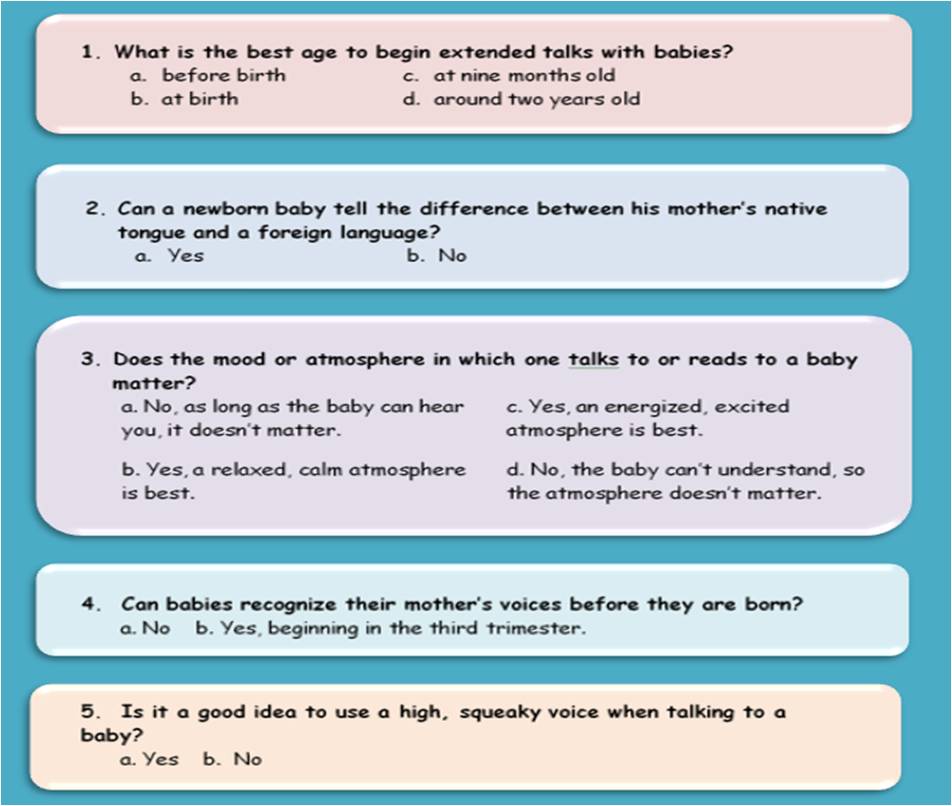
When is the best time to prepare babies for reading?

Click on the graphic below to enlarge it.Questions

Anwsers:  Question 1, Question 2, Question 3, Question 4, Question 5  (each answer will open a browser tab)

Pregnant mom talking to baby in womb.What has this to do with reading?  Babies who have been spoken to often pick up the sounds of their native language.  They learn the patterns of sound that make words and sentences.  They learn that when there is a pause in the sounds, that is a good time for them to respond (with babbling at first).  They learn vocabulary.  When the time comes for them to connect sounds, intonations, pauses and vocabulary with written letters, they are way ahead of children who have limited exposure to oral language.

It’s fair to say that the groundwork for teaching a child to read begins in the womb.  –Mrs. K


Give your child the gift of books. Give your child a library card.

I remember getting my first library card in kindergarten.
Child excited about her first library card.I needed to be able to write my own name with my mother promising to be responsible. As the librarian looked on, I carefully printed my name in block letters on a paper. Then the librarian put a blank library card into a typewriter, typed my name on it, and handed me the gift of books.

I felt so grown up, like when I earned my driver’s license years later. And did I ever use that card!

Luckily, my public library was three blocks away from my home, on a corner I passed to walk to kindergarten. Once a week my mother would meet me there after school and I would pick out two or three books. How I loved wandering through the tiny children’s section to pull my own selections. How I loved it when the librarian stamped my book!  My mother would take out books for my younger siblings using her card, but I took out my books on my own card.  And when I was in first grade, I could go all by myself, two or three times a week, and exchange books I’d read for new selections.

If your library allows young children to get their own library cards, this is a rite of passage worth celebrating. Keep the library card in your own wallet, if you think your child might lose it, or find a special place for it at home, but get your child a library card.  Take your child to the library, and let her relish the thrill of using a library card. Take her picture with her spanking new library card to show that you consider this an important milestone.

Just like enrolling your child in school, encouraging her to be a faithful library patron is one of the best investments in her education that you can make. And summertime is a great time to get a library card and to take part in the library’s summer reading program. –Mrs. K

Getting my own library card was a momentous occasion. Luckily, I had a short name so I could print it in the tiny space allotted. Back then, a library card was made from card stock. Each library book had a card and a pocket in the back for the book’s card. I never could quite figure out the system for keeping track of it all. But the stamp with the rolling date! I’m not even sure if those are sold anymore!

Living in a city, the library was available on a daily basis. Summer days it was a place to go! And it was free! Yes, the library was then and has always been a big part of my life. –Mrs. A

How many books are enough books for a preschooler?

Preschooler looking at a tall stack of books.1,000 books is a great goal, according to the 1,000 Books Foundation, a nonprofit organization which has enlisted the help of libraries across the US to promote reading. Their effort, “1,000 Books before Kindergarten,” has a simple goal: Children should be read 1,000 books before they start kindergarten.

1,000 books before kindergarten? Yes. They can be all different books or some of the same books read over and over to a child. The reading can begin in utero, or when the child is an infant or toddler, but the counting must stop by the day the child starts kindergarten. Parents are encouraged to write down the name of every book and the date it was read (Log sheets are available at 1000 books).  Writing down the names promotes accountability, and the growing list encourages persistence.

1,000 books might sound daunting, but if a parent reads one book a day for three years, that is more than 1,000 books. Many parents read more than one book a day, making the feat even easier. And if a parent reads a book to two or three children at a time, that counts as a book for each of them.

Some libraries provide their patrons with a journal in which they can list the titles. Some libraries offer stickers to children for meeting benchmark goals. Some local newspapers publish the picture of all children who reach 1,000 books.

Have you participated? Were you able to reach 1,000 books? Let our readers know. –Mrs. K

Of course there are some parents who may be turned off by the idea of listing the title of every book read every day. I know that would become tedious for me. It reminds me of diets where you list every food eaten every day. After a few weeks, most of us cannot maintain the daily log. But how about just a check mark or a number on the calendar…adding up the total at the end of the month and then adding on as the year continues. –Mrs. A

Ever hear of the “summer slide”?

For years, educators have known that students loose reading skills during the summer if they don’t continue reading.  They call this loss the “summer slide.”  It is most severe among low-income students who lose up to two months of reading skills, yet it is sometimes nonexistent among middle class students who make slight gains in reading during summer months.
 
Summer slide (decline) of reading scores.
 
Here’s what some studies show:

  • B. Heyns’ 1978 study of 3000 sixth and seventh graders in Atlanta Public School showed that students who read at least six books during the summer maintained or improved their reading skills.  But students who didn’t read lost up to a whole grade of reading skills.
  • K Alexander’s, D. Entwisle’s and L. Olson’s 2007 longitudinal study of Baltimore students over 15 years found that by the end of fifth grade, students who didn’t read during the summer measured two years behind their classmates who did.  They concluded that 2/3 of the reading difference in ninth graders can be attributed to reading or not during summer school breaks.
  • Dominican University’s study of students completing third grade who took part in their local libraries’ summer reading programs scored 52 Lexile points ahead of their classmates who did not.
  • The Campaign for Grade-Level Reading, funded by many foundations, concluded that children’s absence from reading during the summer is a major hurdle for achieving good reading skills by the end of third grade.
  • The summer slide is cumulative.  Some estimate that by the end of high school the summer slide can account for up to a four year lag in reading achievement, and it can have an effect on high school graduation rates.  According to the Annie E. Casey Foundation, “one in six children who are not reading proficiently in 3rd grade do not graduate from high school on time, a rate four times greater than that for proficient readers.”

So how can you combat the summer slide?

  • Sign your child up for your local library’s summer reading program, and make sure your child completes the reading.
  • Go to the library regularly and let your child select books she will enjoy.
  • Help your child to read a chapter book a week, or a picture book each night.
  • Encourage your child to read the newspaper, television guides, magazines and online articles.
  • Reward your child with a trip to the book store to select her very own book.
  • Read to your child every evening, and let him read to you.  Your reading will teach fluency and pronunciation, and establish the notion that reading for pleasure is fun.

How can I increase the impact of books when I read to my young son?

  • Have you considered pairing two books about the same subject, one facts, one fiction?
  • Or have you considered following a book with a related film?
  • Or have you considered reading a book about the making of a work of art (a cathedral, for example), and then visiting a cathedral with your child?
  • Have you considered reading about the creation of a piece of music and then listening to the actual piece with your child?

This slideshow requires JavaScript.


The example above pairs a picture book, sheet music (on page 78), a youtube piano tutorial, and a youtube video of an orchestra playing Gershwin’s Rhapsody in Blue. Click on these underlined links to see more details or to view the videos.

All too often, we read nursery rhymes, fairy tales and other fiction to our children without considering related nonfiction books, films, music, and paintings. Boys, in particular, might prefer additional factual information.

When my daughter was a third grader, she read Mr. Popper’s Penguins by Florence Atwater. I found some National Geographic Magazine articles on penguins, and together we read them, deepening her understanding of penguins. For a school assignment, she wrote her own penguin book, dedicating it to National Geographic. She could also have read Penguins and Antarctica by Mary Pope Osborne and Natalie Pope Boyce, a nonfiction companion book to Eve of the Emperor Penguin, part of the Magic Tree House fiction series by Mary Pope Osborne. A documentary film about penguins, March of the Penguins, would have told her about the brutal lives of penguins on Antarctica. The animated Happy Feet, though less factual, would have offered another perspective.

Is there a new baby coming into the family? Big Brother Dustin by Alden R. Carter follows a child with Down Syndrome as he anticipates becoming a big brother. A funny companion book might be Junie B. Jones and a Little Monkey Business by Barbara Park, a novel about a kindergartener’s belief that her newborn brother is really a monkey. Many child-oriented nonfiction books are available about pregnancy and birth.

When you read two different types of books on the same subject, often you investigate the subject from two different vantages. Little children need to learn that there are many ways of looking at the same information and that they all might be good, or that one might be real and the other entertaining.

Sometimes the child makes connections between the two books, but sometimes the adult needs to point out similarities and differences to obtain the most impact. For example, you could explain what the words “fiction” and “nonfiction” mean, and how Clifford is a pretend dog while a book about dog breeds shows pictures of real dogs. “Real” and “make believe” are concepts a child needs to learn.

Some children prefer fiction while others prefer nonfiction. By pairing them, the child is exposed to both genres. But of course the main reason for pairing is to deepen meaning for the child. Your child will gain the most impact if you discuss the books with him. –Mrs. K

When I was a child, my favorite book was Black Beauty.  Unfortunately, I never ventured to the nonfiction section of our library.  Was I unaware of it or just stubborn, refusing to step out of my comfort zone?  I certainly would have enjoyed learning more about horses.  My favorite TV horse was a dappled horse ridden by Little Joe on the TV show, Bonanza.  The nonfiction books would have given me opportunities to look at pictures or to read the captions, even if most of the content was too advanced for me. –Mrs. A

How about you? Have you found pairing books or books with other medium to be a good way for your child to learn more? Let us know.

Should I call vowels “long” and “short”? If I don’t, what do I call them?

When a vowel sounds like its name, we have traditionally called it a long vowel. When the vowel can be said with the mouth only partly opened, we have traditionally called it a short vowel.
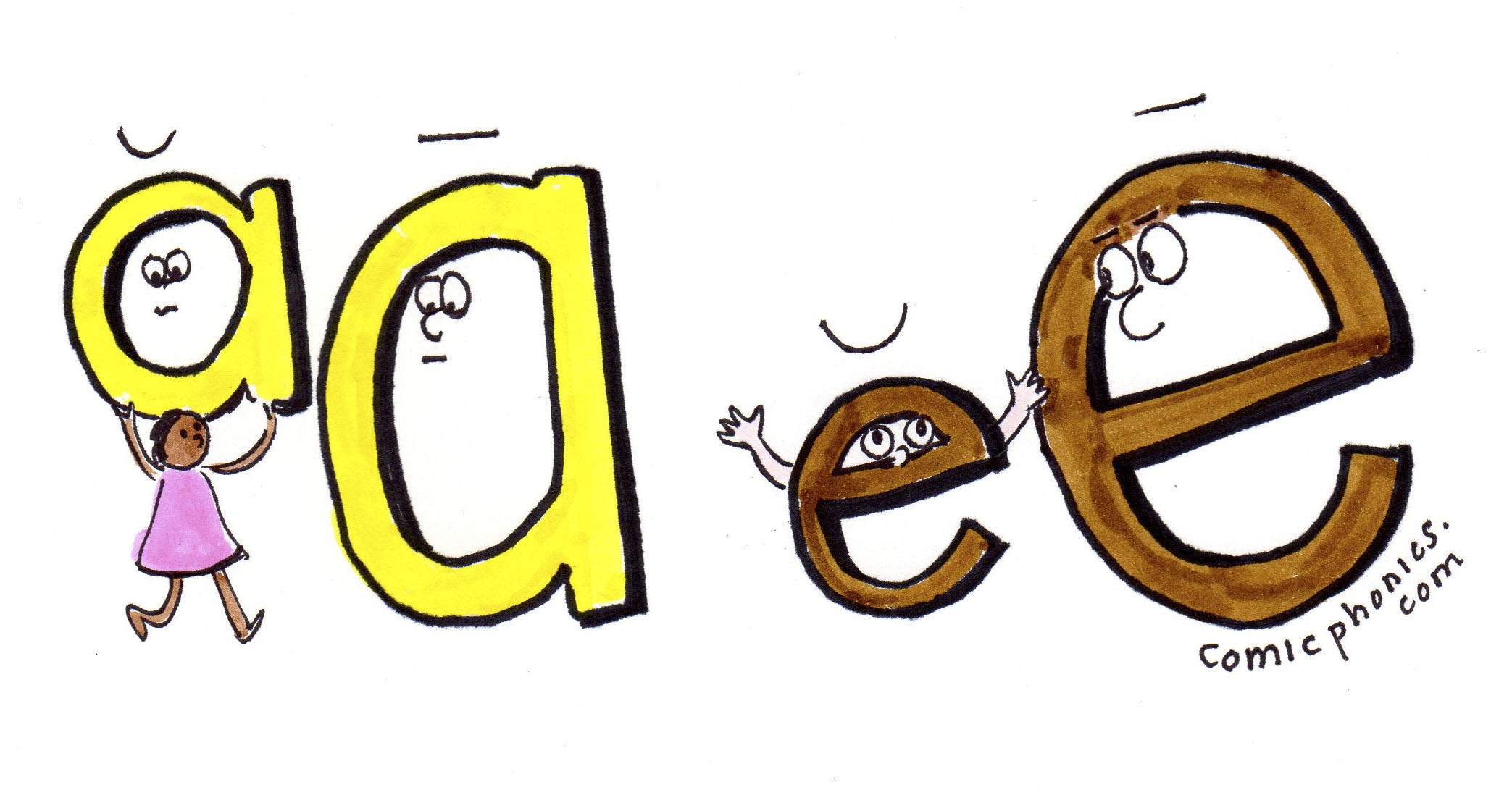
Long and short sounds of a and e
long, short i, o, u
Most Americans learned this way of naming vowel sounds, but today some experts recommend tossing out this old-fashioned naming system for several reasons.

    • First, calling a vowel sound either long or short does not accurately describe the vowel sound since both kinds of sounds take about the same amount of time to say.
    • Second, if the amount of time to pronounce these vowels is about the same, then what does long and short measure? Some experts say it is the length of the opening of the mouth. True, the mouth does open a bit more for long i’s and o’s, but not for the other long vowels.
    • Third, there is a whole other group of vowel sounds which is neither long nor short (ou and oi, for example). Reading specialists call these diphthongs, but that term is usually not used with little children. These vowel sounds are usually called by the sound they make.

You can teach vowel sounds without ever using the terms long and short vowels, but eventually in school, the teacher, or a workbook, or a test probably will use those terms. If your child has not heard the terms before, she might be confused.

I recommend focusing on the sounds until the child knows them. Associate the sounds with letters only after you are sure your child can hear and pronounce the sounds correctly. Mention long and short vowels in passing, but don’t dwell on those terms. After all, it’s not what you call a vowel sound that is important in learning to read; it is being able to pronounce the vowel sound correctly.

When your child notices that the ten common vowel sounds are represented by only five letters, explain that hundreds of years ago, when people were first writing down our language, they ran out of letters to use, so they doubled up on some letters, using them to represent two different sounds. But quickly add that there are clues in the words which tell you which way to pronounce the sounds, so it’s usually not a problem.

What does it mean to be literate? Part 2: Details on American achievement on PISA reading tests

Results of the every-three-year PISA reading tests (Program for International Student Assessment) were announced on Dec. 3, showing that U.S. 15-year-olds again scored average compared to their peers in 64 other countries.

Eight percent of American students who took the test scored in the top ranges; 17 per cent scored at the baseline low range; most scored at the average range.  In the U.S., Massachusetts and Connecticut had more students scoring in the top ranges than did South Korea while Florida scored just a bit below the total U.S. average.  Massachusetts, Connecticut and Florida paid to have more of their students tested so that they could have a representative sample to use to compare their students.

Compare the U.S. scores with those of the best scoring countries:

US literacy rank among other high ranking countries.

What does all this mean?

    • Since the reading testing began in 2000, the U.S. has consistently scored in the average range in years in which comparisons can be made (2000, 2003, 2009 and 2012.


  • Despite the increase in testing of U.S. students, and despite publicizing the results of those tests, and despite shaking up public education with charter schools and other statewide initiatives, U.S. education is stagnating, according to Education Secretary Arne Duncan.

Why the mediocre showing by U.S. students?  Various reasons are proposed, especially the effects of poverty.  Dennis Van Roekel, president of the National Education Association, emphasized the corrosive effects of poverty. The U.S. has one of the highest child poverty rates in the world, double or triple the rate in PISA leading countries such as South Korea, Germany, Finland, Estonia and the Netherlands. Van Roekel called poverty “the main cause of our mediocre PISA performance.”

Do I say “red new book” or do I say “new red book”? Is there some rule to teach my daughter?

Royal Order of Adjectives SignYou say “new red book,” and yes, there is a rule. It’s called the Royal Order of Adjectives—an imperious name for an ordering system. The list below begins with adjectives placed farthest away from the noun (Determiners) to those placed nearest to the noun (Specifiers).

Determiners: Which one (the, a, an, my, her, this, that, these, those). Most singular nouns in English are preceded by either an article, a possessive noun or adjective, or a demonstrative adjective. Plural nouns do not use “a” and “an” but may use the other determiners.

Subjective description: (slow, ugly, easy, delicious) These adjectives can be considered opinions of the speaker or writer.

Size: (large, small, three-inch-long, two-liter) The hyphens are used to create words that don’t exist in English. Notice that every adjective is singular (three-inch, not three-inches) even if the word it describes is plural.

Shape: (round, misshapen, skinny, elongated)

Age: (new, antique, fifty-year-old) Notice that the adjective “fifty-year-old” does not put an “s” on year because all adjectives are singular. “My fifty-year-old brother” but “My brother is fifty years old.”

Color: (red, striped, mottled)

Nationality: (American, Asian, Indian)

Material: (cardboard, polyester, paper, metal)

Specifier: (rocking [chair], player [piano], Apple [iPhone])

Related to this idea of ordering adjectives is the question of which ones need commas to separate them. The rule is that if the adjectives fall into the same category (both colors, for example), then use a comma. If the adjectives come from different categories, no comma is necessary.

 Correct: My successful tall, willowy Korean sister travels often.

Most Americans cannot explain the rule of ordering adjectives. If they have heard the adjectives ordered correctly as children, they use that same order. They go by what sounds right, but they cannot explain it. ESL students who have not heard adjectives ordered a particular way may not know there is an order, and may order the adjectives arbitrarily. It is important for teachers and parents to point out to ESL students that there is a correct order.

Even preschoolers can be told to say “a new red bike, with the color red right next to the bike” so that they become aware that there is a right way to order words. Little children often use size and color to describe an item, so it is important to point out that size comes first, then color.

Some Americans put commas between all adjectives preceding a noun, and others don’t use any commas. More and more the practice in the U.S. is not to use commas unless leaving them out leads to confusion.

Try this quiz to see if you understand the Royal Order of Adjectives:

Adjective test

–Mrs. K

What does it mean to be literate?

Definitions vary:

  • Reading, writing, speaking and listening (The Common Core State Standards Initiative)
  • Understanding, using, reflecting on and engaging with written texts, in order to achieve one’s goals, to develop one’s knowledge and potential, and to participate in society (The Programme for International Student Assessment)
Organization for Economic Cooperation and Development (OECD) 2010 report, Program for International Student Assessment (PISA) 2009 Results

Here’s a video on the PISA 2009 Results.

At its most basic, literacy means the ability to read. When and where did this ability begin?

  • Scientists believe symbols representing ideas first developed around 8,000 years ago in ancient Sumer, in what we call Iraq. The symbols were used by commercial and agricultural interests to keep track of the numbers of things—chickens and eggs, for example.
  • Egyptian hieroglyphics developed about 5,300 years ago; it was the first system to include some phonetic symbols, not just pictographs.
  • Written Chinese notations began around 3200 years ago.
  • Around 3500 years ago, in Canaan, in what is now Syria, a consonant system of notations was first used.
  • Later alphabets (Phoenician, Hebrew and Aramaic) using both consonants and vowels, are thought to be based on this Canaan alphabet.
  • Beginning around 2700 years ago, the Greek alphabet derived from these others.
  • Literacy was widespread among male citizens of ancient Rome, but with the fall of the Roman Empire, literacy retreated , becoming the practice of princes and priests. Over the centuries, as trade increased, so did the need for some literate citizens. The Industrial Revolution which produced cheap paper and books became a strong force for more widespread reading, but so did educational reform which required children to learn reading, writing and arithmetic.

Today in the U.S., the ability to read is not universal, even though some statistics show the U.S. has a 99% literacy rate.

  • One out of three fourth graders scored “below basic” on the 2009 National Assessment of Education Progress Reading Test, according to the Annie E. Casey Foundation.
  • More than 67 percent of all U.S. fourth graders scored “below proficient” on this same test, meaning they are not reading at grade level.
  • If a child is not reading proficiently by fourth grade, that child has a 78% chance of never catching up.

–Mrs. K