
Point of view (POV) is a difficult concept for little children to grasp. If you are reading a picture story to a child, and you ask who is telling the story, the child might say, “You are, Nana.” The child is right—you are reading the story—but the child is also wrong—you are not the narrator in the story.
I find that using many examples, and repeating those examples over and over until the light bulb goes on, is a good way to teach POV. But first of all, a child needs to understand the various possibilities for POV.
- First person—The person telling the story refers to himself as “I” or “me” and refers to groups that he belongs to as “we” and “us.” Autobiographies and memoirs are told in first person.
- Second person—The person talking speaks to you, and uses “you” as a pronoun. TV commercials often use the second person. (“Are your feet hurting? You should buy XYZ foot cream.”) Almost no literature is written in second person.
- Third person limited—The person telling the story knows the internal thoughts of just one person. Readers can hear the thoughts of just one person.
- Third person omniscient—The person telling the story—we don’t know who it is—knows the internal thoughts of more than one person.

Some rules to make it easier:
- Eliminate dialog before trying to determine POV. Cross out direct quotes or internal dialog (a person talking to herself) and analyze what is left.
- If both first and third person pronouns are used(I told my brother I didn’t like his crying), the POV is first person.
Here are some examples meant for third graders or older students.
- It was great living with Jerry Barker as his cab horse. Not all horses were taken care of like I was. I was never overworked and I was clean all the time.
- I won Dribble at jimmy Fargo’s birthday party. All the other guys got to take home goldfish in little plastic bags. I won him because I guessed there were three hundred and forty-eight jelly beans in Mrs. Fargo’s jar.
- At Aunt Grace and Uncle Edwin’s the air was hot and stuffy and the furniture was hot and stuffy and Aunt Grace and Uncle Edwin were stuffy.
- Every clear day Gawaine rose at dawn and went out to kill dragons. The Headmaster kept him at home when it rained, because he said the wood were damp and unhealthy at such times.
- [Mr. Popper] had never been out of Stillwater. Not that he was unhappy. He had a nice little house of his own, a wife whom he loved dearly, and two children, named Janie and Bill. Still, it would have been nice, he often thought, if he could have seen something of the world before he met Mrs. Popper and settled down.
- They were all so happy they could hardly speak at first. They just looked with shining eyes at those lovely Christmas presents. But Laura was happiest of all. Laura had a rag doll.
- That night I thought about Will’s advice. Then I had a great idea. I’d look for pet-sitting jobs. That would show I was responsible!
- Andy didn’t hear him. He was staring at the list. Root hairs? He didn’t even see any roots. Then he thought of the picture in his science book. Duh. Roots were under the ground.
- I went to sleep with gum in my mouth and now there’s gum in my hair and when I got out of bed this morning I tripped on the skateboard and by mistake I dropped my sweater I the sink while the water was running and I could tell it was going to be a terrible, horrible, no good, very bad day.
- My name is Junie B. Jones. The B stands for Beatrice. Except I don’t like Beatrice. I just like B and that’s all.
Answers
- first person POV as told by Black Beauty, a horse, in Black Beauty by Anna Sewell
- first person POV as told by Peter Hatcher in Tales of a Fourth Grade Nothing by Judy Blume.
- third person omniscient POV as told by an unknown narrator in Half Magic by Edward Eager
- third person omniscient POV as told by an unknown narrator in The Fifty-First Dragon by Heywood Broun
- third person limited as told by an unknown narrator in Mr. Popper’s Penguins by Richard and Florence Atwater
- third person limited POV as told by an unknown narrator in Little House in the Big Woods by Laura Ingalls Wilder
- first person POV as told by Teddy, a boy, in The Green Dog by Melinda Luke
- third person limited as told by an unknown narrator in What Homework? By Linda Hayward
- first person as told by Alexander, a boy, in Alexander and the Terrible, Horrible, No Good, Very Bad Day by Judith Viorst
- first person as told by Junie B in Junie B. Jones and the Stupid Smelly Bus
 After students learn to read two- and three-letter words (consonant-vowel-consonant or CVC words), many are ready to learn compound words. Because compound words are longer, reading them makes students feel like they are making progress.

 First, buy two copies of “Why Johnny Can’t Read” by Rudolph Flesch. Send one to your grandson and you keep one. Go to the back where there are lists of words. Start on page one, asking the boy to pronounce the sound of each letter shown. When he can do that, move on to the page of short a words. Have the boy read the short a words, or a portion of them.
 Second, buy two copies of “Explode the Code” workbooks 1, 1 ½, 2 and 2 ½. (Eventually, buy the next sets in this series, but for starts, these workbooks are enough.) This series teaches reading using a phonics-based approach. Kids like it because of the silly illustrations. Have the child start reading while you follow along on your copy, noting and correcting mistakes. Eventually, the child might do some of the pages for homework or with his parents.
 Third, buy a set of letter tiles. You can use the tiles from a Scrabble game or from Bananagrams. Or use a keyboard. What you want to do is to introduce, teach and review new concepts. using tiles or computer words. If you are teaching short a, for example, manipulate the tiles so the child can see them to form “cat” and then “hat” and then “fat,” etc. Changing the first letter while keeping the ending vowel and consonant is easier for beginning readers to decode. Using tiles or computer-generated words enables you to go quickly. Later, you can move from “mat” to “mate” or from “mick” to “mike” and back and forth quickly to show differences in spellings and sounds.
 Fourth, recommend to the child’s parents that the child watch the Netflix series “Alphablocks,” an animated series using silly letter characters to teach phonics. This British series offers tiny segments of three or four minutes to teach particular phonics skills. Even three-year-olds will learn to recognize letters from watching this series. Older children will be able to read words as they pop up on the screen.
 Looking for a fun way to teach or review basic phonics with your beginning reader? Try the game “Blah Blah Blah” Level 1000.
 But strategy counts too. Some cards allow players to force the next player to draw two or four more cards. Other cards force the next player to lose a turn.
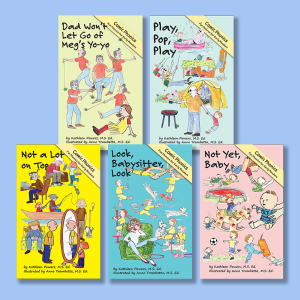


 comicphonics for early readers