Thank you for visiting our blog!

Mrs. A and I want to thank you for increasing the success of our blog.  Thanks to you, this week we had more visitors than at any other time since we began blogging in December.  165 distinct visitors checked out our blog, and many of them returned to give us 355 views.

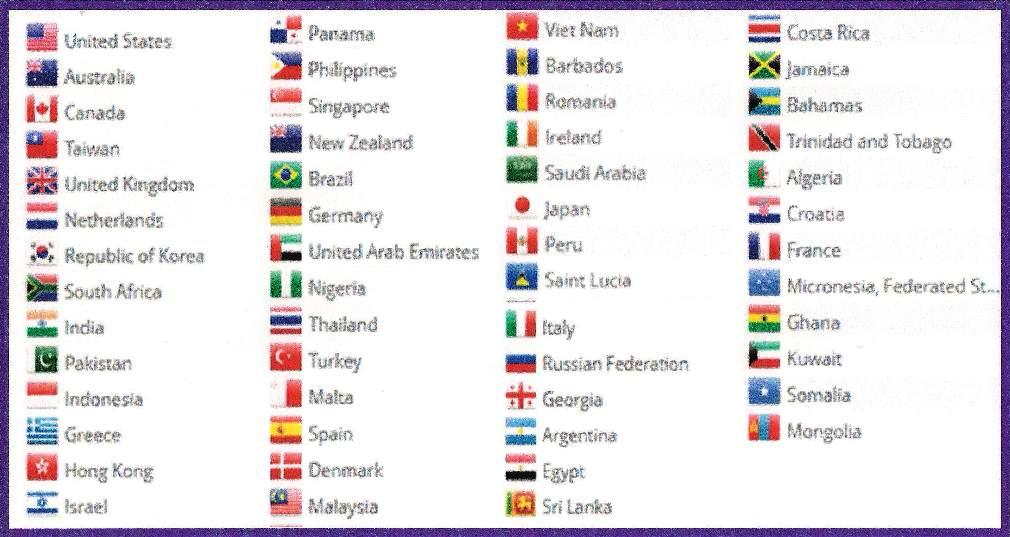
While most of you came from the U.S., we especially welcome our visitors who came from around the world.  Below is a chart showing the countries our visitors have come from in the past five months.

Chart of international  visitors to our comicphonics blog.

Click on the chart to enlarge it.

The month of May, our fifth month blogging, brought double the number of visitors compared to April, our second-best month.  We thank those of you who left comments and we hope more of you will do that.

Later this week, we hope to announce the publication of our second early reading picture book as an app.  But more about that another time.

Sincerely,  Mrs. K

With so many apps available for preschoolers, how do I know which are the best ones to use to teach my child to read?

The best apps to teach reading share many of the same characteristics as the best apps to teach math or to teach games.  Here are some traits to look for, although you will not find each of these traits in every app.

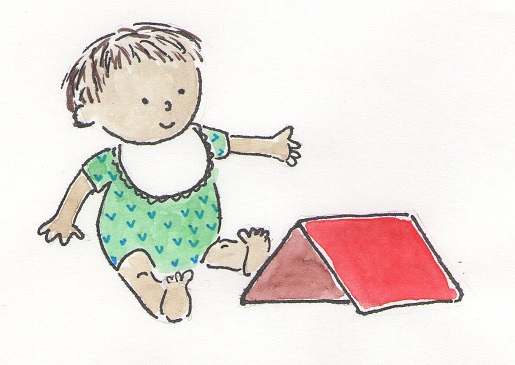
baby looking at an iPad

To enlarge, click on the picture.

  • The app should be age or developmentally appropriate for your child.  It should seem like play but allow the child to gain self-confidence both in mastering the media and in mastering the material presented on the app.
  • The app should be interactive.  Most apps are passive, limiting a child to clicking or scrolling down, but that’s about it.  The best apps allow children to solve problems or to develop curiosity.  Some apps allow coloring, drawing lines and highlighting, with the child deciding how.
  • The app should be intuitive to use.  Using computers is often hard for preschoolers since interaction depends on mastering a mouse and a keyboard.  But pads are intuitive, allowing for swiping with a single finger to move from page to page.  Once the child tries the process a few times, he understands it.
  • The app should allow for repetition.  Young children like to have their favorite books read to them over and over.  They might also like to go to their favorite apps over and over.
  • The app should take advantage of the technology.  A book about a pet might show the word “dog,” but an app might show the printed word, offer a picture of a group of dogs wagging their tails, and create the sounds of panting and barking.
  • The app should be open-ended: divergent, not convergent.  Usually an app encourages a child to hit an icon which might be right or wrong, a dead end for the child.  But if the answer allows the child to continue in a manner she prefers, or to get to an answer in a round-about way, the child has some input into the outcome.
  • The app should extend a child’s skill or make up for a child’s shortcomings.  If a child cannot print yet, or has poor printing skills, a good app would produce the desired letters without the child needing to “write.”  Or for an ESL child or a child with speech problems, a good app might “read” the words aloud so that the child can hear the words pronounced correctly.
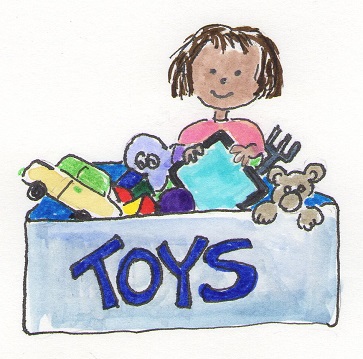
    child taking iPad out of toy chest

    To enlarge, click on the picture.

  • The app should be fun and engaging.  Stories should move in time order so that they are easy for a young child to follow.  There should be an obvious beginning, middle and end.  The vocabulary and sentence structure should be comfortable for the child so he gets it the first time he hears it.  The art work should make the child laugh.
  • The app should foster socialization.  Apps that store child-taken photos of a trip to the zoo allow for later sharing with preschool classmates or with family.  Apps that allow a child to film a Barbie fashion show or Grandpa snoring beg to be shared.  SKYPE allows for sharing over great distances.

Spend some time investigating apps for your young children.  Teach them how to access the apps you have selected.  And next week do it again, because the apps—like your child—are always changing.

Mrs. K and Mrs. A publish first phonics picture book

BREAKING NEWS—Mrs. K and Mrs. A published our first children’s book on May 23.  Called Not a Lot on Top, it concerns the attempts of a little girl to hide her father’s bald head.  The pictures are silly, the words easy and the cost low–$1.99 for the book and ten easy yet educational activity pages relating to the book.

bald dad with lampshade over head

See new app at http://goo.gl/ClVyM

Right now the book is available on all Apple products but we hope eventually it will be available on android products as well.  Go to http://goo.gl/ClVyM to read more information or to order.

More books are in the works.  We hope to publish two in June and one a month after that—all targeted for the beginning reader in English.

Mrs. K and Mrs. A would like to thank Patrick Powers who suggested publishing our books as apps, and who did the technical work to make it possible.  We would also like to thank Bill Powers who has done all the technical work which makes this blog possible.

In my library, I saw some wordless picture books. What are they for?

Wordless picture books (books with no words except for the titles) and almost-wordless books (books that repeat the same word, phrase or sentence over and over) are a category of picture books that began in the 1960’s but have grown increasingly popular.  There are several kinds:

  • Concept books.  These include ABC books, counting books and pictures for infants to identify.  They also provide pictures of everyday objects for ESL students to identify.
  • Books related by a theme or a sequence.  These books show illustrations that are related, but not by a story line.  Books showing different kinds of trucks, or pictures of how the seasons change, or pictures showing a bedtime routine are examples.
  • Books showing expository content.  These books might explain how a caterpillar becomes a butterfly or show all the protection a football player puts under his uniform.
  • Books showing visual games.  Interaction is required to find a hidden object or to find subtle differences in two nearly identical pictures.  The reader might need to point to the hidden item, or circle differences in pictures.
  • Story books.  These might show simple or complicated story lines.

I assume the books you are asking about are story books.  Why have stories without words?  Let’s start by talking about two-year-olds.

baby reading a book

Click on the picture to enlarge it.

Kids who have just turned two are probably not aware of “story” as we know it, even though they might have been read to a hundred times.  When they look at a picture book, they see individual pictures, not parts of a story.  They might be interested in the boy on page 3 because of his glittery sneakers, or they might notice the funny expression on a dog’s face.  When they look at page 4, two-year-olds probably are not aware that events on page 3 have caused events on page 4.  The picture book is not so much a story with a beginning, middle and end for such young children.  Rather it is a collection of fascinating pictures.

For such children, does it matter if there is text on page 3 or page 4?  Probably not.  They are getting their meaning from the pictures.

Does it matter if the adult reads the accompanying text aloud or not?  Probably not to the two-year-olds.  The words give just one meaning—that of the author.  But the children are more interested in gaining their own meanings.  They pick up on their own clues and focus on what is important to them.  You have probably had the situation where you are trying to finish reading a story but your child doesn’t care about the story ending.  He would rather talk about one of the pictures, or leaf back through the book to see a particular picture again.

young boy reading a book

Click on the picture to enlarge it.

Yet sometime between two and kindergarten, most children realize that story books are more than a collection of fun pictures:  the pictures tell a story with a beginning, middle and end.  Do children need text to learn this?  Probably not.  As they become more sophisticated at “reading” pictures, they notice more, they make more connections, and story emerges.  It is only when children begin to read words that they need words on the page.

So back to your question.  What are these wordless story books for?

  • With no right or wrong words to explain what is happening, these books allow for wider interpretations than a text might allow.  Children can bring their own meaning to the stories.
  • Research shows that parents who tell a story based on pictures only use a richer vocabulary and more complex sentence patterns than authors usually use in picture books.  Children pick up on the vocabulary and become attuned to longer sentences.
  • Bilingual parents can mix vocabulary from two languages to make the story meaningful for their children.  Parents who don’t speak English can “read” the story in their own languages.
  • Developmentally delayed children benefit from having the reader tailor the story to their level.  Or they get the chance to tell the story from their own point of view, with no right or wrong perspective.

As children grow, these books have other advantages:

  • Children can learn the elements of story from these books—characters, setting, beginning, middle, and end.
  • Children can think creatively, coming up with various possibilities to interpret a single picture book.
  • Children can learn how to tell stories orally before they have the skills to write stories down.
  • By using recording devices and cameras as children “read” these stories, children can record their favorite stories to share with Grandma in Taiwan or with Mom waiting at the gate for her flight.
  • Once children begin to read and write, they can write their own words for the wordless story books, and read them aloud.
  • Children can use the books as models, illustrate their own stories and then supply words, perhaps dictating to an adult.
  • Children can gain success in reading, like reading and feel confident reading all before they can “read” real words.

Like all books, the quality and sophistication of wordless picture books varies.  A children’s librarian can point out some good ones.  Or you can find lists on the web.  Some classic ones include:

  • A Boy, a Dog, and a Frog by Mercer Mayer
  • Pancakes for Breakfast by Tommie de Paola
  • Time Flies by Eric Rohmann
  • Picnic by Emily Arnold McCully
  • Up and Up by Shirley Hughes
  • Free Fall and Tuesdays by David Weisner
  • board picture books by Helen Oxenbury

Can dyslexia be identified in a preschooler?

By definition, dyslexia is a learning disability characterized by difficulty reading.  There are secondary characteristics—difficulty spelling, and illegible handwriting, for example—but until a child has attempted to read, it’s probably too early to identify dyslexia.

Even so, the National Center for Learning Disabilities has listed several warning signs for dyslexia, shown in the chart below, and some of them apply to preschoolers.

Dyslexia is the most common learning disability, affecting about five percent of American children.  Its cause is unknown, although scientists think it probably has more than one cause.  About a quarter of the children who have dyslexia also have attention deficit hyperactivity disorder, though most children with dyslexia don’t exhibit ADHD.  If an older child in the family or a parent has dyslexia, then the younger child has an increased chance of having it too.

Children diagnosed with dyslexia have normal intelligence and vision, yet they cannot figure out how to read by first grade.  Eventually they do, but they often require intervention from the school system, a tutor or a dedicated parent.

Dyslexia affects information processing in the part of the brain controlling language.  Usually children without dyslexia begin to realize that sounds combine to form words or parts of words, and that those sounds can be represented by letters.  Children with dyslexia have difficulty making these connections.

Children with dyslexia do learn to read, but it takes longer.  Teachers need to repeat the phonemes or basic sounds of English (about 44) and help children recognize these sounds in words and in syllables.  “Go” for example, has two phonemes, g and long o.  Then teachers need to connect these phonemes to letters, and the letters to tiny words which follow the rules of pronunciation.

If you are concerned about dyslexia, the National Center for Learning Disabilities website offers a 40-page toolkit about dyslexia, including several pages about characteristics of children pre-K to second grade and strategies to help them learn.  Your right to have your child tested by the public schools, the type of testing done and a video from an educator who has dyslexia are included in the toolkit.

How can I make reading to my four-year-old a more educational experience (not just fun)?

Children pick up many foundational skills when someone reads to them frequently.  In fact, reading to children is probably the single most important way to prepare them to read by themselves.  But you could monitor your child to be sure he is learning more subtle concepts about reading in English.  Most schools expect these skills to be mastered by the end of kindergarten:

  • Knowing that in English words are read from left to right.  (You could point to words with your finger as you read to reinforce this idea, especially if you come from another language in which words are read from right to left or top to bottom.  If you read to your child in both languages, remind the child that you are reading in English.)
  • Knowing that words are read from top to bottom.  (Occasionally, ask your child where you should begin reading on a page.  Or turn the book up-side-down to see if the child recognizes the mistake.)

    child telling grandpa he is holding the book upside down.

    Click on the picture to enlarge it.

  • Knowing that pages are turned from right to left.  (Ask your child to turn the pages for you.)
  • Knowing that words are shown in print by a grouping of letters with a space before and after.  The space before indicates a new word is to begin; the space after indicates that a word has ended.  (Point to tiny words like “a” or “I” and to big words like “dinosaur,” and comment on the size of the word.  Or ask the child to count how many words are on a particular line.)
  • Knowing that words are formed from specific sequences of letters.  (Write a “word” like xxxxxxx or abcdefg and ask your child if that is a word.  Even though a child cannot read, he begins to figure out that not every grouping of letters makes a word.)
  • Knowing that words are made from combinations of 26 letters, upper and lower case.  (Make sure your child can name the upper and lower case letters.)
  • Since understanding word families helps with reading (pig, wig, big), children need to identify words that rhyme.  (Play rhyming games with your child.  Recite nursery rhymes with your child.)
  • Since English words are made of syllables, understanding the number of syllables in a word is important.  (When you are reading, stop and say “ty-ran-a-saur-us” with a pause between each syllable.  Have your child clap the syllables and count the syllables with you.  Ask your child if you should pronounce the word “ty-ran-a-saur-us” with pauses between the parts, or “tyranasaurus.”  If your child is learning English as a second language, distinguishing syllables from words can be difficult, so for bilingual children you might want to slow down a bit until the child is more fluent in English.)
  • Knowing that rhyming words are the same at the end, but different at the beginning.  (Help a child to sound out the rhyming part and the sound beginnings for words such as bed, red and sled.)
  • Knowing that words are composed of sounds which correspond to letters.  (As you read, help the child to isolate the sounds in some three-letter words, such as sad, hop or fig.  The child doesn’t need to know the letter names that correspond to the sounds at this point, but she should gain experience reproducing the sounds.)
  • Knowing that changing a letter sound creates a new word.  (Say a word like “bag” and ask what would happen if you changed the first sound to the “r” sound or if you changed the last sound to a “t” sound.  Help the child to manipulate letter sounds to form new words.  Using letter tiles helps with this skill.)
  • Knowing that each letter usually corresponds to a sound.  (Help the child to learn the most common consonant letter sounds.)
  • Recognizing that there are long and short vowel sounds, and that adding certain letters, such as an e at the end of a three-letter word, changes the sound and the word.  (This is a more advanced skill, so if your child finds it hard, ignore it for a few months and then try again.)
  • Knowing sight words.  (Help the child to recognize more and more words by sight, and sometimes, let the child read those words when you come to them in a story.  Don’t do it every time or reading to your child won’t be fun.  But as a child gains sight word knowledge, point to the words as you read, so the child can recognize words he knows and can pick up new words.)
  • Knowing that many words are spelled almost the same, but slight differences do change the word.  (Point out “rat” and “rate” or “ball” and “bell” to show what a difference one letter can make.)

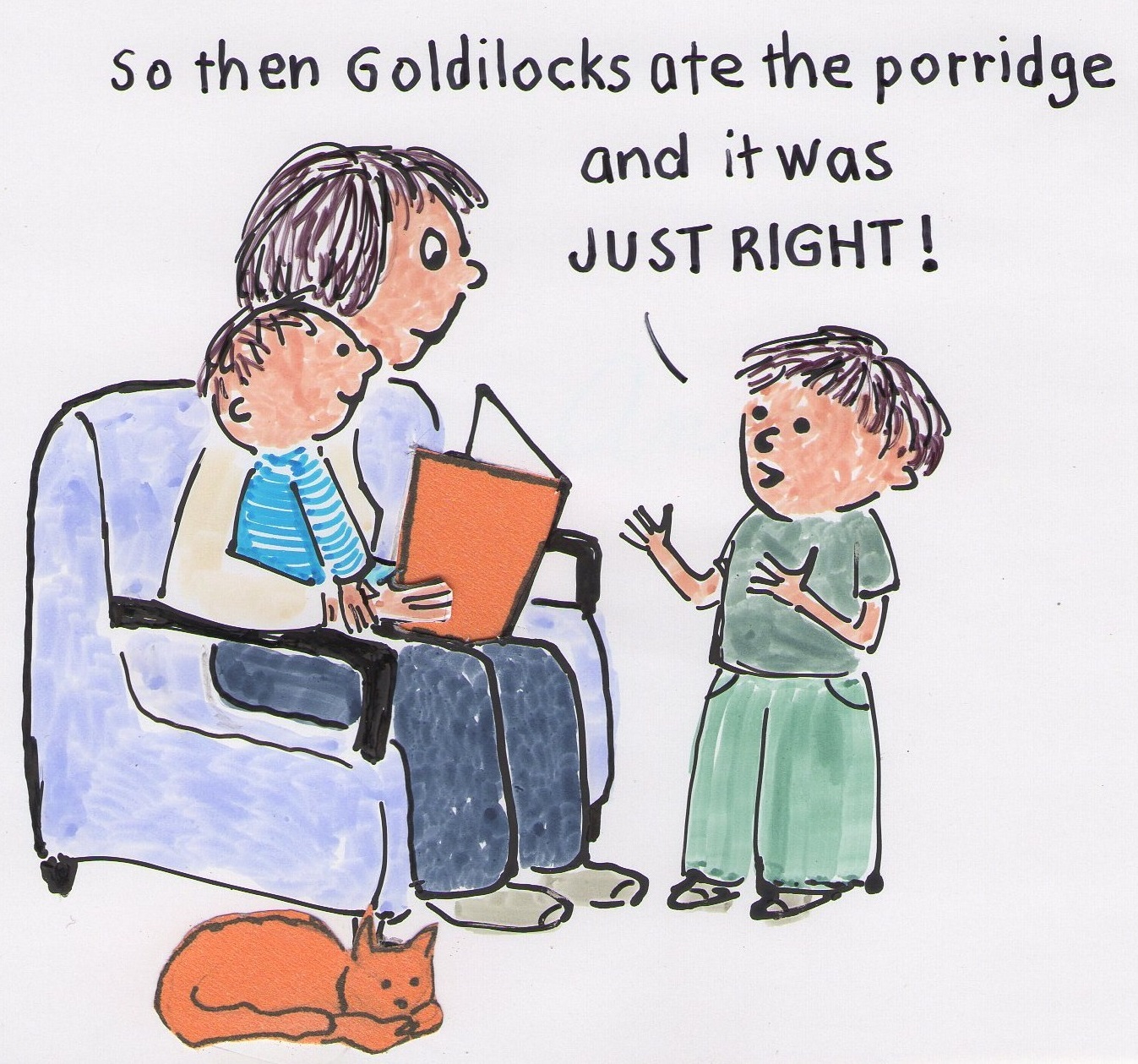
    child retelling story of Goldilocks

    Click on the picture to enlarge it.

  • Hearing sentences read fluently, with pauses at commas and periods.  Children should recognize a change in an emotional tone, or a change of voice when the big, bad wolf speaks compared to when Little Red Riding Hood speaks.  They should learn that there is meaning in stories and in nonfiction.  (Ask your child what is happening on a given page, or what the story is about.  Ask the child to predict what might happen next.  Ask the child what happened first, in the middle, and at the end.)

These ideas come from the Common Core State Standards Initiative (the suggestions in parentheses are from Mrs. K), and are intended as a standard for measuring the foundational reading skills of kindergarteners.  Most states are now using Common Core Standards.  For more information, go to http://www.corestandards.org/ELA-Literacy/RF/K.

Why do we read in English from left to right?

The simple answer is that we read from left to right because we write from left to right.  And why do we write from left to right?  Written English is derived from Latin (written from left to right) which was derived from Greek (also written from left to right).  Okay, so why did the Greeks write from left to right?  There are lots of theories, but no one knows for sure.

The first Western written words were probably written in mud more than 5,000 years ago.  They haven’t survived.  However, there was also writing in stone thousands of years ago (the Ten Commandments, for example).  For a chiseler chipping away, the writing was probably from right to left.  A right-handed chiseler could chip with his right hand and brush away debris with his left hand without putting down his chisel.  Semitic-derived languages such as Hebrew, Arabic, Farsi, Yiddish and Urdu continued in a right to left pattern, and still do, except for the writing of numbers, which are usually written left to right.
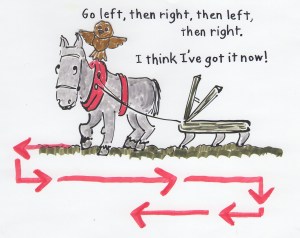
Plow horse crisscrossing a field, left and then right and then left again.

To enlarge, click on the picture.

Another way of writing, called boustrophedon, meaning “as the bull walks,” alternated the direction of the writing.  One line would go from left to right but the next would go from right to left.  This kind of writing can be found in some ancient religious texts.  It was used in the oldest Egyptian, Etruscan, Greek and Latin writings.

Cuneiform writing went from left to right, perhaps so right-handed scribes would not smudge their work in clay with the heel of their hands.  For the same reason, languages that were written with brushes (Chinese and Japanese) might have been written from top to bottom.  The painter/scribe held his brush differently from the way we hold a pen, but to avoid smudges, he went down the page, giving the writing at the top time to dry before a second column was started.

That explains the top to bottom format, but not the right to left format.

As for the Greeks, they wrote on papyrus, a precursor to paper.  With most people being right-handed, a Greek writer could see what he had written without his hand smudging it or covering it if he wrote from left to right.  We inherited that tradition in the English language.  Until ball point pens came along, our ancestors wrote with fountain pens and before that with quill pens, both of which required blotting to absorb the excess ink and to prevent smudging.  Smudging was common in the past, but has become a problem we rarely have any more.

Perhaps the reason we write—and read—from left to right is as simple as to reduce smudging.

Whatever the reason, it is important to acclimate your child to reading from left to right.  More on how to do that in a later blog.

Why is reading such a complex skill?

According to an April 2000 study (www.nationalreadingpanel.org) researched by the National Institute of Child Health and Human Development (a division of the National Institutes of Health) and the federal Department of Education, there are four main components to reading, each of which can be further divided.

Chart of 4 reading components

Click on the picture to enlarge it.

The first component is systematic phonics instruction.  The study defined phonics as how a letter corresponds to a sound in English, and defined systematic phonics as planned, sequential letter-sound instruction.  Some English letters have one corresponding sound (such as most consonants like b and d).  Some letters have two sounds (hard g and soft g, for example).  And some letters have many sounds (vowels and y).  Most systematic phonics instruction begins with teaching consistent consonant sounds and later moves on to vowels with multiple sounds, and then to consonants whose sounds change in combination with other letters (th and kn, for example).

Another component is phonemic awareness.  Phonemes are the smallest units of spoken English, 41 in all, represented by one or more of the 26 letters of the alphabet.  Some words have one phoneme (oh, for example, has the one phoneme o) while most words have two or more phonemes (go, for example, has two phonemes, g and o, while style has four phonemes, s, t, i and l.).  Putting together the phonemes to form words is an important component of reading.

Fluency is the third component.  The federal study defined fluency as reading aloud with speed, accuracy and proper expression.  When a child pauses at a comma or period and changes his pitch if he is reading a quote from a mean witch or a baby duck, that child is showing fluency.  Children who ignore punctuation or who read in a monotone or who plod along do not show fluency.

Reading comprehension, the fourth component, is perhaps the most complex.  It involves understanding vocabulary in the context of a text.  At the same time, reading comprehension means a student is actively engaging with a text so that the student can draw meaning.  If a child can read “trek” but does not know the word’s meaning, comprehension is limited by the lack of vocabulary but not by phonics or phenomes.  If a child can read a text but has little interest in the subject, and reads in a monotone, the child’s comprehension may be limited by fluency or passivity.

Adding to the complexity of reading is that all four of these skills work in unison as a child reads.  When a child is reading words accurately; when that child is grouping words in phrases and sentences with proper inflection; when that child is moving at a moderate rate; and when that child is laughing or questioning or pausing to consider what might happen next, that child is truly reading.

Do electronic games teach kids how to read?

A father of a four-year-old told me his son recently said, “Dad, I know how to spell exit.  E-X-I-T.”

“You’re right.  How did you learn that?” the father asked.

“Easy,” the child replied.  “Playing Mario.”

Seated young boy is playing a portable video game..

Click on picture to enlarge it.

The father explained that the boy is crazy about Mario games.  He can read little words, but not big ones, so sometimes he pauses the game and asks his father what a particular word means.  “He wants to know all the words so that he can beat the game,” the father explained.

So eager is the boy to win the games that on his own he learned how to navigate to YouTube on an iPad and typed in “Mario” and “Super Mario Bros. U.”  Then he listened to college kids commenting on how to win the games.  “He picked up the lingo and improved his vocabulary,” said the father.  And he won the games.  Now he wants to teach other little kids how to win the Mario games which are the rage at his preschool.

This child has been raised with electronics.  At two he received a Leapster and a dozen games, some of which taught letter recognition and small words.  On the family iPad he routinely searches Google for tips on playing Mario games.

Kneeling young girl is playing a portable video game.

Click on the picture to enlarge it.

Sometimes he finds what he thinks might be useful information, but he can’t read it, so he and his father read it together.

Similar to how bilingual children merge words from one language into another, this child mixes “electronic” terms into his “analog” life.  On a family vacation his grandfather was reading a book to him when his mother called the child for a minute.  “Pause it, Grandpa,” the four-year-old said.  “Navigate” is as natural to him as “go.”

How about your child?  Has he or she learned how to read from playing electronic games?

Is using phonics the best approach for teaching reading to young children?

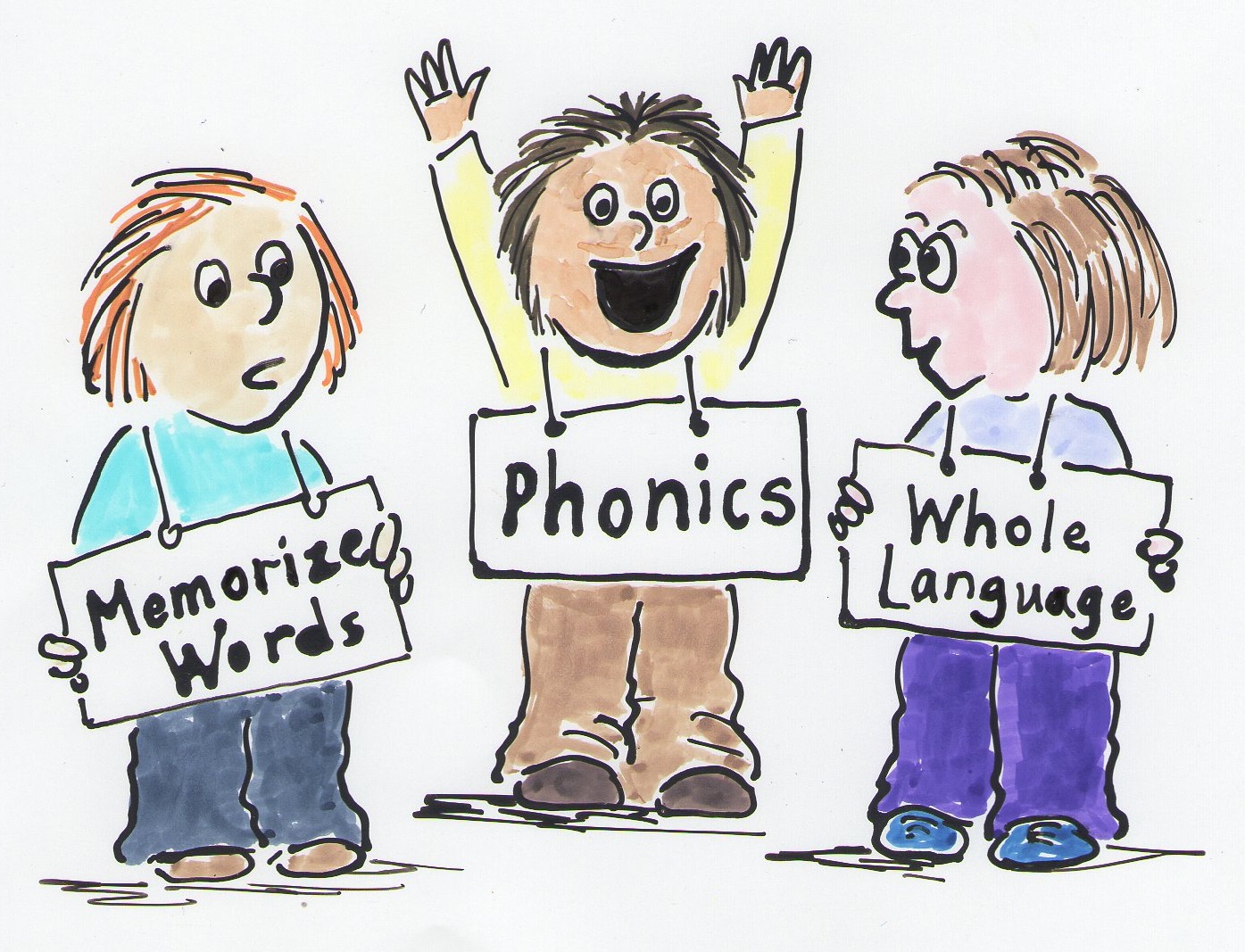
In 1997, Congress asked the National Institute of Child Health and Human Development (a division of the National Institutes of Health) plus the federal Department of Education to investigate the best research about the teaching of reading.  This action came about to settle once and for all the “reading wars” by proponents of various ways of teaching reading.

Three children with signs around their necks that read: Meniruze words, Phonics, Whole Language

Click on the picture to enlarge it.

A panel composed of 12 university professors, one principal from an elementary school, a parent, and one language arts teacher from a middle school, reviewed thousands of experimental research results; held public hearings at which parents, teachers, students, scientists and government officials testified; and asked for input from leading educational organizations concerned with reading issues.

In April 2000, the results were published (www.nationalreadingpanel.org).  They showed that although reading is a complex process and not every child learns to read the same way, a systematic, phonics-based approach yields the best results, especially for the youngest students.  The panel said kindergarteners (the youngest children researched) gain the most reading and spelling abilities from studying phonics, but that students through grade 6 improve using this approach.

For low achieving students and students with disabilities, a phonics-based approach significantly helped them to read words compared to other approaches.  For students who were already good readers, a phonics-based approach helped with spelling.

The panel stressed that systematic phonics instruction needs to be one of four components to teaching reading.  The panel defined phonics as how a letter corresponds to a sound in English, and defined systematic phonics as planned, sequential letter-sound instruction.  The other three components (to be discussed in a coming blog) are phonemic awareness, fluency and reading comprehension.

The panel indicated that teachers and parents should not teach only phonics if they expect a student to learn to read.  Yet phonicst is a good place to begin, especially for the youngest students.