Do you read stories to your children at bedtime?

Dad reading to children in bedIf you do, you are one of a small group of parents. An online survey of more than 1000 US parents shows that one-third of parents read to their young children every night. Half the parents said that their children prefer watching video games or watching TV to reading.

Another survey of 2000 mothers in Britain showed that about 2/3 of mothers read to their children, but only 13% read to their children every night. Parents say stress at the end of the day and lack of time are reasons that they don’t read to their kids. But TV, video games and other distractions also are factors.

Yet reading to children at bedtime can offer so many advantages.

  • Establishing a bedtime ritual—a bath, brushing teeth, kissing family members good-night, a prayer, and a snuggle with Mom or Dad while they read—is a time-honored way to settle children down and prepare them for sleep.
  • Children learn fluency by hearing an adult read. They learn to slow down for commas and periods. They learn to change their tone for direct quotes. They learn that certain parts should be read faster or slower, louder or softer, or in a high squeaky voice or a low threatening voice.
  • In the privacy of the bedroom, parents might feel more inclined to “act” out the words of the book—to be silly or gruff, whiny or sugary. Children sometimes see a different side of their parents during bedtime reading. This can be a great ice breaker between a child and a usually distant parent.
  • Children learn vocabulary. They can ask, “What does that mean?” and get an immediate answer.
  • Children learn about setting, plot, character, tension and happy endings. They learn about culture. Especially as children get older, parents can read books to a child which the child isn’t ready to read yet but which the child is quite able to understand.
  • Children often reveal what they are thinking and feeling during a nighttime read. Snuggled safely with Mom or Dad’s arm around her, a child might open up about her hopes and fears. This is a time for the child to feel protected.

In our next blog we’ll talk about how you can establish bedtime reading if you don’t already do it, or how to improve the experience for you and your child.

The American study was conducted by Macy’s and Reading Is Fundamental in 2013. The British study was conducted by Littlewoods, also in 2013

Did the Common Core eliminate handwriting as a skill kids need to learn? I can’t believe it!

The Common Core requires legible manuscript (printing) in kindergarten and first grade, but after that there are no standards relating to handwriting. 3rd grade student writing

In fourth grade, the Common Core requires students to be able to keyboard or type a full page at one sitting.  Learning cursive writing is not required.

However, the Common Core developers have encouraged individual states and school districts to modify the standards as appropriate for their populations. Some states have included handwriting. In California, kids need to learn printing in second grade and cursive in third and fourth grade. Massachusetts requires legible handwriting of any kind in fourth grade. Private schools, which may or may not follow the Common Core, usually include handwriting as a necessary skill.

Does your state require children to practice handwriting? You can find out by going to your state’s department of education and searching for the state-required curriculum. You may find that your state has adopted the Common Core as a whole, without modification, in which case handwriting will not be taught after first grade.

But that does not mean you can’t augment your child’s learning. Teacher supply stores sell booklets on how to write in cursive. Or you can go online to buy such materials.

There is good reason to do so. Handwriting (as opposed to writing with a keyboard)

  • Develops dexterity in fingers
  • Improves hand / eye coordination
  • Activates many parts of the brain not used when keyboarding
  • Encourages children to write longer passages, and
  • Improves letter recognition.

Another reason to learn cursive is to be able to read letters and documents of the past. I have many letters from my aunt—written in cursive. I have a letter and post cards sent home from Europe by my father during World War II—written in cursive. I have copies of the Declaration of Independence, the Constitution and Lincoln’s Gettysburg Address—written in cursive.

Like much of the Common Core, the reduction in emphasis on handwriting is controversial.

Kids learn sounds from big to small

Little children who are learning about the sounds in words move from larger units of sound—phrases and words—to smaller units of sound—sounds within syllables.

Take the word “elephant,” for example.

Word: elephant
Syllables: el-e-phant
Onsets/rhymes e-l e f-int
Phonemes e l e f i n t

children pronouncing elephant

First, children learn that sentences are composed of words. (I can remember being in first grade and learning that “of the” is two words, a revelation at the time).

Next, children learn the sound of the whole word. They might mispronounce “elephant,” saying it as a two-syllable word (el-phint) as they grow accustomed to it. Eventually they say it right.

Children then learn to break the word into parts (syllables), pronouncing each syllable distinctly.

With a teacher’s or parent’s help, they learn to identify sounds within the word.

Later, they learn to match those sounds to letters.

This sequence—from a phrase to whole words to syllables to the smallest distinct sounds—provides a useful guide for adults teaching reading to preschoolers. We should make sure a child can hear the sounds of a word and can reproduce them properly before we begin to break a word into parts and associate letters with those parts.

What are some activities that help a child to master the phonological awareness sequence?

• Say a two or three-syllable word, leaving pauses of a second or two between syllables. Ask the child to combine the syllable sounds into a word.

• Ask the child to break a two or three-syllable word into its parts. This is a harder skill than combining.

• Ask the child to say (not spell) the sound before the vowel sound in a word (the onset sound). For example, in the word “dog,” the onset sound is the sound a “d” makes.

• Say tongue-twisters and ask the child to identify the alliterated sound. For example, in “Peter Piper picked a peck of pickled peppers,” the onset sound is the sound a letter “p” makes.

• Sing songs with rhymes. Ask the child to identify the rhyming sounds.

• Ask the child to say the rhyme part of a word or syllable. The rhyme part is all the sounds beginning with the vowel. So in “dog,” the rhyme is “og.”

• The hardest activity is for the child to break down a syllable into every sound (phoneme). American English has 42 phonemes, or sometimes more depending on regional pronunciations. (Sounds made by “th,” “sh” and other digraphs are considered distinct sounds, which is why English has more phonemes than alphabet letters.)

While learning the ABC’s is a skill most preschools stress, the other skills explained need to be learned first. Some kids are ready to break a syllable into phenomes at four years old, but many more are not ready until part way through first grade. Don’t rush them. Instead, spend time on all the preliminary steps.

For more details on this sequencing of learning sounds, go to http://www.naeyc.org/files/yc/file/200901/BTJPhonologicalAwareness.pdf. While you are there, check out the list of read-aloud books that emphasize sounds, and the additional activities you can do with a child who is learning sounds.

Phonemes, phonics, phonemic awareness—what’s the difference?

A phoneme is the smallest sound in a spoken language. There are 42 in American English, according to some experts, but more if regional pronunciations are considered. Many are represented by a single letter—b and h, for example. But others are represented by a pair of letters—sh and th, for example. A phoneme is not a letter; it is a sound to which we have associated a letter in order to read the sound. By itself, a phoneme has no meaning.

listof phonemes

Phonemic awareness is the ability to hear words at the phoneme level, to hear that the word “cat” contains three separate sounds. Phonemic awareness does not mean letter awareness. A child can have phonemic awareness without knowing the ABC’s. It means the ability to pull apart words and to say the separate sounds in words. It means a child can recognize that all the sounds we make can be put together various ways to create words.

Phonics is the code, the assigning of sounds to symbols (letters) so that the sounds can be pronounced correctly by looking at visual letters. With more than 250 letter patterns to represent all the sounds in American English, reading instruction focuses mostly on phonics.

Children with excellent hearing and from a language-rich environment pick up phonemic awareness early in life because they hear all the sounds of American English. Before they start school they may be able to pronounce all the phonemes correctly, echoing an adult. But most children cannot figure out phonics on their own. They need instruction matching a sound to a letter or letter pair.

Teach art literacy when sharing picture books

When children start to “read” picture books, generally they are reading the pictures; that is, they are trying to get meaning from the pictures since they can’t read the words yet.

They might study the appearance of a character, noting if it is a boy or girl from the clothes. Or they might look at the dark swirling clouds or the beaming sun to discover the atmosphere of the story. They might look at the colors the illustrator uses. Bright colors and pastels might indicate a happy or peaceful theme; dark colors or colors tinged with greys and blacks might indicate danger. Horizontal lines or smooth lines might indicate calm while jagged or diagonal lines might indicate action.

children looking at picture of Lincoln and Mrs. Lincoln

Some children perceive these clues without explicit instruction, but many children need someone to point out how colors, lines, and facial expressions tell the story too.

According to research by Kathleen Ellen O’Neil, illustrations can interact with the text in four different ways.

  • The art can reinforce the text, “showing” the text. For example, in “The Mitten,” adapted and illustrated by Jan Brett, a boy loses a mitten which his grandmother has just knit. One by one, we see animals from a tiny mole to an adult bear squeezing in to the mitten. The illustrations show the hedgehog’s quills and the badger’s nose poking through the wool.
  • The art can supplement the text, providing description which the text either skimps on or doesn’t describe at all. For example, also in “The Mitten,” we see the boy dressed in a Ukranian tunic, leather pants and boots with folk art borders. The book doesn’t mention where the setting is, but the art shows.
  • The art can provide far greater detail than the text, offering new insights which a literally-minded child might miss. It can illustrate nuances, inferences, humor and irony, adding depth to the text. In “The Mitten,” for example, the boy finds his mitten after the animals have left it behind, and he brings it home. The last page of the story shows the grandmother holding both mittens and noticing how much bigger one is than the other. No words are used, but we can hear her wondering, “How in the world?”
  • The art can convey a parallel story which either expands the text or contradicts it. Still in “The Mitten,” to the left side of almost every page we see the boy playing in the snow—hopping on a log where the rabbit lives, poking with a stick above the hedgehog’s burrow, looking in a tree’s knothole where the owl lives and climbing atop a woodpile where the fox lives. To the right side of those pages we see an animal leaving its disturbed home, and on the next page that animal squeezes into the mitten. Nothing in the text says that the boy disturbed the animals, forcing them to seek shelter elsewhere. A discerning youngster might notice it, but many children will need this part of the story explained.

For more information and other examples of books which clearly show the four different kinds of art interaction with text, go to the November 2011 issue of “The Reading Teacher,” page 214, for the article by Ms. O’Neil.

The Common Core will change what your kids read in school

In the past, most English Language Arts reading material was taken from children’s literature: stories of Aesop, Judy Blume and the Brothers Grim, for example.

But under the Common Core, the amount of time children spend reading and discussing literature in the public schools will steeply decline in most states. In its place students will read more informational and persuasive reading, such as Lincoln’s second inaugural address, a letter home from a Vietnam War soldier, or an article showing the pros and cons of taking music lessons.

boy reading bookFor younger children, reading material will be divided roughly into thirds: one third persuasive reading, one third expository reading, and one third narrative reading. But as children become high schoolers, the amount of time they spend on literature could drop to about one fifth of the total.

The point of this shift is to make students better prepared for the rigor of a college education and the kind of jobs that someday await them.

In the United States’ best universities, the number of English literature majors has dropped noticeably in the past thirty years, while at the same time science, technology, engineering and math (STEM) majors have been attracting more students. Yet many college freshmen are not prepared to understand college science, technology, engineering or math texts. Nor are they prepared to write essays in those fields using logic and critical thinking.

To compete on the world stage, believe the developers of the Common Core, students need a radically different kind of education than their parents received—even in English Language Arts. So out with Huck Finn (or maybe read just an excerpt) and in with primary documents; out with Romeo and Juliet and in with two-sided arguments on the place of women in combat troops.

Figuring out the Common Core

Lately, I’ve been trying to wrap my mind around the Common Core State Standards, especially as they relate to the English Language Arts (ELA) curriculum. I’ve figured out a few things.

  • The Standards are poorly named. Shared state educational goals comes closer to describing what the Standards really are.
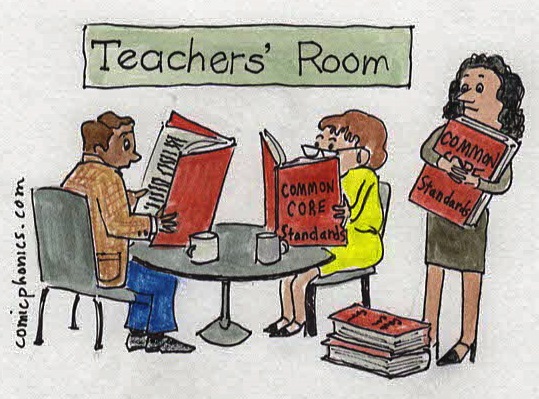
  • There are two sets of standards. One set applies to all students and to all subjects, grades three through high school. The other set applies specifically to one subject at a time in one grade or to one high school course. Yet they apply in tandem.Teachers struggle to read huge books of the Commo Core Standards
  • Like this past winter in Boston, the Standards seem to go on forever. Brief they are not.
  • The purpose of the Standards is to raise the achievement of public school students so they are better prepared to start college or the kinds of jobs that demand a more rigorous education. In particular, they seem geared to preparing students for science, technology, engineering and math (STEM) college majors and careers, not for the humanities.
  • The Standards seem to be taking a scientific, critical approach to studying reading. They demand that a student prove from what paragraph he found his answer. They demand that he understand multiple meanings of words, or roots of words, or idioms. They demand that he be able to summarize a reading selection and contrast it with another reading selection for a precise idea. They demand that a student understand the purpose of a selection and its intended audience and how that influences certain author choices.
  • The Standards seem to require students to study literature less and to study informational and persuasive texts more. These informational and persuasive texts will contain more reading of government-published writing, a red flag for some critics.
  • The Standards are in some ways following the lead of college students who, in the past thirty years, have moved away from majors in the humanities and have moved toward more narrow fields like nursing and computer programming where the jobs are. The Standards are limiting the amount of time a student engages in the humanities and are increasing the amount of time a student engages in more technical reading.
  • The standards don’t require particular reading selections, but for each grade and subject they name a list of readings of the kind they recommend. Critics fear that those lists will become a short list of readings from which teachers will not deviate.
  • Because the Standards are so long-winded, and because teachers’ jobs will depend on how well students test on the Standards, I already see individual teachers deferring to the judgment of district-wide administrators. Those administrators, and not the teachers, are interpreting the Standards and are suggesting specifically how those standards are to be taught and with what teaching materials.
  • The first end-of-year Common Core tests will be taken in ELA and math in many states in April and May 2015. (Science and social studies Standards will be introduced in the 2015-2016 school year in elementary and middle grades.) Scores on the 2015 tests will not be made public until the summer, so for 2015, those scores will not be part of final course grades. But they will be included in final grades in 2016.
  • Expect a hullabaloo as schools and states report test results during the summer. Expect more states to withdraw from the Standards and others to demand changes. Expect teachers to resign from the stress of implementing the Standards.  Expect parents to refuse to allow their children to be tested.  Expect many, many children to feel ashamed that they cannot answer the questions.  Expect a lively debate in the media about the future of US education and the best ways to prepare our students for their futures.
  • The Common Core is far from a done deal.

Is Why Johnny Can’t Read still used to teach reading?

Why Johnny Can’t Read is a book by Rudolph Flesch, Ph. D., a readability expert in the US from the 1950s until his death in the 1980’s. This book advocated a phonics-based approach to learning to read when most American children were learning the “look-see” approach of memorizing the look of a word. Today Flesch’s approach is out of favor if used alone, but if it is used in combination with some other approaches, it can be part of a good approach to teaching reading.

However, kids hate it.

CVC words that end in _ch and _ook.

To enlarge, click on the picture.

Flesch’s approach is to break down phonics into sounds which correspond with letters, and to teach lists of the same sound. One of the beginning lessons is a list of several columns of short a CVC words; it is followed by a page each of the other short vowel sounds. Then the short vowels are mixed together, two vowel sounds at a time. Gradually all the sounds of English are introduced through lists of words which use those sounds.

The problem is that reading lists is boring for children. They find it hard to stay focused for more than a few minutes on such a task, so if that is the only strategy, kids resist these lessons.

Other reading programs have taken Flesch’s idea and have presented the lists a different way. One of the most successful is Explode the Code. For a lesson on bl, cl, fl and gl bends, for example, there are nine pages of activities. On one page the word to be learned is to the left, and to the right are three pictures, one of which illustrates the word. The child needs to circle the correct picture. On the next page the student sees a word on the left and needs to circle the same word (one of three) on the right. On another page the student fills in the blank with a word which is illustrated to the left. On another page the student answers a question using one of the blend words. Students prefer the variety that this approach takes.

When I teach reading to beginners, I use a combination of Flesch’s ideas and others. I don’t use his long list of words, but sometimes I give my students one column of his lists. For variety, I put words on index cards which the child can hold and shuffle, so the child has more control. Again, I limit the number.

I taught my three children how to read using the lists at the back of Why Johnny Can’t Read, so I will always be grateful to Flesch, his research, and his simple, straight-forward approach to teaching phonics. As a writer, I am grateful for his guides on how to write plain English.

My child knows how to read pretty well for a first grader. Should I still read aloud to her?

Yes! Here’s why:

  • A child’s reading level doesn’t catch up with a child’s listening level until eighth grade, according to Jim Trelease, author of The Read-Aloud Handbook. A younger child can appreciate a book she cannot read yet—the plot, the descriptions, the characters and the vocabulary—if an adult reads it aloud to her.

    Father reading to child and child asks, 'How old is Old McDonald?"

    To enlarge, click on the picture.

  • Reading aloud to a child attracts him to reading by himself. He takes pleasure from being read to, and will want more of that pleasure even if an adult is not available to read to him. He will delight in life-long reading.
  • Books contain rich vocabulary, words more numerous than what we parents say on an everyday basis to our children. Children learn the vocabulary from the books we read aloud because we pronounce the words properly and because we explain them to our children. With such a rich vocabulary they are better prepared to understand their teachers and the reading they do on their own.
  • In books read aloud, children hear more sophisticated grammar than they read in grade-level books. Subconsciously they learn good grammar.
  • Good books contain the kind of values we want to pass on to our children. Reading these books aloud offers opportunities to discuss these values with our children.
  • Reading to fidgety children increases their attention span. It gives them practice sitting and listening which they need to do in school to succeed since so much school instruction is verbal.
  • Read-aloud time is bonding time. Do you remember in To Kill a Mockingbird how first grader, Scout, would sit on her father’s lap while he read legal papers aloud? She didn’t care what he read. It was their special time together.

Common Core requires increasingly complex texts

One of the goals of the Common Core Standards that is receiving flak across the country is the push for students to understand increasingly complex texts.

Discouraged child thinks there are too many words in a book she is readingYou might assume that a second grader would read more difficult books than a first grader, but according to the people who wrote the standards, there is not proof that this is happening in US schools. Their “research shows that while the complexity of reading demands for college, career, and citizenship have held steady or risen over the past half century, the complexity of texts students are exposed to has steadily decreased in that same interval.”

They believe that the texts used in middle schools and in high schools have been “dumbed down” over recent decades. To counteract the “dumbing down” of texts, the Common Core Standards want to increase the difficulty of the texts students read so that US students are well prepared for college and for work.

The Standards state that the reading complexity levels for all grades need to be made more difficult, and that what a student studies in May should be more complex than what he studied in the previous September.

How will this be measured? Three ways:

  • Qualitatively: An attentive teacher will note whether a student recognizes various levels of meaning in a work of literature, or if he recognizes that language is used in new or archaic ways, of if the reading requires background specific knowledge that the student might not have.
  • Quantitatively: Readability measures will be used to determine the difficulty level of the materials students read, and the students will be tested to see how much of the material they understand.
  • Reader-task considerations: A teacher with knowledge of her student will rate the student’s motivation, knowledge base, and experience as well as the purpose of the assigned reading, and the difficulty of the task which the teacher assigns (for example, responding to open-ended questions is more difficult than responding to multiple choice questions).
Common Core Georgia Standards

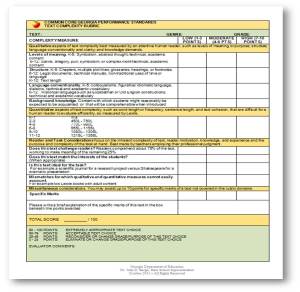
Click on picture for the entire document.

The Georgia Department of Education has created a rubric for teachers (and parents) to use to determine the text complexity of a given reading selection. When the points are totaled, texts with scores of between 80 to 100 are considered of appropriate complexity.

For more information, go to: https://www.learninga-z.com/commoncore/text-complexity.html and https://www.georgiastandards.org/Common-Core/Pages/ELA.aspx