Asking “What’s the main idea?” is not enough

To improve a student’s reading comprehension, asking “What’s the main idea” of a reading passage is not enough.  It’s just the starting point.

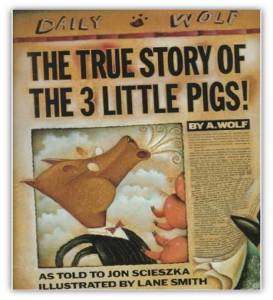
Better is to provide richer texts, and to discuss them before, during, and after a student reads, according to research named in the 2-18-24 issue of EdutopiaJon Scieszka’s The True Story of the 3 Little Pigs

It’s better to ask about an author’s writing style.  Why does the big bad wolf say three times, “I’ll huff and I’ll puff and I’ll blow your house down” to the three little pigs?  Why use “huff” and “puff” which rhyme?  Why not say, “I’ll breathe in and I’ll breathe out and I’ll knock your house down”?  Why does the author of Gone with the Wind have Scarlett O’Hara meet Rhett Butler on the day the Civil War begins?  Why does the author have Melanie Wilkes give birth in Atlanta right as Atlanta is being attacked?

It’s better is to ask a student to summarize or paraphrase a text than name the main idea only.  Many students have trouble distinguishing between important facts or ideas and less important details.  Help them figure out what are the important ideas so they can produce a reasonable summary.  Many students rely on the actual words of a text to explain it and cannot put the ideas into their own words.  Paraphrasing forces them to do that.

It’s better is to ask a student to describe the text’s structure.  Is a cause explained at the beginning of a text, and are its effects described in the second part of the text?  Are the most important facts stated first, as in a news story, and less important facts stated later in descending order?  Is a long-time theory stated first, and then is research presented to debunk the theory—or to support it?

It’s better is to ask a student to describe the tone and the mood of a text.  Tone means the attitude of a writer toward a subject or an audience conveyed through word choice and the style of the writing.  Does the writer show approval of a character or an idea?  Does a writer dismiss an idea as frivolous or bigoted?  Mood is the feeling or atmosphere of a text perceived by the reader.  It is often created by the author’s use of imagery and word choice.  When Laura Ingalls Wilder describes fall in Silver Lake as “From east to west, from north to south, and as far up into the blue sky as eyes could see, were birds and birds and birds sailing on beating wings,” is the mood one of fear?  suffocation?  wonder?  How do you know?

It’s better is to ask a student to find, identify and explain figurative language.  When Romeo says, “Juliet is the sun,” what figure of speech is Shakespeare using?  Why does this line occur in a passage that focuses on light?  Is “Juliet is the sun” stronger or weaker than “Juliet is like the sun”?  In Lord of the Flies, what figure of speech does the author use when he says of palm trees, “These stood or leaned or reclined against the light”? Why not say some trees’ trunks were straight up, some leaned over, and some tipped so much that they were almost parallel to the ground?  And why “against the light”?

It’s better to ask why the author of a novel reveals some information in the opening chapters and holds other information until later.  In Cinderella, why does Cinderella face problem after problem before the happy ending?  Why does Junie B. Jones believe her baby brother is a monkey until the end of the book?

Require more of students and you will increase the depth of their  reading comprehension.

How to teach G and J

A reader asks how to teach spelling with G and spelling with J.

J always sounds like J as in jam, Jen, gin, John and June.  That is true if the J is at the beginning of a word or if the J is in the middle of a word.  A child learning to read or to spell needs to know only a handful of words with a J in the middle of the word:  ajar, banjo, and adjective.  A few other words begin with either the prefix ab- or ad- followed by a J:  abject, adjoin, adjust and adjacent.  I suspect only the word “adjust” needs to be part of a first grader’s vocabulary and spelling.

With just three or four exceptions, J is found only as the first letter in words.

G is trickier.  In most words starting with the letter G, the G sounds like a hard G as in game, go and goofy.  Hundreds of words begin with a hard G.

Rules for hard G include

  • Use a hard G before consonants, as in “grade.”
  • Use a hard G before the vowels a, o, and u, as in “go.”
  • Use a hard G as the last letter in a word, as in “rug” and “ring.”

When G is followed by an E, an I, or a Y, usually the G sounds like a soft G (the same sound as a J) as in gem, giraffe, and gym.  Many words begin this way.

Rules for soft G include

  • Use a soft G before the vowels E, I, and Y, as in “gem” and “gym.”
  • Use a G followed by an E at the end of a soft G-ending word, as in “ageing” and “binge.”

However, about a dozen words a first grader might know do not follow the soft G rules.  In these words, the G is followed by an E or an I, yet the G sounds like a hard G.  These words include

gear gecko geek
geese get geyser
gift giggle gilded
gills ginkgo girdle
girl give

I would teach these words as exceptions to the rule of soft G.  Limit the number of exceptions to a handful at first–maybe “get,” “gift,” “girl,” and “give”–so as not to overwhelm the student.  Practice them often to reinforce their spelling.  With time, they will become sight words, as almost all learned words do.

How to teach words ending in the K sound

A reader asks how to teach her first grader words which end in a K sound.

That’s a tough question to answer because even though there are basically three ways of ending English words with a K sound (“c,” “ck,” and “ke”), there are many variations of short-ish vowel sounds before the K sound (-ac, -alk, -awk, -ek, -ic, -ilk, -ok, -ook, and -uk.)  There are even more variations of long vowel sounds before the “K” sound (-ache, -ake, -eak, -eek, -eke, -iek, -ike, -ique, -oak, -oke, -olk, and -uke).

But luckily, first graders don’t need to know all the variations.  So, let’s offer them a few basic rules.

For words which rhyme with book and look, the spelling is –ook.  Make sure the child can distinguish between the -ook sound and the –uk sound.  Say both kinds of words aloud and ask the child to tell you if you are saying an -ook or a -uk word.  Words which end in –ook include

book hook shook
brook look took
cook nook
crook rook

Words which end in -uk include

buck muck suck
chuck pluck truck
cluck puck yuck
duck struck
luck stuck

Most short-vowel, one-syllable words end in -ck.  In addition to the -uck words  above, other common -ck words include

back black crack
flak hack jack
knack lack pack
quack rack sack
shack slack smack
snack stack tack
track whack check
deck fleck heck
neck peck speck
wreck brick chick
click flick kick
lick nick pick
prick quick sick
slick stick thick
tick trick block
clock crock dock
flock frock jock
knock lock mock
rock shock smock
sock stock

A small number of words end in -lk where the L is silent: chalk, talk, and walk.  Some people pronounce these words as rhyming with -ok (walk, lock) while other people pronounce them as rhyming with the -aw sound (talk, hawk).  I would teach these -lk words as a small word family and not confuse the child with other letter variations.

Most long-vowel, one-syllable words ending in a “K” sound end in -ke.  They include

bake Blake brake
cake fake flake
Jake lake make
quake rake sake
shake snake stake
take wake bike
hike like pike
spike strike broke
choke Coke joke
poke smoke spoke
stoke stroke woke
woke fluke Luke
nuke puke

Many long-vowel, one-syllable words ending in a “K” sound end in two vowels before the K, such as beak and soak.  In order not to confuse the child, I would skip over teaching these kinds of words until the previous kinds of “K” words are learned.  The exception I would make is teaching –eek words.  I often teach -ee words before I teach silent E words, and when I come to silent E words, I tell students that almost all long-vowel, E words are spelled with –ee.  Instead of the E coming at the end of the word, it comes after the first E, I say.  This does not seem to confuse students.

The only words ending in just a C that a first grader might need to know are doc, picnic and music.  And the only short-vowel, one-syllable word ending in just a K that I can think of is trek.  Teach these as exceptions to rules.

I suspect what the child is confused by is not how to read all these words, but how to spell them.  If so, I would teach them as word families, and review them often.

Transitioning from short vowels to long vowels

Today I worked with a kindergartener who has mastered CVC words with blends at the beginnings and ends of words (for example, “slept” and “brand”).  It was time to move on to long vowels.

I started with two-letter words ending in “e” (be, he, me, and we).  I explained for small words ending in “e,” the “e” is pronounced differently.  Even so, the child wanted to say the words as if they ended in a short e.

In one way this was satisfying to me, her teacher.  She had learned the rules about pronouncing short vowels.

But in another way it was frustrating.  Her brain was saying she didn’t accept the logic of one letter representing two sounds.  Until now every letter of every word we have read together has had one sound only.  But now I am changing the rules.  It’s like I am telling the child that until now your little brother has had one name, but from now on he is going to have two names, and you have to remember when to call him John and when to call him Fred.  Huh?

Some students learn sight words in school at the same time they are learning phonics.  For them, words like “me” and “go” are memorized rather than sounded out.  But my student has not learned sight words, so I needed to switch gears.

I stopped focusing on two-letter words.  Instead, I focused on words ending in “ee.”  It was easier for my student to accept that “ee” represents a different sound from “e.”  So, we worked on reading words like “bee,” “fee,” “lee,” “see,” and “tee.”  I added nonsense words like “dee,” “pee,” “vee,” and “zee” as well to extend the practice.

At our next class I plan to continue delaying two-letter words like “he” and “me.”  Instead I will continue with “ee” words, adding ending letters and blends.  “Bleed,” “creek,” “heel,” “seem,” “green,” “sleep,” and “feet” are some examples.

Until now, my student has moved quickly in acquiring reading skills.  But I may need to slow down now and make sure she can go back and forth from short-vowel words to long-vowel words and vice-versa.  For some students this is easy.  For others, it takes months.  We will see.

Don’t stint on advanced reading skills

One of my students is a high schooler still learning English as her second language.  She has learned so much in the few years she has lived in the US, but she struggles with reading.

She has pretty much mastered how to read one-syllable and two-syllable words which follow the rules.  But three-syllable words confound her.  Instead of stopping to figure out big words, she slurs over them and keeps reading almost as if they aren’t there.

That works when the reading level is at the second or third grade level because not many three- or four-syllable words are in books meant for that reading level.  But my student is in high school.  She is confronted with long words in almost every sentence she reads in text books.  Like many older students I have taught, she thinks she can get by skipping over words.  Now that she is preparing for the SAT, she realizes she can’t.

In late elementary grades students learn about root words, prefixes and suffixes.  Knowing words can be dissected leads good readers to break apart words rather than skipping over them.  My student thinks this is too time-consuming, so she is reluctant to do this on her own.

She is a wiz with computers and can look up the meaning of a word faster than I can.  But sometimes the synonyms are long words too.  Or sometimes one synonym works in one context, but not in another context.  Or sometimes, most times, she doesn’t bother.

What’s my point?  Reading instruction can’t stop after a student learns basic phonics rules.  This is especially true for impatient students who would rather finish quickly than finish well.  The tedious work of learning how to break words into syllables can’t be skipped.  Nor can understanding the meanings of prefixes, suffixes and roots.

Reading is probably the most important skill we learn in school.  Don’t stint on it.

Cursive is on the upswing

The number of states requiring that cursive writing be taught is increasing, according to MyCursive.com.  IN 2016, 14 states required teaching cursive.  Today that number is 21.

Why is that important for students learning to read?  Brain studies have shown a positive connection between writing in cursive and reading.  (More about that in my next blog).

To find out if your state requires cursive, scroll down.

AK:  No.

AL:  Yes, cursive must be taught in grades 2 and 3.

AR:  Yes, cursive must be taught before students leave grade 3.

AZ:  Yes, students must be taught and must master cursive by grade 5.

CA:  Yes, students are taught cursive in grades 1 to 6.

CO:  No.

CT:  No.

DC:  No.

DE:  Yes, cursive must be taught by the end of grade 4.

FL:  Yes, cursive must be taught between grades 3 and 5.

GA:  Yes, public schools must teach cursive in grades 3 and 4.

HI:  No.

IA:  No.

ID:  Yes, public schools must teach cursive.

IL:  Yes, public schools must teach cursive by the end of grade 5.

IN:  Yes, public schools must teach cursive.

KS:  Yes, the Kansas Board of Education does require teaching cursive.

KY:  Yes, public schools must teach cursive beginning in grade 1.

LA:  Yes, cursive must be taught beginning in grade 3.

MA:  Yes, cursive must be taught beginning in grade 3.

MD:  Yes, cursive must be taught between grades 2 and 5.

ME:  No.

MI:  No.

MN:  No.

MO:  No.

MS:  Yes, cursive must be taught between grades 2 and 8.

MT:  No.

NC:  Yes, cursive must be taught to public school students.

NE:  No.

ND:  No.

NH:  Yes, cursive must be taught to public school students.

NJ:  No.

NM:  No.

NV:  No.

NY:  No.

OH:  Yes, public schools must teach cursive.

OK: Yes, cursive must be taught in grades 4 and 5.

OR:  No.Child writing with right hand.

PA:  No.

RI:  No.

SC:  Yes, public schools must teach cursive by the end of grade 5.

SD:  No.

TN:  Yes, public schools must teach cursive.

TX:  Yes, cursive must be taught in grades 2 and 3.

UT:  No.

VA:  Yes, public schools must teach cursive between grades 2 and 5.

VT:  No.

WA:  No.

WI:  No.

WV:  Yes, public schools must teach cursive between grades 2 and 4.

WY:  No.


Record students’ voices while they read, play back, and improve

The latest issue of Edutopia (www.edutopia.org) suggests several ways to integrate technology into reading classes in order to improve student reading.  Here is one easy way to improve reading fluency:

Have students record their own voices while they read aloud.  Then play back the recording.  Ask students to reflect on their reading skills.

What questions can they ask themselves?

  • Do I use punctuation properly? Do I pause at commas, pause slightly longer at periods, and raise my voice at the ends of sentences that end in question marks?
  • Do I read with rhythm, linking together the words in phrases?
  • When reading dialog, do I raise or lower my voice and add emotion to mimic the imagined voice of the characters who are speaking?

Now, have students record the same passages again and listen for improvement.

Even though students seldom read aloud, the skills they use when reading aloud are likely the same ones they use when reading silently.  If students are poor “out loud” readers, they are likely to be poor silent readers, too.  Especially for poor readers, recording their voices reading and then listening to their performance can improve overall reading skills.


Learning to read is not a race

This fall I am teaching two kindergarteners to read via Zoom.  I am making progress with both students, but it is an uneven progress typical of young children.

One student—I will call her Jane—is lighthearted and imaginative.  For Halloween, she came to class wearing a wolf’s face.  Jane is social, engaging me in conversation as easily as she talks to her sibling.  She can identify almost all letters and letter sounds.  When I show her an alphabet letter, she will say, “Maybe B, for banana and ball.”

Jane is working on reading two-letter “A” words like “at” and “ax.”  Three-letter words are a bit advanced except for a few she has memorized.  Her mother tells me that outside class she loves to mix up letters and to make silly sounds.

John is serious and reserved with me.  He does not engage in chit-chat during our lesson.  Two months ago, he could identify fewer letters and their sounds than Jane could, but now he has mastered them all.  He pronounced two-letter “A” words with such consistency that we have moved on to three-letter “A” words.  At our lesson this week John read several phrases and a few sentences containing short “A” words (A fat cat sat.  A man ran in a can.).  I was thrilled.  He smiled and said nothing.  At our next lesson we will begin to work on short “O” words.

Mrs. K is a writing, reading and grammar tutor.

Both Jane and John are normal kindergarteners, displaying behaviors typical of children learning to read.  One is not better.  One is not worse.  They are each moving along at their own pace.

Learning to read is not like learning algebra.  With algebra, every student starts at the same place on page one of the text and is expected to keep up with the pace the teacher sets for covering the curriculum within a school year.

With reading, students start at different places depending on personality, preschool or parental exposure to letters and sounds, hearing and vision acuity, being read to, and speaking English as a native language or as a second language.  Age of the student is another factor.

By the end of kindergarten, both John and Jane should have a solid foundation in phonics.  They will continue instruction in how to read in first and second grades.  At that point their reading skills will probably not be any more identical than they are now. But they will read sufficiently well to use their reading skills to learn more.  That’s why we learn to read, after all—so we can keep learning.


14 disconnects between letter names and letter sounds

Two kindergarteners I am teaching this fall are having the same problem when trying to figure out the sound a letter is associated with.  They are listening to the beginning sound of the letter name, and they are assuming that must be the sound linked to the letter.

In some cases they are right.  The name of the letter B begins with a “b” sound, just like the sound B stands for.  The name of the letter K begins with a “k” sound, just like the sound K stands for.

But for many letters, this correlation does not hold true.  The name of the letter C, for example, begins with an S sound.  The name of the letter F begins with an E sound.  The name of the letter G begins with a J sound.  The name of the letter W begins with a D sound.

Take a look at the table below and notice how many letter names do not begin with the sound that the letter represents.  By my count, it’s more than half.

Letter    Sound the letter name begins with

a             a

b             b

c             s

d             d

e             e

f              e

g             j

h            a

i              i

j              j

k            k

l              e

m            e

n             e

o              o

p              p

q              k

r               ah

s               e

t               t

u             y

v             v

w            d

x             e

y             w

z             z

So, if you have a little one struggling to pair a letter name with the sound the letter stands for, relax.  It’s normal.  Be patient.  Gently correct the mistake as many times as it takes.  Your child will get it eventually.  We all do.

What are the most frequently used letters in the English alphabet?

  1. What is the most frequently used vowel in text?
  2. What is the least frequently used vowel?
  3. What is the most frequently used consonant?
  4. What is the least frequently used consonant?

And the answers are

  1. E is the most frequently used vowel.
  2. U is the least frequently used vowel.
  3. T is the most frequently used consonant.
  4. Z is the least frequently used consonant.

How did you go about figuring out your answer?  I thought of  letter frequencies in the game Scrabble.  I know from playing the game that E has the most tiles of any letter–12 tiles.  A and I have nine tiles, O has 8, and U has 4.

For consonants, I was stumped.  Again, I thought of Scrabble tiles.  I chose S, but S has only four tiles.  N and T both have six.  In fact, T is the most commonly used consonant.  For the least commonly used consonant, I would have chosen Z or Q or X based on the number of Scrabble tiles and also on the value of those tiles (each worth 10 points).

Who cares?  If you are someone who deciphers coded messages, knowing expected letter frequency can help.  Almost two hundred years ago, Samuel Morse, the inventor of Morse Code, needed to know which letters were more commonly used in order to assign them the simplest dot and dash patterns.  He didn’t have Scrabble to help him.  He turned to sets of letters printers used.

Morse found that the letter E appeared 12,000 times, the letter T 9,000 times, the letter U 3,400 times, and the letter Z 200 times in printers’ job cases. These numbers relate to the number of times letters are used in commonly used English words, not to the number of times they appear in a collection of all English words.

To find how many times letters appear in all English words, the number of letters in every word in the Concise English Dictionary (1995) was computed.  Those results show the letter E is used the most, followed in descending order by A, R, O, I, T, N, and S.  U appears least of all the vowels, and Q appears least of all the consonants.

If you wonder about the frequency of letters appearing at the beginning of words, S is the clear-cut winner.  E appears halfway down the list, and X is the least used first letter in English.

Writing topics yield different letter frequencies.  For example, most fiction is written in the past tense, increasing the expected number of times D and ED appears.

The California Job Case was a box used to sort and store moveable type. The number of times a letter appears in the box is shown by the relative size of the compartment allotted to that letter.