Category Archives: teaching tips

A few students in my class read quickly. What do I do to keep them on task?

You could prepare a quiz ahead of time on the reading selection. Let the quiz focus on the pages to be read.  Ask students to raise their hands when their reading is done, give them the quiz and watch.  Since the quick readers are often gifted students, ask questions not at the knowledge level, but at higher level thinking.  Ask inference questions too which everyone finds tough.  Ask students to write not only the answer but the page and paragraph or line number which proves their answers.  Collect and check the quizzes to know if the quick readers are skimming or truly gaining knowledge.
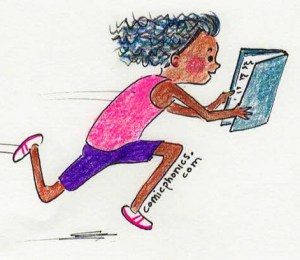
dhild running with book in hands

You could ask quick readers to outline the reading passage. If it is nonfiction, then the outline could name the way information is presented, such as chronological, problem and solution, cause and effect, or whatever is appropriate.  Then the students could write one sentence per paragraph describing the information in each paragraph.  If the reading selection is fiction, then the outline could state the type of writing, such as description, dialog, action, or whatever is appropriate.  Writing one sentence per paragraph might not work for fiction, but one sentence per scene or character might.  The point is for the students to prove to you that they comprehend what they have read.

You could ask students to choose five words from the passage that they don’t understand or that they think their classmates might not understand and use a classroom dictionary to look them up. Then students should write each word in sentences to show what the word means.

You could ask students to write one (or two or more) questions about the reading which require thoughtfulness to answer. Collect them, shuffle them, and then use them for class discussion or homework.

Notice that all of these assignments focus on the original reading selection and either extend or deepen students’ understanding of it.  Students need only paper and pen and possibly a dictionary to do the work.  If you have the extra assignments printed up to use as needed, you can pass the appropriate one out any time a student finishes early.  And most of the ideas work well in science and social studies classes as well as in ELA classes.

Of course you could always have early finishers take out books and read them.  If the books’ Lexile numbers fit the students’ reading levels, this works.  But it does not enrich the reading lesson, and it could cause resentment among the slower readers who might feel punished for their slower progress.
Work with kenesthetic learners’ strengths–their bodies

Most preschoolers and many school-aged children are kenesthetic learners, that is learners who learn best when they are physically active.

Should my child sit still when she learns to read?

Ask such a child what “humongous” means, and she will spread her arms as far as she can reach.  Ask a one-year-old what the dog in the picture is doing, and the child will get down on all fours and sniff.  Ask a child the difference between up and down, the child will stand on a chair and say, “up,” and then jump to the floor and say, “down.”

These children use as much of their bodies as possible not only to learn but to demonstrate that they have learned.

How do you know if a child is a kenesthetic learner?

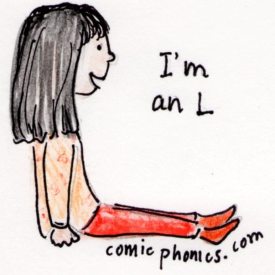
Child sitting with legs outstretched, forming the letter L

  • The child loves sports—running, jumping, dancing, and tumbling.
  • The child seems more active than other children of the same age.
  • The child gestures while talking.
  • When the child sees a demonstration, the child wants to try it herself.
  • The child ends the day dirty—dirt under his fingernails, peanut butter in his hair, shoes scuffed—and he is oblivious.
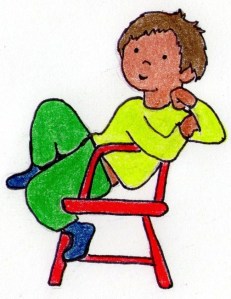
  • When reading or writing, the child kneels on a chair, stands, sits on the desk, stands on the chair and leans over, and does all of these in the span of five minutes.
  • The child fidgets while learning—tapping her fingers, puffing up her cheeks, wriggling her shoulders—yet she pays attention.
  • The child loves Legos, puzzles, and toys that can be put together or taken apart.
  • The child has great hand-eye coordination, and can learn to control pencils, paint brushes, screw drivers and tools with ease.

dhild running with book in hands

How does such a learning style affect reading?  What can you do?

  • Since a kenesthetic learner often reads later than his peers, you might panic that he is lagging his classmates. It helps if you can accept that for this child, reading is a low interest activity.  You can reinforce what he is learning by connecting it to activities he loves.  “A is for arrow.  B is for basketball.  C is for coach.”
  • Because the child needs to move, let him swing his legs, stand, lie on the floor, or move a rubber ball from hand to hand as he listens to instruction.children moving letter tiles
  • Break up reading lessons into mini-lessons with in-between times when the child is free to move around. Use this time for the child to act out what he has learned.
  • Since the child likes to use his hands, teach using manipulatives such as letter tiles, pictures to sort by sound, parts of sentences cut into phrases, flashcards, and online work which includes using a mouse. Vary the writing instruments the child uses since the feel of some will attract the child to work.
  • Suggest that the child draw what he is learning. Have her fill in boxes and use arrows to show relationships.
  • Use repetitive physical activity to deepen learning. Throw a ball back and forth while spelling new words.  Take a walk while discussing subjects and predicates.  Move magnetized words into sentences on the refrigerator while shifting weight in a dancing rhythm.  Draw mind webs while reading to show comprehension.
  • Teach a hard concept after physical activity.

How to Raise a Reader, according to The New York Times

The New York Times published  an excellent article last month entitled, “How to Raise a Reader.”  You might find the article at your library in the Book Review section.  It is worth the effort.  Here are some highlights from “How to Raise a Reader.”

Become a reader yourself.  If you have let your reading habit slip, reacquaint yourself with the print world.

Read aloud to your infant.  Your reading material might be a medical journal or Dr. Seuss.  The content doesn’t matter to an infant.  What does matter is that you make eye contact with your child, use voice inflection, and read in the normal rhythms of your language.  If the baby responds with baby sounds, respond in kind.

Read aloud to your toddler.  Encourage your child to link the sound of your voice reading to him with strong, positive emotions.  Read at bedtime and during daytime too.  Offer your child variety in picture books, but respect his or her preferences, even if that means reading “Go, Dog, Go” night after night.  When the child interrupts, that shows he is engaged.  Stop and respond.  Finishing a book isn’t all that important at this age nor is reading every word.

Continue to read aloud to your emerging reader.  Once your child shows interest in letters and words, keep reading to him or her.  Encourage her to join in, but don’t pull back now.  She shouldn’t think of reading as work.  She should think of it as fun.  Allow your child to develop reading skills at her own pace, but if you suspect problems, follow through with her teacher.

Continue to read aloud to your early reader.  Take him or her to the library or book store.  Expand his selections from fiction to nonfiction.  Ask him and his friends what they are reading and discuss their preferences.  Let your child stay up a bit later if she reads in bed.  If your child prefers comic books or graphic novels, or if he wants to read about his favorite video game, be thrilled.  He’s reading.

Stash reading materials throughout the house. On the coffee table, in the bathroom, or in the bedroom, show off books, magazines and other reading materials to encourage reading.

Help your child build a personal library.  Make a bookcase part of the child’s bedroom or a children’s section of books part of your home library.  Give books as gifts and rewards.  Bring home armloads of books from the library.  Celebrate your child’s first library card with family stories of other first library cards.

This wonderful New York Times article goes on to describe the kinds of books children are ready for at different times in their lives.  Enjoy.


10 picture books with simple illustrations

Picture books with simple illustrations and bland backgrounds—the kinds which appeal to toddlers and children with sensory integration problems—can be hard to find if you search online or on shelf.  Even harder to find are such books which tell a story.

But they are great books for reading aloud to sensitive children.  And they are equally valuable for suggesting story ideas for children to write.

Here are ten such books from all over the world which your child might enjoy.  Many have won awards.


Why Mosquitos Buzz in People’s Ears by Verna Aardema

The Enormous Crocodile by Roald Dahl (the version illustrated by Quentin Blake)

The Snowman by Raymond Briggs

Puss Jekyll Cat Hyde by Joyce Dunbar

The Farmer and the Clown by Marla Frazee (wordless)

Flora and the Penguin by Molly Idle (wordless)

The Great Paper Caper by Oliver Jeffers

The Snowy Day by Ezra Jack Keats

Snow White and the Fox by Niroot Puttapipat

Lon Po Po:  A Red Riding Hood Story from China by Ed Young

For kids with sensory integration issues, choose picture books with pared down shapes, colors, focus

If your child resists being read to or resists reading certain picture books, it could be the pictures themselves that discourage reading.

Look for books with no backgrounds, solid colors, and focused on one or two characters.

Picture books with detailed backgrounds or with copious patterns can turn off children with sensory integration issues.  Such children have difficulty focusing if there is too much pattern, noise, motion, or texture in any experience.  They prefer plain painted walls and plain bedspreads, not papered walls and patterned bedding; low, instrumental music by a single instrument, not loud music or music with lyrics; sitting or standing still, not rocking or dancing; and loose knit clothing, not clothes with tags or clothes that are tight-fitting.

When you choose books for children who show sensory integration issues, search for picture books with these characteristics:

  • Pictures with no backgrounds, or just the hint of background—a wash of green to represent grass and trees, for example, or one or two birds in the sky, not a whole flock.
  • Characters dressed in solid colors without shading or patterns in their clothes. If you have seen Pippa the Pig books or cartoons, with their simplistic images, that is the kind you want to show your child.
  • Pictures using flat shapes and limited colors, the kind that children themselves produce. (Think of the way Peanuts cartoon characters are presented—Charlie Brown with his round head and Lucy with her dress of a single color.)
  • Pictures focusing on one or two characters, not groups. Look for pared down, minimalist images which have removed everything but the essential elements.

Likewise, when you look for  picture books for children with sensory integration issues to write about, search for picture books with the same features.  Some wordless picture books offer these kinds of pictures, but not all do.

Finding such books in your library or book store is not easy.  A section labeled “simplistic art” doesn’t exist.  I have had to scour shelves to find what I am looking for.  But the search is worth it to entice a reluctant child reader or writer.

Next blog:  Names of some books that might appeal to kids showing sensory integration issues.

How to make reading anything easier

boy reading on the floorBefore you read:

  • Read the title and look at the photos, drawings, charts, and maps. Try to figure out what they mean without reading  the text.
  • Read the subheadings. Ask yourself, “What is this about?”  Try to predict the topic you will be reading about.
  • Read vocabulary words out loud, find out how to pronounce them (ask an adult) and ask or look up what they mean.  If there are vocabulary words in the margins, or if words are highlighted in the text, they are there because they are important and because you might not know them.

girl with ipad in bed

While you read:

  • Figure out the main idea. Usually in nonfiction it is named at the end of the first paragraph.  If you own the book, underline the main idea.  If not, start a mind web with the main idea in the middle.
  • Figure out what details are important. Add those to your mind web.  It’s easier to study a mind web than it is to study a whole lot of paragraphs.
  • Highlight or write down every word you don’t understand.
    • Look for clues in the nearby words.
    • Ask an adult to help you.
    • Or look up the words in a dictionaryWrite down what they mean, and read over the words and meanings until you know them.
  • If something is difficult or confusing, ask an adult to explain it.
  • Define important words on your mind web.
  • Summarize each paragraph into one or two sentences to be sure you understand it.  If you can write down what it means, you understand.

Teaching “and” and “but”

Learning new vocabulary words in elementary school is important for reading comprehension.  But vocabulary instruction needs to include a deeper understanding of words students use all the time, words they haven’t paid much attention to, such as the conjunctions “and” and “but.”

boy reading

Children know what “and” and “but” mean.  But do they realize they use “and” to connect two words or ideas which are both positive or both negative?  And do they realize they use “but” to join one word or idea they favor and another word or idea they don’t favor?

Helping students learn to read means pointing out the relationships which conjunctions create.  Here’s how.

  • Start with the word “and.” Write a sentence such as “I like ice cream and cookies.”  Point out to the student that you used “and” to join two ideas you feel the same way about.  Ask her if there are any other ways she could say “I like ice cream and cookies” without using “and.”  If she is stumped, suggest, “I like ice cream.  Additionally, I like cookies.”  Or, “I like ice cream as well as cookies.”  Or, “I like ice cream.  Also, I like cookies.”  Point out that “and,” “additionally,” “as well as” and “also” all are used to connect ideas which we feel the same way about, either positively or negatively.

Other words which mean the same as “and” include consequently, because,  moreover, and furthermore.  A semicolon between two sentences usually indicates that the idea in the first sentence continues in the second sentence.

  • Now write a sentence such as “I like ice cream but not anchovies.”    Ask her if there is any other way to say that idea.  She might say, “I like ice cream.  However, I don’t like anchovies.”  Or, “I like ice cream although I don’t like anchovies.”  Or, “I like ice cream even though I don’t like anchovies.”  Point out that “but,” “however,” “although” and “even though” all are used to connect ideas we don’t feel the same way about.  One idea we like and one idea we don’t like.  One idea usually uses a form of “not” or a prefix that means “not” such as un, im, ir, or dis.

Words which mean the same as “but” show contrast.  Some other words are though, despite and yet.

  • To reinforce the difference between “and” and “but” and their synonyms, suggest two ideas, such as summer and winter. Ask the student to say or write a sentence saying how they feel about those two times of year.  Now ask the student to change the word or words they used to connect summer and winter to a word or phrase which means the same thing.  Now do it again to another phrase or word which means the same thing.  Try another relationship, such as snakes and dogs.  Again, ask for synonyms for the connecting words.

Being aware how “and” and “but” and their synonyms create different relationships between ideas is important in reading.  If a child is reading and comes to the word “however,” she knows the thought has just changed to an opposite kind of thought.  If she comes to the word “moreover,” she knows more of the same kind of thought is coming.

Another way of teaching these ideas is to suggest that “and” is something like a plus sign, but “but” is something like a subtraction sign.  Or “and” is something like walking straight ahead while “but” is something like taking a U-turn.

How to make kids better readers

Renaissance Learning offers many ways to make children better readers.  Here are some of their suggestions.

“Give your students more choices.” Let children choose which books to read from a huge selection, both fiction and nonfiction.Young girl 's reading choices include a print book and an eBook.Young girl 's reading choices include a print book and an eBook.

Make sure the reading level is just right.”  A useful gauge is to count the number of words a student misses on a single page.  If it is five or more, that book is probably too hard and will discourage children from reading.

Devote time to reading practice.”  Designate a certain time every day—before bed, before the morning school bus or during the school day—for reading.  Children will look forward to this time, especially if it is part of a routine.boy reading on the floor

Build relationships with daily check-ins.” During reading time, talk to your child.  Comment on what he is reading.  Let him know you care.

Make reading practice a social experience.” Read together with a child, one page for her, one page for you.  Or after you read, discuss what you and the child like and don’t like.

Create a book-store style display.” On the bookshelf, show off books by their jackets or front covers to encourage a child to choose that book.  Display books you have read so you can talk to the child about why you like the book and why he might.girl reading Junie B. Jones

Read aloud to students of all ages.” When you read to a younger child, you expose him to books whose ideas he can grasp even though the vocabulary might be difficult for his reading level.  When you read to an older child, you introduce genres which the child might not choose, and you model comprehension strategies such as predicting, asking questions and summarizing.

Acknowledge and celebrate success.” Praise your child for his reading.  Create a spot to post his reading accomplishments—names of books and articles read, or number of pages read.

For more detailed information, go to http://doc.renlearn.com/KMNet/R60386.pdf.

How to encourage multiple perspectives on a reading topic

When students take Advanced Placement (AP) courses, they must read and analyze several documents on a given topic.  Those documents come from various sources, such as diaries, government publications, laws, news reports, emails and speeches.  The documents approach the topic from various perspectives, such as a private citizens, columnists, people with a grudge, historians and mental health experts.

EPSON MFP image

From all these documents students are asked to understand a complicated issue and to make sense of it.

Can we work with young readers, even beginning readers, to encourage a similar wider, multifaceted understanding of a topic?  Can we help children to identify important ideas and then help them to compare and contrast those ideas through various reading sources?  Can we help our earliest readers to become critical thinkers?

Yes.  One way is by choosing several books or other reading sources which approach a topic from different perspectives or genres.  First, decide on a question you would like the student to explore, such as, What was it like to take the Oregon Trail? or Why do polar bears need ice?  To have the greatest impact, the topic should be one the student is studying or a seasonal or timely topic.  Together the sources should give a wider and more profound understanding than any one source alone can give.

Here are some examples for primary grade students.

graceforpres

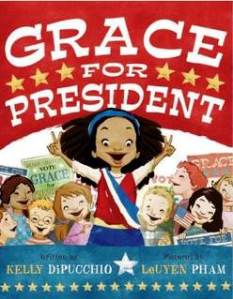
The question might be, Can a girl be President?  Show the student a copy of The Constitution and explain what it is.  Then have reproduced the appropriate lines from Article II defining the President’s qualifications.  Discuss what they mean.  Then have the student read Grace for President by Kelly S. DiPucchio, about a little girl who decides to run for president at her school.  Discuss how hard it is to become President.  Finally, your child could read a biography of Hillary Clinton, such as Hillary Rodham Clinton:  Some Girls Are Born to Lead by Michelle Markel or Who is Hillary Clinton? by Heather Alexander.  Discuss whether Mrs. Clinton has the qualifications needed, and what other strengths might be needed to be a President.

If the question is What’s an idiom? your student could start with In a Pickle: And Other Funny Idioms by Marvin Terban. This book explains what an idiom is and then illustrates well-known idioms with funny drawings.  Next, your child could read Raining Cats and Dogs: A Collection of Irresistible Idioms and Illustrations to Tickle the Funny Bones of Young People by Will Moses.  This book illustrates common idioms, but goes one step further:  it explains how the idioms came to be.  My Teacher is an Idiom by Jamie Gilson shows what happens in a fictional second grade when a new student from France misunderstands English idioms, and when the English-speaking kids misunderstand French idioms.  The reader learns that all cultures have idioms, but sometimes they do not translate into another language.

If the question is What is the water cycle? you could explore Water is Water:  A Book about the Water Cycle by Miranda Paul.  With poetry and evocative art, readers follow two children as they pass through the water cycle as water goes from rain outside to steam in the tea pot to evaporation into clouds.  In The Drop in my Drink: The Story of Water on Our Planet by Meredith Hooper, readers travel back to a young planet Earth to find out where water came from and to learn about erosion and how all living things depend on water.  National Geographic Readers: Water by Melissa Stewart shows more about the water cycle through beautiful photography and easy reading words.

Do you multitask when you teach your child?

Do you multitask when you oversee your children’s work?  Do you listen to little Sia read while stealing glances at your smart phone for text messages?  Do you cut away from little Andy writing his ABCs to check your Facebook page?

EPSON MFP image

According to research, those little breaks in concentration — just two or three seconds — can double the number of errors a person makes in his or her work.  When your work is supervising your child’s work, you can miss your child’s victories and mistakes and miss opportunities to intervene.

All the technology around us and our speed in using it encourages us to multitask.  We run the treadmill while watching TV.  We drive with buds in our ears.  We push the baby carriage while texting.  We make dinner while we supervise the children’s homework.  It’s not possible all the time to stop multitasking, but when it is possible, we should.  Research shows that multitasking is just another word for doing two things poorly. Single tasking, or as Grandma used to say, “paying attention” is the way to do work well.

I have seen parents on their laptops or cell phones or both while their preschooler works a puzzle in a doctor’s waiting room.  The child looks up for affirmation, but no one notices: an opportunity to show the child how important he is — wasted.

When your work is teaching children to read or write, turn off the electronics.  Put the tablet and cell phone out of sight.  Sit close so your child can see he has your full attention.  When he speaks, respond not with “uh-huh” or “um” but with specific words that show you are listening.  Look at your child’s body language.  When her grimace shows you she is confused or needs help, offer encouragement.  When she pronounces a word well or writes a big kid word like “irritable,” say how proud you are of her work.

If you must take a call, answer an email, or mix the meatloaf, tell the child you will work with her in four or twelve or however many minutes.  Then set the kitchen timer so the child can see it, and when it rings, give her your undivided attention.  Let her know some of your time is just for her.  Make her feel treasured.

For more information on the ineffectiveness of multitasking, read an article in The New York Times, at https://goo.gl/m33dNg.