Category Archives: teaching tips

Use wordless picture books to teach reading and writing

Wordless picture books are just what they seem to be—beautifully illustrated picture books without any words.  Most tell stories with everything you’d expect from a story—a setting, characters, a plot, a crisis, and a resolution.  Wordless picture books are a great way to teach reading and writing.

How can you use them to teach?

For a nonverbal toddler, show the pictures and ask the child to show what is happening by acting out the story. Let the child linger over the pictures to gain as much meaning as possible.

For a verbal preschooler who cannot write, show the pictures one at a time, and ask the child to tell you what is happening. To round out the child’s observations, ask questions about emotions shown, relationships of people and animals, and predictions of what will happen next.  Ask if the story is scary or silly or serious.

For a child who can write a little, show the pictures and ask the child to write one sentence about each page. Focus on the content of the sentence.  Encourage the child to figure out the main idea of a page and write about that.  But remind about capital letters and punctuation.

For older elementary grade children, look at the pictures first. Discuss what happens at the beginning, middle and end.  Ask about the setting (time and place), what problem needs to be solved, who is the main character/s, who or what opposes that character, and how the character overcomes the problem.  Now ask the students to write an outline—not sentences, but words or phrases to remind the students what they want to include in the story.  You might share  a check list of elements to include.  Now have them write the story.
For middle school students, show the story to them once for them to get the gist of it. Then ask the students to write (one word/phrase to a line) the following situations:  exposition, inciting action, rising action, crisis, falling action, resolution.  Review these words if students seem forgetful.  Now show the pages of the book again, slowly, and ask the students to identify what happens in the book for each situation.  When done, discuss the student choices and help students match the scenes in the book with the six situations.  Now ask the students to write the story.

Where can you find wordless picture books?  Search online or, if you have a children’s librarian at your school or public library, ask the librarian.  Look for books with enticing illustrations that tell a story with a beginning, middle and end.  Two of my favorites are The Fisherman and the Whale  by Jessica Lanan and The Farmer and the Clown by Marla Frazee.

You can also use wordless films.  A favorite of mine is La Luna by Pixtar.

How to teach words ending in the K sound

A reader asks how to teach her first grader words which end in a K sound.

That’s a tough question to answer because even though there are basically three ways of ending English words with a K sound (“c,” “ck,” and “ke”), there are many variations of short-ish vowel sounds before the K sound (-ac, -alk, -awk, -ek, -ic, -ilk, -ok, -ook, and -uk.)  There are even more variations of long vowel sounds before the “K” sound (-ache, -ake, -eak, -eek, -eke, -iek, -ike, -ique, -oak, -oke, -olk, and -uke).

But luckily, first graders don’t need to know all the variations.  So, let’s offer them a few basic rules.

For words which rhyme with book and look, the spelling is –ook.  Make sure the child can distinguish between the -ook sound and the –uk sound.  Say both kinds of words aloud and ask the child to tell you if you are saying an -ook or a -uk word.  Words which end in –ook include

book hook shook
brook look took
cook nook
crook rook

Words which end in -uk include

buck muck suck
chuck pluck truck
cluck puck yuck
duck struck
luck stuck

Most short-vowel, one-syllable words end in -ck.  In addition to the -uck words  above, other common -ck words include

back black crack
flak hack jack
knack lack pack
quack rack sack
shack slack smack
snack stack tack
track whack check
deck fleck heck
neck peck speck
wreck brick chick
click flick kick
lick nick pick
prick quick sick
slick stick thick
tick trick block
clock crock dock
flock frock jock
knock lock mock
rock shock smock
sock stock

A small number of words end in -lk where the L is silent: chalk, talk, and walk.  Some people pronounce these words as rhyming with -ok (walk, lock) while other people pronounce them as rhyming with the -aw sound (talk, hawk).  I would teach these -lk words as a small word family and not confuse the child with other letter variations.

Most long-vowel, one-syllable words ending in a “K” sound end in -ke.  They include

bake Blake brake
cake fake flake
Jake lake make
quake rake sake
shake snake stake
take wake bike
hike like pike
spike strike broke
choke Coke joke
poke smoke spoke
stoke stroke woke
woke fluke Luke
nuke puke

Many long-vowel, one-syllable words ending in a “K” sound end in two vowels before the K, such as beak and soak.  In order not to confuse the child, I would skip over teaching these kinds of words until the previous kinds of “K” words are learned.  The exception I would make is teaching –eek words.  I often teach -ee words before I teach silent E words, and when I come to silent E words, I tell students that almost all long-vowel, E words are spelled with –ee.  Instead of the E coming at the end of the word, it comes after the first E, I say.  This does not seem to confuse students.

The only words ending in just a C that a first grader might need to know are doc, picnic and music.  And the only short-vowel, one-syllable word ending in just a K that I can think of is trek.  Teach these as exceptions to rules.

I suspect what the child is confused by is not how to read all these words, but how to spell them.  If so, I would teach them as word families, and review them often.

Transitioning from short vowels to long vowels

Today I worked with a kindergartener who has mastered CVC words with blends at the beginnings and ends of words (for example, “slept” and “brand”).  It was time to move on to long vowels.

I started with two-letter words ending in “e” (be, he, me, and we).  I explained for small words ending in “e,” the “e” is pronounced differently.  Even so, the child wanted to say the words as if they ended in a short e.

In one way this was satisfying to me, her teacher.  She had learned the rules about pronouncing short vowels.

But in another way it was frustrating.  Her brain was saying she didn’t accept the logic of one letter representing two sounds.  Until now every letter of every word we have read together has had one sound only.  But now I am changing the rules.  It’s like I am telling the child that until now your little brother has had one name, but from now on he is going to have two names, and you have to remember when to call him John and when to call him Fred.  Huh?

Some students learn sight words in school at the same time they are learning phonics.  For them, words like “me” and “go” are memorized rather than sounded out.  But my student has not learned sight words, so I needed to switch gears.

I stopped focusing on two-letter words.  Instead, I focused on words ending in “ee.”  It was easier for my student to accept that “ee” represents a different sound from “e.”  So, we worked on reading words like “bee,” “fee,” “lee,” “see,” and “tee.”  I added nonsense words like “dee,” “pee,” “vee,” and “zee” as well to extend the practice.

At our next class I plan to continue delaying two-letter words like “he” and “me.”  Instead I will continue with “ee” words, adding ending letters and blends.  “Bleed,” “creek,” “heel,” “seem,” “green,” “sleep,” and “feet” are some examples.

Until now, my student has moved quickly in acquiring reading skills.  But I may need to slow down now and make sure she can go back and forth from short-vowel words to long-vowel words and vice-versa.  For some students this is easy.  For others, it takes months.  We will see.

Teaching kinesthetic learners how to read

Have you ever taught a student who acts like this? 

  • Changing positions frequently—sitting on a folded leg, kneeling on a chair, or wriggling her shoulders?
  • Responding to a question with gestures—thumbs up, a face showing precise emotions, drawing a picture in the air?
  • Reading out loud when he should be reading silently?
  • Miming a situation or a reaction?

These students might be kinesthetic learners, people who need to engage their whole bodies to learn optimally.  Some are hyperactive,  tempermentally unable to sit still.  Some are dyslexic, unable to read or to learn to read the usual way.  Some are autistic, non verbal or preferring repetitive motions or intensely focused on one activity.  Some are artistic, preferring to draw in almost every situation.  Some are actors, dramatizing their responses.  child making letter T with his body

The younger the child, the more apt he is to be a kinesthetic learner.  Males tend to be kinesthetic learners longer than females.  Children with highly focused hobbies or interests—assembling Legos for hours at a time, enjoying sports practice several times a week, wanting everything Spiderman, drawing and coloring every day—are probably kinesthetic learners.

The problem for kinesthetic learners is that most classrooms are made for the auditory learner, the person who sits still and listens to the teacher, the person who reads silently to learn, not for the person who roams, fidgets, mumbles, acts out, or plays games to learn.

Child sitting with legs outstretched, forming the letter L

So what hands-on activities will help your beginning reader to learn the alphabet and easy words?

  • Ask the child to act out the letter shapes, that is, form the letters with her body.
  • Allow nonverbal responses—pointing, gesturing, showing facial emotion, performing.
  • Use games—letter tiles, for example—that offer the child the opportunity to pick up, arrange, and invent. Or hold letter “bees” in  which the children form teams and the you hold up letters or words for a team member to identify.
  • Teach using puppet shows—two characters debating what a given letter is, or how to hold a book, or if “fun” rhymes with “fan.”
  • Let groups of students create an ABC book . The artist in the group might draw and color pictures while other students might cut out pictures from magazines and paste them.
  • After you have read a story to students, ask some to act out the story to test comprehension. Let other students join in.
  • Create an alphabet from Play Doh or Legos or pipe cleaners.
  • Create word family books with drawings or cut-and-pasted pictures.
  • Take a scavenger walk in the neighborhood to see shapes of letters in tree branches, sidewalk cracks, clouds or roof lines.

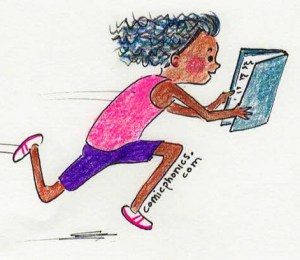
dhild running with book in hands

You might think, these activities take time and slow down the learning process.  Yes, they do take time, and yes, they do slow down the initial learning process.  But since this kind of learning sticks, you need to do less reteaching and may gain time in the long run.  Just as importantly, students who are reprimanded for not sitting still or for being unable to leave a task they like are praised for their learning.  These students become leaders, helping other children who are not as kinesthetically gifted.

Teaching ĭ CVC words and ĕ CVC words

Ĭ and ĕ are the two hardest vowel sounds to distinguish.  Here is how I suggest you work with children to differentiate these sounds.  Mix the ĭ CVC words with the previously learned ă, ŏ, and ŭ CVC words.  Then mix the ĕ CVC words with the previously learned words, not including the ĭ words.  Lastly mix only the ĭ CVC words with the ĕ CVC words.  Repeat these steps indefinitely until your child can read the majority of ĭ and ĕ CVC words correctly.  Learning the ĭ and ĕ CVC words can take longer than the other three letter sounds combined.

Sample ĕ words

bed fed led red Ted
beg egg keg leg Peg
Ben den hen men pen
bet get jet let pet
bell dell fell Nell sell
Bess less mess Tess yes

Sample ĭ words

bid did hid kid lid
big dig fig pig rig
dim him Kim rim Tim
bin din fin pin tin
dip hip lip quip zip
bit fit it pit zit

Problem: Distinguishing between nearly identical sounds and words

Short ĕ and short ĭ are difficult sounds to distinguish for most beginning readers.  When I teach these sounds, I rely on two game-like activities.

For one of the activities, I gather the pictures of  words which start with ĕ and ĭ, or which use them in the CVC pattern.  I put these Ee and Ii cards in front of the child and we practice saying those letter sounds.  Then the child sorts the deck of cards I have created, putting cards under one of the two letter sounds.  We say the word aloud to reinforce the letter sound.

For another activity, I have created BINGO-like cards of ĕ and ĭ words.  I limit each BINGO card to nine words.  More words can seem overwhelming.  I say one of the words and the child finds and covers it, using a marker.  To extend this activity, the child and I exchange places.  The child says the words and I find the correct spelling.

big beg dig
set sit bet
lit let bit

Learning to read, one sound at a time

A six-year-old kindergartener learning to read VC and CVC words worked with me yesterday for the first time.  We met the day before via zoom.  He was nervous, sitting on his grandmother’s lap for support.

I started by assessing his phonics skills.  Because he doesn’t know me and has not worked online, his responses to the phonics assessment I did might not be spot on.  After a few lessons, when he is more relaxed, I will have a better idea of his skill level.


But for now he was able to show me he knows letter names, consonant sounds and short vowel sounds.  He can sound VC words easily.  When he reads CVC words, he cannot “slide” all the sounds together to form words.  So that is where my reading instruction will begin.


Yesterday we worked using letter tiles.  I put before him the word “at,” and then I added one onset letter sound at a time, forming words like “fat” and “rat.”  He sounded out words from several word families using short a, o, and u.  After 20 minutes, his squirming became excessive, and we ended the lesson.  Today I will teach him again for another short lesson.


His grandmother showed me a “beginner” picture book the boy has, but as is often true, that book is not a good “beginner” book for students learning phonics.  In that book, advanced reading words are mixed in with sight words and CVC words.  I recommended she set it aside for a few months.


She wondered if she should use flash cards with words printed on them to help her grandson learn.  If the words are sight words which cannot be sounded out phonetically—words like “are” and “the”—then yes.  But if the words are capable of being sounded out, I said the student should learn them by sounding them out.  Otherwise he might think he should memorize the look of a word to pronounce it.


Should he guess at words?  No.  If a child learns to read following the rules of phonics, eventually he will be able to sound out almost any word, even long words like “dinosaur” and “alphabet.”  Teaching a child to guess introduces a habit which will hobble him the rest of his reading life.


This student has learned to read the way phonics experts recommend, sounding out each letter.  With time, almost all CVC words will become sight words for this student and he will no longer need to sound them out.  But to reach that stage of reading, he needs practice sounding out words.

Teach ŭ before teaching ĕ and ĭ

Suppose you have taught your child VC (vowel-consonant) and CVC (consonant-vowel-consonant) words using ă and ŏ and the 16 consonants that always sound the same at the onset of words.  You have had your child read lists of words with ă and ŏ shuffled.  Your child is able to pronounce those words correctly.

Now it is time to move on to ŭ.  I recommend teaching ŭ before teaching ĕ and ĭ.  In my teaching experience, children recognize the sound associated with ŭ quicker than the sounds of either ĕ and ĭ.  Some children do have trouble pronouncing ŭ, but they don’t confuse the sound with either ĕ or ĭ.  They can distinguish a difference between ŭ and ĕ / ĭ.  Children have a harder time distinguishing between the sounds of ĕ and ĭ.  So I recommend teaching ă, ŏ and ŭ in that order.

Some of the commercially available support materials you might use with your child do not sequence the short-vowel words in this order.  In that case, I recommend you jump ahead to the ŭ word section and return to the ĕ and ĭ sections later.

Sample ŭ  VC and CVC words include:

up hub pub rub tub
bud dud Judd mud Rudd
bug dug hug jug lug
dull gull hull lull null
but cut gut nut rut

Sample ŭ  VC and CVC words with ă and ŏ in sentences include:

  • Judd cut a nut.
  • Rudd dug up a bug.
  • Tess can run in the mud but not Tom.
  • Tom dug a rut.
  • Jan can hug a mutt.

How to teach words using ă and ŏ

Suppose you have taught your child the 16 consonant sounds which don’t vary at the beginning of words: b, d, f, h, j, k, l, m, n, p, qu, r, t, v, x, and z.  Now you are ready to teach vowel sounds.

Explain what vowels are

Because you will be using the words vowel and consonant with your child as you teach, make sure you take time to explain what these words mean.  Vowel refers to five letters all the time (a, e, i, o, and u) and two letters sometimes (y and w).  Consonant refers to all the other letters and to y and w most of the time.  For now you can leave out the y and w, but when you teach small words like by and now, mention that y and w act as vowels sometimes.

Should you say short / closed vowels?  Or long / open vowels? 

Today many support materials refer to vowels followed by a consonant in the same syllable (cat, hot) as closed vowels.  Years ago these vowels were called short vowels, and they were pictured with a curve over the vowel as in ă, ĕ, ĭ, ŏ and ŭ.  Similarly, vowels coming at the end of a syllable (go, hero) are today called open vowels by some reading support workbooks.  Previously they were called long vowels and pictured with a horizontal line over them as in ā, ē, ī, ō, and ū.  I will use the terms short and long since those are the terms most parents recognize.  I will use markings over vowels such as ă, ĕ, ĭ, ŏ and ŭ when referring to a particular short vowel sound and ā, ē, ī, ō, and ū when referring to a particular long vowel sound.

Naming vowel sounds as short or long is important because we need a vocabulary to use with children when we refer to vowels pronounced like their letter names and vowels pronounced more softly.  Whichever terms you use, make sure your child understands them.

Teaching words with a ă sound

While you are teaching the 16 consistent consonant-letter sounds, you can begin to teach one short vowel sound.  I recommend starting with the letter ă because almost all phonics support materials start with the vowel ă, and because ă might be the easiest short vowel sound to master.  The support materials I suggest for my students are the Explode the Code series.  That series starts with ă words.

When I am teaching in person, I use flash cards with pictures of words beginning with ă such as alligator, astronaut, and apple.  I recommend you teach your child to say “ă as in apple” to reinforce the letter connected to the sound.

Choose five or six consonant letter sounds your child has mastered.  Using letter tiles, form two and three letter words such as am, an, at, bat, bam, tan, and mat, etc.  Place the letter tiles for one word an inch or so apart and ask your child to say the sounds, keeping the picture of the apple on the table too, for reference.  Repeat saying the sounds as you slowly move the letters closer and closer together until the child says the word.  It might take many tries, but usually there is a Eureka! moment when the child realizes she is reading a word, not just letter sounds.  Reading teachers call these tiny words CVC words, meaning consonant-vowel-consonant words.

Gradually add more consonant sounds and form more words with ă as the vowel sound.  If the child loses interest, one way to extend the lesson is to use her name and write a goofy sentence such as Kim is a pan or Kim is a map.  Another way is to use your name and have her end the sentence.  Mom is a ____.  Teach her that the vowel goes first or in the middle.  Try mispronouncing a word she writes and ask her if you said it correctly.

You can buy magnetic cards which you can cut into small rectangles to attach to the back of letter tiles.  Then you can work in a metal lasagna pan or pizza pan or on the refrigerator.  If your child is four or five, a short lesson (ten minutes) teaching in one mode followed by another short lesson in another mode (writing words on an iPad or laptop, writing in a workbook) might be all she can handle for one session.  I have given one-hour lessons to a four-year-old, but I needed to have six mini-lessons to sustain her interest.

Teaching words with a ŏ sound

When, after several days or weeks, you are sure your child can read ă words, move on to ŏ words.  Create a reference card—an octopus, for example.  Work on two and three letter ŏ words such as on, off, odd, Oz, nod, fob, and Bob, etc.  After several days or weeks—whatever it takes—mix ŏ words with ă words.

To reinforce your work, read together picture books.  When you come to a word she can pronounce, point to it and ask her to say the word.  Two or three times are enough to show her that what she is learning applies to her real world.


Children learn sounds from big to small

children pronouncing elephantLittle children who are learning about sounds in words move from larger units of sound—phrases and words—to smaller units of sound—sounds within words and syllables.  Adults hear “On your mark, get set, go,” but a two-year-old hears “Onyourmark, getset, go.”  Children need to hear distinct sounds within words and to reproduce those sounds properly before they start pairing sounds with letters.

For this reason, most two-year-olds are too young to learn to read.  Even some five-year-olds might not be able to distinguish sounds within words.  In some countries, children don’t learn to read until they are seven. 

A good example of this is when children learn the ABC song.  Most three-year-olds can start the song with A-B-C-D. . .E-F-G-. . .H-I-J-K .  But when they get to L-M-N-O-P they sing L-um-men-oh-P or M-uh-let-O-P.  They don’t hear L-M-N-O as distinct sounds.

I still remember the day when I was in first grade when  my teacher taught my class the words of and the.  I thought, wow, those are two different words.  I didn’t know that.  I thought ofthe was a single sound.

Most two-year-olds are too young to learn to read.  Even some five-year-olds might not be able to distinguish sounds within words.  For this reason, in some countries, children don’t learn to read until they are seven. 

What can you do to help your child hear sounds more clearly?  Speak distinctly.  Slow down.  Face your child and let her watch your mouth when you talk.  When you hear her slurring sounds together which should be pronounced separately, don’t correct her but instead repeat the sounds properly.

While we’re on the subject of hearing words correctly, children will subconsciously learn the rules of grammar without instruction.  A four-year-old might say, “Mommy goed to the store,” properly making the verb past tense by adding the d sound to the end of the word without realizing go does not follow the rules.  Or he might say, “I amn’t done yet.”  He is learning contractions, not realizing that am can’t be contracted in the negative form.  Or a child might say, “Her said so.”  Objective pronouns are learned before subject pronouns.

To correct these mistakes, repeat what the child says correctly without comment on the error.  When the child hears words said properly enough times, he or she will say words that way too.


How to teach a child to read

When my older son neared the end of first grade, his teachers told me he would need to repeat because he could not read.  What!  I couldn’t believe it. I phoned my brother, a special ed teacher, and he said, “Relax. You can bring him up to grade level if you work with him all summer.”  He recommended I buy Why Johnny Can’t Read by Rudolph Flesch, a then out-of-favor approach to teaching reading using phonics. My brother said to turn to the word list at the back of the book and start there.  I trusted my brother, bought the book, and worked with my son every day.  He hated the lessons—lists of progressively more difficult words—but in September he started second grade reading on grade level.

Thus began my interest in how to teach reading.  Time and research have proven Flesch and my brother right.  A systematic—not random—phonics-based approach yields the best results in teaching children to read.  Even so, today many teachers do not teach reading using phonics.  And as a result, many children fail to learn to read.

If your child has been left behind, or if you want to be sure that never happens, this blog is for you.  In coming weeks I will advise parents and teachers of beginning readers

1) how to teach reading skills by sounding out letter patterns, and

2) in what order to teach those letter patterns. 

If your child already knows how to read some words, you can assess his or her skills by using the word lists below to know where to begin.

These lessons start with one sound represented by one letter, a simple yet reliable decoding system.  While these lessons introduce the most common letter patterns of English, they do not introduce them all.  That is not necessary.  As children read widely, they encounter new letter patterns which they figure out from context clues, by asking questions, or by using a dictionary.

If you choose to supplement the ideas in coming lessons with lessons from reading sources like Why Johnny Can’t Read or Explode the Code (both good), their lessons might not sequence letter sounds or letter patterns in the same order as I do.  That is because reading experts do not agree upon a single sequence for teaching reading.  The sequence I will use here extends the one-sound, one-letter pattern as long as possible, reinforcing what seems logical to little children.

IMPORTANT: Beware of any reading advice which encourages your child to guess at words, a strategy that can lead to lifelong reading problems.  Instead, ask your child to sound out words based on the rules of phonics.  That leads to reading independence.

Phonics assessment

The following words are listed in the same order as the lessons I will share in coming weeks.  If your child can read some words, and you wonder where to begin teaching her phonics, ask her to read these words in order.  When she starts making mistakes, stop her and turn to my corresponding lesson.  Proceed from there.

bad, hem, fit, don, pug, am, if, lass, jazz

lock, Mick, bills, cliffs, mitts, catnip, Batman

grand, stent, frisk, stomp, stuck

chuck, shun, them, branch, brush, tenth

star, fern, birds, fork, purr, actor, doctor, victor

muffin, kitten, collect, pepper, gallon

complex, helmet, falcon, napkin, after

tantrum, muskrat, constant, fulcrum, ostrich

skate, bike, Jude, mole, dare, shore, tire, pure

need, cheer, aim, hair, bay, pie, boat, oar, Joe, low, soul

fruit, few, child, blind, fold, colt, roll, light, high

earn, worm, rook, pool

fault, claw, all, chalk, Walt

boil, so, pound, down

comet, dragon, liver, salad, denim

total, ever, student, basic, demon, vital

apron, elude, Ethan, Owen, ideal, usurp

inside, nearly, absent, unicorn, degrade, tripod

advance, offence, fence

gripped, planned, melted, batted, handed

sweeping, boiling, thinning, flopping, biking, dating

rapper, saddest, finer, bluest, funnier, silliest

easily, busily, massive, active, arrive, wives

keys, monkeys, armies, carried

action, section, musician, racial, crucial, nuptials

brittle, pickle, carbon, dormer

parcel, decent, gem, urge, badge

lose, sugar, nature, sure

graph, Phil, then, moth

bomb, thumb, gnat, gnome, high, sign

whip, whirl, echo, ghoul, knee, knob

could, calf, folk, hustle, listen, wrist

alone, bread, bear, chief, young, squaw, swan, waltz, word

decision, exposure, gigantic, polarize, occupant, quarantine