Category Archives: reading disabilities

You diagnose the reading problem

You diagnose the reading problems.Situation:  A first grader can read CVC words in lists and on flash cards.  When another consonant is added to create a blend CCVC word (cot to clot, or ran to bran) she stops, sounding out the first consonant and skipping the second consonant.  She asks what the four-letter words mean.

When she sees paragraphs, she cringes and says, “That’s too hard.”  Throughout a half-hour lesson she asks every five minutes or so if the lesson is over yet.  The mother is concerned that this child is behind her classmates in reading.

Diagnosis:

  • This little girl is already intimidated by the reading process. Her repeatedly asking if the lesson is about to end shows her discomfort with reading.  This child needs much encouragement.
  • Repeating successful work might be a good way to begin a lesson in order to give the girl confidence.
  • She could benefit from frequent but short lessons (ten or fifteen minutes), perhaps with a timer.
  • How two consonants work together to form blended sounds is a new concept for her. Working on one blend each lesson (“bl,” for example) might be a good place to begin.  She could be shown pictures of “bl” words (blue, black, blaze, bleed, blocks, blossom, blueberry, blush, blow, and blouse).
  • After sounding out the words and recognizing the “bl” sound, she could be shown the “bl” letter blend. Letter tiles moved slowly together to form BLVC words could reinforce the blended sound of those letters.
  • She also needs work on vocabulary, so as often as possible seeing a picture of the new word, or acting out the new word, might help her remember its meaning.

As for the mother’s concern that the child has fallen behind classmates, that might be true.  However, the girl is not far behind and can easily catch up with frequent, short, unpressured lessons.  Her mother might read to her strictly for pleasure, perhaps pointing out a CVC word here and there that the child probably knows.  The mother could keep a list of words that the child can read on the refrigerator, asking the child to add a word or two each day a day so the child and the mother can see progress.
What’s a graphic novel?

One of the biggest trends in children’s literature in the past ten years is the rise of graphic novels.  Not sure what I mean?  Think Captain Underpants and The Wimpy Kid.  Graphic novels are

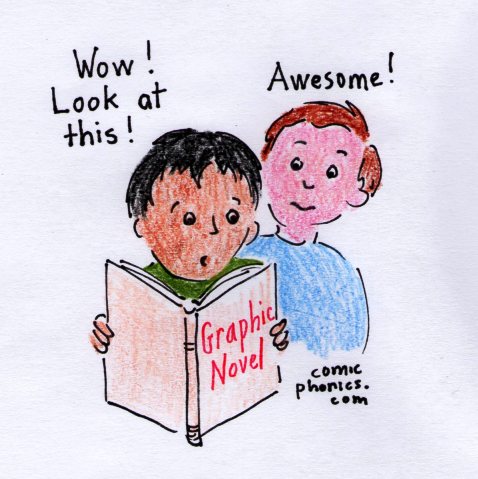
  • Two boys reading a book entitled "Graphic Novel."comic-strip-like stories with a beginning, middle and end (not a continuing saga).
  • fiction and nonfiction stories told as much in colorful drawings as in words.
  • a hybrid form of action literature that appeals to 12 to 18-year-olds but now is working its way to much younger readers.
  • a newly recognized form of literature by the Young Adult Library Services Association, part of the American Library Association, which has been selecting the best graphic novels for teens since 2007.
  • a form of children’s literature reviewed in respected journals such as School Library Journal.

Graphic novels, like all novels, cover many themes such as romance, sci-fi, fantasy, super heroes, and modern warfare.  Not all graphic novels are novels.  Recent nonfiction titles include Pride and Prejudice, a biography of Thomas Jefferson, Poseidon, landing on the moon and the great apes of Africa.

When graphic novels started appearing, said Mary Tyner, a media specialist from Peachtree Elementary School in Peachtree Corners, Georgia, they were inferior literature and she did not buy them for her school library.  But as they improved and as they were reviewed by respected journals, she began buying, and now she can’t keep the 153 titles on her library’s shelves.

“They are an extremely motivating literature that encourages children to read,” Tyner said.  Over time, she has seen the reading level of graphic novels press downward, but there are few for beginning readers, perhaps because it is hard to have a meaningful story line in beginning reading books, said Tyner.

Another advantage of graphic novels is that they teach synthesizing skills, said Deb Schiano, media specialist at Loundsberry Hollow Middle School in Vernon, New Jersey.  “In our society children must be aware how to read images,” said Schiano, and how to combine the images with words to form meaning.  She compares graphic novels to storyboards from which the student can pick up story arcs by reading the drawings.  Combining the pictures with the words creates more complex meaning.

Graphic novels also attract disabled students, said Schiano.  “For the dyslexic student who can’t decipher words, graphic novels are another way to learn.” In her school last year one teacher used them consistently with learning disabled students.

Both media specialists said graphic novels also encourage children to write and illustrate their own stories, sometimes using online sites.

What has all this to do with beginning readers?

  • Young children will see their older siblings reading graphic novels, and will enjoy paging through them to study the drawings.  The joy that that the older child shows might encourage the younger child to want to read.
  • With time, graphic novels will probably reach down into first grade reading levels and attract younger and younger readers.
  • As a child’s reading ability improves, he might want to buy these books or to borrow them from the library.  Parents unfamiliar with this genre might scorn graphic novels as inferior, but it is worth remembering they have advantages over text-only books.  For reluctant readers, or disabled readers, or boys, they can be a way to motivate the child to read.
  • Graphic novels can also be found on iPhones and Android phones.  Expect your young children to be intrigued when they find them online, and eventually, to want to buy them this way.

What are high/low books?

High interest / low reading level books are books that appeal to children who are older than the reading level of the book.

High/low books in a way are a mismatch: the reading level is lower than the age of the child to whom the book appeals. A good example is the Fudge series by Judy Blume. The early books are written at a second grade level but appeal to third or fourth grade children because the narrator begins as a fourth grader and grows older in the series.

Too many words on a page make reading hard.These books appeal to children who are struggling to read. The stories are about kids their age doing activities they do. These books are also good for ESL students whose age might not align with their reading level in English, and for disabled children, including those with dyslexia, who are behind their peers in their reading level.

What makes these books different? They share many of these qualities:

  • Shorter, everyday vocabulary words with concrete meanings
  • Short sentences
  • Short paragraphs
  • Large margins
  • Unjustified right margins (margins that look ragged)
  • Larger type size (minimum 11 point) in clear fonts
  • Realistic characters who are the same age as the reader
  • Easily differentiated characters
  • A fast moving plot which is low on description
  • Compelling stories
  • Chronological order (no flashbacks)
  • One point of view, not two
  • Illustrations, photos, graphs and maps
  • Tight, concrete writing

Many lists of these books can be found online.

A long list can be found at http://www.schoolonwheels.org/pdfs/3328/Hi-Lo-Book-List.pdf. This list gives the reading level (RL) and the interest level (IL) plus a one sentence description of the book. All the books on this list are fiction.

Some small house book publishers are known for publishing books for reluctant readers who often happen to be high/low readers. At http://www.nbss.ie/sites/default/files/publications/READ_-_hilow_books.pdf you can find the books of several publishers which are geared to students older than their reading level suggests. These books are mostly appropriate for high schoolers.

At http://www.booktrust.org.uk/books/children/bookmark/booklists/141/ there is a list of 14 books for various age levels written below age level.

http://specialeducation.answers.com/english-and-math/10-high-interest-low-reading-level-books-for-teens-with-reading-difficulties gives information about ten books, some nonfiction, which are written at low reading levels but which would still appeal to kids in their teens.

The largest teachers’ union in Britain has a listing of book publishers and book series appropriate for high/low readers. Go to http://www.teachers.org.uk/node/12418 .

Seven publishers of high/low books are listed at http://www.writing-world.com/children/foster03.shtml. Included are hyperlinks to those publishers. –Mrs. K


With so many apps available for preschoolers, how do I know which are the best ones to use to teach my child to read?

The best apps to teach reading share many of the same characteristics as the best apps to teach math or to teach games.  Here are some traits to look for, although you will not find each of these traits in every app.

baby looking at an iPad

To enlarge, click on the picture.

  • The app should be age or developmentally appropriate for your child.  It should seem like play but allow the child to gain self-confidence both in mastering the media and in mastering the material presented on the app.
  • The app should be interactive.  Most apps are passive, limiting a child to clicking or scrolling down, but that’s about it.  The best apps allow children to solve problems or to develop curiosity.  Some apps allow coloring, drawing lines and highlighting, with the child deciding how.
  • The app should be intuitive to use.  Using computers is often hard for preschoolers since interaction depends on mastering a mouse and a keyboard.  But pads are intuitive, allowing for swiping with a single finger to move from page to page.  Once the child tries the process a few times, he understands it.
  • The app should allow for repetition.  Young children like to have their favorite books read to them over and over.  They might also like to go to their favorite apps over and over.
  • The app should take advantage of the technology.  A book about a pet might show the word “dog,” but an app might show the printed word, offer a picture of a group of dogs wagging their tails, and create the sounds of panting and barking.
  • The app should be open-ended: divergent, not convergent.  Usually an app encourages a child to hit an icon which might be right or wrong, a dead end for the child.  But if the answer allows the child to continue in a manner she prefers, or to get to an answer in a round-about way, the child has some input into the outcome.
  • The app should extend a child’s skill or make up for a child’s shortcomings.  If a child cannot print yet, or has poor printing skills, a good app would produce the desired letters without the child needing to “write.”  Or for an ESL child or a child with speech problems, a good app might “read” the words aloud so that the child can hear the words pronounced correctly.
    child taking iPad out of toy chest

    To enlarge, click on the picture.

  • The app should be fun and engaging.  Stories should move in time order so that they are easy for a young child to follow.  There should be an obvious beginning, middle and end.  The vocabulary and sentence structure should be comfortable for the child so he gets it the first time he hears it.  The art work should make the child laugh.
  • The app should foster socialization.  Apps that store child-taken photos of a trip to the zoo allow for later sharing with preschool classmates or with family.  Apps that allow a child to film a Barbie fashion show or Grandpa snoring beg to be shared.  SKYPE allows for sharing over great distances.

Spend some time investigating apps for your young children.  Teach them how to access the apps you have selected.  And next week do it again, because the apps—like your child—are always changing.

Can dyslexia be identified in a preschooler?

By definition, dyslexia is a learning disability characterized by difficulty reading.  There are secondary characteristics—difficulty spelling, and illegible handwriting, for example—but until a child has attempted to read, it’s probably too early to identify dyslexia.

Even so, the National Center for Learning Disabilities has listed several warning signs for dyslexia, shown in the chart below, and some of them apply to preschoolers.

Dyslexia is the most common learning disability, affecting about five percent of American children.  Its cause is unknown, although scientists think it probably has more than one cause.  About a quarter of the children who have dyslexia also have attention deficit hyperactivity disorder, though most children with dyslexia don’t exhibit ADHD.  If an older child in the family or a parent has dyslexia, then the younger child has an increased chance of having it too.

Children diagnosed with dyslexia have normal intelligence and vision, yet they cannot figure out how to read by first grade.  Eventually they do, but they often require intervention from the school system, a tutor or a dedicated parent.

Dyslexia affects information processing in the part of the brain controlling language.  Usually children without dyslexia begin to realize that sounds combine to form words or parts of words, and that those sounds can be represented by letters.  Children with dyslexia have difficulty making these connections.

Children with dyslexia do learn to read, but it takes longer.  Teachers need to repeat the phonemes or basic sounds of English (about 44) and help children recognize these sounds in words and in syllables.  “Go” for example, has two phonemes, g and long o.  Then teachers need to connect these phonemes to letters, and the letters to tiny words which follow the rules of pronunciation.

If you are concerned about dyslexia, the National Center for Learning Disabilities website offers a 40-page toolkit about dyslexia, including several pages about characteristics of children pre-K to second grade and strategies to help them learn.  Your right to have your child tested by the public schools, the type of testing done and a video from an educator who has dyslexia are included in the toolkit.