Category Archives: reading comprehension

How to find the main idea in nonfiction articles

Understanding the main idea of a piece of writing is probably the most important aspect of reading once children understand phonics.  Yet many children struggle to find the main idea.  How can we help them?

  • Ask the children to read the title and any subheadings. Ask the children what those words mean.  Ask the children to predict what the writing might be about.
  • Ask the children to look at any graphics such as photos, graphs, charts, maps, diagrams or other nontextual information. Ask the children what they have learned from those graphics.  Ask them to predict what the reading might be about.
  • In nonfiction, the main idea is often expressed at the end of the first paragraph. Ask the children if the last sentence of the first paragraph tells what the main idea is.
  • In nonfiction, many times the first paragraph or even two or three paragraphs are a hook. They might give hints about the topic of the writing, but they might not tell the main idea.  Ask the children if that is the case with what they are reading.
  • In nonfiction, topic sentences often start the body paragraphs of a reading. Ask the child to read the first sentences of the body paragraphs.  Are they topic sentences?  If so, what is the topic that they are giving details about?
  • In the last paragraph of nonfiction, the main idea is often repeated. Ask the children to read the last paragraph and to identify the main idea if it is there.
  • Reading the first important paragraph (not the hook) and the last paragraph, one right after another, can sometimes help children to discover the main idea. Do both paragraphs talk about the same thing?  If so, what is it?

Some children will understand immediately while others will need many, many lessons focused on the main idea.  If children need more examples, more tries at figuring it out, make sure they get those extra examples and time.  Figuring out the main idea will be on almost every reading test they ever take from first grade to the SATs.

But more importantly, it is a life skill which they will need.
How to help children figure out new vocabulary words when they read

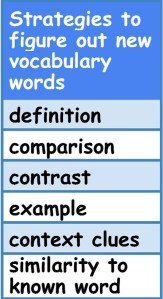
Children need strategies to learn new vocabulary words when they encounter such words in their reading.  Here are several strategies:

Definitions: Sometimes, definitions are given immediately after a new word.  Definitions can be separated from the word with a comma (An avalanche, a quick moving mass of snow,), with a dash (An avalanche—a quick-moving mass of snow—), with the words “that is” (An avalanche, that is a quick-moving mass of snow) or with the Latin abbreviation for that is, i.e. (An avalanche, i.e. a quick-moving mass of snow,).

Comparisons: Sometimes a word is compared to another word or idea which is similar.  “A zebra is similar to a wild horse but with different markings.”

Contrasts: Sometimes a word is contrasted with another word or idea which is different from the new word.  “A mug differs from a tea cup because the mug is taller and contains more liquid.”

Context clues: Sometimes a new word can be learned from other words in the same sentence or nearby sentences.  “The car crash caused one fatality.  A woman not wearing her seat belt died.”

Examples:  Sometimes a word is explained by the example which follows it.  “Academic vocabulary is the kind tested on the SAT and ACT.  Some examples include obstacle, complement and mollify.”

Similarity to a known word: Sometimes a word will sound like or remind a student of another word.  “The child clasped her mother’s hand.”  Clasped sounds like “grasped.”

How to recognize these clues to the meaning of new words needs to be taught to children, and they need practice using each clue.  Knowing the clues will improve children’s reading comprehension, since comprehension depends so much on understanding vocabulary.

Vocabulary comes in three tiers

Educated people use a three-tiered vocabulary, according to research* done thirty years ago.

  • Tier 1 words include basic words, the working vocabulary The X factor in type facesof little children. Children do not need to be taught these words; they learn them from interacting with their caretakers and other children.  In kindergarten, some of these words are called sight words.  Usually these words do not have multiple meanings.  Such words include “no,” “dad” and “dog.”

  • Tier 2 words include words we use frequently as adults but which little children do not use. These “adult” words can be used in many contexts.  They are harder for children to learn since they have multiple meanings.  Tier 2 words add detail to our speech and writing and are necessary to learn in order to understand what we read.  ”Obvious,” “complex” and “verify” are examples.
  • Tier 3 words are used infrequently, but are necessary to speak and to read about particular areas of study. In an English class, such words might include “predicate,” “narrator” and “sonnet.”  In a medical journal such words or phrases might include “prefrontal cortex,” “neuroplasticity” and “synapses.”  These are often “idea” words used as scaffolding to build further knowledge.

The Common Core State Standards are asking teachers to teach and use Tier 3 words more.  Instead of saying the “action word,” teachers say the “verb.”  Instead of asking for the “total,” teachers ask for the “sum.”

What this means is that students, beginning in primary grades, are being taught Tier 3 vocabulary words.  Children are expected to know what “analyze” and “cite” mean, and they are expected to use those words, not euphemisms, in explaining their thinking or behavior.  And when words like those appear on state-wide, end-of-year exams, children are expected to know what they mean and know how to respond accordingly.

You, as parents, can reinforce Tier 3 vocabulary by using appropriate academic vocabulary with your children.  Harry Potter is the protagonist of his stories.  Three and two are factors of six.  Anne Frank’s diary is a primary source.  Arthropods have an exoskeleton.

Children need to master certain Tier 3 words in order to understand directions from teachers and directions on tests.  We will talk more about these words in future blogs.

*Beck, I. L., McKeown, M. G., & Kucan, L.  (2002).  Bringing words to life.  New York:  Guilford.

Kids who retain primitive reflexes can have reading, writing problems

Babies are born with primitive reflexes—automatic physical responses that increase their chances of being born properly and of surviving infancy.  These same primitive reflexes, if they persist beyond the first few months of life, can indicate poor physical functioning in the toddler, and reading and handwriting problems for the young child.

Some common primitive reflexes include:

Moro Reflex (or startle reflex):  This reflex has three parts.  First, the baby rapidly extends his arms.  Then, just as rapidly, he pulls his arms close to his trunk.  Lastly, he cries.  When a baby feels he is falling or losing his balance, he displays this reflex.  It is the baby’s way of showing fear.  The Moro reflex shows for the first four months of life and then subsides.  If it persists beyond four or five months, the child may show sensory processing problems, anxiety, balance and coordination difficulties, poor muscle tone, motion sickness and poor impulse control.

ATNR:  The asymmetrical tonic neck reflex shows when a new baby moves her head from one side to another.  If her head turns to one side, her arm and leg on that side extend into a straight position while her arm and leg on the opposite side bend.  The ATNR reflex is sometimes called the fencing reflex because the baby takes the same pose as a fencer.  This reflex develops before birth and helps the baby navigate through the birth canal.  Usually it disappears by six months, but if it continues, it could show as several problems.

  • Handwriting can be difficult because each time the child turns her head, the hand on that side will want to straighten and the grip on the pencil will loosen. Children compensate by holding their pencils tightly, causing stress in the hand.  They focus on the physical process of holding a pencil rather than on the ideas they are writing.  The handwriting might slope every which way.
  • Reading can be difficult because of eye tracking problems. Instead of moving smoothly across a page of text, the eyes jump.  The child might lose her place and lose comprehension.
  • Mixed laterality can show as a child not developing a dominant hand for writing, holding utensils and catching a ball, and not developing a dominant foot for kicking, walking and running. The brain is more efficient if one side dominates.  Otherwise both sides compete for dominance.  Poor coordination can result.

STNR:  The symmetrical tonic neck reflex shows between six and eight months of age.  When a child is on his tummy, this reflex allows the child to straighten his arms and bend his legs in order to crawl.  This reflex is needed for crawling and for developing hand-eye coordination.  As the child grows, the STNR reflex allows the child to read without losing his place and to follow his hand with his eyes while writing.

TLR:  The tonic labyrinthine reflex causes the baby’s arms and legs to extend when the baby’s head turns up, and causes the arms and legs to fold when the head bends down.  This reflex helps a baby to crawl.  Children with poor posture, or who walk on their toes, or who have trouble playing with a ball may have this reflex persisting long after four months of age.  If it persists it can also interfere with speaking because the tongue wants to extend.

Spinal Galant Reflex:  When an infant’s skin is stroked on the side of her back, she will tend to move toward the stroked side.  This helps during birth but usually disappears by nine months.  If not, problems could include an inability to sit still; a dislike of tight clothing, especially around the waist; bed wetting; and poor short term memory, making reading comprehension difficult.

How to make reading anything easier

boy reading on the floorBefore you read:

  • Read the title and look at the photos, drawings, charts, and maps. Try to figure out what they mean without reading  the text.
  • Read the subheadings. Ask yourself, “What is this about?”  Try to predict the topic you will be reading about.
  • Read vocabulary words out loud, find out how to pronounce them (ask an adult) and ask or look up what they mean.  If there are vocabulary words in the margins, or if words are highlighted in the text, they are there because they are important and because you might not know them.

girl with ipad in bed

While you read:

  • Figure out the main idea. Usually in nonfiction it is named at the end of the first paragraph.  If you own the book, underline the main idea.  If not, start a mind web with the main idea in the middle.
  • Figure out what details are important. Add those to your mind web.  It’s easier to study a mind web than it is to study a whole lot of paragraphs.
  • Highlight or write down every word you don’t understand.
    • Look for clues in the nearby words.
    • Ask an adult to help you.
    • Or look up the words in a dictionaryWrite down what they mean, and read over the words and meanings until you know them.
  • If something is difficult or confusing, ask an adult to explain it.
  • Define important words on your mind web.
  • Summarize each paragraph into one or two sentences to be sure you understand it.  If you can write down what it means, you understand.

Teaching “and” and “but”

Learning new vocabulary words in elementary school is important for reading comprehension.  But vocabulary instruction needs to include a deeper understanding of words students use all the time, words they haven’t paid much attention to, such as the conjunctions “and” and “but.”

boy reading

Children know what “and” and “but” mean.  But do they realize they use “and” to connect two words or ideas which are both positive or both negative?  And do they realize they use “but” to join one word or idea they favor and another word or idea they don’t favor?

Helping students learn to read means pointing out the relationships which conjunctions create.  Here’s how.

  • Start with the word “and.” Write a sentence such as “I like ice cream and cookies.”  Point out to the student that you used “and” to join two ideas you feel the same way about.  Ask her if there are any other ways she could say “I like ice cream and cookies” without using “and.”  If she is stumped, suggest, “I like ice cream.  Additionally, I like cookies.”  Or, “I like ice cream as well as cookies.”  Or, “I like ice cream.  Also, I like cookies.”  Point out that “and,” “additionally,” “as well as” and “also” all are used to connect ideas which we feel the same way about, either positively or negatively.

Other words which mean the same as “and” include consequently, because,  moreover, and furthermore.  A semicolon between two sentences usually indicates that the idea in the first sentence continues in the second sentence.

  • Now write a sentence such as “I like ice cream but not anchovies.”    Ask her if there is any other way to say that idea.  She might say, “I like ice cream.  However, I don’t like anchovies.”  Or, “I like ice cream although I don’t like anchovies.”  Or, “I like ice cream even though I don’t like anchovies.”  Point out that “but,” “however,” “although” and “even though” all are used to connect ideas we don’t feel the same way about.  One idea we like and one idea we don’t like.  One idea usually uses a form of “not” or a prefix that means “not” such as un, im, ir, or dis.

Words which mean the same as “but” show contrast.  Some other words are though, despite and yet.

  • To reinforce the difference between “and” and “but” and their synonyms, suggest two ideas, such as summer and winter. Ask the student to say or write a sentence saying how they feel about those two times of year.  Now ask the student to change the word or words they used to connect summer and winter to a word or phrase which means the same thing.  Now do it again to another phrase or word which means the same thing.  Try another relationship, such as snakes and dogs.  Again, ask for synonyms for the connecting words.

Being aware how “and” and “but” and their synonyms create different relationships between ideas is important in reading.  If a child is reading and comes to the word “however,” she knows the thought has just changed to an opposite kind of thought.  If she comes to the word “moreover,” she knows more of the same kind of thought is coming.

Another way of teaching these ideas is to suggest that “and” is something like a plus sign, but “but” is something like a subtraction sign.  Or “and” is something like walking straight ahead while “but” is something like taking a U-turn.

How to make kids better readers

Renaissance Learning offers many ways to make children better readers.  Here are some of their suggestions.

“Give your students more choices.” Let children choose which books to read from a huge selection, both fiction and nonfiction.Young girl 's reading choices include a print book and an eBook.Young girl 's reading choices include a print book and an eBook.

Make sure the reading level is just right.”  A useful gauge is to count the number of words a student misses on a single page.  If it is five or more, that book is probably too hard and will discourage children from reading.

Devote time to reading practice.”  Designate a certain time every day—before bed, before the morning school bus or during the school day—for reading.  Children will look forward to this time, especially if it is part of a routine.boy reading on the floor

Build relationships with daily check-ins.” During reading time, talk to your child.  Comment on what he is reading.  Let him know you care.

Make reading practice a social experience.” Read together with a child, one page for her, one page for you.  Or after you read, discuss what you and the child like and don’t like.

Create a book-store style display.” On the bookshelf, show off books by their jackets or front covers to encourage a child to choose that book.  Display books you have read so you can talk to the child about why you like the book and why he might.girl reading Junie B. Jones

Read aloud to students of all ages.” When you read to a younger child, you expose him to books whose ideas he can grasp even though the vocabulary might be difficult for his reading level.  When you read to an older child, you introduce genres which the child might not choose, and you model comprehension strategies such as predicting, asking questions and summarizing.

Acknowledge and celebrate success.” Praise your child for his reading.  Create a spot to post his reading accomplishments—names of books and articles read, or number of pages read.

For more detailed information, go to http://doc.renlearn.com/KMNet/R60386.pdf.

Reading tips from Scholastic

Scholastic, the publisher of so many children’s books, offers seven tips to increase reading opportunities for children on its website, http://www.scholastic.com/parents/resources/article/more-reading-resources/reading-tips-parents.  I have paraphrased them below.

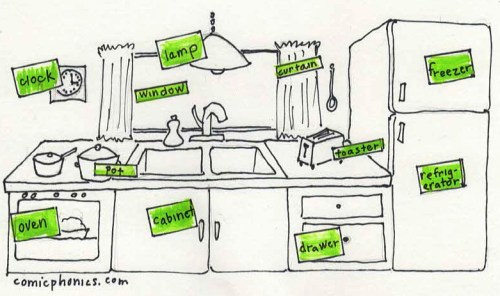
  • Label everything in your home with masking tape or Post-it notes.  This is a great way for young children to learn vocabulary, including long words such as refrigerator and calculator.
  • Find a book that is “just right” for your child.  Have the child read the front cover, the back cover, and the first page of a book.  If the child can read all the words, the book might be okay or it might be too easy.  If the child can’t read five of the words, the book is probably too hard.
  • Teach the child how to read a street map of your neighborhood.  Reading diagrams, maps and graphs is an important skill in Common Core curriculum.  Have the child translate the diagram into word directions.  “Go down the front steps.  Turn left.  Walk to the end of the street.  Turn left onto Delaware Avenue and keep walking until you get to Lincoln Park.  Be careful crossing the street.”
  • Read greeting cards together.  Go to the grocery store or drug store’s birthday card section.  Read the cards together and vote which one is best.
  • Take pictures during an outing or vacation.  Later, ask the child to create captions for each photo and gather them into a photo album.  Or make a booklet of photos and words.
  • Read the Sunday comics with your child.  Cut out good ones to hang on the refrigerator.  Reread them.  [Inference can be learned from this activity, looking at facial expressions where words are not used.]
  • Help your child write a letter to his favorite author.  Most authors have a website which will accept emails.  Or you can find a mailing address on the publisher’s website.

How to encourage multiple perspectives on a reading topic

When students take Advanced Placement (AP) courses, they must read and analyze several documents on a given topic.  Those documents come from various sources, such as diaries, government publications, laws, news reports, emails and speeches.  The documents approach the topic from various perspectives, such as a private citizens, columnists, people with a grudge, historians and mental health experts.

EPSON MFP image

From all these documents students are asked to understand a complicated issue and to make sense of it.

Can we work with young readers, even beginning readers, to encourage a similar wider, multifaceted understanding of a topic?  Can we help children to identify important ideas and then help them to compare and contrast those ideas through various reading sources?  Can we help our earliest readers to become critical thinkers?

Yes.  One way is by choosing several books or other reading sources which approach a topic from different perspectives or genres.  First, decide on a question you would like the student to explore, such as, What was it like to take the Oregon Trail? or Why do polar bears need ice?  To have the greatest impact, the topic should be one the student is studying or a seasonal or timely topic.  Together the sources should give a wider and more profound understanding than any one source alone can give.

Here are some examples for primary grade students.

graceforpres

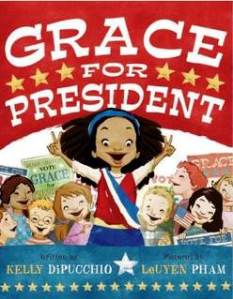
The question might be, Can a girl be President?  Show the student a copy of The Constitution and explain what it is.  Then have reproduced the appropriate lines from Article II defining the President’s qualifications.  Discuss what they mean.  Then have the student read Grace for President by Kelly S. DiPucchio, about a little girl who decides to run for president at her school.  Discuss how hard it is to become President.  Finally, your child could read a biography of Hillary Clinton, such as Hillary Rodham Clinton:  Some Girls Are Born to Lead by Michelle Markel or Who is Hillary Clinton? by Heather Alexander.  Discuss whether Mrs. Clinton has the qualifications needed, and what other strengths might be needed to be a President.

If the question is What’s an idiom? your student could start with In a Pickle: And Other Funny Idioms by Marvin Terban. This book explains what an idiom is and then illustrates well-known idioms with funny drawings.  Next, your child could read Raining Cats and Dogs: A Collection of Irresistible Idioms and Illustrations to Tickle the Funny Bones of Young People by Will Moses.  This book illustrates common idioms, but goes one step further:  it explains how the idioms came to be.  My Teacher is an Idiom by Jamie Gilson shows what happens in a fictional second grade when a new student from France misunderstands English idioms, and when the English-speaking kids misunderstand French idioms.  The reader learns that all cultures have idioms, but sometimes they do not translate into another language.

If the question is What is the water cycle? you could explore Water is Water:  A Book about the Water Cycle by Miranda Paul.  With poetry and evocative art, readers follow two children as they pass through the water cycle as water goes from rain outside to steam in the tea pot to evaporation into clouds.  In The Drop in my Drink: The Story of Water on Our Planet by Meredith Hooper, readers travel back to a young planet Earth to find out where water came from and to learn about erosion and how all living things depend on water.  National Geographic Readers: Water by Melissa Stewart shows more about the water cycle through beautiful photography and easy reading words.

When I work with my son on reading, should he read silently or should I interrupt and ask questions?

If you are working with your son, you should be involved.  What does an involved reading teacher do?

  • Before he reads a selection, you could read it, understand it, and preview it with your son. That does not mean giving away the ending if it is a story.  But it might mean explaining the setting or motivation of the main character.  In nonfiction, it might mean showing him a map or other graphic to make the reading easier to comprehend.

Tutor teaching a child.

  • Before reading, you and your son together could look at any graphics accompanying the article. You could ask him to interpret the graphics to be sure he understands the data.  You could ask him to read headlines and subheadings, and then ask him to predict what he is about to read.
  • If he has trouble pronouncing words or if he slurs big words, ask him to read a short section at a time aloud. Go back to the words he missed and discuss them, asking him to pronounce them, writing the words in syllables on notebook paper so he can see the structure of the word, explaining prefixes, suffixes or word roots.  If there are vocabulary words you suspect he might not know, ask him the meanings, and if he can’t explain them correctly, discuss their meanings.  Then ask him to read that part of the selection again.
  • Now ask him what it means. Don’t accept, “It’s about a farm,” but ask for more specific meaning.  “It’s about a small baby pig that a farmer is going to kill.”  Ask him if his prediction was right or should he change it.
  • Fluency can only be judged by a teacher if the child reads aloud.  Listen for pacing, inflection, changing of voice tone, loudness or softness.  If you know your child is a fluent reader, you needn’t have him read aloud often for fluency.  But if he is not a fluent reader, you might want to read a sentence at a time using fluency and have your child mimic you.
  • If you read along silently, and your child finishes a selection long before you do, probably he is racing. Ask him about the meaning.  If his answer is vague, ask him to read again but slower.
  • If your child is a competent reader, your job might consist of asking for feedback—orally or written. If your child is reading fiction, you might ask about setting, characters, theme, ups and downs in the story and the climax.  If he is reading nonfiction, ask for the thesis and organization of the article.  Ask a question which the article answers and let the student find and read the part which answers your question.
  • If you can’t be engaged with your child during the reading, you could leave questions to answer so you know the child has paid attention.

Good teachers interrupt when they hear mistakes or hesitancy.  They ask questions if they suspect the student is not understanding.

But if your son is reading strictly for his own pleasure, back off.  Maybe when the day’s reading is done, ask him what his reading selection was about or what he liked, but don’t pressure him.  If he is asking you questions like, “Hey, Mom, what does contentious mean?” or “Why do hunters want elephant tusks anyway?” he is doing what you want—consulting an expert when he doesn’t understand.