Category Archives: nonfiction reading

Is the Common Core’s emphasis on nonfiction reading justified?

Perhaps the biggest change the Common Core is bringing to public school reading in the US is its emphasis on reading more nonfiction and less fiction. The reasoning behind this change is to prepare students better for the reading they need to do in their math, science and social studies classes and in their future careers, especially in STEM fields (science, technology, engineering and math).

Is the change really necessary? Let’s compare fiction reading and nonfiction reading for students who are beyond the picture book stage.
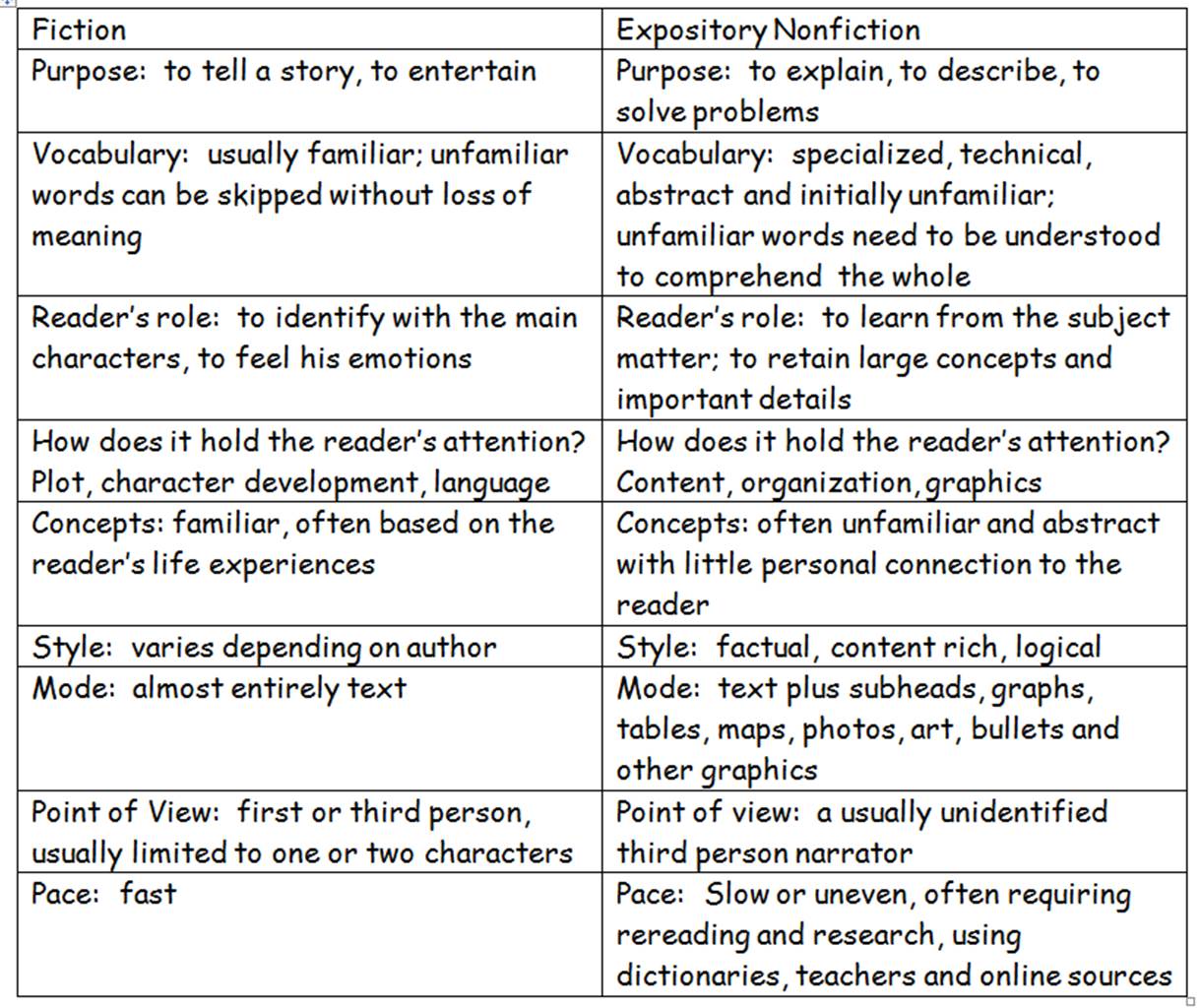
chart comparing fiction reading skills with nonfiction reading skills

(Adapted from State of Wisconsin, Wisconsin Governor’s Literacy Education and Reading Network Source)

As you can see, reading nonfiction is harder than reading fiction. It often requires more parent or teacher involvement prior to the reading to make connections to what the student already knows; during the reading to explain vocabulary and concepts; and after the reading to restate the main ideas and important details or to explain complicated concepts.

Fiction, too, can be better understood with teacher involvement, but usually fiction can be appreciated (if to a lesser degree) by the student reading alone so long as the student’s reading level matches the reading selection.

If you hope your child will have a great career someday as a doctor or environmentalist or physics teacher, you can appreciate why an increased emphasis on nonfiction reading is important even in first grade. You may question the Common Core, but its emphasis on more nonfiction reading can only help our kids.
Online site offers current events reading for young readers

If you have a young reader who is reading at a third grade level, a new online site offering nonfiction news articles might attract him.

Child Browsing the WebAt www.newsela.com news stories at five different reading levels are offered. The lowest reading level is targeted for an average third grader, and the highest (the original news story) is written at a college level.  In between are three rewrites at intermediate reading levels.  Two news articles are posted daily, along with a quiz for each article.  Both the news stories and the quizzes are aligned with the Common Core standards for nonfiction literacy.

The news stories are divided into seven topics:  war and peace, science, kids, money, law, health and arts.  Articles from Feb. 6 and 7 include “CVS to stop selling cigarettes,” “Marine biologists baffled by beached whales in Florida,” and “Fourth-graders have become better readers.”

Articles are geared to younger readers by the subject matter, choice of vocabulary and the average sentence length.  I calculated the CVS article written for third graders to have about 8 words per sentence.  Paragraphs in that article ranged from one sentence to five sentences.

To the right of each article, which comes with a colored photo or graphic, are five tabs to allow the reader to choose his own reading level.  If a child finds one level too hard or too easy, he can choose another.

Jennifer Coogan, chief content officer for the website, selects the stories to feature from the AP News Service and the McClatchy-Tribune News Service.  Stories might be international, such as a story about Parliament telling Buckingham Palace to cut back on expenses and to repair its palaces.   Or they might have regional interest, such as the effects of an inch or two of snow on Atlanta.

The people who rewrite the original stories use guidelines for readability, including sentence structure, context clues, and time shifting in narratives.  Because younger readers don’t have “reading stamina,” said Coogan, the articles’ word counts are aligned to state-wide assessments.

The quizzes use multiple choice questions, but they also might ask a student to tell in which paragraph an idea is found.  In the works are questions that require short answers from student readers.  Also coming is a Spanish version of this service.

Although the primary target audience of the website is teachers, parents can sign up for their children.  The annual cost is $18 per student for an individual student; $2,000 per grade in a single school; and $6,000 for a whole school.  So far 90,000 teachers and a half million students are using the site.

In an earlier blog, I wrote how boys often prefer nonfiction reading.  Websites like this one might be a good alternative for them.  The timeliness of the articles, the daily introduction of new articles, the subjects themselves—plus reading and answering questions online—might attract boys who are not keen on reading fiction.  –Mrs. K