Category Archives: methods of teaching reading

4 ways to improve reading comprehension

For years I have focused on the importance of a phonics-based reading curriculum for beginning readers.  Research shows that young students exposed to sequential phonics instruction have better reading outcomes than students who learn primarily through other approaches.

But once students have learned the basic rules of phonics, and they are reading to learn new information, research shows other activities can help students comprehend better.  Here are some.

Photos, drawings, sounds, videos and picture books can help students understand new-to-them concepts before they read about them.  Providing students with rich background information can make acquiring new information easier.  Students can fit new ideas into old ideas, or show how the new idea is the same or different from the old idea.

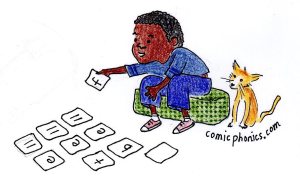
Venn diagrams are another way to do this.  For example, to learn the relationship of math operations, students could see a Venn diagram like this:


The idea is to connect new information to information students already know.  Stick figures showing two families’ with arrows from one person to another could show what nieces and nephews are.

Tables connecting what students know to what they don’t know can help.  Here is how.  Create a row of three sections.  On the left, write a vocabulary word or concept students know.  Leave the middle blank.  On the right, write the new concept to be learned.  Help students fill in the center by connecting the idea on the left to the new word on the right.

my birthday important day in my life, hard to forget day, day I think about milestone
What I’m doing at different times all day long 8  Pledge of Allegiance

8:15 reading class

9:15 snack

9:30 math class

schedule

We adults connect new concepts to what we know all the time.  And, like students, if what we know is scant, we have a hard time learning the new concept.  For example, I was reading a novel about a World War I soldier who was demobbed.  What in the world is demobbed? I wondered. Attacked by a mob?  Thrown out from a mob?  I looked the word up, and found that demobbed means discharged from military service.

Okay, so how do I remember it?  I know what a mob is, but in this case mob is short for mobilized, so that doesn’t help.  I know what a mobile phone is though, so I pictured a soldier texting someone on his mobile phone to tell that he is discharged.  Maybe he is throwing his hat in the air too.  So connecting pictures to words and events is another method of comprehending.

Learning to read doesn’t stop with applying the rules of phonics.  That is a vital start.  Another vital aspect of reading is comprehension, a lifelong process.


The idea is to connect new information to information students already know.  Stick figures showing two familie with arrows from one person to another could show what nieces and nephews are.

Tables connecting what students know to what they don’t know can help.  Create a row of three sections.  On the left, write a vocabulary word or concept students know.  Leave the middle blank.  On the right, write the new concept to be learned.  Help students fill in the center by connecting the idea on the left to the new word on the right.

my birthday important day in my life, hard to forget day, day I think about milestone
What I’m doing at different times all day long 8  Pledge of Allegiance

8:15 reading class

9:15 snack

9:30 math class

schedule


We adults connect new concepts to what we know all the time.  And if what we know is scant, we have a hard time learning the new concept.  For example, I was reading a novel about a World War I soldier who was demobbed.  What in the world is demobbed? I wondered. Attacked by a mob?  Thrown out from a mob?  I looked the word up, and demobbed means discharged from military service.  Okay, so how do I remember it?  I know what a mob is, but in this case mob is short for mobilized, so that doesn’t help.  I know what a mobile phone is though, so I pictured a soldier texting on his mobile phone that he is discharged.  Maybe he is throwing his hat in the air too.

Learning to read doesn’t stop with applying the rules of phonics.  That is a vital start.  Another vital aspect of reading is comprehension, a lifelong process.

New kindergarteners, new readers

It’s September, which means a new school year, which means a new set of kindergarteners learning to read.

Where to start?  I have hundreds of blogs on this website showing how to teach reading.  But in general,

Start with prereading skills.  These include knowing how to hold a book, which cover is the front, reading from left to right and from up to down, and knowing that text means words.

Teach that letters are symbols of sounds, with each letter representing a different sound. Of course, some letters represent more than one sound, and some letter pairs represent a single sound, but that news can wait.

Help the child memorize several consonant/sound pairings and one vowel/sound pairing (usually the letter A). The child does not need to know every letter sound to start reading.  Learn a few, and while you make words, learn a few more.  And knowing ABC order is not important at all at this point.

Make sure the child realizes that joining letters together forms words.  Create two- and three-letter words with the letters the child knows.  I recommend using letter tiles, saying aloud the letter sounds and moving them closer together until they create words.

Help the child learn one-syllable, short-vowel words which follow the rules.  “Golf,” yes.  “Half,” no.

Help the child learn often used “sight” words necessary to form sentences.  Lists are online.

Cover adding S for the plural; double F, L, S, and Z to make a single sound at the end of some words; CK to make the sound K; blends at the beginning of words; and blends at the ends of words.  By now it’s winter break or maybe spring break depending on how often your child works on reading and how ready your child is.

Supplement what your child is learning with small early-reading booklets. You will find many publishers.

Review what the child has learned at each lesson. One way is to buy reading workbooks.  The quality varies greatly.  I recommend Explode the Code because it follows the pattern I have outlined above and because children like the silly drawings.  (I have no connection to the publisher of that series.)

Keep reading to your child to instill a strong interest in reading.

Teach long-vowel, single-syllable words containing silent E and double vowels.  Expect backsliding here from many children.

By now your child is more than ready for first grade.  Check with your state education department’s standards for kindergarten to be sure you have covered everything.  If you haven’t, or even if you have, keep at it over school breaks, including summer break.

And check back issues of my blog.  If I haven’t covered a topic you are looking for, let me know and I will.

Ten questions to gain deeper understanding of a book

I write quizzes about books  to help my students understand books better.  Coming up with thought-provoking questions is a struggle.  Too often I want to ask for a single fact, such as “Who is Peter’s little brother.” To help me devise more meaningful questions, I keep a list of question types. Here are questions you might use with your students.

What is the best summary of the book/chapter?  I provide four options, keeping in mind that some students have trouble distinguishing between main ideas and details.

What is the best paraphrasing of a sentence or paragraph?  I provide options which range from mostly restating information to truly putting the information into other words.

Why does the author ____?  Repeat a word?  Describe the weather so much?  Not talk about negative feelings?  Use a simile?  These kinds of questions ask the student to consider the author’s style and the choices the author makes in writing a particular way.

How is this book/chapter structured?  In chronological order?  From most important to least important information?  Stating a cause and its effects?  Stating effects leading to a cause? From scary to scarier to scariest?  Stating a conversation that becomes funnier and funnier?  Many students read without realizing someone wrote what they read, and that someone made choices.

Does the writer like or approve of ____?  We know right from the beginning that J.K. Rowling does not approve of Malfoy in the Harry Potter series.  But how do we know that?  What words tell us that?  What actions?  What facial expressions?

In what order do actions occur? List two or three actions, and ask what the next action is.  Sequencing questions might force students to reread sections or to read more carefully the first time.

What is the tone of a chapter or conversation?  What is the mood?  I usually define tone and mood in the question to help the student.

What might a certain action foreshadow? A child falls while jumping rope.  What might that fall foreshadow?  Probably another, more serious fall.

What is an important fact in a chapter?  Many children cannot distinguish between trivial facts and important facts.  All facts seem important.  Questions like this force students to rank facts.

What can you infer from the frown on a character’s face?  Or from a character’s silence?  Or from a character’s cowering?

From the picture book stage to the chapter book stage, these questions can be used to help a student grasp a deeper understanding of a book and the choices its author made to create it.

Asking “What’s the main idea?” is not enough

To improve a student’s reading comprehension, asking “What’s the main idea” of a reading passage is not enough.  It’s just the starting point.

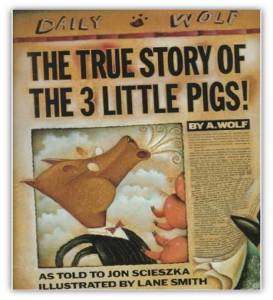
Better is to provide richer texts, and to discuss them before, during, and after a student reads, according to research named in the 2-18-24 issue of EdutopiaJon Scieszka’s The True Story of the 3 Little Pigs

It’s better to ask about an author’s writing style.  Why does the big bad wolf say three times, “I’ll huff and I’ll puff and I’ll blow your house down” to the three little pigs?  Why use “huff” and “puff” which rhyme?  Why not say, “I’ll breathe in and I’ll breathe out and I’ll knock your house down”?  Why does the author of Gone with the Wind have Scarlett O’Hara meet Rhett Butler on the day the Civil War begins?  Why does the author have Melanie Wilkes give birth in Atlanta right as Atlanta is being attacked?

It’s better is to ask a student to summarize or paraphrase a text than name the main idea only.  Many students have trouble distinguishing between important facts or ideas and less important details.  Help them figure out what are the important ideas so they can produce a reasonable summary.  Many students rely on the actual words of a text to explain it and cannot put the ideas into their own words.  Paraphrasing forces them to do that.

It’s better is to ask a student to describe the text’s structure.  Is a cause explained at the beginning of a text, and are its effects described in the second part of the text?  Are the most important facts stated first, as in a news story, and less important facts stated later in descending order?  Is a long-time theory stated first, and then is research presented to debunk the theory—or to support it?

It’s better is to ask a student to describe the tone and the mood of a text.  Tone means the attitude of a writer toward a subject or an audience conveyed through word choice and the style of the writing.  Does the writer show approval of a character or an idea?  Does a writer dismiss an idea as frivolous or bigoted?  Mood is the feeling or atmosphere of a text perceived by the reader.  It is often created by the author’s use of imagery and word choice.  When Laura Ingalls Wilder describes fall in Silver Lake as “From east to west, from north to south, and as far up into the blue sky as eyes could see, were birds and birds and birds sailing on beating wings,” is the mood one of fear?  suffocation?  wonder?  How do you know?

It’s better is to ask a student to find, identify and explain figurative language.  When Romeo says, “Juliet is the sun,” what figure of speech is Shakespeare using?  Why does this line occur in a passage that focuses on light?  Is “Juliet is the sun” stronger or weaker than “Juliet is like the sun”?  In Lord of the Flies, what figure of speech does the author use when he says of palm trees, “These stood or leaned or reclined against the light”? Why not say some trees’ trunks were straight up, some leaned over, and some tipped so much that they were almost parallel to the ground?  And why “against the light”?

It’s better to ask why the author of a novel reveals some information in the opening chapters and holds other information until later.  In Cinderella, why does Cinderella face problem after problem before the happy ending?  Why does Junie B. Jones believe her baby brother is a monkey until the end of the book?

Require more of students and you will increase the depth of their  reading comprehension.

Largest US school system to change how reading is taught

With half its students unable to pass reading tests, the City of New York has decided to change the way it teaches reading.

CVCC twin consonants

Starting this fall in some schools and in the fall of 2024 in others, “the science of reading” will ground all reading instruction.  This means that students will focus on learning sounds associated with letters (phonemes) and on joining those letter sounds (phonics) to form words.

Chancellor David C. Banks will announce the change today (May 9, 2023).  He hopes the new approach will change the current outcome in reading instruction in which half the city’s third through eighth graders are not proficient in reading.

The city’s schools are divided into 32 local districts.  Each district can choose one of three acceptable reading programs, all of which focus–to varying degrees–on phonics.  Research has shown that a phonics-based approach to learning to read produces the best results for primary grade students.

The city’s principals’ union is opposed to a one-size fits all approach in the city’s 700 elementary schools.  Teachers say they need training.

Local school districts within the city will have some choice in how to proceed.  They must choose one of three reading programs: Into Reading, Expeditionary Learning, and Wit & Wisdom.  They can and in some cases must supplement these programs with more systematic phonics instruction.

One advantage of the unified approach is to provide students who transfer from one New York school to another a single reading curriculum.  Another is to follow the mandate of New York’s Mayor Eric Adams, who has dyslexia, to teach reading using a phonics-based approach.  Still another is to provide teachers with materials that have been shown to work, so each teacher doesn’t need to seek materials independently.

The change will start this fall in city school districts showing the least proficiency in reading.

New York is the latest and biggest school district to show dissatisfaction with the way reading has been taught and to turn to a research-supported approach.  Poor student performance on reading tests, parents’ demanding change after Covid 19 educational losses, and a growing cohort of students who cannot read are propelling changes in reading instruction throughout the US.

Reading instruction is finally catching up to research

Increasing numbers of state legislatures are mandating that a phonics-based approach be used to teach young children how to read.  Not all states are on board yet, despite a massive study more than 20 years ago that culled research and concluded that teaching children phonemes (the sounds associated with letters) and phonics (assembling letters into words) is the most successful way to teach reading.

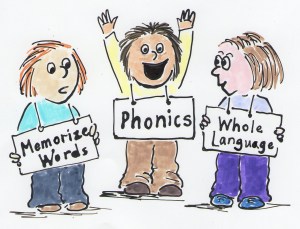
Three children with signs around their necks that read: Meniruze words, Phonics, Whole Language

Beginning in 2014 in Mississippi, states have forced teacher training programs, school districts and public school teachers to switch to a phonics-based approach to teaching reading.  Here are states* which have passed legislation mandating a phonics-based approach or strengthening laws already mandating such an approach.

  • 2013: Mississippi
  • 2014: South Carolina
  • 2015: Nevada
  • 2016: Michigan, Mississippi
  • 2017: Arkansas
  • 2018: Montana, Nebraska
  • 2019: Alabama, Colorado, New Mexico, Nevada, Oklahoma, Rhode Island, West Virginia
  • 2020: DC
  • 2021: Arkansas, California, Connecticut, Delaware, Florida, Louisiana, Minnesota, North Carolina, North Dakota, Oklahoma, Pennsylvania, Tennessee, Texas
  • 2022: Arkansas, Arizona, Kentucky, Utah, Virginia

As you can see, the number of states passing laws to require phonics-based reading instruction has steadily increased with the greatest increase in 2021.  Educators surmise that because students were home for months in 2020 because of the Covid 19 virus, parents became more aware of how their children were being taught to read.  As a result, they demanded change.

While not all states have updated their education laws concerning the teaching of reading, the trajectory is in that direction.  Expect improved reading scores on national tests as students being taught using this approach infiltrate into higher grades.  Mississippi has already noted this positive change.

*according to Education Week

Two games make phonics fun for beginning readers

With young students, games are the easiest way to maintain interest and learn at the same time.  I’d like to suggest two games to teach beginning reading (CVC words).  Neither game is new, but both attract youngsters, from my experience.

One game is BLAH BLAH BLAH Word Game, Level 1000.  This game consists of three sets of playing cards, color coded according to level.  Each card consists of one word printed in the middle, and individual letters of that word printed in the corners.  A player needs to match one letter on a card in his hand to one letter on the face-up word in the middle of the table (hat and tug, for example).

This game has three levels:  CVC words; CVC words with blends; and words with long vowels (oa, ai, ee, oo, etc.).  It does not include words ending with silent e at the 1000 level.  When a player matches a letter, he must place his card over the face-up word already played and read the word aloud.  The next player must match one of the letters on the just matched card.  However, other cards (skip a turn, take four cards, change order) allow a player without a match to play.  The first player to play all his cards wins.

I have played this game with an about-to-start kindergartener, who sounds out each word as he plays.  He uses the “joker” cards strategically to stop a player from winning or to enact revenge on a player who interferes with his goals.  But it could be used with a child learning his letters but not yet able to read words.

The only drawback I have found is the size of the cards.  For little hands, regular-sized playing cards are too big to fan.  Too bad the deck isn’t smaller-sized.

The other game my almost kindergartener and I like is Zingo!  Each player receives a BINGO-like card with six words printed on it.  However, one of the letters of each word is missing as in “_ig” or “c_t.”  A player must take letter tiles distributed from a machine-like device and use them, one at a time, to create words by covering the blank spaces on his card.  Consonants are black and vowels are red.  The first player to cover his card wins.

This game offers two levels, one on each side of the BINGO card:  CVC words and CVC words with blends.  The machine-like device which distributes the tiles is attractive to little hands, and can easily distract a youngster from the purpose of the game.  This game is harder than the previous game since it requires the child to read several incomplete words at each turn and to try to figure out where placing a tile makes sense.  For beginner readers, this requires help.

I like to use games like this at the end of a lesson to extend the lesson time.  Little kids have short attention spans, so ending a lesson with games like these continues the learning.

Teaching ĭ CVC words and ĕ CVC words

Ĭ and ĕ are the two hardest vowel sounds to distinguish.  Here is how I suggest you work with children to differentiate these sounds.  Mix the ĭ CVC words with the previously learned ă, ŏ, and ŭ CVC words.  Then mix the ĕ CVC words with the previously learned words, not including the ĭ words.  Lastly mix only the ĭ CVC words with the ĕ CVC words.  Repeat these steps indefinitely until your child can read the majority of ĭ and ĕ CVC words correctly.  Learning the ĭ and ĕ CVC words can take longer than the other three letter sounds combined.

Sample ĕ words

bed fed led red Ted
beg egg keg leg Peg
Ben den hen men pen
bet get jet let pet
bell dell fell Nell sell
Bess less mess Tess yes

Sample ĭ words

bid did hid kid lid
big dig fig pig rig
dim him Kim rim Tim
bin din fin pin tin
dip hip lip quip zip
bit fit it pit zit

Problem: Distinguishing between nearly identical sounds and words

Short ĕ and short ĭ are difficult sounds to distinguish for most beginning readers.  When I teach these sounds, I rely on two game-like activities.

For one of the activities, I gather the pictures of  words which start with ĕ and ĭ, or which use them in the CVC pattern.  I put these Ee and Ii cards in front of the child and we practice saying those letter sounds.  Then the child sorts the deck of cards I have created, putting cards under one of the two letter sounds.  We say the word aloud to reinforce the letter sound.

For another activity, I have created BINGO-like cards of ĕ and ĭ words.  I limit each BINGO card to nine words.  More words can seem overwhelming.  I say one of the words and the child finds and covers it, using a marker.  To extend this activity, the child and I exchange places.  The child says the words and I find the correct spelling.

big beg dig
set sit bet
lit let bit

Learning to read, one sound at a time

A six-year-old kindergartener learning to read VC and CVC words worked with me yesterday for the first time.  We met the day before via zoom.  He was nervous, sitting on his grandmother’s lap for support.

I started by assessing his phonics skills.  Because he doesn’t know me and has not worked online, his responses to the phonics assessment I did might not be spot on.  After a few lessons, when he is more relaxed, I will have a better idea of his skill level.


But for now he was able to show me he knows letter names, consonant sounds and short vowel sounds.  He can sound VC words easily.  When he reads CVC words, he cannot “slide” all the sounds together to form words.  So that is where my reading instruction will begin.


Yesterday we worked using letter tiles.  I put before him the word “at,” and then I added one onset letter sound at a time, forming words like “fat” and “rat.”  He sounded out words from several word families using short a, o, and u.  After 20 minutes, his squirming became excessive, and we ended the lesson.  Today I will teach him again for another short lesson.


His grandmother showed me a “beginner” picture book the boy has, but as is often true, that book is not a good “beginner” book for students learning phonics.  In that book, advanced reading words are mixed in with sight words and CVC words.  I recommended she set it aside for a few months.


She wondered if she should use flash cards with words printed on them to help her grandson learn.  If the words are sight words which cannot be sounded out phonetically—words like “are” and “the”—then yes.  But if the words are capable of being sounded out, I said the student should learn them by sounding them out.  Otherwise he might think he should memorize the look of a word to pronounce it.


Should he guess at words?  No.  If a child learns to read following the rules of phonics, eventually he will be able to sound out almost any word, even long words like “dinosaur” and “alphabet.”  Teaching a child to guess introduces a habit which will hobble him the rest of his reading life.


This student has learned to read the way phonics experts recommend, sounding out each letter.  With time, almost all CVC words will become sight words for this student and he will no longer need to sound them out.  But to reach that stage of reading, he needs practice sounding out words.

How to teach a child to read

When my older son neared the end of first grade, his teachers told me he would need to repeat because he could not read.  What!  I couldn’t believe it. I phoned my brother, a special ed teacher, and he said, “Relax. You can bring him up to grade level if you work with him all summer.”  He recommended I buy Why Johnny Can’t Read by Rudolph Flesch, a then out-of-favor approach to teaching reading using phonics. My brother said to turn to the word list at the back of the book and start there.  I trusted my brother, bought the book, and worked with my son every day.  He hated the lessons—lists of progressively more difficult words—but in September he started second grade reading on grade level.

Thus began my interest in how to teach reading.  Time and research have proven Flesch and my brother right.  A systematic—not random—phonics-based approach yields the best results in teaching children to read.  Even so, today many teachers do not teach reading using phonics.  And as a result, many children fail to learn to read.

If your child has been left behind, or if you want to be sure that never happens, this blog is for you.  In coming weeks I will advise parents and teachers of beginning readers

1) how to teach reading skills by sounding out letter patterns, and

2) in what order to teach those letter patterns. 

If your child already knows how to read some words, you can assess his or her skills by using the word lists below to know where to begin.

These lessons start with one sound represented by one letter, a simple yet reliable decoding system.  While these lessons introduce the most common letter patterns of English, they do not introduce them all.  That is not necessary.  As children read widely, they encounter new letter patterns which they figure out from context clues, by asking questions, or by using a dictionary.

If you choose to supplement the ideas in coming lessons with lessons from reading sources like Why Johnny Can’t Read or Explode the Code (both good), their lessons might not sequence letter sounds or letter patterns in the same order as I do.  That is because reading experts do not agree upon a single sequence for teaching reading.  The sequence I will use here extends the one-sound, one-letter pattern as long as possible, reinforcing what seems logical to little children.

IMPORTANT: Beware of any reading advice which encourages your child to guess at words, a strategy that can lead to lifelong reading problems.  Instead, ask your child to sound out words based on the rules of phonics.  That leads to reading independence.

Phonics assessment

The following words are listed in the same order as the lessons I will share in coming weeks.  If your child can read some words, and you wonder where to begin teaching her phonics, ask her to read these words in order.  When she starts making mistakes, stop her and turn to my corresponding lesson.  Proceed from there.

bad, hem, fit, don, pug, am, if, lass, jazz

lock, Mick, bills, cliffs, mitts, catnip, Batman

grand, stent, frisk, stomp, stuck

chuck, shun, them, branch, brush, tenth

star, fern, birds, fork, purr, actor, doctor, victor

muffin, kitten, collect, pepper, gallon

complex, helmet, falcon, napkin, after

tantrum, muskrat, constant, fulcrum, ostrich

skate, bike, Jude, mole, dare, shore, tire, pure

need, cheer, aim, hair, bay, pie, boat, oar, Joe, low, soul

fruit, few, child, blind, fold, colt, roll, light, high

earn, worm, rook, pool

fault, claw, all, chalk, Walt

boil, so, pound, down

comet, dragon, liver, salad, denim

total, ever, student, basic, demon, vital

apron, elude, Ethan, Owen, ideal, usurp

inside, nearly, absent, unicorn, degrade, tripod

advance, offence, fence

gripped, planned, melted, batted, handed

sweeping, boiling, thinning, flopping, biking, dating

rapper, saddest, finer, bluest, funnier, silliest

easily, busily, massive, active, arrive, wives

keys, monkeys, armies, carried

action, section, musician, racial, crucial, nuptials

brittle, pickle, carbon, dormer

parcel, decent, gem, urge, badge

lose, sugar, nature, sure

graph, Phil, then, moth

bomb, thumb, gnat, gnome, high, sign

whip, whirl, echo, ghoul, knee, knob

could, calf, folk, hustle, listen, wrist

alone, bread, bear, chief, young, squaw, swan, waltz, word

decision, exposure, gigantic, polarize, occupant, quarantine