Category Archives: how to make learning fun

Should I give my beginning reader spelling tests?

Little children love to show that they are growing up.  If they have older siblings, they have probably watched them write their spelling words and have heard you pretest them on those words.  Since the whole idea of testing is new and “grown-up,” of course they want to be part of it.

Young child writing C-A-T.

Click on the picture to enlarge it.

Rudolph Flesch, the proponent of teaching a phonics-based reading system in the mid-20th century, advocated teaching spelling at the same time as reading.  His position was, if the child can read a word, he can spell it.

But how to test?  Here is one way to make spelling tests games.

  • Cut out little pictures of words to be tested—cat, hat, bat—and paste them on a sheet of paper with a number next to each picture.  Five to ten pictures per page is plenty.  Then have the child spell the word orally to you, or if the child can write her letters, have the child write the answers on a separate piece of paper.
  • Start by using all rhyming words—bat, cat, fat, hat, mat, pat, rat, sat; can, fan, man, pan, ran, tan, van; big, dig, pig, wig, for example.  Then, when you are sure the child had mastered the rhyming words, mix up words of the same vowel sound.  If the child is successful, then mix various CVC words on the test.  This method ensures success for the child and gives her confidence before she faces words with varying vowels.
  • If the child is writing the spelling words, you do not need to be nearby—a plus for the child’s independence.
  • Or you can go online to have a similar experience using a computer.
  • At www.mrskilburnkiddos.wordpress.com/reading/CVC-words , you can see photos of another type of spelling test.  A picture of a CVC word is glued on an index card.  Below the picture are three squares where the child can spell the word with letter tiles.  Several index cards are joined together with a ring to form a single test.  You would need to use this idea as a pattern to create the test yourself.

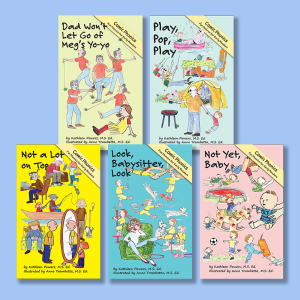
What’s behind the ‘Comic’ in ComicPhonics?

When reading is fun, readers stay engaged.  With a little silliness, even reluctant children may find reading enjoyable.  With that in mind, Mrs. A. has drawn some silly images to accompany easy reading phrases and sentences for your early readers.

Click on any one of the comics below and a full-size gallery will appear for you to page through, forward or backward. Your early reader might enjoy reading these comics online.   After viewing the gallery, it takes two steps to get back to my blog: first click a few times on the “back arrow” icon until comicphonics.com appears–or type comicphonics.com; then click on the “refresh” icon.

You can also download this gallery, save it to your computer for later viewing, or print up some 8-1/2 x 11 sheets.  Just click here on  Comic Phonics .    Enjoy.

How can I make learning to read fun for my child?

The key is to make learning a game.  The more game-like learning is, the more likely the child is to want to participate.  If the child can use her hands or whole body, learning will seem more like a game.  Try these strategies:

  • Let the child put a star child playing letter  BINGOor some other sticker on the corner of an alphabet card when the child knows a letter.  Or if the child is reading a book you own, let the child paste a star on each page she can read.  The child will enjoy pasting the star, will have visible proof of learning, and will have something concrete to prove progress for Dad or Grandma.
  • Let the child stamp alphabet cards with the date when the child knows them.  Remember how the librarian used to stamp the books with the return date?  Those kinds of stamps are still available at office supply stores.  (You can buy a deck of alphabet cards for a dollar or two at dollar stores, so don’t be concerned if the cards are defaced.)
  • Let the child hit or shake some kind of noisemaker for a successful answer.
  • If you play BINGO letter or word games, ask the child to create or accumulate the markers.  Plastic caps from milk or juice containers, Barbie doll high heels, shapes that the child has colored and cut, coins, stamps cut off of envelopes—let the child decide what markers to use today.  What fun to cover a BINGO card with Angry Birds and pigs.
  • As the child begins to read books, let the child underline the words she knows in pencil or highlight them with markers.  Read the same book a week later and let the child underline in a different color.  Do it a week later with a third color.  The child should notice more and more underlined words.  (You can buy used children’s books for a dollar or two at Goodwill and other resale stores, so don’t fret if the books are marked.)
  • Let the child write his name or other words on the refrigerator using magnetized letters.  Point out the work proudly to family members.
  • On the computer, pull up a blank page and let the child hunt and peck for ABC’s or the letters of his name.  Use a large font—size 36 or bigger.  Vary the color of the ink and the type faces.  Print the page and display it proudly.
  • For reluctant learners, use a kitchen timer to limit the time for any learning activity.  Usually, the younger the child, the shorter the time.  Five minutes might be long enough.  Let your child’s behavior guide you.