Category Archives: ABC’s

New kindergarteners, new readers

It’s September, which means a new school year, which means a new set of kindergarteners learning to read.

Where to start?  I have hundreds of blogs on this website showing how to teach reading.  But in general,

Start with prereading skills.  These include knowing how to hold a book, which cover is the front, reading from left to right and from up to down, and knowing that text means words.

Teach that letters are symbols of sounds, with each letter representing a different sound. Of course, some letters represent more than one sound, and some letter pairs represent a single sound, but that news can wait.

Help the child memorize several consonant/sound pairings and one vowel/sound pairing (usually the letter A). The child does not need to know every letter sound to start reading.  Learn a few, and while you make words, learn a few more.  And knowing ABC order is not important at all at this point.

Make sure the child realizes that joining letters together forms words.  Create two- and three-letter words with the letters the child knows.  I recommend using letter tiles, saying aloud the letter sounds and moving them closer together until they create words.

Help the child learn one-syllable, short-vowel words which follow the rules.  “Golf,” yes.  “Half,” no.

Help the child learn often used “sight” words necessary to form sentences.  Lists are online.

Cover adding S for the plural; double F, L, S, and Z to make a single sound at the end of some words; CK to make the sound K; blends at the beginning of words; and blends at the ends of words.  By now it’s winter break or maybe spring break depending on how often your child works on reading and how ready your child is.

Supplement what your child is learning with small early-reading booklets. You will find many publishers.

Review what the child has learned at each lesson. One way is to buy reading workbooks.  The quality varies greatly.  I recommend Explode the Code because it follows the pattern I have outlined above and because children like the silly drawings.  (I have no connection to the publisher of that series.)

Keep reading to your child to instill a strong interest in reading.

Teach long-vowel, single-syllable words containing silent E and double vowels.  Expect backsliding here from many children.

By now your child is more than ready for first grade.  Check with your state education department’s standards for kindergarten to be sure you have covered everything.  If you haven’t, or even if you have, keep at it over school breaks, including summer break.

And check back issues of my blog.  If I haven’t covered a topic you are looking for, let me know and I will.
Learning to read is not a race

This fall I am teaching two kindergarteners to read via Zoom.  I am making progress with both students, but it is an uneven progress typical of young children.

One student—I will call her Jane—is lighthearted and imaginative.  For Halloween, she came to class wearing a wolf’s face.  Jane is social, engaging me in conversation as easily as she talks to her sibling.  She can identify almost all letters and letter sounds.  When I show her an alphabet letter, she will say, “Maybe B, for banana and ball.”

Jane is working on reading two-letter “A” words like “at” and “ax.”  Three-letter words are a bit advanced except for a few she has memorized.  Her mother tells me that outside class she loves to mix up letters and to make silly sounds.

John is serious and reserved with me.  He does not engage in chit-chat during our lesson.  Two months ago, he could identify fewer letters and their sounds than Jane could, but now he has mastered them all.  He pronounced two-letter “A” words with such consistency that we have moved on to three-letter “A” words.  At our lesson this week John read several phrases and a few sentences containing short “A” words (A fat cat sat.  A man ran in a can.).  I was thrilled.  He smiled and said nothing.  At our next lesson we will begin to work on short “O” words.

Mrs. K is a writing, reading and grammar tutor.

Both Jane and John are normal kindergarteners, displaying behaviors typical of children learning to read.  One is not better.  One is not worse.  They are each moving along at their own pace.

Learning to read is not like learning algebra.  With algebra, every student starts at the same place on page one of the text and is expected to keep up with the pace the teacher sets for covering the curriculum within a school year.

With reading, students start at different places depending on personality, preschool or parental exposure to letters and sounds, hearing and vision acuity, being read to, and speaking English as a native language or as a second language.  Age of the student is another factor.

By the end of kindergarten, both John and Jane should have a solid foundation in phonics.  They will continue instruction in how to read in first and second grades.  At that point their reading skills will probably not be any more identical than they are now. But they will read sufficiently well to use their reading skills to learn more.  That’s why we learn to read, after all—so we can keep learning.


14 disconnects between letter names and letter sounds

Two kindergarteners I am teaching this fall are having the same problem when trying to figure out the sound a letter is associated with.  They are listening to the beginning sound of the letter name, and they are assuming that must be the sound linked to the letter.

In some cases they are right.  The name of the letter B begins with a “b” sound, just like the sound B stands for.  The name of the letter K begins with a “k” sound, just like the sound K stands for.

But for many letters, this correlation does not hold true.  The name of the letter C, for example, begins with an S sound.  The name of the letter F begins with an E sound.  The name of the letter G begins with a J sound.  The name of the letter W begins with a D sound.

Take a look at the table below and notice how many letter names do not begin with the sound that the letter represents.  By my count, it’s more than half.

Letter    Sound the letter name begins with

a             a

b             b

c             s

d             d

e             e

f              e

g             j

h            a

i              i

j              j

k            k

l              e

m            e

n             e

o              o

p              p

q              k

r               ah

s               e

t               t

u             y

v             v

w            d

x             e

y             w

z             z

So, if you have a little one struggling to pair a letter name with the sound the letter stands for, relax.  It’s normal.  Be patient.  Gently correct the mistake as many times as it takes.  Your child will get it eventually.  We all do.

Teaching kinesthetic learners how to read

Have you ever taught a student who acts like this? 

  • Changing positions frequently—sitting on a folded leg, kneeling on a chair, or wriggling her shoulders?
  • Responding to a question with gestures—thumbs up, a face showing precise emotions, drawing a picture in the air?
  • Reading out loud when he should be reading silently?
  • Miming a situation or a reaction?

These students might be kinesthetic learners, people who need to engage their whole bodies to learn optimally.  Some are hyperactive,  tempermentally unable to sit still.  Some are dyslexic, unable to read or to learn to read the usual way.  Some are autistic, non verbal or preferring repetitive motions or intensely focused on one activity.  Some are artistic, preferring to draw in almost every situation.  Some are actors, dramatizing their responses.  child making letter T with his body

The younger the child, the more apt he is to be a kinesthetic learner.  Males tend to be kinesthetic learners longer than females.  Children with highly focused hobbies or interests—assembling Legos for hours at a time, enjoying sports practice several times a week, wanting everything Spiderman, drawing and coloring every day—are probably kinesthetic learners.

The problem for kinesthetic learners is that most classrooms are made for the auditory learner, the person who sits still and listens to the teacher, the person who reads silently to learn, not for the person who roams, fidgets, mumbles, acts out, or plays games to learn.

Child sitting with legs outstretched, forming the letter L

So what hands-on activities will help your beginning reader to learn the alphabet and easy words?

  • Ask the child to act out the letter shapes, that is, form the letters with her body.
  • Allow nonverbal responses—pointing, gesturing, showing facial emotion, performing.
  • Use games—letter tiles, for example—that offer the child the opportunity to pick up, arrange, and invent. Or hold letter “bees” in  which the children form teams and the you hold up letters or words for a team member to identify.
  • Teach using puppet shows—two characters debating what a given letter is, or how to hold a book, or if “fun” rhymes with “fan.”
  • Let groups of students create an ABC book . The artist in the group might draw and color pictures while other students might cut out pictures from magazines and paste them.
  • After you have read a story to students, ask some to act out the story to test comprehension. Let other students join in.
  • Create an alphabet from Play Doh or Legos or pipe cleaners.
  • Create word family books with drawings or cut-and-pasted pictures.
  • Take a scavenger walk in the neighborhood to see shapes of letters in tree branches, sidewalk cracks, clouds or roof lines.

dhild running with book in hands

You might think, these activities take time and slow down the learning process.  Yes, they do take time, and yes, they do slow down the initial learning process.  But since this kind of learning sticks, you need to do less reteaching and may gain time in the long run.  Just as importantly, students who are reprimanded for not sitting still or for being unable to leave a task they like are praised for their learning.  These students become leaders, helping other children who are not as kinesthetically gifted.

Children learn sounds from big to small

children pronouncing elephantLittle children who are learning about sounds in words move from larger units of sound—phrases and words—to smaller units of sound—sounds within words and syllables.  Adults hear “On your mark, get set, go,” but a two-year-old hears “Onyourmark, getset, go.”  Children need to hear distinct sounds within words and to reproduce those sounds properly before they start pairing sounds with letters.

For this reason, most two-year-olds are too young to learn to read.  Even some five-year-olds might not be able to distinguish sounds within words.  In some countries, children don’t learn to read until they are seven. 

A good example of this is when children learn the ABC song.  Most three-year-olds can start the song with A-B-C-D. . .E-F-G-. . .H-I-J-K .  But when they get to L-M-N-O-P they sing L-um-men-oh-P or M-uh-let-O-P.  They don’t hear L-M-N-O as distinct sounds.

I still remember the day when I was in first grade when  my teacher taught my class the words of and the.  I thought, wow, those are two different words.  I didn’t know that.  I thought ofthe was a single sound.

Most two-year-olds are too young to learn to read.  Even some five-year-olds might not be able to distinguish sounds within words.  For this reason, in some countries, children don’t learn to read until they are seven. 

What can you do to help your child hear sounds more clearly?  Speak distinctly.  Slow down.  Face your child and let her watch your mouth when you talk.  When you hear her slurring sounds together which should be pronounced separately, don’t correct her but instead repeat the sounds properly.

While we’re on the subject of hearing words correctly, children will subconsciously learn the rules of grammar without instruction.  A four-year-old might say, “Mommy goed to the store,” properly making the verb past tense by adding the d sound to the end of the word without realizing go does not follow the rules.  Or he might say, “I amn’t done yet.”  He is learning contractions, not realizing that am can’t be contracted in the negative form.  Or a child might say, “Her said so.”  Objective pronouns are learned before subject pronouns.

To correct these mistakes, repeat what the child says correctly without comment on the error.  When the child hears words said properly enough times, he or she will say words that way too.


DISTAR and the Initial Teaching Alphabet–a system of teaching reading that didn’t catch on

Ever hear of DISTAR?  The Direct Instructional System for Teaching and Remediation—DISTAR for short—is a phonics-based reading program developed in the 1960s.

Its advantages are

  • Learning goes fast at first.
  • One letter corresponds to only one sound.
  • It uses a one-to-one logic system little children intuitively understand.

With these advantages, why is DISTAR not widely used?

  • DISTAR uses a unique alphabet called the Initial Teaching Alphabet, not the standard English alphabet.
  • Teachers need to know and consistently use this alphabet for the system to work.
  • Most parents have no experience with this alphabet, so they cannot help their children without instruction.
  • Eventually, students must be weaned from this alphabet to the standard English alphabet, causing confusion.
  • Few books are written using this alphabet.
  • Children who try to use this alphabet to handwrite can wind up with impossible-to-read handwriting.

Initial Teaching Alphabet is shown below.


As you can see, some letters are the same as standard English letters, including 19 consonants and the five vowels used as closed or short vowels.  Open or long vowels are written as two vowels joined.  Digraphs, less used vowel sounds and certain consonant sounds are written as either double letters or single letters.  But those letter shapes do not correspond to standard English letter shapes.

The Initial Teaching Alphabet was developed in the 1960s by Sir James Pitman.  He hoped the alphabet could help children learn to read easier than using a traditional alphabet.

This alphabet uses a distinct typeface developed specifically for it.  All letters are considered lower case.  When capitals are needed, a larger version of the lowercase letter is used.

Because children needed to learn two alphabet systems in the primary grades if they learned using the Initial Teaching Alphabet and DISTAR , these systems were not widely used.  During the 1960s, the teaching of reading was switching from a phonetic approach to a whole language approach, another reason for DISTAR’s and the Initial Teaching Alphabet’s lack of support.

Today research shows that a phonetic approach is the best way to teach young children to read.


Six questions to test your beginning reader knowledge

What is the best method for learning to read, based on research?

  • primarily using phonics
  • figuring out words from their context or from pictures
  • memorizing words (sight words, whole language)

Two fists with thumbs up and knuckles touching make letter "b" and "d" with a BeD visualized between the two thumbs.What two printed letters are the hardest for children to distinguish?
  • p and q
  • q and g
  • b and d
  • m and n

Which two short vowel sounds are hardest for children to distinguish?

  • a and e
  • e and i
  • o and u
  • a and o

In order to learn to read, do children need to recite and/or recognize the ABC’s in alphabetical order?

  • yes
  • no

Which comes first?

  • recognizing a letter
  • recognizing a sound?

How many letter sounds does a child need to hear and speak in order to speak standard American English?

  • 26
  • 23
  • 42

Answers

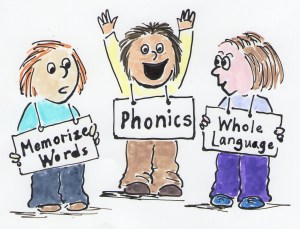
Three children with signs around their necks that read: Meniruze words, Phonics, Whole LanguagePrimarily using phonics is the best method for learning to read. The US government did a comprehensive study of hundreds of research studies on how children learn to read and discovered that using a phonics-based approach produces the best results.
Lower case “b” and “d” are the hardest letter shapes for children to distinguish. Most children are confused at first.  Sometimes this confusion lasts into third grade, but with time, all children figure it out.

Short “e” and “i” are the hardest letter sounds to distinguish. Most reading series start by teaching short “a” followed by short “o” because these two sounds are the easiest to distinguish.  Expect lots of errors when “e” and “i” words are learned, and expect learning them will take more time.  Short “u” is harder than “a” and “o,” but since there are far fewer such words, learning “u” is not so hard as learning “e” and “i.

Beginning readers do not need to know their ABC’s in order. Alphabetic order is a second or third grade skill, so it doesn’t need to be learned immediately.

Recognizing a sound is more important than recognizing a letter at first. Beginning readers need to be able to hear sounds and to pronounce them aloud.  They do not need an alphabet in front of them to do that.  Toddlers can learn to recognize sounds long before they are ready to read letters.

Child looking at flash cards of two and three letter words.

.

American standard English has 42 sounds. Some of the 26 letters duplicate sounds such as “c” and “k,” “c” and “s,” “s” and “z,” and “qu” and “kw.”  Many vowel sounds can be written multiple ways (ugly, Hannah, other).  Some sounds take two letters to make (th, ch, sh).  Regional dialects can add or subtract a sound or two, but in general there are 42 separate sounds in American English.

Eight ways you can become a better reading teacher

Here are eight ways you can become a better reading teacher.

One.  Evaluate four- and five-year-olds to see if they are ready to learn to read.  If a student is not ready, delay.

Two.  Teach your beginning readers to encode more and to decode less. Offer daily time to orally create words from sounds that the students already know.  Show a picture of a pig.  Ask students to sound out pig, not using letters, but using the sounds in the word.

Three.  Start with words whose sounds have a one-to-one correspondence to consonant and short vowel letter sounds—no digraphs, no silent letters, no exceptions to the rules.

Four.  Refer to letters by their sounds for beginning readers. Explain that letters are pictures of sounds, and that it is the sounds which are important for reading.

Five.  Teach children to pay attention to their lips and mouths when they sound out words. Each time their mouth opens or closes, or their lips change shape, their mouth is saying a different sound.  When we join together the sounds, we form words.When you introduce the ABC’s, start with a one-to-one correspondence between the sounds of English and a letter or letter pair. This is easy if a consonant makes only one sound, such as “b.”  But when a sound can be represented multiple ways (for example, “oi” and “oy”) pick one “default” way for starts and stick to it.  Avoid words which are not spelled with the default letters.  You might teach boy, toy and coy, but for now avoid teaching boil, toil, and coil.  On the other hand, if a child writes, “Mom spoyls me,” ignore the misspelling.  But when children repeatedly write a word wrong (“wuz,” for example), tell them the correct spelling so the phonetic spelling does not become embedded in their brains.

Six.  Don’t teach concepts such as digraphs, blends, and diphthongs to beginning readers. Teach sounds.  If there are fancy academic words to call these sounds, don’t use them.  You will only confuse beginning readers.

Seven.  Don’t become a speller for your students. Once they are writing and using ABC’s, write difficult words on the board.  Otherwise, tell students to sound words out.  Also don’t mark misspelled words wrong.

Eight.  When you introduce ABC’s, use typefaces which show the versions of letters which children will use when they handwrite. For example, use this type of “a” and “g.” Also, typefaces which slightly enlarge half-space letters like “a,” “c” and “e” are easier for kids to read.  (The typeface you are reading is such a typeface.)

Recognizing sounds come first, not recognizing letters

Which comes first, reading or speaking?  Speaking, of course.  A one-year-old can say a few words, but hardly any one-year-old can read.  Most two-year-olds can say hundreds of words and can form tiny sentences, but hardly any two-year-olds can read.

Which comes first, recognizing sounds or recognizing letters? Recognizing sounds, of course.  A one-year-old can recognize and repeat the sounds of many words, but few one-year-olds can recognize letters.  A two-year-old knows hundreds of words, but hardly any two-year-olds recognize more than a handful of letters.

So if sounds and speaking come before recognizing letters and reading, why do some teachers teach the ABC’s first—recognizing visual “pictures” of sounds—rather than teaching the sounds of our language first?

Are we teaching reading backwards?

What if instead of teaching children to read “cat” using ABC’s, we taught children to read “cat” orally, with no ABC’s?  What if we taught children how to recognize the separate sounds that form words like “cat”?  What if we said “c-a-t” slowly, emphasizing the “c,” “a,” and “t” sounds without ever naming those sounds with letter names?  What if we asked preschoolers to break down little words like “cat” into their beginning, middle and ending sounds without ever naming those sounds with letter names?

This would be a radically different approach to teaching reading.  But this approach would align with what researchers are learning about how our brains learn to read.

The foundation of reading is not ABC’s.  The foundation of reading is sounds, sounds listened to by a child and sounds repeated aloud by a child.

How would that work in practice?

  • You, the teacher, would say, one-at-a-time, the 40-plus sounds of the English language. Your student would repeat those sounds, one at a time.  If some sounds were hard for the student to say, you would repeat those sounds and ask the child to repeat those sounds until you were sure the child could hear and pronounce those sounds correctly.
  • Next, one-at-a-time, you would say some tiny words and ask the child to say each word and to say the sounds in the word. You would model how to do this with many words until the child knew what was expected.  You would make it a game, looking around and saying the name of an object nearby like “bat.”  You would sound out the word slowly—“b,” “a,” “t”—and ask the child to do the same.  At first this might be hard for the child, but once she figures out what is expected, she would sound out words quickly.
  • With practice, the child would understand that individual sounds, when combined, form words. Only then would you introduce ABC’s.

Pronunciation of words is an important aspect of learning to read.  Our brains store the sounds of words just like they store the meaning and the look of words. In your mind, right now, as you are reading these words, you are saying the words, right?  And you are remembering the meaning of those words, though at this stage of your life, that might be so automatic that you are unaware of it.  Long ago when you were learning to read, it was the sound of the words which came first to you, long before you knew what the words meant or before you could decipher the letter patterns of words.  Sounds come first.

For more information, read the research of Linnea Ehri (2002).

How to teach tiny, short-vowel (CVC) words to a beginning reader

So you are teaching your four-year-old to read.  She can duplicate the 40+ sounds of the English language.  She can recognize many of those sounds at the beginnings of some words.

Now it is time to pair letter sounds with a handful of letters and to form words.  Your child might not be able to recognize all the sounds yet, but as long as she can recognize some of them, she can begin to learn words.

Most phonics programs start with three letter words using the vowel sound of “short a” and easily recognizable consonant sounds such as “b,” “h,” “m,” “t” and “s.”  You could just as readily start with the vowel sound of “short o” and other consonant sounds.  Choose one short vowel sound and four or five consonant sounds which you think the child knows.

I recommend you use letter tiles.  If you can find lower case letter tiles, great, but if not, use capital letter tiles.

Show the child a letter tile and ask the child to name its sound.  If the child is not sure of that letter sound, don’t use that letter tile yet.  Choose a different one.

Lay out three letter tiles which form a word, such as “h,” “a,” and “t.”  Separate the tiles by an inch or two.  Say the sound represented by each letter as you point to the letter.  Ask the child to do the same.  Now, slowly move the letter tiles closer together while pointing and saying the letter sounds until you are saying “hat.”

Try to make this a game.  Reward the child with a high-five when she is able to say the word as you are moving the letter tiles closer and closer.  Then try another word.  If you keep the vowel and ending consonant the same at first, all the child needs to concentrate on is the first letter.  So after “hat,” you might try “bat,” “mat,” and “sat.”  Review each word several times.

What your child is learning is called phonics, or the forming of words from letter sounds.  Some children will pick it up quickly and others will take many lessons using just those same half dozen letters.  Don’t rush the child.  Keep the learning time as game-like as possible.  Aim for short lessons of ten minutes here and there rather than a half hour at a time, especially if your child is a young four-year-old or is resistant.

When the child knows the handful of words ending with “t,” change the ending letter to one of the other consonants, such as “m.”  Go through the process again, moving the letter tiles closer and closer until the child can hear the words “ham,” Sam,” and “bam.”  When you are sure she knows how to recognize and pronounce the words ending in “m,” alternate words ending in “m” with the already learned words ending in “t.”

These three-letter words are sometimes referred to as CVC for consonant, vowel, consonant.

Resist the urge to move quickly.  You want your child to build confidence about reading.  To reinforce her confidence, you could start a phone or computer document listing all the words she knows.  Or you could hang such a document on the refrigerator.  As she sees the list growing, she will feel proud.