Category Archives: oral language

New York students must learn phonics in 2025

Phonics must be taught to students in grades pre-K through third grade in all New York State (NYS) schools beginning in the fall of 2025.
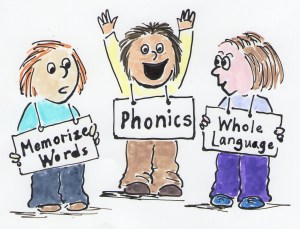
Three children with signs around their necks that read: Meniruze words, Phonics, Whole Language

This emergency directive by the NYS Board of Regents requires all public school districts to review how reading is taught in their districts.  It requires NYS districts to make necessary changes so that phonics is taught to pre-primary and primary grade students next September.

In particular, districts must teach six concepts associated with reading:

  • phonemic awareness (the ability to hear individual sounds in a word such as the sounds K A T in the word “cat”),
  • phonics (the ability to put together individual sounds to form words),
  • fluency (the ability to read words accurately, at a reasonable pace and with expression),
  • comprehension (the ability to understand what is read)
  • vocabulary (the ability to understand the meaning of words and to integrate new words into reading), and
  • oral language (the ability to listen and to speak).
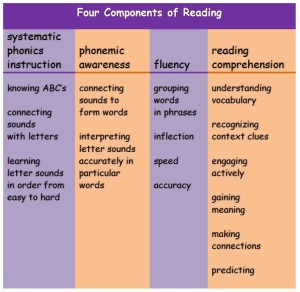
Chart of 4 reading components

Click on the picture to enlarge it.

This emergency action by the NYS Regents comes because almost a third of students cannot figure out new words by fourth grade.  They have been taught to memorize sight words and high frequency words.  But they have not been taught how to sound out new words.  As a result, about a third of students can’t read fourth grade texts.

The NYS Regents is authorized by law to oversee all educational activities in NYS.

Nearly 25 years ago a federal study of research on reading showed that knowing phonemes and phonics is fundamental to learning to read.  Yet many teacher training programs and district curricula do not focus on teaching phonemes and phonics.  Last year the Regents encouraged school districts to teach phonics but resistance was strong.  Now the Regents has mandated it.

The four, no five, no eight pillars of reading

Focusing on four skills leads to good reading achievement in children, we used to think.  Then came a comprehensive US government report in 2000 saying five skills are necessary.  In the ensuing 23 years, researchers tell us three more skills are necessary.   Let’s look at those skills, starting with a chart showing four skills, followed by information on five skills, and ending with the latest three skills.

Chart of 4 reading components

Previously, vocabulary was considered part of the fourth component of reading. Now it is considered a separate component, as are three previously unrecognized skills: oral language, writing, and background knowledge.

  • Phonemic awareness, the ability to hear and identify individual sounds in words—such as the sound of “b” in “bat”—and to move sounds around to hear them in various parts of words. This skill is taught in pre-K and kindergarten to most American school children.


  • Phonics, the ability to match the sounds of English to letters or to letter pairs in order to form words. This skill is usually taught in kindergarten and first grade.


  • Vocabulary, the ability to recognize and understand three kinds of words: everyday spoken words, more complex words (SAT-like words), and domain specific words (words used in specific contexts, such as the baseball-related words of pitcher, shortstop, foul ball and bunt).


  • Fluency, the ability to read text accurately at conversational speed, using expression.


  • Comprehension, the ability to understand what is read.

The three other skills that have been identified as crucial to learning to read are

  • Oral language, the ability to understand spoken language and to speak it. Proficiency in oral language precedes proficiency in reading.


  • Writing, the ability to use written symbols to represent words and to transmit meaning


  • Background knowledge, the ability to store and retrieve information and apply it to new knowledge gained from reading.


No wonder reading is such a complex skill for children to master.