Category Archives: methods of teaching reading

How can I help my child not to mix up b and d?

When children are learning the lower case alphabet, they frequently mix up certain pairs of letters:  p and q, g and q, l and I, and especially b and d.   This is normal.  As they get experience, they recognize differences in these letter pairs.  But mix-ups with b and d might linger well into elementary school.

b sees dOne solution is to tell the child that b and d look at each other.  Draw the letters with the b loop facing the d loop, and put dark irises in the loops.  Tell the child that b comes before d in the alphabet, so when looking at b d, b is the first letter and d is the second letter.
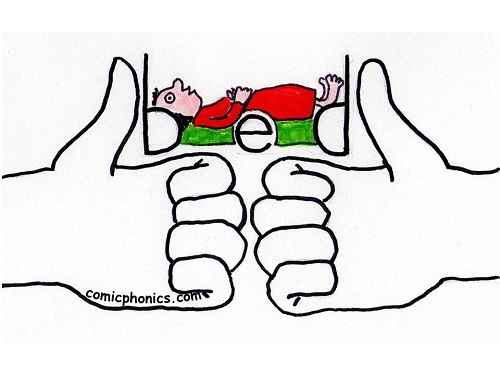
two hands making letter b, d with a bed spelled out between the thumbs.Another way to handle the b d problem is to have the child make fists with both hands while holding up the thumbs.  When the child looks at his left hand, it looks like the letter b with the thumb the stem and the fist the loop of the letter.  When the child looks at his right hand, it looks like the letter d.  Now tell the child to bring her fists together until they touch and to look at the shape.  Her hands should look like a bed with the thumbs the bedposts and the fists the mattress.  If the child knows the word “bed,” the child can easily figure out b and d.

How can I make learning to read fun for my child?

The key is to make learning a game.  The more game-like learning is, the more likely the child is to want to participate.  If the child can use her hands or whole body, learning will seem more like a game.  Try these strategies:

  • Let the child put a star child playing letter  BINGOor some other sticker on the corner of an alphabet card when the child knows a letter.  Or if the child is reading a book you own, let the child paste a star on each page she can read.  The child will enjoy pasting the star, will have visible proof of learning, and will have something concrete to prove progress for Dad or Grandma.
  • Let the child stamp alphabet cards with the date when the child knows them.  Remember how the librarian used to stamp the books with the return date?  Those kinds of stamps are still available at office supply stores.  (You can buy a deck of alphabet cards for a dollar or two at dollar stores, so don’t be concerned if the cards are defaced.)
  • Let the child hit or shake some kind of noisemaker for a successful answer.
  • If you play BINGO letter or word games, ask the child to create or accumulate the markers.  Plastic caps from milk or juice containers, Barbie doll high heels, shapes that the child has colored and cut, coins, stamps cut off of envelopes—let the child decide what markers to use today.  What fun to cover a BINGO card with Angry Birds and pigs.
  • As the child begins to read books, let the child underline the words she knows in pencil or highlight them with markers.  Read the same book a week later and let the child underline in a different color.  Do it a week later with a third color.  The child should notice more and more underlined words.  (You can buy used children’s books for a dollar or two at Goodwill and other resale stores, so don’t fret if the books are marked.)
  • Let the child write his name or other words on the refrigerator using magnetized letters.  Point out the work proudly to family members.
  • On the computer, pull up a blank page and let the child hunt and peck for ABC’s or the letters of his name.  Use a large font—size 36 or bigger.  Vary the color of the ink and the type faces.  Print the page and display it proudly.
  • For reluctant learners, use a kitchen timer to limit the time for any learning activity.  Usually, the younger the child, the shorter the time.  Five minutes might be long enough.  Let your child’s behavior guide you.

What letter sounds should I teach first?

Suppose your child knows her ABC’s.  How do you start teaching letter sounds?  With vowels?  With consonants?  In ABC order?

Child seeing letter on dog's collarThe English alphabet includes 26 letters, of which 16 letters, almost always make the same sound.  If you begin teaching letter sounds using those letters there are advantages for your child.

  • These 16 letters follow rules for the sounds they represent.  A ”B,” for example, always sounds like a “B.”  An “M” always sounds like an “M.”  This predictability is reassuring to children who are deciphering the alphabet sound code.
  • Whether those 16 letters come at the beginning of a word, or in the middle, or at the end, the child can identify a consistent sound.  The “N” in “not” sounds the same as the “n” in “pencil” and the “n” in “pan.”  Compare that to a “Y” which has one sound at the beginning of words (such as “yo-yo”) and multiple sounds at the end of words (“party,” “boy” and “buy”) or no sound at the end of words (“day” and “key”).

It makes sense to begin by teaching letter sounds that follow rules.  It also makes sense to begin with letters that have meaning to the child.  If the child’s name is Pranavi, start by teaching the letter sound “P.”  If the child’s brother’s name is Bhavik, teach the “B” sound.

If the child can remember a particular letter with a particular word, the child can go to that special word to compare new words for sound.  “Z” is for zoo is great, but if the child’s brother’s name is Zachary, then “Z” is for Zachary might be more meaningful, and so more easily remembered.

The 16 letters that almost always make the same sound are B D F H J K L M N P Q[u] R T V X and Z.

Should my child sit still when she learns to read?

That depends on many factors, such as your child’s usual activity level, the learning site and your own expectations.

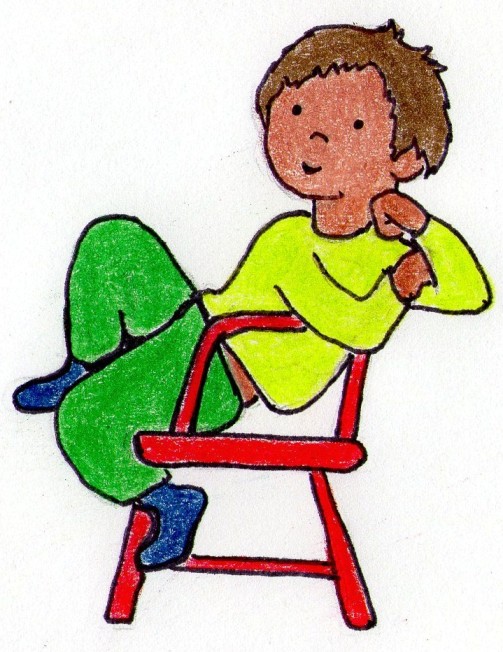
In general, little kids can’t sit still or focus Should my child sit still when she learns to read?on one topic for long.  They learn well through movement. To reach them, have short lessons and vary the method of learning (for example, moving ABC tiles, printing letters, playing Mother, May I? and walking through the house finding objects that begin with a certain letter).  If the child thinks he is playing a game and can move around, he will hang in there much longer.

If you have set up a table where you want to work with your child, evaluate the setting from the child’s vantage.  Does the chair allow her short legs to touch the ground?  Or if the chair is higher, is there a shelf for her to rest her legs?  (You can stack some books or a cardboard box under her feet.)  Does the chair support the child’s back?  (You can tie a pillow to the chair to fill the space if the chair seat is too deep.)  Is the table low enough (waist-high or just a bit higher) so that her arms can relax while she works?  All these accommodations to a child’s small size encourage a child to sit longer.

Some children prefer to stand while they work.  They can stand straight, slouch, spread their legs or lean—quite a bit of movement all while staying in one place and paying attention.  Some kids prefer to kneel or to squat on a chair or to stand on a chair and bend at the waist.  The child might look absurd, but if he is paying attention, who cares?

Maybe the real question is whether you are comfortable teaching a squirming child?  If you are not, let the child know up front that the lesson will last only a few minutes.  Use a timer so the child knows that when the timer rings, he can move around.

If another adult is watching, you might feel pressure to make your child sit still.  But is this in your child’s best interests?  If the child feels pressured to conform to some standard that he is not ready for, he will not learn as well as if he is relaxed.

How to prepare a two-year-old for reading

Suppose you have a two-year-old that you want to prepare for reading.  Do you

  • Enroll the child in an excellent tutoring center?
  • Use flash cards for sight words?
  • Play Simon Says?
  • Do nothing.  Two is too early for reading lessons?

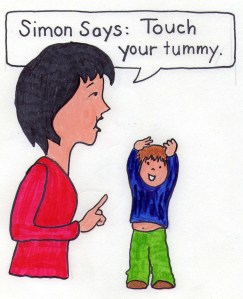
Simon Says touch your tummyResearch at Oregon State University shows that playing Simon Says, Red Light Green Light and other games that require a child to listen, focus, and act appropriately may be the best way to prepare a child for learning.

The idea is to take a simple game, add increasingly complicated directions, and the child will learn how to learn.  One example of an increasingly complicated direction is when the child has to do the opposite of the direction.  So if Simon Says “Rub your tummy,” the child would rub her lower back.

An increasing body of research shows that when a child masters focusing and self-control, the child will do better in learning reading, math and other cognitive skills.

Singing and clapping are additional “games” that improve learning skills.  Songs sung in rounds like “Row, Row, Row Your Boat” are difficult for a young child to master, but worth the effort.  Start by having the child sing along with you, learning the words and the tune.  Later clap to the beat.  Still later introduce the idea of rounds.

(For more information, see “Simon Says Don’t Use Flashcards” in the August 23, 2012, issue of The New York Times.)

How do I teach my child the names of letters?

Suppose your three-year-old is aware of letters and is ready to begin naming letters properly.  Where do you begin?  Since all children are self-centered, start with their names and the names of important people and pets.ABC Song

  • Begin with the child’s name.  Teach the child to name the letters in his or her name, and in family members’ names.
  • Point out letters from the child’s name on food items, and on the computer, and ask the child to name the letters.
  • Introduce letter names in small batches, three or four at a time.  26 capitals and 26 lower case letters—that’s a lot to learn all at once.
  • Explain that all letters can be written two ways, as capitals and as lower case letters.  Point out examples of both when you are naming letters.
  • Let the child be the detective.  Ask if the child can find the “t” on a box of oatmeal, or the “T” in the title, Ten Apples up on Top.
  • Cut out multiple copies of letters and glue them to a paper.  Let the child glue similar letters near the one on the paper.
  • With little children, the process is more important than the product.  Perfection can come later.
  • Even though today’s refrigerator masterpiece will be tossed out with next week’s recyclables, highlight today’s work so that the child sees you value his work as important.
  • Sing the ABC song with your child.  Don’t worry if she says “el-en-em-oh” for “L, M, N, O.”  You say it correctly and with time, she will too.
  • ABC flash cards can be great to help mastering letter names.  For starts, use just the letters the child knows, and gradually introduce more.  26 letters all at once can be intimidating.
  • Expect confusing with b and d, p and q, I and l, and M and W.  If the child is trying to say the letters, gently correct.  “Oops, that’s a backwards b.  What do we call a backwards b?”  It’s common for children to confuse some letters for several years, but eventually they will outgrow it.

Focus on letter names that are important to the child.  Don’t worry about the sounds that letters make.  That comes later.

How do I begin teaching reading to my child?

First, as with all “work” with young children, keep the lessons short and repeat them as often as possible.  Children are eager to learn but their attention spans are short.  Several five-minute lessons may be better than one 15-minute lesson for a three-year-old.

KELLY spelled out on the refrigerator

Also, make learning fun.  Children respond to work disguised as games and humor better than to work that seems like work.

That said, where do you begin?

Help the child become aware that letters are all around, and that they are important.  How?

  • Start with the child’s name.  Teach him or her to recognize his name on a birthday card, on decorations, and on your computer.
  • Point out family names on envelopes, smart phones and tags.
  • On food items—cereal boxes, soup cans, rice bags—point out letters, especially letters from the child’s name or family members’ names.
  • When you are reading to the child, point out letters from his name or from other words he is learning.
  • On electronic devices, point out letters and let the child create letters.
  • In the car at a red light, point out letters on a license plate or in a company name.

Focus on the existence of letters, not their proper names.  That comes next.