Category Archives: main idea in a reading passage

Asking “What’s the main idea?” is not enough

To improve a student’s reading comprehension, asking “What’s the main idea” of a reading passage is not enough.  It’s just the starting point.

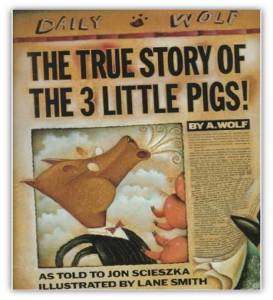
Better is to provide richer texts, and to discuss them before, during, and after a student reads, according to research named in the 2-18-24 issue of EdutopiaJon Scieszka’s The True Story of the 3 Little Pigs

It’s better to ask about an author’s writing style.  Why does the big bad wolf say three times, “I’ll huff and I’ll puff and I’ll blow your house down” to the three little pigs?  Why use “huff” and “puff” which rhyme?  Why not say, “I’ll breathe in and I’ll breathe out and I’ll knock your house down”?  Why does the author of Gone with the Wind have Scarlett O’Hara meet Rhett Butler on the day the Civil War begins?  Why does the author have Melanie Wilkes give birth in Atlanta right as Atlanta is being attacked?

It’s better is to ask a student to summarize or paraphrase a text than name the main idea only.  Many students have trouble distinguishing between important facts or ideas and less important details.  Help them figure out what are the important ideas so they can produce a reasonable summary.  Many students rely on the actual words of a text to explain it and cannot put the ideas into their own words.  Paraphrasing forces them to do that.

It’s better is to ask a student to describe the text’s structure.  Is a cause explained at the beginning of a text, and are its effects described in the second part of the text?  Are the most important facts stated first, as in a news story, and less important facts stated later in descending order?  Is a long-time theory stated first, and then is research presented to debunk the theory—or to support it?

It’s better is to ask a student to describe the tone and the mood of a text.  Tone means the attitude of a writer toward a subject or an audience conveyed through word choice and the style of the writing.  Does the writer show approval of a character or an idea?  Does a writer dismiss an idea as frivolous or bigoted?  Mood is the feeling or atmosphere of a text perceived by the reader.  It is often created by the author’s use of imagery and word choice.  When Laura Ingalls Wilder describes fall in Silver Lake as “From east to west, from north to south, and as far up into the blue sky as eyes could see, were birds and birds and birds sailing on beating wings,” is the mood one of fear?  suffocation?  wonder?  How do you know?

It’s better is to ask a student to find, identify and explain figurative language.  When Romeo says, “Juliet is the sun,” what figure of speech is Shakespeare using?  Why does this line occur in a passage that focuses on light?  Is “Juliet is the sun” stronger or weaker than “Juliet is like the sun”?  In Lord of the Flies, what figure of speech does the author use when he says of palm trees, “These stood or leaned or reclined against the light”? Why not say some trees’ trunks were straight up, some leaned over, and some tipped so much that they were almost parallel to the ground?  And why “against the light”?

It’s better to ask why the author of a novel reveals some information in the opening chapters and holds other information until later.  In Cinderella, why does Cinderella face problem after problem before the happy ending?  Why does Junie B. Jones believe her baby brother is a monkey until the end of the book?

Require more of students and you will increase the depth of their  reading comprehension.

How to find the main idea

Finding the main idea in a reading passage is one of the most important reading comprehension skills.  Because of that, questions about the main idea repeat on the SAT and ACT and on almost every reading test from second grade through college.  So how do you find the main idea?

In a one-paragraph passage, the main idea is almost always stated in the first sentence, called the topic sentence.  A student can figure this out because the rest of the paragraph contains details about that first sentence.

Some students think a main idea and a topic are the same thing.  Wrong.  A topic can be stated as a single word or a phrase, but a main idea can be stated only as a complete sentence.  For example, a topic might be “dogs,” but a main idea might be “Boxers are the best dogs,” or “Dogs need to be bathed every week,” or “Dogs come in all sizes.”

If a writer begins a paragraph with a hook, the main idea might not be in the first sentence.  It might be in the second sentence.  Or it might be in the last sentence where the writer repeats the main idea to be sure the student has found it.

Another place to look for the main idea is in the title or headline.  Sometimes the title or headline contains hooks to lure a student to continue reading.  But many times they identify the topic, and sometimes they state the main idea.

As students read longer passages, they should still expect to find the main idea in the beginning paragraph.  However, it might be found routinely in the last sentence of that first paragraph.  The earlier part of the paragraph introduces the topic of the passage, but the main idea is stated in the last sentence of that paragraph.  Many writers repeat the main idea—not in exactly the same words—in the conclusion.

Look at the first sentences in the body paragraphs.  Those first sentences should be backing up an idea.  Many times that idea is stated in those sentences.

In longer passages, a strong clue to the topic is a word or phrase or its synonyms which are repeated more than any other idea in the passage.  For example, “Water pollution,” “river trash,” “ocean dead spots,” and “toxic runoff” all are types of water pollution.  These words tell the topic, but they don’t tell the main idea.  But with the idea of water pollution, students can go back to the first paragraph and the last paragraph to narrow in on the topic sentence.

Another way for young children to identify the main idea is to ask questions:

  • Who is the passage about? No one in particular?  Then keep looking.  But if it is a particular person or group whose name is repeated, the main idea probably has something to do with them.
  • What is the passage about? Every passage is about something.  Put into your own words what the passage is about.  Now go back and see if you can find evidence backing up your conclusion.
  • Are there numbers in the passage? If so, numbers about what?  Numbers usually back up or prove something.
  • Do illustrations give a clue?  Sometimes art can help a young student figure out the topic.  Knowing the topic, a student can look in the usual places for the main idea.

Sometimes a writer talks around a topic, implying a main idea without stating it, at least at first.  The writer does state the main idea eventually, but it might not be where you expect.

Why is identifying the main idea so important?  As a student grows older, he or she will need to learn more and more from what he or she reads, and less and less from what a teacher says.  That student will need to be able to identify quickly what the main idea is in order to make sense of an article or book or research paper.  When a student does research, he or she will need to be able to analyze information to see if it is relevant.  The most important skill to do that is to identify the main idea.

.


7 symbols early readers can use to annotate texts

Annotating texts is an important reading skill.  Finding the main idea, identifying ideas which support that main idea, identifying facts (not opinions), discovering new or unusual words—as adults we know to look for this kind of information and to annotate it in the margins as we read.

But what if you are a beginning reader and can’t write words like “main idea” or even “fact”?  How do you annotate a text so you can go back and understand it better?

An elementary school in the Bronx has figured out how.  The school teaches preschoolers to mark texts with the following seven symbols.  (The meaning of the symbols follows.)   

Marking the text this way is part of Concourse Village Elementary School’s way of helping students understand what they read.  And it works!  88 percent of students scored at the advanced or proficient levels on the New York State exams in both math and English language arts in 2018.  That’s more than 40 points higher than the citywide averages.  To find out more information, go to an article in Edutopia at https://www.edutopia.org/article/driving-deep-reading-comprehension-k-5.

Identify the main idea with a colored pencil

I find colored pencils or highlighters are so useful when teaching writing.  But they can be just as useful when teaching reading, especially if the same colors are used consistently.

Suppose you are teaching students to identify the main idea in a reading passage, and that the students are reading from a source which they can mark.  First, have students read a passage.  Then help them discover the main idea.  Instruct them to underline or highlight the main idea with a particular color, such as red.  Later, whenever you are working on main idea, ask students to identify it with a red underline.

Sometimes a whole sentence is a main idea, but sometimes the main idea is not identified so neatly.  Sometimes a phrase can be underlined.  Or sometimes the student needs to write the main idea over the title using red ink if it is implied but not stated directly.

Many times all or part of the main idea is repeated in paragraph after paragraph.  Students need to know that the main idea is often repeated, and they need to identify examples of it by underlining those repeats with their red pencils.

What if you are teaching supporting details?  A different color—say orange—could be used to underline supporting details.  If the main idea in a Cinderella story is that Cinderella wants to go to the ball, then all the details helping her get there should be underlined in orange—the fairy godmother, the pumpkin carriage, the mice footmen, the ball gown and of course the glass slippers.  Even the clock striking is an important detail.

Almost every reading test asks for the main idea.  Students need practice, lots of practice in all kinds of reading materials, to identify the main ideas and the details which support the main ideas.

If you are consistent with your color choices, students will get used to seeing their reading through the colors they apply.  And if you are checking to see if students are identifying correctly, all you need to do is look for the color red or orange or whatever color scheme you decide on.  Walking around a classroom, you can easily tell if the students identify correctly, or if they are fooled.

You might be thinking, but students can’t mark textbooks.  True.  But so many schools today use workbooks in many subjects for each student.  Even if the purpose of a particular passage has nothing to do with finding a main idea—a science or math passage, for example—you can still use it to identify main ideas.