Category Archives: readiness for the next grade

Check this list to see if your child is ready for first grade reading

As you prepare to send your recent kindergarten grad off to first grade, you might wonder, “Is he ready?  Does he have the reading skills necessary to start first grade confidently?”

One way to know is to go to your state’s standards for kindergarten to check the skills your state says a kindergartener needs to know to progress to first grade.  You can find these standards through your state department of education’s website.

Since most states adhere to the Common Core of Educational Standards, a simpler way is to check the following standards.  Your state’s will be similar.

___Does my child hold print materials properly, knowing what is the top of a page, and knowing that pages are read from left page to right page?

___Does my child identify front and back covers and title pages?

___Does my child follow words from left to right and from top to bottom?

___Does my child pronounce syllables, words and phrases properly?

___Can my child explain whether printed materials make sense?

___Can my child read 10 high frequency words?

___Can my child read and explain his own writings and drawings?

___Can my child identify upper and lower case letters?

___Can my child match sounds to letters?

___Can my child identify consonant sounds at the beginnings of one-syllable words?

___Can my child use pictures to predict the content of picture books?

___Can my child retell stories from beginning to middle to end?

___Can my child discuss characters, setting and events in stories?

___Can my child use story language like characters and setting to discuss stories?

___Can my child identify what an author is?  What an illustrator is?

___Can my child identify topics in nonfiction readings?

___Can my child print upper and lower case letters?

___Can my child print his own name?

___Can my child write phonetically to describe his own stories?

___Can my child write from left to right and from top to bottom?

___Has my child explored the use of technology for reading / writing?

If you can say yes to most of these questions, your child is probably ready to start first grade.

However, some children in his class will be performing at higher levels than these standards suggest.  In well-to-do neighborhoods where parents are highly educated, these standards might be minimal ones.  If you believe that is the case, work with your child to bolster his achievement.  You don’t want your child to feel he is behind, or worse, that he is “dumb.”  Such negative feelings can worm their way into his self-esteem even if he is on grade level.

Reading is the most fundamental skill your child will learn in school.  Give him every advantage to do well from the start.
Four stages in learning to read

The saying goes, in kindergarten through third grade, a child learns to read (think phonics); in third and later grades, a child reads to learn (think comprehension).*

But practically, what does this mean?

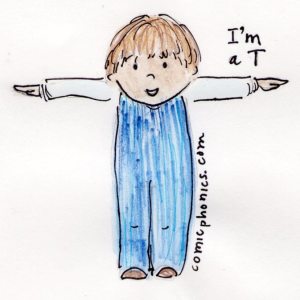
Child with arms stretched out at his sides, forming the letter T.

By the end of kindergarten:

  • Students can recognize almost all letters, upper and lower case.
  • Some students can state the sound represented by an individual consonant letter, and they can recognize closed (short) vowel sounds.
  • Some students can read consonant-vowel-consonant (CVC) words.
  • Most students cannot yet read open (long) vowel patterns such as oa and ight.
  • Many students rely on first and last letters in words to sound words out.
  • Students rely on pictures to help figure out words.

By the end of first grade:CVCC twin consonants

  • Students can decode one-syllable CVC words, including those with blends.
  • Students can decode one-syllable words ending in a silent e.
  • Students can read one-syllable open (long) vowel words like he and my.
  • Students can read one-syllable r-controlled words like star and dirt.
  • Students can read some one-syllable words with two-vowels like bee and boot.
  • Many students need to sound out common one-syllable words rather than recognizing them as sight words.
  • Students depend less on pictures and context clues to decipher words.

By the end of second grade:children looking at picture of Lincoln and Mrs. Lincoln

  • Increasingly, students are able to decode two- and three-syllable words if those words follow rules of phonics.
  • Students can decode words by separating familiar suffixes and prefixes to find root words and then reassembling the parts.
  • Students recognize common letter patterns.

By the end of third grade:girl reading Junie B. Jones

  • Students have mastered decoding of words using phonics, including many multi-syllabic words.
  • Students recognize most common words by sight.
  • Students recognize word families and can use that knowledge to decipher new words.

This breakdown covers word recognition.  But there is another part of learning to read, namely, language comprehension.  We will discuss that in the next blog.

*Researcher Jeanne Chall (1983) first coined this idea.

See researchers Linnea Ehri (1991, 2005) and Spear-Swerling (2015) for more indepth discussion of reading stages.

Completing the 2019-2020 school year and preparing for 2020-2021

My grandson, who has been studying at home with his mother and me since mid-March, finishes kindergarten next week.  His classroom teacher has been diligent about sending daily homework:  writing journal entries and illustrating them, writing new sight words in sentences, completing pages in a math workbook, listening to someone read picture books and then filling in worksheets about how a character is like another character  or identifying and drawing the setting.  Then there is online work at a phonics site and a math site three times a week.  Phew!

The question now is what kind of work to do during the summer months so my grandson enters first grade well prepared.

I went online to find out exactly what skills are required for a rising first grader.  I made a list and of the ones my grandson has not accomplished.  He needs practice holding a pencil properly, and he needs to consistently write his letters and numerals frontwards.  In math he has more to perfect:  counting to 100, counting backward from 10, displaying data in graphs and tables (really?  in kindergarten?), and extending patterns.

That, plus reviewing and extending his reading skills, is our summer curriculum.

If you are wondering if your child is ready to start the next grade, go online to your state’s department of education and find the standards for the basic subjects of the grade he or she is completing.  Make a list of the standards your child hasn’t met and let that list become his or her summer school work.  Sometimes you can accomplish these goals by finishing up workbooks.  Or you can order workbooks on particular skills for your child to master.   Or you can create your own materials, but of course this takes time.

And if you don’t have time to do everything?  If your child is in the primary grades, focus on two things:  basic reading skills (phonics) and simple addition and subtraction.  Keep reading to your child for enrichment but focus on the essential skills of reading and math.