
Ever hear of DISTAR? The Direct Instructional System for Teaching and Remediation—DISTAR for short—is a phonics-based reading program developed in the 1960s.
Its advantages are
- Learning goes fast at first.
- One letter corresponds to only one sound.
- It uses a one-to-one logic system little children intuitively understand.
With these advantages, why is DISTAR not widely used?
- DISTAR uses a unique alphabet called the Initial Teaching Alphabet, not the standard English alphabet.
- Teachers need to know and consistently use this alphabet for the system to work.
- Most parents have no experience with this alphabet, so they cannot help their children without instruction.
- Eventually, students must be weaned from this alphabet to the standard English alphabet, causing confusion.
- Few books are written using this alphabet.
- Children who try to use this alphabet to handwrite can wind up with impossible-to-read handwriting.
Initial Teaching Alphabet is shown below.
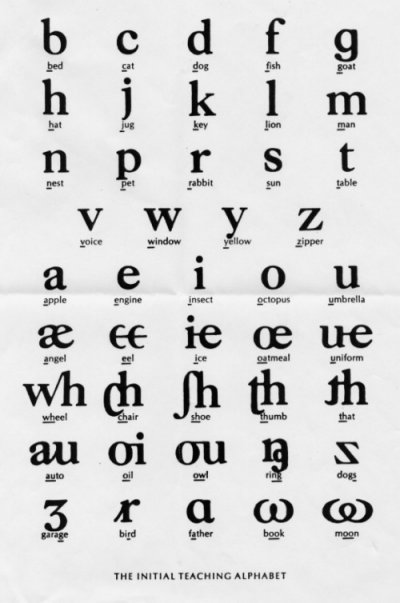
As you can see, some letters are the same as standard English letters, including 19 consonants and the five vowels used as closed or short vowels. Open or long vowels are written as two vowels joined. Digraphs, less used vowel sounds and certain consonant sounds are written as either double letters or single letters. But those letter shapes do not correspond to standard English letter shapes.
The Initial Teaching Alphabet was developed in the 1960s by Sir James Pitman. He hoped the alphabet could help children learn to read easier than using a traditional alphabet.
This alphabet uses a distinct typeface developed specifically for it. All letters are considered lower case. When capitals are needed, a larger version of the lowercase letter is used.
Because children needed to learn two alphabet systems in the primary grades if they learned using the Initial Teaching Alphabet and DISTAR , these systems were not widely used. During the 1960s, the teaching of reading was switching from a phonetic approach to a whole language approach, another reason for DISTAR’s and the Initial Teaching Alphabet’s lack of support.
Today research shows that a phonetic approach is the best way to teach young children to read.




 comicphonics for early readers
Our Chicago inner city elementary school used the reading and language program with grades one through three. We experienced great success. Some 75 to 80 percent achieved a third grade reading level after three and one half years. This program was also implemented in 1970 and was continued into the eighties. The social studies and science program was also taught in fourth and fifth grades. A big advantage was the number of children included in a single lesson. Eight to twelve. You could also teach as many lessons a day as the kids could handle. I would say that 75 percent of the kids graduated from our K-6 school with a fifth grade reading level. Unfortunately CPS in their infinite wisdom dropped the program. I used the Distar program in my special education class that included learning disabled and educable handicapped children with similar results at this school. My daughter who is a special education teacher uses it exclusively today. For a lot of children this phonics approach is very effective.
LikeLike